Showing posts with label Berlin winner. Show all posts

Wednesday, November 19, 2025

286. Vietnamese film director Pham Ngoc Lan's debut feature film "Cu Li Never Cries" (Cu Li khong bao gio khoc) (2024) (Vietnam), based on his original screenplay, co-authored with Ngiehm Qyunh Trang: Intelligently interplaying time with history, tradition and family life in unified Vietnam as two ordinary Vietnamese lovers decide to get married


"They say live in the now as much as you can. But the past returns regardless. Un-whole. Fragmented. Existing in pieces of experience."
--- words spoken, underscoring the importance of time, by the elderly aunt of the young lady, Van, who wants to get married, following an unplanned pregnancy


"Rivers can dry up. Mountains erode. But you remain the same."  
--words spoken, by the aunt, underscoring the mindset of elderly individuals (such as her former colleague) in unified Vietnam, who subscribe to the old ideology of the North, singing/enjoying patriotic songs


Debut feature films by young filmmakers, especially those with original screenplays, are fascinating ever since writer-director Orson Welles made Citizen Kane in 1941. Young Vietnamese filmmaker Pham Ngoc Lan treads the same path decades later with his first feature film made in 2024, where he too, like Welles, has a collaborator (Nghiem Quynh Tranh) on his debut film's script. The film Cu Li Never Cries, though packaged as a bitter-sweet tragi-comedy of the working-class contemporary, unified Vietnam, offers multilayered perspectives of the past, present and future of Vietnamese citizens and their country's tumultuous history. There are occasions when the film resembles a threnody--a song or a lamentation for the dead. At the same time in the film, the elders wistfully look at their past errors in judgement, and wish the younger generation to move forward without repeating the mistakes of their elders. 

Two generations of Vietnam are presented. The first generation saw life in Communist East Germany to be fascinating and emigrated there. The elderly lady, whose husband lived there, has died and she returns to Vietnam from Germany, after a recent trip, with her dead husband's ashes and her husband's pet--a pygmy, slow loris monkey--to her modest living space in Hanoi, which she shares with her young-orphaned niece, Van. Van earns a living as a nanny looking after a few tiny tots, while their biological parents are at work.

Van baby-sits two toddlers as a nanny in her apartment,
to earn an income. Her amputated left arm is never
discussed, but could be a subtle link to the Vietnam war,
as probably was her parents' death.


The film presents the mindset of two contrasting generations in contemporary Vietnam. The recently widowed aunt of Van has brought home the urn containing her dead husband's ashes to be immersed in the river water as per Vietnamese tradition. The younger generation of Van and her partner, merely involves the elders of the family in a quickly arranged betrothal. The rest of the marriage imitates a Caucasian wedding process, though the newlyweds are not Christians, complete with gowns, westernized wedding dresses, songs and dances. Even the elder generation has evolved to enjoy slow ball-dancing as entertainment in the evening of their lives and the widow attracts a young waiter to dance with her, with her pet slow loris perched on his shoulder--perhaps providing a link to her dead husband in her mind.

The screenplay uses the presence of the uninvited slow loris in a creative way to link several strands of the film's structure. Nobody cries in the film. The cinematographer makes us aware of the animal's cute eyes--sad, yet beautiful. 

The sad, yet beautiful eyes of the slow loris,
carried around by Van's aunt in a bag


The dwarf slow loris peers from behind a flower pot
at humans in the room


A broken metal rib of the aunt's umbrella is a clever detail added by the director/scriptwriter to allegorically show her fractured life of past mistakes and present widowhood. The bride is unsure of her future and disappears for a while from the wedding banquet realizing that she is possibly leaving her aunt who had not been happy to learn of the quick decision to marry but the aunt goes searching and finds her, only to present her with the aunt's own necklace as a tacit well-considered final approval of the wedding from the older generation to the newer one. This sequence presents the future of the tale. (The necklace finds pride of place in the film's official poster above.)

The slow loris is called Cu Li, which in many Asian countries resembles the word "coolie'' for a lowly paid worker, who rarely talks back to the master. The sequence in the film where Cu Li  is perched on the waiter's shoulder when the widowed, lonely aunt asks the waiter to dance with her serves as a visual, wistful reminder of her past life. Cu Li possibly is the visual link to the missing presence of her dead husband  with whom she possibly danced in the past. The slow loris, when scared, sweats a toxic liquid, which when the animal licks mixes with its saliva can cause pain/allergic reaction to humans. The kids under the care of Van, the nanny, must have scared Cu Li, and subsequently get skin rashes. Van is upset that Cu Li is sick and "infecting" the kids. Full grown slow lorises are found in thick forests in Vietnam and rarely adopted as pets. The dwarf Cu Li observes quietly the bitter, sweet human tale unfolding around its urban environment as a human would.


Van's recently widowed aunt dances with an obliging,
young waiter who places the dwarf slow loris, Cu Li,
 on his shoulder. Later, in the film, she passes off the waiter
as her son (she never had one), to her former colleague.


The rich narrative of the film is sprinkled with subtle humor. The widowed aunt's former colleague shows off an imposing statue of Ho Chi Minh, looking over a dam that has tamed the Black River, causing some parts of it to run dry, while elsewhere the river dam generates electric power before the residual water flows to merge with those of the Red River, ultimately flowing into the sea. The humorous part of the description includes an aside about the re-positioning of Ho Chi Minh's arm on the statue on account of its weight, which gives the final gesture a different meaning than was originally intended. Earlier in the film young men, including the groom, having a late night picnic, discuss with crude humor the linguistic differences between the populations of the south and north Vietnam.

The film was made on a shoestring budget. Though shot in color, the final black-and-white version was arrived at to trim post-production costs, according to the director, while meeting the press at the Berlin Film Festival 2024, where the film won the best debut film award.

While Cu Li Never Cries is not comparable with debut masterpieces such as Citizen Kane, Sir Ridley Scott's oft-unsung film The Duelists (1977) or Jean-Pierre Melville's Le Silence de la Mer (Silence of the sea) (1949), it is a laudable attempt of a young filmmaker to team up with another screenplay writer to look at their country's history and weave a story that provides a poetic perspective of preserving memory, complete with Van's amputated arm and the death of her parents (a likely indirect reference to the past war years), and Vietnam's fauna, while reconciling completely with the present day unified Vietnam.  

Recent debut films from three different Vietnamese directors are notable: Ash Mayfair's The Third Wife (2018), winner of the Gold Hugo award at the Chicago international film festival, Best Film award at the Kolkata International Film Festival, and minor awards at the Sundance and Toronto film festivals; Thien An Pham's Inside the Yellow Cocoon Shell (2023), winner of the Golden Camera award at the Cannes film festival, the Roberto Rossellini award for the best film at Pingyao International Film Festival (China) and the Best Asian Film award at the Singapore International Film Festival; and finally Pham Ngoc Lan's Cu Li Never Cries (2024), winner of the GWFF Best Feature Film award at the Berlin Film Festival, winner of the Shaji N Karun award for the Best Asian Debut Film at the 20th International Film Festival of Thrissur, winner of the Best Picture award in international competition at the Jeonju International Film Festival (South Korea), winner of the Best Performance award at the Las Palmas Film Festival (Spain) for lead actress Minh Chau (playing the widowed aunt), winner of the NETPAC award for Best Asian First Film at the QCinema International Film Festival, winner of a special mention at the Bucharest International Experimental Film Festival (Romania), Vietnamese cinema is indeed on the march with these three young filmmakers leading a revival of a new kind. Coincidentally, both The Third Wife and Cu Li Never Cries share the same film editor: Julie Beziau.

This critic was the chairperson of the main jury of the 20th International Film Festival of Thrissur (India) that awarded the inaugural Shaji N Karun Award for the Best Asian Debut Film to Cu Li Never Cries. The citation of the award bestowed by the festival jury also highlights the editing of the film.


P.S. Four debut films mentioned in the above review have been discussed in detail earlier on this blog: The Duelists (1977); La Silence de la Mer (1949); The Third Wife (2018); and  Inside the Yellow Cocoon Shell (2023). (Click on the names of the films mentioned in the post-script to access the reviews.)


Sunday, May 04, 2025

285. Dominican film director Nelson Carlos de Los Santos Arias' fourth feature film "Pepe" (2024) built on his own original screenplay: A fascinating, multi-layered cinematic work that uses a "talking" hippopotamus that is dead to present the history of African slaves in the Americas that curiously parallels the forced translocation of the hippo


What an unusual treat this film offers a perceptive and patient viewer! First, it is film is narrated for a substantive length of the film's duration by a hippopotamus, who realizes it is dead (in the present world) in at least three languages: a Namibian tribal language; Afrikaans (the language of the erstwhile colonial South Africa and South-West Africa); and Spanish, a fact that this critic discovered only on subsequent viewings, as one is initially concentrating and imbibing the English subtitles. The hippo has no perception of time but is well aware that it is already dead (inversing the techniques often used by the late Chilean director Raoul Ruiz as in his film Three Crowns of the Sailor, where the narrator quirkily admits that he is the only sailor alive while all others on the ship are dead!). The hippo's narration begins with the words "I never heard the sounds that come out of my mouth. I have no memory of sound that explained things. Two certainties--someplace like this should be my home with Africa as a name. They travel in my head together. Second, I am dead.... How do I know what a word is? Above all, what did I do to be dead?"  The hippo from South-West Africa, now known as Namibia, had been captured/stolen from that African nation and taken on a ship to Colombia in South America, by the infamous drug lord Pablo Escobar to populate his personal zoo. Escobar was eventually killed by Colombian military forces. Pepe, the talking hippo in the film only talks to us. the viewers of the film, and refers to humans he encounters as "the two legged." 

The above poster of the film encapsulates (in Spanish) the story of Pepe brought to Colombia by Escobar at the cost of 30 million dollars, which in turn must have cost the death of some 5000 people as a consequence of  the 80% of the global drug traffic orchestrated by Escobar, only to adorn his personal zoo.

Early in the film, the director introduces us to the basic characteristics of the huge animal that originally lived in Africa. Foreign tourists in a bus in Namibia are introduced by the tour conductor to Namibian natives (the bus driver is one) and the world of hippos. The bus driver tells the tourists "The hippos always lived here and we lived together.. Each animal teaches us something.. They can run and swim faster than us...If they come silently under your boat, you should get away fast, as a hippo can break the boat in two."


The introduction to hippos and their origins in Africa
in the film
Pepe and its quaint relationship
with "the two legged"

Soon we switch in time to Pepe narrating his early life in Namibia with his sibling Pablito, an alpha male hippo, who eventually drives Pepe away from the hippo family he belonged after a power struggle. Pepe, while isolated, is captured and transported to Colombia for the drug baron to procreate more hippos on his private zoo. Pablito, is a possibly a discrete reference to the drug lord Pablo Escobar, who was feared for his brutal power tactics in Colombia to become rich and powerful until he was killed by the state/military (a sequence enacted in the film). Historically, Escobar did bring four hippos to his ranch with other exotic animals from all over the world. Colombia to relocated all those animals to various zoos except for the hippos (due to their weight ranging from 1 to 4.5 tons) which now populate the marshy lands near Magdalena river in that country.  

The film is made up of sequences shot in Namibia and in Colombia using drones, hidden cameras in jungles and helicopters. 


Pepe admits he doesn't remember learning his life story.
(However, this shot of real hippos swimming underwater
in the river, is captured by a drone carrying a camera.)


Director Arias' film Pepe is not limited to the Escobar connection to bring hippos from Africa to South America. His work is first a close look at the beast in the wild at close quarters with hidden cameras and cameras capturing the animals floating in the rivers. What Pepe doesn't  to tell the viewer is that beast eats grasses, vegetables, and fruits, not meat, unless it cannot find sufficient vegetation. Arias' film shifts gears to the fisherfolk on the shores of the Magdalene river, who never encountered the African beast in their lives, suddenly upsetting their fishing activities. Hippos do not attack human beings unless they are provoked on land but do attack them in water bodies, as they regard them as intruders in their territory. Today, because of Escobar, the population of hippos in the Magdalena river has apparently exceeded 160, which is higher in density than those in pockets of Africa, where there are wild animals such as lions, crocodiles and hyenas that kill and eat hippos and thus keep their population in check. The increasing population of hippos in the Magdalena river is not just a direct threat to the fisherfolk today  but the fish-oriented ecosystem, which is threatened by the large amount of hippo waste in the water lowering the oxygen levels negatively thereby affecting the lives of fishes and the fishing community alike . Though herbivorous, some 500 deaths are attributed to hippos worldwide each year, possibly in waterbodies such as rivers and lakes  Recent information on the internet states that that two hippos are going to be sent from Columbia to a zoo in Gujarat, India, and some 10 hippos to zoos in Mexico.

Hippos can swim fast in water and hide beneath the water
surface, and what appears above the water can be mistaken
for a small piece of  floating wood


The usual part of the head and ears of a hippo seen above
water in Magdalena river, while it can submerge
itself totally at will, as shown in
Pepe 


Director Arias connects the hippos with a popular children's cartoon in Latin American television called "The Peter Potamus Show" where the hero is a hippo, by showing a young boy hooked to the TV screen. That's a part of the unusual structure of Arias' screenplay--a dead hippo who suddenly realizes the noise he makes is his new found ability to talk. What he talks is not drivel but his memory of Africa, his travel across oceans which he describes as a river with a bottom we can never reach--all of which come close to the oral history traditions of Africa (ref. the driver of the tourist bus in Namibia who states that each animal teaches us something)  and Latin America (the fisherfolk lore, rarely believed, but true in the case of the hippos of the Magdalena river basin). 

However. the fisherfolk get scared of hippos and the scare gets permeated to local law-keepers and then on to to higher authorities until a German hunter is recruited to find and kill "Pepe" with the help of the Colombian army somewhat like the end of the drug lord Escobar in 1993. 


One of the many hippos that play the role of Pepe
in the film
Pepe


A drone shot of Pepe shot dead by a German hunter with
the support of the Colombian army with elongated shadows
of "the two legged." In reality, the (fictional?) killing of Pepe 
did  
not rid the Magdalena river of hippos--they still continue to exist.


The entire story of Pepe parallels the Europeans enslaving Africans for monetary gain and selling them to colonial populations in the Americas. The African slaves in the Americas can recall their roots through oral history. They often get killed without realizing what they did wrong to get killed, just like Pepe.

Director Arias switches situations and time in the film just as Pepe's narration does. Arias introduces us to a brief beauty pageant in the fisherfolk community that mimics the Miss Universe contest format with young contestants having to state to the community what they hope to do later in life. One of them appropriately wishes to be a zoo-pathologist! The social connection is possibly related to the fact that contestants from Colombia have often been strong finalists in international beauty pageants. Then there is a village where an old railroad line is creatively used to transport the fisherfolk on roller boards, without an engine, mimicking the rowing motion of their boats . 

Finally, the amazing cinematic work Pepe of director Nelson Carlos de Los Santos Arias recalls multifaceted contributions of Italian director Ermanno Olmi  while making The Tree of Wooden Clogs. Like Olmi, the Dominican director wrote the complex original screenplay, provided the music, was the major co-cinematographer and a major co-sound director. Multiple viewings could be required to absorb the plethora of cinematic styles within the film that one hopes young creative filmmakers will assimilate and utilize to make films in other countries than their own, just as this director did in Colombia and Namibia and create exciting, varied parallels tales for the minds of perceptive contemporary viewers to contemplate upon. 

The film truly deserved the Silver Bear for Best Director at the 2024 Berlin Film Festival. 

Most of all, viewers should ruminate on the final flow of Joycean stream of consciousness crafted by the original screenplay-writer/director Arias emanating from the mouth of the dying Pepe towards the end of the film, while the Colombian armed militia close in on the hippo: "I saw them from afar and immediately knew who they were. They also knew, I knew, and kept moving forward. Everything was clear. The day had no secrets. They looked beautiful. I felt them close to me, and death was simply that. That's how mine arrived--there lying with my strongest pain I have ever felt in my whole life. This sound came from my mouth explaining nothing. I spoke and dreamed for the first time. Fractal movements.... What's authentic and what's false? What's serious and what's playful? To this sound, to this space, where everything is constantly related? Banishing the very idea of an annihilating transparency, which is like a curse that does not stop repeating the same story.'' 

P.S. The two films mentioned Ruiz' Three Crowns of the Sailor and Olmi's The Tree of Wooden Clogs have been reviewed earlier on this blog. Pepe is included in the author's Best Films of 2024 list. (Click on the bold names in the post-script to access the reviews of those films)


Monday, August 22, 2022

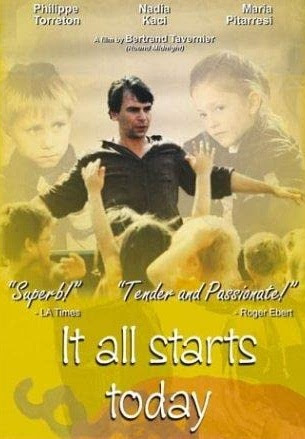
276. The late French director Bertrand Tavernier’s feature film “Ça commence aujourd'hui” (It All Starts Today) (1999), based on a commendable screenplay co-written by the director, his daughter Tiffany, and Dominique Sampiero: A primary school teacher who walks the extra mile to serve and speak for the tiny tots raised by parents with marginal incomes


"For its commitment to everyday heroism, its multi-layered approach to an array of social problems, and for the visual force of the storytelling.”

--Citation of the FIPRESCI award bestowed on the film It All Starts Today at the Berlin International Film Festival

There have been several films made on uplifting student-teacher relationships. These include To Sir, With Love (1967) a film on boisterous white high school students from slums of London eventually admiring and respecting their black rookie teacher;  Dead Poet’s Society (1989) on another rookie teacher kindling creative self-expression through poetry in  a US boarding school for senior US students from wealthy  backgrounds resulting in their unwavering respect and love for him; Goodbye, Mr Chips (1969), a remake of a film made 30 years before, where a stodgy Latin teacher after his marriage transforms  himself into an endearing school headmaster winning the hearts of his students;  Not One Less (1999), a neorealist Chinese film with real life characters playing their real roles directed by Yimou Zhang, focusing on a real life 13-year-old substitute teacher bringing to the fore the urban-rural education divide and the earnest desire of the teacher to teach and care for all her wards equally well;  and The Class (2008), a French film on the true experiences of a French language and literature middle-school teacher dealing with his foreign-born students disciplining them and gradually gaining their confidence--yet, not all students feel they ‘learned’ anything in his class.

It is Bertrand Tavernier’s two feature films on related subjects that discuss matters more substantive in the teacher-pupil interactivity, namely his films A Week’s Vacation (1980) and It All Starts Today (1999). In both films, the teachers are not rookies they have some credible experience in their jobs. The former discusses the importance of a female teacher observing and "listening" to her pupils in their early teens in a school in Lyons, France. The film underscores the fact that a reflective teacher could gain from the interactions with the pupils. However, Tavernier’s  It All Starts Today inverts the teaching role further to a teacher taking proactive steps to get the local government and the student’s parents to get involved in helping the teachers to impart education as they wish they could with limited resources provided by the local government.


Daniel (Philippe Torreton) truly cares for his students
and they love him for it


It All Starts Today has actor Philippe Torreton playing the role of Daniel, a head teacher of a primary school in a small mining town in France where former miners Daniel’s father survive with an oxygen cylinder strapped to his back. Miners not only battle pollution of particulate matter affecting tem while they worked in the mines, they have few other options of re-employment. Some are not clever enough to look for sustainable options for livelihood and slip into despair. Most are not sufficiently educated to move out and nor do they have any plans to start a new life and hence spend their days and nights in front of the TV sets. Their offspring are named after characters like “Starsky” and “Hutch”  from popular US TV serials. Some of the families cannot pay their utility bills and send their kids where they can get some education and mingle with others of their age. Worse still it is these cash-strapped families who are expected to support Daniel’s school through funds provided by the local civil council.

Daniel is the angry young man who is livid when the council cuts the lunch program for the kids and the parents are supposed to provide each kid with their lunches. When Daniel confronts the chief of the civic body, he is told the council has no money and Daniel, the underpaid teacher, offers a small contribution from his purse so that they make efforts to garner more funds to restart the scheme.


Daniel takes food on a personal initiative to the home of a
child whose parents are struggling to survive;
the other kids on the street are only marginally better off

Tavernier and his co-scriptwriters keep the viewer cleverly engaged to the bleak tale of the film using two tools. The first is Daniel’s demanding parallel personal life where his father is sick and his girlfriend wants him to father her next child while he pleases every student  (including his girlfriend's son from an earlier relationship with another man) with care and empathy. The second is Daniel's and his girlfriend’s out-of-the-box ideas to keep the young students happy and educated. One such innovative idea is to ask a parent, who is a truck driver, to bring his heavy duty truck to the school for the students to see what it could do—which proves to be a real treat for the kids who have never seen such a huge vehicle up-close.

Daniel, the angry multi-tasking primary school teacher,
is not just good at his job, he is loved by his students


When a financially struggling parent commits suicide with the children, the community that had preferred to look the other way comes out in full strength providing a flower-decked hearse.  Tavernier’s strength has been his choice of credible actors in minor roles such as the lady—Mrs Henry--who is driven to suicide because she does not see any hope to improve her lot.


Daniel talks to a child to figure out if he is 
being ill-treated at home, a role uncommon in a usual
teacher-student relationship

Daniel is concerned and takes proactive steps to stop a student from being brutalized at home by an abusive step-parent. The film is not merely a tale of an angry teacher forced to multi-task; it is a film about an individual being proactive to make the economically depressed society of a mining town to realize that change in their attitudes will go a long way to help their progenies to prepare for the future. The FIPRESCI award citation for the film (mentioned above) captured the strengths of the film well.


P.S.   It All Starts Today won the FIPRESCI prize at the Berlin international film festival in 1999 and was nominated for the Golden Bear. It won the Prize of the Ecumenical Jury and an Honorable Mention from the main Competition Jury for “the specialty of the topic;” the Best Film awards at the ASECAN, Sant Jordi  and the Fotogramas de Plata film festivals, all  three in Spain; the Audience Award at the San Sebastian International Film Festival, Spain; the Best Actor award at the Lumiere Awards, France; and  the Ecumenical Film Award at the Norwegian Film Festival. The other 1999 film mentioned above Not One Less, made in China, was reviewed earlier on this blog. (Please click on that name in this post-script to access the review)


Wednesday, June 22, 2022

275. Italian director Paolo Taviani’s twenty-second feature film “Leonora addio” (2022), based on his original screenplay: A fitting, unique tribute to the Nobel Prize in Literature winner Luigi Pirandello and to the late film director Vittorio Taviani from the 91-year-old Paolo, younger brother of Vittorio


“Have any of you read Pirandello?” asks a senior priest in a Sicilian seminary to his junior priests 
“I read him in secret, then I confessed” replies a junior priest meekly, with penitence, “I have read one novel--The Old and The Young.” 
“Do you remember the inscription? It reads –To my children: young today, old tomorrow” adds the senior priest, a Pirandello admirer
--conversation between priests in a seminary within the film Leonora addio

Paolo Taviani collaborated with his late elder brother Vittorio on 20 feature films until Vittorio’s demise in 2018 at the age of 88. Their first feature film was released/made in 1962. The two brothers had a unique method of directing their films. Each directed alternate scenes with the other watching but never interfering. That formula worked. The Russian film maestro Aleksander Sukorov, in an interview given to this writer, said it was very rare and commendable for two creative persons to collaborate as directors on feature films for a long stretch of time (he was referring to Grigori Kozintsev and Leonard Trauberg of Russia who worked on a much shorter list of films than what the Tavianis made together.) Two of those Taviani collaborations won the highest award at the Cannes (Padre Padrone) and Berlin (Caesar Must Die) film festivals over the decades. Many of their films are geographically related to Sicily in Italy. All the Taviani films have either original or adapted screenplays written by the brothers. Paolo Taviani has made two feature films after the death of the Vittorio—the first of the two was based on the jointly written screenplay of both the brothers. Leonora Addio, the latest work of Paolo Taviani, made at the ripe age of 91 is the sole work where there is no official contribution of the late elder brother—but in the title credits, soon after the film’s title, are the words “...to my brother Vittorio.” 

Leonora addio is not a mere tip of the hat to Vittorio from Paolo. It is also an acknowledgement of the brothers’ admiration for the Italian playwright, novelist and poet Luigi Pirandello, winner of the Nobel Prize for Literature in 1934. Though controversial as a supporter of Mussolini’s Fascism for a while, he was admired and respected, not merely in Sicily but all of Italy and the world as people became increasingly aware of what he had written and published. The Taviani brothers had made a fascinating 1984 film titled Kaos (released as Chaos in USA) based on four short stories written by Pirandello. In Leonora addio, some scenes from Kaos are included, or rather, recreated. 

Years later in 1998, the brothers made another feature film You Laugh based on two Pirandello stories. Pirandello was indeed close to the hearts and minds of the two Sicilian brothers. 


While Sicilians respect Pirandello, they are superstitious
and refuse to fly on a flight with his ashes on board


Pirandello's ashes arrive in Sicily in a Greek urn
and are transferred to a white coffin meant for a dead child,
while Pirandello's admirers peek at the activity


The comedy of Pirandello rubbed off on films of the Taviani brothers. In Leonora addio, Pirandello’s ashes are carried in a white coffin of small size meant for a sinless child because “the town has run out of adult coffins.” A child who witnesses the stately procession of the coffin asks her father innocently, “Papa, has a child died?,” evoking spontaneous laughter from the grieving adults. 

In this dreamlike sequence, a nod to Kubrick's final sequence in
2001-A Space Odyssey, Paolo Taviani recreates
an old man (Pirandello?/Vittorio?) on his deathbed as the door opens
to reveal three children who emerge and age fast to elderly adulthood


Later in the film, when the final resting place for the ashes is decided after a 15-year search for an appropriate final resting place, there is a leaping leg-clap by the individual who located it, recalling Carol Reed’s musical film  Oliver!, where the leg-clap is beautifully executed by actors Ron Moody and Jack Wild walking into the sunset at end of the film! 

Leonora addio may not be appear to be a perfect film on a casual viewing but it provides perfect entertainment for those familiar with the works of Pirandello and of the Taviani brothers. Much of the film deals with the relocation of the jar containing Pirandello’s ashes to the area in Sicily where the writer was born and grew up. That process of relocation is described with considerable respect which mingles with wry humor, typical of most Taviani films. Most of all, one has to respect the effort of a 91-year-old director showing his love and respect for his elder brother and colleague, as also to a great Italian writer that both brothers admired. Implicit in  Leonora addio are the decisions taken by people in the evening of their lives and how those decisions are dealt with by those who survive the person who has died. The film constantly deals with children and the elderly--"young today, old tomorrow."


Leonora addio's second segment is Pirandello's The Nail,
where an affable Sicilian immigrant boy (in Brooklyn) who
can dance to music while working as a waiter. In Taviani's earlier work 
Kaos, Sicilian boys dreamt to emigrate to USA


The immigrant boy waiter who dances, later kills a girl who was
fighting another seemingly "without purpose." Taviani's earlier film
Good Morning, Babylon was about two Sicilian brothers who
emigrate to USA and find work with D W Griffith in Hollywood 


It is thus not without purpose that the first half of Leonora addio, dealing with the relocation of Pirandello’s ashes as per the writer's wishes, is shot in black and white, which is followed by a Pirandello story titled The Nail set in Brooklyn, USA, filmed in contrasting lush color, This segment also deals with death of a little girl with a large nail and her killer’s frequent trip to place flowers on her grave on a regular basis, after his release from prison. When the killer is asked why he killed the girl, he answers that he killed  the girl because she was was fighting with another “without purpose.” The viewer could reflect if the growth of Fascism under Mussolini was "without purpose" as well.

The most intriguing trivia is that the title Leonora addio is indeed the title of a written work of Pirandello that surprisingly is not discussed within the film. So why did Paolo choose the title of that Pirandello work as the title of the film? There must be a reason and there is one that fits logically. There is a Pirandello play called Tonight We Improvise, which is part of the Pirandello trilogy of plays better known as ‘Theatre within Theatre.’ In this play, a famous opera singer describes the physical theater to her children, who have never seen it, while singing parts of the opera ending with the duet Leonara addio, she apparently dies from exhaustion only to get up later and seek the forgiveness of the audience. 

Time must pass and carry us away with all the scenarios of life” is a Pirandello quote spoken in Leonora addio. The film allows us to do the same recalling both Pirandello and the elder Taviani. All this adds to the details inter-mingling the memories of the works of Pirandello with the past works of the Taviani brothers and other works of Italian cinema shown in clips within the film. Leonora addio’s depth of communication will be lost on those viewers who are not sufficiently exposed to the films of the Taviani brothers or the written works of Pirandello, significantly his most famous play Six Characters in Search of an Author and its related concept of “theatre in the theatre.” It can argued that Pirandello’s “theatre in the theatre” laid the foundation for the more famous concept of “theatre of the absurd” of Samuel Beckett, Eugene Ionesco and Arthur Adamov. However, for those who are familiar with all that, Leonora addio provides quality entertainment. If we look closely at the title credits, the title of the film followed immediately by the dedication, is a personal message from Paolo “Leonora addio.. to my brother Vittorio,” which a lover of good cinema and literature would relish and approve of. 

P.S. Leonora addio won the FIPRESCI prize at the Berlin international film festival in 2022 and was nominated for the Golden Bear. The Taviani brothers' film Caesar Must Die (2012) has been reviewed on this blog. (Click on the film's title in this post-script to access the review). Paolo Taviani is one of the author’s favorite 15 active filmmakers in the world. Two of the Taviani films are included in the author’s list of top 250 films: Padre Padrone and Kaos. Leonora addio is one of the author's best films of the year 2022.


Sunday, December 26, 2021

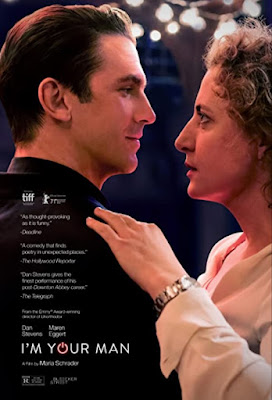
270. German film director Maria Schrader’s third feature film “Ich bin dein Mensch” (I am Your Man) (2021) (Germany) in German, based on a short story by Emma Braslavsky: Can artificial intelligence and robotics find your perfect spouse in the near future?


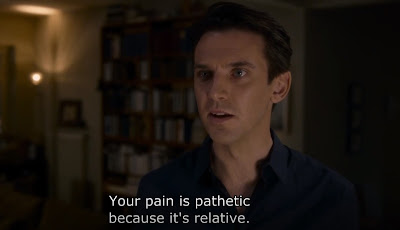
Your pain is pathetic. It is pathetic because it is relative. It is also not pathetic because it is part of you, and that’s why I love it.” 

---The android Tom created by algorithms and constantly capable of processing new information and thus evolving and responding constantly to be the designed perfect partner of Alma, a human archaeologist, ironically studying how people have changed over 4000 years by studying cuneiform scripts.


Maria Schrader’s film I am Your Man is a fascinating sci-fi (science fiction) film. The film progresses from the milestones set by the talking and scheming computer HAL of Stanley Kubrick’s 2001: A space odyssey (1968), to the crafty gynoid (a female android) of Alex Garland’s Ex Machina (2014), to the algorithm-oriented holographic spouses of the sci-fi play by Jordan Harrison and its adapted movie version of Michael Almeyreda’s Marjorie Prime (2017) to eventually introduce us to director Maria Schrader’s Tom—a perfect android, very smart, handsome, affable and totally benevolent to humans. In Kubrick’s 2001: A space odyssey, HAL the computer had become so smart that it began to give malevolent advice to misguide humans and even went to the extent of turning off the life-support system of three crewmen surviving in animated suspension, killing them instantly, in an effort to control the human crew of the space ship. In Garland’s Oscar-winning Ex Machina the near-perfect gynoid Ava locks up her human friend and leaves her mortally wounded human creator’s scientific facility to blend with the outside world of humans—yet another but more sophisticated variant of HAL. In Harrison’s/Almeyreda’s Marjorie Prime, while the holographic spouses cannot be touched they provide psychological and benevolent comfort to humans suffering from Alzheimer’s disease but can recall the memories of those suffering from the disease and thus provide succor. But one of the holograms does trip up to upset the near perfect scenario. Thus both Maria Schrader’s I am Your Man and Almeyreda’s Marjorie Prime take the viewer to the distinct possibility of recreating memories of past love in humans with the intelligent use of artificial intelligence in the not-so-distant future.  Schrader’s film scores over Almeyreda’s film because the android Tom in I am Your Man is physical, protective, affable with all humans, and good looking. Screenplay writers Jan Schomburg and Maria Schrader reveal towards the end of the film that even the name Tom is connected with Thomas, a childhood sweetheart of Alma, the archaeologist—evidently information sourced by the company that manufactured Tom by delving deep into the memory of Alma aided by her brain scans. (Actress Maren Eggert, won the Best Actress award at the Berlin International Film Festival, 2021, for her performance as Alma in I am your Man.)

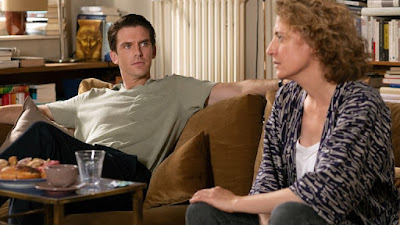
The android Tom (Dan Stevens) observing Alma 
(Maren Eggert) to pick up minute details to please
her, in her apartment

In the film I am your Man, Alma the archaeologist, faces a fund crunch for her scientific project and to augment her depleting financial resources she agrees to participate in a 3-week evaluation of an android boyfriend developed by a company by assimilating her past memories with the aid of a brain scan among other sources of information to suit her dream spouse--intelligent, handsome and somewhat exotic. The evaluation period of Tom includes a 3-day live-in period when the pair does have a sexual encounter that satisfies the needs of Alma. 

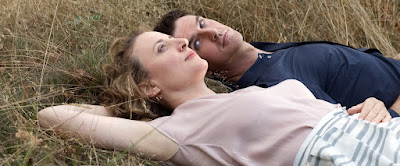
Tom and Alma outdoors--Alma loves
the companionship

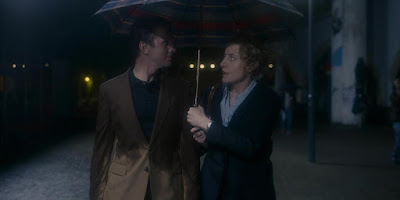
Alma is touched by Tom waiting the rain to meet
her as agreed earlier


Tom and the android company's 
representative (Sandra Huller)

Alma is single, middle aged and successful in her field of archaeology. She has had a recent affair with her boyfriend that unfortunately resulted in a miscarriage. Soon he starts dating another woman and that woman is now pregnant. Alma is pushed into a fragile psychological state: her ability to conceive is in doubt and her boyfriend has found a new flame. Her father is battling dementia. Evidently, Alma does not want to die alone. When she asks Tom what is the saddest thing he can think of, Tom responds as Alma would have done in an honest moment: "Dying alone." Tom, the android watching Alma work in the lab, is able to absorb the basics of her work, search the internet and warn her that another set of scientists in another part of the world is ahead of her and on the verge of publishing their results before Alma’s team would be able to do the same. Tears well up in Alma’s eyes, while confronting these facts. The reaction of Tom to that situation is his profound analytical response: “So the tears in your eyes only relate to you yourself and your career? They are egotistical tears.”  Tom even graciously suggests an alternate paper that Alma could put together with the work she has put in thus far. Alma is hurt and packs him off to the android factory that manufactured him.

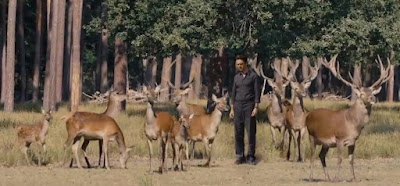
Wild animals may be wary of humans;
not so of androids

A key line spoken in the film


Today, we tend to assume that human beings have better feelings than machines/programmed androids. Schrader’s film contradicts that notion. Tom sits next to a customer in a café, while both watch a TV clip showing people failing to implement a plan. The customers sitting next to Tom laugh as they fail. Tom asks the customer seated next to him: “Could you explain to me what is funny about it?” He is answered “It looks so silly. I don’t know. I can’t explain it.” Tom continues, “The fact that no one dies?” He gets this answer, “That definitely would not be funny. Dying is definitely not funny, right?” Schrader and short-story writer Braslavsky thus project a future scenario when programmed androids could be more humane than humans in their gut reactions that sift good from the bad/insensitive ones.

After dispatching Tom off back to the factory that made him in egotistical anger, Alma writes up her evaluation of Tom, who is “not human” and is “not flawed in any conventional sense” during the 3-week period. Lines from her negative evaluation include “Are humans intended to have all their needs met with a push of a button? It will create a society of addicts who decide to not challenge themselves and endure conflicts.

A key scene between Tom and Alma


The delightful end of this unusual film is quite unpredictable providing the viewer with a cocktail of light entertainment, science, and thought-provoking questions about humans and machines programmed to improve themselves in a positive way, quite unlike “HAL”, “Eva”, and “Marjorie Prime” who preceded “Tom,” in cinematic chronology. Congratulations to the filmmakers and the short-story writer!


P.S.  I am Your Man won the Silver Bear Award at the Berlin International Film Festival for Ms Maren Eggert who plays Alma. It has also won the best fiction film and the best director awards at the German national awards and is Germany’s submission to the Oscars in the foreign language category.. It is one of the best films of 2021 for the author. The sci-fi film Marjorie Prime (2017) has been reviewed earlier on this blog.  (Click on the colored name of the film in the post-script to access the review.)


Sunday, November 14, 2021

269. Canadian film director Denis Côté’s tenth feature film “Hygiène sociale” (Social Hygiene) (2021) in French, based on his original script: An unusual film that serves to entertain verbally and visually as a dark comedy, without sex or violence


T
he title of the film Social Hygiene will remind viewers of the Covid pandemic’s cardinal rule to avoid infection—maintain social distancing to avoid infection. In fact, no two characters make physical contact in the entire film and maintain at least a 12 feet distance between each other. There is no mention of Covid or even wearing of masks in the film. Simply put, though the film was made during the pandemic, the film has nothing to do with it. Further, the film’s original script was written by the director Denis Côté in 2015, much before the onset of the pandemic. 
 
Antonin (right) spars verbally with his love
Cassiopée, while her new admirer silently watches 
in the background


The film is built around the pivotal character, Antonin, married, but staying away from his wife, Eglantine. Where? In a friend’s Volkswagen! Antonin, we realize is prone to making up unreal stories, is well read, deft with language wordplay, and is a thief, vandalizing cars in the process. The director/screenplay-writer Denis Côté’s central character encounters four ladies apart from his wife Eglantine. He meets with his sister, Solveig; his secret love, Cassiopée; a lady named Rose from the Ministry of Revenue tracking him down to coerce him to cough up his unpaid tax dues; and finally, Aurore, who has been also tracking him to get back a jacket and a computer he stole from her car, and some compensation for smashing its windows to steal those items.   

Antonin talks to his wife Eglantine

Antonin talks to Rose (note she wears pink),
the tax collector who can send him to prison


All the meetings with the five ladies are staged like a Samuel Beckett play with two or three characters (always including Antonin) in open grassy fields, often on the edges of forests. There is minimal movement from the characters often rooted to the same spot; only wordplay ensues with pregnant pauses between spoken lines. The only exceptionally active scene is Aurore dancing by herself in the forest to music, the source of which is never revealed. Why and what provokes Aurore, a theology student who works in a McDonald’s outlet, to suddenly dance or decide to take an interest in criminals is an amusing conundrum. To the casual viewer, the social criticism of Facebook, internet and taxes in the script may not be obvious. All the characters have lines to speak that refer to the ills of contemporary society and lifestyles.   

Antonin interacts with Solveig, his sister,
after she states that she found a lover at a restaurant
Note: She is still holding her wine glass 


Côté’s Antonin (mostly captured by the static camera in long shots, with a rare close-up towards the end of the film) is revealed as a filmmaker struggling to complete his script, and responds to Aurore’s revelation that she is a student of theology thus: “I believe in myself. I believe I can find the keys to my enigmas in my life by myself.”  

Antonin returns the jacket he stole from
Aurore's car to her. Note: Aurore's dress differs
 from those worn by other women


When asked about when and where he met his wife, Antonin wittily replies “I met my wife in a zoo, by the cage of the hyena. The rest is a long quiet river.” 

In Côté’s interesting script, the best lines are not invested with Antonin alone. Antonin’s love Cassiopée calls him a narcissist and says “You are 100 times dead. I love you as a zombie....Men are like mushrooms. The more handsome they are the more poison they contain.” The cocky Antonin pleads and buckles under Rose’s threat “I have the key to your prison cell at the edge of my pen,” to pay his taxes. To Aurore, Antonin agrees to return the jacket and computer. His sister, Solveig, finally finds a lover over tea and long tales, uttering the words “Carpe Diem.” His wife, too, leaves him for another lover. The once confident and witty Antonin is completely “socially distanced.” 

Antonin holds a flower he wishes to present to his love
Cassiopée (center, background) while his wife (left)
notes it all and decides to leave her philandering husband


Denis Côté, the filmmaker is essentially a charming, absurdist playwright, who stages his written work in natural open surroundings with clearly demarcated stage markings for his actors in grassy patches with distant bird, animal, and traffic sounds on the soundtrack. The rare body movements of most characters are in sharp contrast to Aurore flexible body movements during her dancing spell in the film. 

Aurore dances in the forest, the only character
in the film who moves a lot physically


While Côté presents verbal sparring that will interest most viewers, there are details that some could miss. The clothes worn by all actors are period costumes a century old, with the sole exception of Aurore’s clothes that are contemporary. Thus her clothes and her dance movements are in interesting contrast to all other characters. Is Côté suggesting that Antonin’s appropriate love interest should be Aurore, not the characters wearing century-old costumes? Antonin does confess he finds Aurore attractive. 

Antonin (Maxim Gaudette) levelled by all women:
The only close-up shot in the entire film


Then there is a deliberate smudge in the static vision to the left corner of the First Act in the countryside with Antonin sparring with his sister possibly to accentuate the picture postcard shot, because Solveig retains her hands-on-the-hips pose for a long while. When the static camera moves, there seems to be a purpose to intervene in the social distancing of the actors and the camera. Denis Côté’s film provides unusual entertainment for those who can appreciate good playwrights and a totally fresh approach to the medium that is visually and verbally witty. A very interesting filmmaker setting a new style! 

 P.S.  Social Hygiene won the Best Director award at the Berlin Film Festival’s “Encounters” section and the Best Director award at the Fajr Film Festival in Iran. This film is one of the best films of 2021 for the author.


Wednesday, October 28, 2020

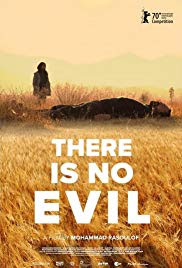
257. Iranian director Mohammad Rasoulof’s seventh feature film “Shetan vojud nadarad” (There is No Evil) (2020), based on an original script by the director: Distinct tales of four Iranian men (three of whom were soldiers) who either chose to actively participate or conscientiously refuse to hang condemned men and the consequences of their actions on their family life


The film is “about people taking responsibility” for their actions and “each story is based on my own experience”

---Director Mohammad Rasoulof, quoted from BBC News on the Wikipedia page on the film There Is No Evil


Most filmgoers around the world might not have heard of Mohammad Rasoulof, an Iranian film director. He is one of most courageous filmmakers in the world today making amazing, well-crafted, award-winning films on morality within Iranian society, governed by rules that wreck the lives of its conscientious citizens. The seven feature films he made have upset the Iranian government authorities who do not appreciate dissenting views while his films gathered plaudits and awards worldwide. Both he and another relatively more famous film director Jafar Panahi are facing jail terms, currently in suspension, for highlighting some of the ills within the country. While the Damocles’ sword of prison time has cowed down Mr Panahi, Mr Rasoulof has come out with his most hard-hitting film yet-- There Is No Evil--which is arguably one of the best films of 2020 worldwide, in terms of content and quality and one of the best films from Iran over the decades. That it won top honors at the Berlin Film Festival is no surprise.

Director Rasoulof's daughter Baran plays an
interesting role in the fourth segment--"Kiss her"
The actor: Mohammad Seddighimehr


What is the film about? The four segments of this portmanteau film deal with four male characters who either hanged prisoners or objected to hanging condemned prisoners, often during their forced conscription for military duty or for economic necessity of bringing “home the bacon” in one case or, in the case of a tertiary character in the film, for covering the medical bills of a family member. None of the four enjoy their activity. In some segments, their close family are well aware of the decisions they make; in some, their dark activity is never fully revealed to their loved ones. And what are the crimes of the prisoners who are executed? Some are murderers, some are drug peddlers, some are political activists or believers in other faiths than those allowed to be practiced in the country by rigid Islamists.

Apparently if a conscripted soldier refuses to hang a condemned prisoner in Iran, you are punished by being given other tough and distasteful tasks, additional time to serve in the military, refusal of a driving license and a required permit to travel abroad. Your life becomes a living hell if you abide by your conscience.

To be involved in hanging a condemned man
or not is the question


The awesome aspect of Rasoulof’s scriptwriting lies in the contrasting details of thought that gets weaved into it. Those who hang condemned prisoners, even if it is for the sake of their family’s economic survival, and after regularly collecting their salaries and their rationed rice for their apparent remorseless activity, reveal a kind heart while discussing upset school girls from broken families or saving kittens stuck in unlikely places. On the flip side, conscientious objectors to hanging convicted human beings in the film refuse to kill foxes that harm their own livestock and choose instead to feed them with food enabling them to survive. One of Rasoulof’s hangmen who is quiet about the work he does also exhibits silent remorse as he stops his car at a red light and doesn’t move on when the lights turn green, on his way to work. The camera merely captures the unmoving car which does ultimately move after a while. What an imaginative way to capture the mind of a sullen, seemingly unperturbed individual!

The car scenes like this one
can be found in all the four segments. 


There is a strange common denominator in the films of Abbas Kiarostami (Certified Copy; A Taste of Cherry; Ten), Jafar Panahi (Taxi; 3 Faces), Reza Mirkarimi (Castle of Dreams) and Mohammad Rasoulof (There Is No Evil) in their propensity to film actors sitting in front seats of moving cars often, if not always, in non-studio shots. It is possible that these directors look at economics of filmmaking, ability to get reactions in real time of two or more actors in a single shot, or both. Yet this method of filming has only raised the distinct stamp of creativity of these directors in some of their important and celebrated recent works.

An evocative shot beautifully composed
and balanced by the cinematographer and the director.
That shot visually encapsulates an entire segment 
The actress is Mehtab Servati

If we go by information available on the IMdB website, it is quite possible that many of the male actors in There Is No Evil are either non-professionals making their debut or they have never acted in films sufficiently famous to be included on that website. It is indeed a remarkable achievement for Rasoulof to cast them and get fascinating outcomes.  

While Rasoulof’s personal views on death penalty is obvious, the film's strength lies in his astute development of interactions of various major characters, often within their family or a family of a close friend. The infusion of unusual details in the screenplay clearly surpasses his efforts in his past films, such as Good Bye and A Man of Integrity. Here he uses cats, foxes and even honey bees to add value to the conversation of the main characters in the four segments (There is no evil; She said ”You can do it; Birthday; Kiss me) of  the film There Is No Evil. If there is an element where the viewers have to suspend their disbelief in what they are watching, it would be portions of the second segment. But to the credit of the director/screenplay writer that weak segment is also the most entertaining amongst the four. But who cares? The somber value of the other segments more than makes up for it. The film is essentially about moral strength of its four characters not one providing popular entertainment.

Rasoulof and his contemporaries among Iranian directors are blessed with a range of beautiful and talented actresses—and this film is a testament to that factor. Rasoulof considerably depends on them. While his male protagonists may appear to have lead roles, their female counterparts in each segment have equally demanding and more commanding roles in his films and in this one in particular.

This film is in many ways close to Christian, Buddhist, Jainist, and humanist tenets though it is made by an Islamic cast and crew. It is essentially a film about respect for human life and that of animals.

The strength of There Is No Evil is based on several unusual elements—the ability of Rasoulof to make yet another film that could upset many in the Iranian government and judiciary while having a suspended jail term to serve out; writing a fascinating original script based on his own experience; wonderful casting of actors that include Rasoulof’s daughter in a major role in the final segment; and the intelligent cinematography by Askhan Askhani (who also worked on Rasoulof’s A Man of Integrity). While it is quite predictable that Iran will never nominate There Is No Evil to the Oscars, one hopes it gets nominated in the categories of direction and screenplay by the Oscar authorities, rules permitting.   


P.S.  There Is No Evil won the Golden Bear for the best film, the Prize of the Ecumenical film Jury, and the Guild Prize for director Rasoulof at the 2020 Berlin film festival. It has also won the Grand Prize at the Heartland international film festival, Indiana (USA), Best Narrative Feature Film award at Montclair festival, New Jersey (USA), and the Special Jury Prize of the Crested Butte Festival (USA) for “courage in filmmaking.”  The film is participating in the 2020 Denver Film Festival, USA. There Is No Evil is one of the author's best films of 2020 Rasoulof's earlier films Good Bye (2011) and A Man of Integrity (2017), Kiarostami's Certified Copy (2010), Panahi's Taxi (2015) and Mirkarimi's Castle of Dreams (2019) have been reviewed on this blog earlier as also Kieslowski's Dekalog 5 (1988), a major cinematic statement on capital punishment from Poland. (Click on the names of the films in this post script to access the reviews)