Tuesday, May 14, 2013

145. Japanese maestro Akira Kurosawa’s “Ikiru“ (To Live) (1952): A prescription for curing our ailing souls and living our lives meaningfully.


“Life is so short, dear maiden,
so fall in love while your lips are still red
And before your passion cools
For there will be no tomorrow.
. . .Tomorrow will not come again.”
--The Gondola Song, written in 1915, sung by the lead character 
Kanji Watanabe (played by actor Takashi Shimura)

Three films of Akira Kurosawa figure in this critic’s top 100 films of all time: one is Dersu Uzala (1975), another is Red Beard (1965) and the third is Ikiru (1952). There are several reasons why the Berlin Film Festival’s Silver Bear winner Ikiru is sufficiently enchanting to watch again and again. When you view Ikiru, the fact that you are watching a Japanese film slowly recedes into the background and you realize that this is indeed a powerful and universal tale, amazingly knit together by a brilliant screenplay. That it is Japanese becomes inconsequential.

It is a tale of an ineffective bureaucrat named Kanji Watanabe, who has slogged away in a government office for 30 years pushing files diligently without taking a day off or making any willful difference to anyone in his office or to society at large by acting on any matter raised in those files. Watanabe is suddenly confronted with the fact that he is dying of cancer and has a bare year to live. The first half of the film Ikiru deals with the transformation of Watanabe by this sudden revelation. The second half of Ikiru deals with how different individuals perceive his transformation differently. In fact, many film critics see parallels in Ikiru’s structure with the German Wolfgang von Goethe’s play Faust, especially with the literary work divided into Faust on earth versus Faust in macro-cosmos. The German play and the Japanese film are structured in a similar way. This is not surprising because it is well known that F W Marnau’s silent German film Faust (1926), based on Goethe's play, was one of Kurosawa’s favorite films.

The film Ikiru is not about death that will eventually strike all of us—it is a film about living a life that will make a difference to humanity, and not merely living a life that is fulfilling to us and our immediate family. It is a film that reverberates with Buddhist values that the Dalai Lama expounds: ‘‘Awareness of death is the very bedrock of the path. Until you have developed this awareness, all other practices are obstructed.’’ Now Kurosawa was not a practicing Buddhist but it quite possible that Kurosawa’s co-scriptwriters Hideo Oguni (1904-96) and Shinobu Hashimoto were Buddhists.

Dr Francis G Lu, a Professor of Clinical Psychiatry at the University of California San Fransisco,  has published scientific papers on Kurosawa's (and his co-scriptwriters')  observations in Ikiru on human reactions of individuals shaken out of their mundane existence by life threatening diseases to transform themselves dramatically and lead meaningful lives. One of his scientific papers that appears in The Journal of Trans-personal Psychology, 2006, Vol. 37, No. 1, states that Kurosawa himself admitted ‘‘Sometimes I think of my death. I think of ceasing to be ... and it is from these thoughts that Ikiru came.’’ Another scientific paper on Ikiru's appeared in the same journal in 1987, Vol.19, No.2, which was co-authored by Dr Sanford Weimer, (Chairman, Department of Psychiatry, CIGNA, Los Angeles, USA) and Dr Francis Lu comparing Watanabe's transformation in Ikiru with a real life case study.  Yes, good cinema can be serious subjects of scientific journals!

For this critic, Ikiru does recall the life changing willful transformation of the Indian King Ashoka the Great (304-232 BC) from king to a monk and conversion to Buddhism, a fact  that Professor Lu seems to have missed mentioning in his otherwise excellent scientific paper written in 2006.

A jolt at the zenith of your career

It would be too simplistic to categorize Ikiru as a  mere tale of living life meaningfully before death. It is a film that explores the love of a father for his son and the apparent lack of love for the father from his son, who in his turn only cares for what he can inherit after his father’s passing. Kurosawa and his co-scriptwriters weaved a lovely discussion between the cancer-stricken bureaucrat Watanabe and the vivacious Miss Toyo Odagiri who had worked under Watanabe but subsequently wants to resign her bureaucratic job so that she could  make toy rabbits for the children of Japan. Miss Odagiri and Watanabe discuss the aspect that children "don’t ask to be born" and it finally dawns on the young lady that Watanabe led the colorless life thus far for the sake of his only son: "I know why you did it. You love him!" Evidently Watanabe doesn't have a wife anymore—so all his love is focused on his son. Watanabe wistfully confides to Miss Odagiri: “I became a ‘mummy’ for the sake of my son and he does not appreciate me. My son is far away somewhere, just as my parents were far away when I was drowning.”   These words reveal stories that are never fleshed out in the film but were there in the minds of the three scriptwriters. The Asian trait of living one’s life for the sake of one’s progeny might be unfamiliar to non-Asians.  It is this withdrawal of focus on his family that Watanabe adopts as death approaches him that is similar to another ancient Asian religion Hinduism that classifies the last two stages of a man’s life as Vanaprastha  and Sanyasa, moving away from the household duties (in Watanabe's case, of caring for his son and daughter-in-law). Now Kurosawa was neither a Hindu nor a practicing Buddhist but he was Asian in his outlook, and this Asian heritage and values come through in the final screenplay.

"Life is short"

Finally, Ikiru is a brilliant study of human characters that we encounter each day.  The first group examined in Ikiru are the typical bureaucrats that populate Watanabe’s office and who are given nicknames that typify bureaucrats. These include: 'eel' (a slippery man), 'fly paper' (a person who sticks to certain people), 'the fixed meal' (a man who has no preferences in life), 'gelatin' (the quivering man who is scared of taking decisions), 'drain cover' (a man who is figuratively dampens every mood) and 'mummy' (apparently a living dead man). And appropriately Watanabe’s nickname in his office is ‘mummy.’ In this first part of Ikiru, Watanabe decides that he will not live the last year of his life like a ‘mummy ‘ The second part of Ikiru provides equally interesting studies of various politicians and officials participating in Watanabe’s wake who show their guile in appropriating the positive contribution of the dead Watanabe as their own. More importantly those who promise to uphold the values of the latter day Watanabe, return to their desk jobs only to reprise the very actions of the inactive Watanabe of old. A policeman also attends the wake and recalls Watanabe sitting on a swing in the park that Watanabe helped create for total strangers in the falling snow singing the Gondola song after which he apparently died. The policeman feels sorry that he did not intervene and had left Watanabe to freeze in the cold.

"Christ carrying a cross called cancer" is how Watanabe is perceived by the  hack writer

The power if Ikiru is not limited to its wonderful tale. Its characters include a second-rate writer (the Mephistopheles equivalent) who has a problem sleeping and offers to show where Watanabe can enjoy women and song, and drink the best of liquor as well, when Watanabe offers him sleeping pills possibly stockpiled by Watanabe for a future suicide attempt. Watanabe's interactions with such characters and the effect he has on them are interesting details for the viewer to study.  When Watanabe tells his medical predicament to the writer, the Mephistophelian actor says “Men are such fools. They only realize how beautiful life is when they are face to face with death. And even those people are rare. Some die without knowing what life is. You are a fine man. You are rebelling against it. . .That's what impresses me. You've been a slave to life; now you are trying to master it. Man's duty is to enjoy life. It's against God's will not to do so. Man must have a lust for life. Lust is considered immoral but it is not. A lust for life is a virtue."  These interesting words reveal the combined power of the three screenplay-writers who made Ikiru what is today: Hideo Oguni (1904-96), Shinobu Hashimoto, and Akira Kurosawa. Drs Lu and Weimer have praised Kurosawa for his insights on human psychology but Oguni and Hahimoto need to share the praise from the professors as well. The conversations and the body language of varied characters can be appreciated endlessly by viewers half a century after the film Ikiru was made because of its honesty.

Screenplay writer Oguni contributed to seven Kurosawa movies, and screenplay writer Hashimoto, to eight Kurosawa films. Thus it is fascinating to note that Ikiru is an unusual product of two of Kurosawa’s closest screenplay collaborators.  Oguni would have collaborated on an eighth Kurosawa film, had Kurosawa indeed made the film Runaway Train co-scripted by Oguni and Kurosawa, but the film was eventually made by the Russian director Andrei Mikhalkov-Konchalovsky in Alaska, USA, with Hollywood actors. (Runaway Train, nominated unsuccessfully for the Best Film, Best Actor and Best Supporting Actor Oscars in 1986, remains to this day, one of the favorite films of this critic. Director Konchalovsky was Tarkovsky classmate and collaborator on one Tarkovsky film.) Oguni apparently had modeled the lead role as a gangster dying of cancer but his co-scriptwriters transformed the gangster into a bureaucrat in the final script. But the one of the finest moments in the film Ikiru is when a gangster confronts the transformed bureaucrat and threatens to kill him.  "Don't you value your life?" the gangster asks the meek Watanabe "I can't be angry, I don't have the time” is the loaded reply from the dying Watanabe. It does not matter whether those lines were written by Oguni or Hashimoto or Kurosawa. Those are one of the finest lines in cinema that not only disarms the gangster but the viewer of the film. Equally important is visage of actor Shimura when he utters those lines.

The trio of screenplay writers structured the story with the denouement of the tale in the opening scenes and then probably at the behest of Kurosawa, the tale was structures on the lines of Goethe’s Faust. The end result was a film that went beyond the tale of Watanabe’s disease, transformation, and death. The film was able to put on display different sets of people and their varied reactions to the few reformed Watanabes we are likely to come across in our own lives. Do we change as ‘gelatin’, the colleague of Watanabe, did in Ikiru? Only he could appreciate the sunset as Watanabe did and evidently the transformed ‘gelatin’ had become 'rock solid' with a new perspective to living life, thanks to Watanabe. The screenplay writer Oguni did look closely at Leo Tolstoy's novel The Death of Ivan Ilych. The similarities between Ivan Ilych and Watanabe cannot be ignored.
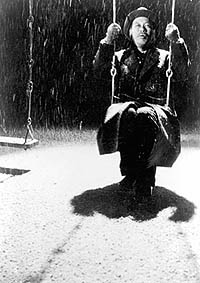
You are ready for death when you are no longer a 'mummy'

The other pillar of Ikiru will remain actor Takashi Shimura who plays the ineffective bureaucrat dying from cancer. Actor Shimura (1905-82) was a thespian in 21 of 30 Kurosawa films—yet people tend to forget Shimura but recall another Kurosawa film regular—Toshiro Mifune, who played the tough-guy roles. Shimura on the other hand could play both the wimp and the tough guy (as in Seven Samurai) and that capability of playing distinctly different characters is why Shimura needs to be admired more than Mifune, whose roles were mere variants of the tough guy. When Shimura playing Watanabe in Ikiru was required to sing the Gondola song , Kurosawa’s apparently directed him thus:  "Sing the song as if you are a stranger in a world where nobody believes you exist." (IMDB trivia). And that is exactly what Shimura did with aplomb.

In essence, the film teaches us to go beyond ourselves and our families, to reach out with compassion to help strangers—the basic element of all the great religions including Buddhism. It is exemplified in the words and actions of the most important female character in the movie, Miss Toyo Odagiri, who resigns her clerical job to make toy rabbits for children and suggests to Watanabe: ”I mean it...all I do is make these little things. Even making these is so much fun. Making them, I feel like I'm playing with every baby in Japan. Why don't you try making something, too?"

"I know why you did it. You love him."

Every viewer of Ikiru will be forced to re-evaluate their own lives, whether they are a cancer patient or not. That is the power of this Kurosawa classic.

P.S. An Indian film Hrishikesh Mukherji’s Anand (1971) went on to win many awards including one for its screenplay. What few people realized in India was that it mirrored Ikiru. Hrishikesh Mukherji had insisted to his screenplay-writer Gulzar that he wanted to inform the audience that the cancer patient played by Rajesh Khanna was dead at the start of the movie itself (ref: IMDB trivia of Anand) --the very concept that Oguni/Hashimoto/Kurosawa had so effectively used in Ikiru


Wednesday, April 24, 2013

144. US director Terrence Malick’s sixth feature film “To the Wonder” (2012): Love your spouse in the context of divine love


Terrence Malick’s films tend to perplex certain audiences. To the Wonder is likely to leave many viewers, used to the typical Hollywood movies with unambiguous narrative tales, totally stone cold. And yet it is true poetry on celluloid for others.

Malick’s cinema is different from the average Hollywood fare. In many ways, To the Wonder is comparatively easy to appreciate amongst Malick’s body of work because this is a film that deals essentially with a regular man-woman love affair, a subject that would go down well with for most traditional movie-goers.  However, it is the treatment of the subject that is so different from the usual fare, not the subject. A major difference that an attentive viewer will pick up is that when you hear the voice-over of Marina, the main protagonist, the constant occurrence of  “you” in her monologue do not merely refer to her beau Neil but also to God. A viewer is likely to assume that she is addressing her male companion because he does appear to be the obvious center of her affection on screen—but a careful study of the ambiguous words reveals that Marina is addressing God as well.

Dance of joy during courtship

Appreciating Malick’s cinema, or at least appreciating the last five of his six films, does not necessarily require the audiences to be believers in God—but belief in God and knowledge of Christian scriptures definitely helps understand Malick’s dialectics beyond the visual and the spoken word.  Malick’s cinema can be enthralling by the sheer and combined  beauty of the pristine images of nature, natural light and physical movements of gay abandon captured by cinematographer Emmanuel Lubezki  (his third feature film for Malick) that visually waltzes with joy recalling the Geoffrey Unsworth’s camerawork in Stanley Kubrick’s 2001: a Space Odyssey, which had sequences where space stations seemed to dance to the music of Johann Strauss. Any viewer would appreciate the importance that Malick when his films tend to linger and savor natural light (especially during twilight and dawn) and magnify the beauty of wind, plants, grasses, trees, flowers, animals and even insects-- all visuals and imagery to underscore the tale of love between men and women in the forefront of the cinematic tale.  A viewer with a taste for music can also appreciate the eclectic and the magical choice of music that Malick arranges from diverse sources (especially in his The Tree of Life, and less so in To the Wonder) in his films. In To the Wonder, Malick carefully picks sublime pieces by Wagner, Tchaikovsky, Haydn, Gorecki, Bach, Shostakovich, and Rachmaninoff and knits them into the film with profound effect.  But these very visuals and music take on added meaning, if they are appreciated in the context of the voice-overs (the spoken words that the viewer rarely sees actually being spoken by actors on the screen).  

Silent grazing bisons and humans during twilight

In To the Wonder,  Malick introduces images of the American bison, wild horses and tamed horses, and even a couple of insects on the wall of a house. Is it by accident or by design? The human behavior captured in To the Wonder appears to be a projection of these very images of natural fauna—there is Neil. who is mostly quiet but can be as violent as a bison when provoked, there is Marina who can be carefree and happy as a wild horse and simultaneously difficult to contain her impulses as a corralled horse, and there are several individuals in the movie such as the two insects on the wall attracted to each other.

Almost all the later Malick films increasingly resort to the sporadic voice-overs  of characters who are participating in the film but may or may not be in front of the camera. And in To the Wonder, Malick adds yet another element that could irritate the conventional cinema-goer:  the voice-over begins before the visuals change. Editing gets a makeover. Malick is changing the grammar of cinema in a way the French director Jacques Demy attempted with his feature film The Umbrellas of Cherbourg, a 1964 French film that replaced regular spoken dialog totally with songs. No one attempted another film like that again but Malick is relentless in a somewhat similar effort to create cinema with a difference. There is hardly any conventional spoken dialogue between two individuals in To the Wonder: what the audience gets served instead are visuals, music, silence (the incredible scene with the bisons, often incorrectly referred to as the American buffalo), and meditative voice-overs. For Malick, the changes of scenes are mere beads on a rosary—they are all interconnected thematically and he wishes to make the connection more obvious by bringing in the voices of the next scene before the existing scene disappears.

W
Wonder of natural beauty set off against human beings again in twilight

What difference is Malick gradually introducing to cinema you might ask? In To the Wonder, the entire film is a visual poem with very few sequences where people speak to each other on screen. Regular dialogues are rare and minimal.  If characters speak, it is only to provide a clue to what follows.  For instance, the child Tatiana asks her mother Marina (Olga Kurylenko) in the Paris apartment, “Why are you unhappy?” The response to the on-screen question is typical of Malick—a silent street shot of Paris from a window in an apartment, suggesting the unhappiness of Marina awaiting some affirmative response from her lover Neil. This is followed up with visual scenes of happiness with Marina gamboling with joy outdoors with Tatiana and Neil after Neil invites them to Oklahoma.  Happiness is emphasized through body movements as Marina and Tatiana frolic just as the characters in The Umbrellas of Cherbourg did. Unhappiness is depicted visually when Marina is sitting on the floor trying to play a musical instrument.  Interestingly, the few instances where there is conventional dialogue, it is between Tatiana (Marina’s daughter) and Neil (Ben Affleck) and later during the interactions of the Catholic priest Father Quintana (Javier Bardem) tending his flock in his parish and in a prison. For this critic, the only few significant “conventional” dialogs in the entire film were of Tatiana rejecting Neil as her “father“ and  Quintana’s  interactions with a black parishioner on “light” versus “spiritual light” and an elderly white woman parishioner who holds the priest’s hands and stating that she will “pray for him” to the poor man’s amazement.  Almost all others spoken lines in the film involve a single statement or a rhetorical question followed by a visual answer.  Neil and Marina even fight verbally but the sound is muted and the fight is captured visually by the indirect effect on Tatiana listening to the squabble! Malick is very deliberate in what dialogues need to be heard.

To appreciate To the Wonder there are a few Malickian keys that unlock the true wonder of the film. First, Malick’s recent films seem connected in a unique manner. The Thin Red Line began with a shot of a flame in darkness. The flame reappears when the Pvt. Witt (Jim Caviezel) confronts the imprisoned AWOL First Sgt Welsh (Sean Penn) and later when Welsh asks Witt about believing in “the beautiful light” and Witt responding “I still see a spark in you.” The visual flame was further explained in the film to the viewer by the spoken words of Pvt. Bell (Ben Chaplin) “Love. Where does it come from? Who lit this flame in us? No war can put it out, conquer it. I was a prisoner. You set me free.” For Malick, divine love is introduced in his films by the flame. In Malick’s The Tree of Life, the flame is used as punctuation. It appears at the start of the film and then again when the transformation of the adult Jack (Sean Penn) is signified by the lighting of the blue candle. In To the Wonder, the first spoken lines are those of Marina “Newborn. I open my eyes. I melt into the eternal light. A spark. I fall into the flame. You brought me out of the shadows.  You lifted me from the ground. Brought me back to life.” To those uninitiated to Malick’s cinema, these words would be a monologue of Marina representing love with Neil. That would be too simplistic an interpretation of the words. It is actually a spiritual rumination. And this aspect can only be accepted by a viewer who accepts God or accept cinema that deals with God. The final words spoken in the film are also a spiritual statement from Marina “Love that loves us. Thank you.” Again to the un-initiated Malick viewer, this crucial monologue of Marina could also be relating to Neil, but it is not. It is an intense personal conversation with God. The entire plot of the film falls into place, if we note the last words, especially the epilogue following Mariana’s second departure to France followed by the wild horses running free and wild in Oklahoma---all visual clues for the viewer to understand the ending of the tale.

The film, ostensibly a love story of Neil and Marina, is structured on four key sacraments of the Church—baptism, marriage, confession and the Holy Communion. There is no baptism: we only hear the opening words of being “newborn” when the”child” in the film is actually a grown-up Marina who is entering a second marital relationship. There are several mentions, visual and aural, of marriage and how Marina, a Catholic, is worried about the aftermath of her first broken marriage and implications it has on her spiritual life (recall the brief statement she makes to Fr. Quintana on her arrival in Oklahoma, prior to her second marriage, on the sacraments.) Then she is tempted to commit sin within marriage and there is a subsequent confession (to both the priest and to her husband separately). Marina significantly receives the Holy Communion after her confession from the priest.

Malick is urging his viewers to study the parallels of Marina’s life as she struggles to discover true love while searching in vain for a resolute response from Neil with the crisis of faith of Fr Quintana as he tends to the contrasting spiritual needs of sick and dying members of his Parish, the rich members of his Parish who are only concerned about adding facilities to the existing Church, of convicts in jails who see his visits as a glimmer of hope of salvation. And yet the priest rues “Everywhere You are present, and yet I can’t see You. You are within me, around me, and I have no experience of You. Not as I once did.” Malick seems to be revisiting the theological doubts of the priest in Ingmar Bergman’s 1963 classic film Winter Light. A moot question for the viewer would be why does Malick introduce the priest into this cinematic tale? The priest helps put into context the importance of the blessed sacraments that Malick is discussing in Marina’s life—marriage, confession of sin and absolution though Holy Communion. The movie is centred on Marina not the priest. (In Malick’s earlier film, The Tree of Life, a priest was included to provide a sermon on bereavement with a touch of Kierkegaardian philosophy “Do you trust in God? Job too was close to the Lord.”) Priests in Malick’s films are not ornaments—they add to the theological debate running through the length of the films. Regular Malick followers will note a startling departure—the priest is for the first time is a Roman Catholic. In To the Wonder, the priest serves a similar function to the one in The Tree of Life—to give prescient spiritual meaning to Neil’s actions with his sermon “To choose is to commit yourself and to commit yourself is to run the risk of failure. Forgiveness he (Jesus) never denies us. The man who makes a mistake can repent. But the man who hesitates, who does nothing, who buries his talent in the earth, with him he can do nothing.” Neil defers commitment and when he does so, he walks on a tight rope from which he could easily fall off.

Spirituality is not limited to priests in Malick’s films—it pervades the few spoken lines. Jane (Rachel McAdams) speaks of losing a child and her father consoling her and asking to read Romans, a book in the Bible, and Jane speaks the specific lines to Neil “And we know that all things work together for good (Romans 8:28). He believed that and prayed with me


Human beings set against a man-made wonder and silt deposits surrounding the monument 

There is yet another parameter that can be used to appreciate the film To the Wonder: this is the element of earth and sky, what is below us and what is above us just as Fr Quintana’s sermon mentions “burying one’s talent in the earth.” The unusual Mont Saint Michel is a deliberately chosen location by Malick to fit into the tale. The 11th century abbey and church is built on an island on the French coast with formidable architecture considering its natural foundations. It is today a UNESCO World Heritage site that is called the Wonder. Malick uses visuals of climbing the steps and the unusual and dangerous silt (caused to accumulate by short-sighted human decisions)  near the sea front surrounding the heritage site reacting to the sea tides as recurring symbols of God in the heavens (a repeat of The Tree of Life) and heavenly love as opposed to human love on earth.  The film is peppered with voice-overs that refer time and again to the sky and heights as counterbalance to the polluted earth and waters below our feet. Visually there are shots of the sky through trees, of birds just as there are shots of turtles swimming underwater.  There are sufficient visual and verbal suggestions that we on earth are polluted (as the soil of the Oklahoma town) and imperfect and that we need to let the light of goodness shine on earth.  The shore line of Mont St Michel with the abbey in the background reappears at the end of the film to highlight the difference in heights subtly introduced time and again throughout the film in different contexts. Every visual shot reinforces Malick’s total appreciation of divine love, which for Malick comes from above but can be found below as well. The script is Malick’s own and one can guess there are considerable autobiographical touches to the tale, by the mere fact that Malick once lived in the town of Barnesville where the movie is largely shot.

Just as The Tree of Life was a paean to the love of a man for his dead younger brother and for his mother, To the Wonder is a paean to the love of a woman for her husband. In both films, the reassuring touch of hands embellishes this idea. In The Tree of Life there was the evocative scene of the child reaching out to its elder brother’s hand.  In To the Wonder a similar affection is alluded to as future man and wife hold hands in the train. Both films use images and emotion of love between individuals to study and appreciate divine love. “We were made to see You” says Fr Quintana in a parting monologue towards the end of the film. The pollution and the filth around the town is set off against the beautiful natural unpolluted visuals of birds in flight and flowing water.
A poster that tells a tale: a symbolic fold in the middle, suggesting the Neil-Jane interlude

Having seen the entire body of Malick’s feature films, The Tree of Life, The Thin Red Line and Days of Heaven are three films that tower over all the others in substance and scope of subject matter, while each work of Malick will provide additional satisfaction with repeat viewings, just as we never tire of reading monumental works of literature again and again.  Malick is indeed America’s most awesome living filmmaker.


P.S. The Tree of Life, The Thin Red Line and Days of Heaven have been reviewed earlier on this blog and are included in the author’s top 100 films of all time. To the Wonder won a minor award at the Venice film festival 2012. Mr malick is also one of the author's 15 favourite active filmmakers

Monday, April 08, 2013

143. Italian filmmaker Paolo Sorrentino’s film made in USA “This Must Be the Place” (2011): Place and time continuum reinforced for the reflective viewer


Paolo Sorrentino is definitely a talented director.  His films considerably rely on visual statements.  Sorrentino’s This Must Be the Place indirectly urges the film’s viewer to observe the details of visual statements, which often put in context the quaint sense of humor of the spoken word in the film.  That does not mean the viewer should miss the quirky spoken words either, such as the deadpan non sequitur "Why is Lady Gaga?"  The most important lines, stated nonchalantly, come mid-way into the film and those lines are the key to understanding it:

You have to choose a moment in your life to be not afraid.
And have you chosen that moment?”
Yes, I have.”

Those critical lines explain the entire film for those who might find the film exasperating to understand, beyond the obvious strands of the film being a cocktail of a road movie, a detective movie and a Nazi-criminal-hunt movie.  It also a vengeance movie but one that presents the antithesis of violence one associates with Hollywood vengeance movies, a la Quentin Tarantino. The film is perhaps best described as a psychological study about individuals who wear masks and are able to remove their masks when they are no longer afraid and ultimately realize they don’t need masks to survive. The film also gives importance to the time and place when a life-changing moment in one’s life allows for an important u-turn in your life, a point in life when you mentally grow up.


Cheyenne (Penn) and wife (McDormand)

This Must Be the Place is an unusual film and for many viewers half an hour into the film will probably make them cringe away from looking at the screen and instead glance in the wrong direction—the exit door. One is likely to have similar urges with Sorrentino’s spectacular and more complex work The Consequences of Love (2004) as well. However, if you have some forbearance, both films will prove to be audacious, intelligent and rewarding provided you stay glued to the screen right up to the end of the film. And if you do stay right up to the end, you are likely to be delighted to have viewed cinema of a distinct and unusual quality and re-evaluate the early bits of any Sorrentino film in a totally new light once the movie gets over.  That is the amazing talent of Sorrentino.  And Sorrentino is only 42!

Sorrentino is an Italian who has made his name with works totally Italian. And yet his latest film which is only his fourth feature film,  This Must Be the Place is remarkably different: it is in English language, with Hollywood actors, and capturing Americana as an American director would to the bone. But the movie retains its European directorial style, just as German Werner Herzog made Stroszek (1977) or German Wim Wenders who made Paris, Texas (1984) and decades later followed up with The Million Dollar Hotel (2000) in USA utilizing several Hollywood stars, some of whom were already major actors elsewhere before they became to be known as Hollywood stars.

Fear of flying

This Must Be the Place has major Hollywood stars—Sean Penn and Frances McDormand.  And Sean Penn does an amazing turn as a burned out Goth Rock star, a character that is bizarre but will remain indelible in the minds of most viewers.  Sean Penn wears lipstick, eyeliners, and a weird hairdo and talks slowly in a manner one associates with drug addicts. You begin to wonder initially if Penn is playing a transvestite and then you realize he is not. He is just a rock star caught in a time warp and living retired life in Dublin, Ireland, as though he is still mentally on stage before a live audience of screaming fans. We soon realize he is not dangerous but an innocent and well-meaning husband with strange tastes for his appearance. But Penn and Sorrentino create another dimension:  Penn speaks slowly but in unusually high pitch in this role and what he speaks is never tripe but often measured words of wisdom.  When being served a cheeseburger, the waitress converses with Cheyenne (Sean Penn) and apologizes that the burger is a bit too well done. “You don’t mind, do you? Unfortunately that’s life” she adds. Cheyenne’s deadpan response is “You know what the problem is...we go on from an age where we say ‘My life will be that’ to an age where we say ‘That’s life’.” Or take another case when Cheyenne is offered a cigarette he responds “Why with all the vices I indulged in I never took up smoking?” Now that is Sorrentino and co-scriptwriter Umberto Contarello at work.  All these lines tell you that the film is definitely more than a road movie, a detective movie and a Nazi-criminal-hunt movie.

Making contact, when in trouble, with his wife


The opening shots of Sean Penn applying lipstick and eyeliner and sporting the weird hairdo of Goth Rock musicians give the viewer a clue. This is a mask of a troubled mind.  But then the clues of what is bothering Cheyenne only slowly tumble out. Despite the lovely house in Dublin (evidence of sufficient financial security) and a 35 year old stable marriage with a loving wife (Frances McDormand) who is a fire-fighter and loves “saving lives”, it is easy for the viewer to note that Cheyenne is carrying heavy emotional baggage.  We first learn that two teenage kids committed suicide due to the lyrics of Cheyenne’s songs and this has affected him. Then we learn of his fractured relationship with his father in USA, who is a Holocaust survivor on his deathbed. We also note that an old woman and Cheyenne’s not-so-cheerful neighbour in Dublin hates the sight of the old pop star every time he passes by her window because she associates Cheyenne with her son who has left her for a long while. And we realize that Cheyenne understands her pain: he himself is suffering the pangs of a broken father-son relationship.

This Must Be the Place is a film that suggests violence but does not show it—in fact the film is an ode to non-violence.  Sorrentino’s original script has some lovely comments about the easy purchase of guns in USA. In a gun shop, in the film, a customer comments: “If we are licensed to be monsters, we end up with only one desire--to truly be monsters.” These are the gems of a Sorrentino film that makes you think.

Sean Penn and Sorrentino build up Cheyenne’s character with great care—it is part feminine, part childlike. The character is only deceptively childlike. When someone remarks “Didn’t you use to drink a lot?” Cheyenne answers, “Enough to decide to stop.” The adult in Cheyenne is revealed by the uncanny detective skills he employs to reach his target—a Nazi criminal. He meets the Nazi criminal's wife as though he is an old student of hers.  He meets his Nazi criminal’s daughter and grandchild and even sings a song at their request. To locate his Nazi, Cheyenne chats up the inventor of adding wheels to bags (played by Harry Dean Stanton, a mild reference to Wenders’ movie Paris, Texas). 

With a native Indian

As a road movie, there is even a silent but evocative drive with a silent native Indian and a ping pong game where Cheyenne teaches youngsters the finer points.

Without revealing the crucial outcome of the Nazi-criminal and Cheyenne meeting, the more important aspect is how it transforms Cheyenne.  He has a haircut. He is able to walk in Dublin with an energy that eluded him before his trip to see his estranged father in USA. He can look straight in the eye of his neighbor looking at him out of her window.  Cheyenne has not just physically changed, he has changed psychologically. He has dropped off the emotional baggage. And the best part of the Sorrentino tale, the old woman gets transformed by the sight of the new Cheyenne. She is able to see that one day her own son could also return to her, transformed as Cheyenne has.

The visual tale


What is remarkable about This Must Be the Place to make it one of the finest films of 2012? Apart from the obvious remarkable performance of Sean Penn and Sorrentino’s story/screenplay/direction, it is the film’s ability to raise the quality of cinema by its images. All the four Sorrentino films released so far have Luca Bigazzi, the cinematographer, making his definite imprint on the viewer.  Bigazzi’s outdoor crane shots and the long shots come alive on the big screen.  Both in The Consequences of Love and This Must Be the Place (the only two Sorrentino  films that this critic has seen)  the alienation of the main characters are accentuated by their physical loneliness captured on camera with no individual in proximity. Even when filming scenes indoors, Bigazzi/ Sorrentino capture the loneliness with large spaces and distances. My favourite scene is of Penn/Cheyenne sitting alone in a darkened room watching slides and as the slides change the camera captures his face and the discrete changes in emotions, punctuated by the total darkness that merges with his black hair. A remarkable and clever sequence involving camerawork, screenplay and editing is how the scene of David Byrne singing the title song is introduced into the film that begins with woman sitting in an armchair in a closed room with the visuals taking you to David Byrne performing and Cheyenne commenting on the song to Byrne. However, in scenes where Penn and McDormand are together there is not much of distance separating them as they are evidently portraying a happy couple.  (In an interview, Sorrentino revealed that the close relationship and understanding in the film between Cheyenne and his wife is built on Sorrentino’s own relationship with his wife.)  Even in the shot of Cheyenne returning from the US approaching the window of his neighbor who had earlier despised him the physical distances between them appear to be reducing. Every shot in the Sorrentino films reminds one of the visual distances you encounter in films of Antonioni.  

Cheyenne is hyperactive playing handball with his wife in an empty swimming pool

This Must Be the Place might not be as great a film as The Consequences of Love but it definitely proves that Sorrentino, Penn and Bigazzi are each remarkable in their own individual but versatile contributions they have made to this lovely film. The film deservedly won the Ecumenical Jury prize at the Cannes Film Festival 2012.


P.S. This Must Be the Place is one of the top 10 films of 2012 for the author. Sorrentino’s The Consequences of Love has been reviewed earlier on this blog. Mr Sorrentino is also one the author's 15 favourite active filmmakers


Sunday, March 17, 2013

142. British film director Ken Loach’s film “The Angels' Share” (2012): A comedy that entertains and makes you think as well


If you get half a dozen viewers of this lovely film together across a table and ask them what the film was all about after they had watched it, you are likely to get up to six different views on the same film. 

One would say it is a comedy. One would consider it to be a caper film. One would call it is a cinematic essay on the virtues of single malt whisky.  Another would see it as a study of dilemmas facing the urban Scottish youth today.  Yet another would see the movie as a critical look at the prevalent judicial system and its inadequate ways to reform delinquents who would love to reform and seek a life far away from the urban violence and gang warfare that they are involuntarily pulled into. A smart guy could interpret the tale as a family film, on the virtues of  looking ahead to build a financially secure future for your nuclear family. And there could be yet another view that this is a lopsided movie where the “bad” guys win. And all of these perceptions of the film would be correct. That is the intriguing aspect of The Angels' Share and that is also its unusual strength.


The reformer spotting the reform-able

If you ask a person of my age, The Angels' Share is first and foremost a lovely fictional tale revolving around Scotland’s most popular and distinct produce:  fine Scotch whisky, and more specifically, single malt whisky. And the film is NOT about people guzzling down the lovely liquid, euphemistically called the “water of life”; the film is instead a very educative movie that reveals all about the complexities of manufacturing it, aging it, grading it, evaluating the better ones by connoisseurs, and finally auctioning the rarest of the single malts (called “Malt Mill” in the movie) for incredible sums to bidders from all over the world, where the cost could be literally higher than gold.

In the words of director Ken Loach provided in an interview to Neil Ridley in the Whisky magazine: Appreciating whisky is about taking great care and enjoying it. It’s the opposite of just getting wasted. So, like anything, it’s about catching the imagination of younger people. It has the added bonus of requiring the drinker to keep focused to discover what they really like. (In the film) we discuss the remarkable longevity and job security often experienced at many of Scotland’s well-known distilleries and the fact that the whisky business is one of the only industries where people have remained with the same employer for decades, helping to maintain the sense of local community in rural Scotland.” Thus, in a way the film is not about whisky per se, but about the workers who are devoted to the industry that has made Scotland and fine whisky synonymous worldwide. Much of the film educates the viewer and would even serve as case studies for human resource management gurus as to why employees of these distilleries remain loyal to their employers—and, perish the thought; it is not because they get to swig the liquid.

One of the first and most important bits of trivia the viewer of the film learns is the meaning of the movie’s title: The Angels' Share.  When good whisky is aged in wooden oak barrels a small percentage of the liquid is lost to evaporation, and the varied flavors that the different oaks used to make the barrel can impart to the liquid ultimately makes the evaluation of the final product so important. The rarest of the single malts are auctioned just the way famous works of art are auctioned and buyers from all corners of the globe bid astronomical sums.  But then is the film The Angels' Share about whisky alone or something else?

The 76-year-old Ken Loach’s cinema (often termed as “kitchen-sink” realism) has been varied if one looks at his body of work. He has discussed the Irish War of Independence and the Irish Civil War in The Wind that Shakes the Barley (2006), which won the director the highest honor at the Cannes film festival that year.  His documentary film Which Side are You On? (1985), with the cinematographer Chris Menges,  was based on the songs and poems of the UK coal miners’ strike and the movie went on to win an award at the Berlin film festival after it encountered some stumbling blocks after it was made. Loach’s most important work is arguably Kes (1969), also with cinematographer Chris Menges, a tale of a troubled schoolboy and his pet bird, a kestrel. Today Kes is widely accepted as one of the finest works in British cinema.  In recent years, Loach’s nine film collaboration with Kolkata-born screenplay writer Paul Laverty has been phenomenal. The collaboration includes award-winning films The Wind that Shakes the Barley, The Angels' Share, Bread and Roses (2000), Carla’s Song (1996), Tickets (2005: co-directed by Iranian Abbas Kiarostami and Italian Ermanno Olmi) and Sweet Sixteen (2002),  Loach is definitely a socialist and a Free Thinker. And that is what makes his films tick—not just the subject he chooses but rather his approach to the subject. And going by the recent films, Paul Laverty has contributed considerably to Loach’s work getting increasingly recognized.

The Whisky magazine interview reveals this collaboration further when Loach discusses the genesis of The Angels' Share. Says Loach “Well Paul and I were endlessly nattering about the way of the world and the starting point was the massive alienation that you find among young Scottish people--where they’re often victims of a system that gives them nothing. We spent some time with them and were really struck by their wild senses of humor  how inventive they were and how they don’t fit the stereotype of what you’d imagine. From that, we started to think of a story that would really reflect this and give people a positive view of those who are often disregarded. Paul had the idea of marrying that with the ‘national industry’ and the arcane and extravagant language that whisky lovers use.

Getting the "share"

Therefore, director Loach and scriptwriter Laverty leverage the world of whisky production in The Angels' Share to give the viewer a comedy, a robbery film, and a social study of Scottish youth all knitted well to suit different viewer tastes.  The filmmakers are aware of the problems that face the poorer sections of the Glasgow population, mostly not well-educated and with few job opportunities available for them, caught up in the web of urban petty wars (or call it gang violence) that are generations old and eventually make the youngsters end up as law-breakers. The Angels' Share begins by focusing on the youngsters as Glasgow delinquents who take to drugs and violence and gradually become regular lawbreakers. Later into the film, the socialist Loach presents another contrasting view:  the educated and the rich can be equally doing acts that are against the law. The filmmakers point out that there are unethical criminal minds even among very important people in society who can be connoisseurs of single malt. Therefore, there is not much difference between those accepted in society and the social misfit Glaswegians, who just need a chance to change their lives. Loach and Laverty develop the film’s tale where actions of the ‘innovative’ and struggling delinquents appear acceptable as today’s modern quixotic Robin Hoods, who with their talent are able to conjure up law-breaking acts that forge a pathway to reform themselves and escape getting sucked into a no-win whirlpool of crime and punishment.

It is equally a family film where the new responsibility dawning on a young father makes a life-changing difference in attitudes. A misfit in society suddenly yearns to fit into the very society that would have rejected him through his own ingenuity and a little help from a mentor who has faith in him.

A fellow film-festival junkie was exasperated that he could not follow the merry jokes that pepper the film, which this critic fortunately could, having worked with Scots as colleagues over the decades.  For those who might be watching the film on DVD, it might help if the subtitles are turned on to aid with the comprehension. If you can follow the language in the movie, the film would prove to be a delight apart from some obvious visual humor of police harassment of the kilt-wearing youngsters.

Realism mixing with visual humor


There is an underlying message that the film offers. That message is typified by the character of the community service supervisor in the film. Even the dregs in our society can redeem themselves if one gives them a fleeting chance to do so, especially when they are young, and steer them in the right direction. Some viewers of The Angels' Share might wonder if the ending of the film is an ethical one—but one has to consider the broader canvas of the film that Loach and Laverty have painted on and we realize the film’s stealing angle is only a segment of the total picture. The movie is about a bouquet of subjects—it is even a tale of a "bad guy" reforming as much as it is a classical love story of the hero riding off into the sunset with his spouse and their new born child.

And that brings us back to double meaning of the movie’s title The Angels' Share.  The second meaning of the term in the movie’s context could also be interpreted as the share of the robbery for the true angels in the film. The Angels' Share is a movie that gets you to tap your feet to the music of the Proclaimers’ 1988 song ”I am gonna be/500 miles” that also underlines the optimism of the film embodied by the engaging debut performance of actor Paul Brannigan as the lead character, Robbie, in the film. The film won for Loach the Cannes jury prize in 2012, which is effectively the prize given to the second best film in competition each year. And Loach continues to bewitch audiences and film festivals decade after decade.


P.S. The Angels' Share is one of the top 10 films of 2012 for the author.   

Sunday, March 03, 2013

141. Italian directors Paolo and Vittorio Taviani’s “Cesare deve morire” (Caesar Must Die) (2012): Meta-film at its thoughtful best from the venerable octogenarian directors


Caesar Must Die is a movie that revolves around Shakespeare’s tragedy Julius Caesar and yet it is not a film that unfolds the entire play.  If a viewer, who has not read the play, went to see this movie, the viewer will have a blinkered view of the power of the written work, mainly because the play is never presented in full in this movie. However, a viewer who has read/studied the play will be able to grasp the subtle nuances of the film a lot more than a viewer who is not familiar with the play. Why is that? Why did the film win the Golden Bear for the Best Film at the Berlin Film Festival?

To answer those questions one needs to start with a requisite understanding of where the filmmakers of Caesar Must Die are coming from—what they have done in their past cinematic works and what they are attempting now in this film.

The Roman Senate recreated with prison walls for rehearsals

First, the Tavianis are two Italian brothers, both journalists turned film directors and screenplay writers, who work together on films which have a distinct style of their own. Their unusual style is not easily perceptible to an average viewer, unless the viewer is a keen observer: each brother alternates the role of the director for each scene.  In other words, you are seeing a movie with one scene directed by Paolo, followed by the next made by Vittorio and so on. Yet they are beads of the same necklace—and the viewer appreciates the necklace, not the beads.  Perhaps increased exposure to their cinema will reveal those differences, if any, between the two brothers in their directorial style. 

"Brutus" in the final performance

Second, interestingly the brothers Taviani have consistently shown their attraction to world literature, which they have adapted for cinema with a difference, with their scripts often departing from the original in imaginative ways but rarely moving away from the perspective of the underprivileged/oppressed. One of their finest works, Padre Padrone (Father and Master) (winner of the Best Film at the Cannes Film Festival in 1977), was an adaptation of an Italian autobiographical novel by Gavino Ledda, in which author Ledda himself appears at the end of the film and speaks to the viewers.  Kaos (1984), Fiorile (1993) and Tu ridi (1996) were based on works of the master storyteller and Nobel laureate Luigi Pirandello.  (For the sake of readers who are not well versed with Pirandello, the Taviani brothers honored Pirandello specifically by giving the first film, of the above-mentioned three films, its title Kaos (chaos), because Chaos was the name of the Italian village where Pirandello was born.)   The Sun Also Shines at Night (1990) was an adaptation of Leo Tolstoy’s remarkable novella Father Sergius, with the additional contribution of the fascinating scriptwriter Tonino Guerra. The duo has made TV films adapting other works of Tolstoy and a book of Alexander Dumas. A recent work, The Lark Farm (2007), was based on the Armenian genocide, again adapted from a bestselling novel by Antonio Arslan.  Therefore, the Taviani brothers choosing to adapt Shakespeare would be no surprise to Taviani watchers but what is amazing is what they do with the written work on screen.

In Caesar Must Die, they use Shakespeare’s play, while not presenting Shakespeare’s play in full. And yet there are important segments of scenes from the play that are enacted with a honesty that seems to come close to a faithful  adaptation, while the film cannot be classified as a regular adaptation.

Those who have loved the Taviani brothers’ masterpiece Padre Padrone will recall they had already begun an experimentation that makes its full impact and culmination in Caesar Must Die. In Padre Padrone, the directors used non-actors alongside professional actors. Some ten movies later, in Caesar Must Die they make the movie almost totally with non-actors except for one actor/ex-Rebibbia prison convict who plays Brutus (he had acted in the 2008 Mafia film Gomorrah) and a real-life theater director Fabio Cavalli. The actor who plays Brutus was a convict who had served out his term in the prison, made an impact as an actor subsequently, and returns to Rebibbia to play the role of Brutus, at the request of the filmmakers.

"Brutus" rehearsing

In Caesar Must Die, the Taviani brothers, who are now in their eighties, present a remarkable theater project, primarily as a documentary. It is claimed that the Taviani brothers got the idea to make this film after watching some Italian prisoners enact a portion of Dante’s Inferno.  The brothers go into a high security prison in Rebibbia, Rome, Italy, and with the permission of the prison authorities pick real-life convicts to participate in an experiment where the convicts rehearse and ultimately enact the play all under surveillance of rifle-toting police guards to a well-heeled public audience who arrive to see the production within the prison, just as they would in a regular theater, after passing rigorous security checks.  Interesting project, you would say.  Other directors have indulged in similar projects of meta-film, where the movie shows actors/dancers/musicians preparing for an event and then you see the final event. Truffaut‘s Day for Night  (1973), Ariane Mnouchkine’s superb works Moliere (1978) and 1789 (1974), or if we stretch the point, the recent Aronofsky’s Black Swan, are a few examples among many that one could recall. The real strength of Caesar Must Die is not the meta-film process that unspools but the inherent underscoring of the power of cinema not merely of recording the process involved in staging a play with non-actors in an unusual ambiance (famous Italian director Pasolini did just that in so many films, most notably in this critic’s favorite 1963 black and white Biblical The Gospel According to St Mathew)  but suggesting,  or rather nudging, the viewer  to appreciate the real life parallels of the actor’s life and that of the play’s character he is preparing to play in this theater experiment.  The real life parallels that are suggested beyond Julius Caesar, the play, beyond the convicts and the Rebibbia prison, are what make the film so delectable. To savor the feast of emotions Caesar Must Die offers, the viewer needs to be alert and attentive all 76 minutes of its run time.


Memories for "Brutus"

Another remarkable difference the Taviani brothers adopt in this meta-film Caesar Must Die is the virtual absence of the directors in front of the camera during the entire process. You hear someone directing the actors (in a firm young voice, not one that you would associate with octogenarians, probably the voice of Fabio Cavalli, who is credited as the theater director) but you never see the film’s directors—only the actors (read prisoners) and the prison guards in the background.  The entire process of casting, rehearsals, actors memorizing their lines, is captured in crisp black and white.  When the play is finally performed and the public audience arrives, the movie switches to full color. This very difference of color versus black and white prods the audience to note the illusion and the reality in the entire cinematic exercise that theater cannot capture.  And that is indeed the essence of Caesar Must Die:  the Taviani brothers are presenting the power of cinema and not the power of theater, reminiscent of the meta-theater concept put forward by the Taviani’s favorite writer and playwright Pirandello in his famous play Six Characters in Search of an Author. In that play, Pirandello had dealt with the complex interactions of actors, characters in a play, theater directors, and playwrights in the process of putting up a stage production.  In many ways, Caesar Must Die presents a work more mature than this critic’s favorite Taviani film Padre Padrone, because unlike Padre Padrone this later cinematic work is more a tribute to film-making than limiting itself to the subject of the film.

The camera in Caesar Must Die not merely captures the rows of prison bars and concrete walls but also the impressive shadows they create from the perspectives of the rifle-toting guards who watch their prisoners rehearse the assassination of Caesar in the Senate. The film allows the viewer to experience the “unreal” freedom of the actors playing their dramatic roles within the confines of the prison. When the camera enters the actor’s real cell and you view the pictures on the walls put up by the prisoner, the alienation of the actor playing role and reality is underscored. The proscenium stage providing space without bars becomes a brief illusion to be enjoyed by both actors and their audience, with the prisoners only to be led back to their cells to serve out their sentence after a performance is well appreciated by the public. The most important line for this critic in the film is the line of the film spoken by one of actors who plays Cassius towards the end: “Ever since I discovered art, this room has become my prison” or words to that effect. What a statement to record Brechtian alienation (the defamiliarization or the distancing effect for the actor) ! The actor was in the same cell before the entire exercise—but after the event he is able to re-evaluate his confinement, his past and his future. In an interesting post script, the viewer is informed that two of the prisoners became authors—an uncanny parallel with the real life of author Gavino Ledda (the true story of Padre Padrone) who survived the “imprisonment” imposed by a strict and uneducated father to become an author.

If the camera and the color were some of the levels to appreciate the cinema of Caesar Must Die, there are others as well. The film captures the emotions of the actors preparing for their roles.  Sometimes they recall their own lives outside the prison; sometimes the roles ignite sparks of tension between the prisoners involved in the experiment.  As one actor rehearses the cleverly modified Shakespearean line “Trust me, my gentle friend, like I trust you,” a co-prisoner chirps in the background “Don’t trust him. Look where trust got me.”  The Taviani brothers are able to record certain impromptu comments by the Mafia thugs while they rehearse their lines such as “It sounds as this Shakespeare lived on the streets of my city” or words to that effect.  The subtle nuances of a Cassius or a Brutus that Shakespeare might have hinted at but not fleshed out bring out the parallels in real-life mafia betrayal, treachery, and assassinations that the actor/convicts have experienced in their lives, before being convicted for their crimes.  The Palm Springs International Film Festival while bestowing the film with the FIPRESCI prize gave three of the principal actors playing Cassius, Brutus, and Julius Caesar, the prize for “embodying roles with several levels of dramatic meaning, and drawing them together to achieve a compelling emotional resolution.” How true!
The performance

Another clever decision the Taviani brothers made was to incorporate certain obvious changes to the adapted play for the film. One was to chop off the second half of the play, following Mark Antony’s speech. The second was to eliminate the two interesting female characters of Calpurnia and Portia altogether.  If the full play was indeed staged in reality in the prison, we are not shown those segments—a full play of the tragedy would be 2 hours long but the entire movie Caesar Must Die just lasts 76 absorbing minutes. That brings us to the clever editing of the film. The sound of “the crowd offering a crown to Caesar that Caesar declines three times” is captured not by visuals but by the sound of prisoners in the Rebibbia prison off-camera. (This is true to the play's original structure, but the origin of the sound is what contributes to interesting cinema.)  In such a scenario, the film editing and sound editing of the film need to be commended.

One can guess there is a written script by the Taviani brothers for this “documentary” and the credits do state that. The old foxes are probably leading us to believe that we are watching a documentary while we are actually watching certain scenes that are acted out as a documentary on the cues provided by the directors. The only actors who are not acting are probably the prison guards.  But they are not plastic, emotionless characters.  The most amusing trivia for this critic was the deliberate (mis)-casting of Cassius by the directors. Those familiar with Shakespeare’s text will recall that Cassius had a “lean and hungry look.”  But the Tavianis pick a prisoner far removed from those physical attributes to play the part of Cassius. The modern day Cassius prowling the streets of Italy peddling drugs or killing people as part of the Mafia wars need not have a “lean and hungry look.”  This provides the viewer yet another level to appreciate Caesar Must Die. One has to disassociate the physical with mental character of the conspirators and evaluate their minds anew.  The film records their subtle reactions to the entire preparation for staging the play (read, a novel prison exercise).  The Taviani brothers superimpose a modern element of “crowd reaction” (where sometimes the crowd is represented by the prison guards) to the run-of-the-mill ‘crowd reactions’ in the written play.  

Finally, what the viewer will realize is that the film is not about Shakespeare’s play but more about using the play intelligently to comment on modern day Rome/Italy, the value of freedom, and the importance of literature in life. And that is precisely what the Taviani brothers have done, if we evaluate their cinematic works in toto.  The Golden Bear award at Berlin Film Festival was the most deserving accolade for the octogenarians in bringing literature closer to modern-day reality using the medium of cinema.


P.S. Caesar Must Die is one of the top 10 films of 2012 for the author. The movie was Italy’s official entry to the 2013 Oscars, but the film did not make the final nomination lists for the best foreign film at the Oscars. The Taviani brothers' Padre Padrone (Father and Master) (1977) is one of the top 100 films of all time for the author.