Friday, October 26, 2018

227. Italian director Valerio Zurlini’s last film “Il deserto dei tartari” (The Desert of the Tartars) (1976) (Italy), based on the Italian novel "The Tartar Steppe" by Dino Buzzati: An unforgettable film where cinema proves to be almost as effective as the novel


In life, everyone has to accept the role that was destined for him” 
–words spoken in the film The Desert of the Tartars, words that best describe the essence of the film
The film Desert of the Tartars, when released in 1976 did not win accolades at film festivals outside Italy, not even being nominated at the prestigious Italian Venice Film festival. Over the decades, it has gradually been recognized as a classic and, 37 years after it was made, it was restored and screened at the 2018 Cannes film festival as one.

One could argue that the importance of the film is primarily due to its adaptation of a major literary work The Tartar Steppe by Dino Buzzati published in 1940 in Italian and subsequently translated into English.  Like the movie, the novel bloomed with time. In 1999, the prestigious French daily Le Monde, in its poll, ranked Buzzati’s book as the 29th best book of the century.  The book had become an iconic example of “magic realism” in literature. The book went on to influence the writings of major writers including the Nobel Prize winner J E M Coetzee, the Lebanese-American statistician and financial analyst turned author Nassim Nicolas Taleb (author of The Black Swan, described by The Sunday Times of UK as one of the 12 most-influential books since World War II) and the Booker Prize winner Yann Martel (author of Life of Pi).


The idealistic Lt Drago (Jacques Perrin) arrives on the outskirts of the
Fort Batiani where he will serve for years seeking glory that will elude him


Italian director Valerio Zurlini saw of the opportunity of adapting the novel on screen when its value was lesser known than it is now, realizing the potential of subtle visuals and music on screen to bring the magic realism of the words in the book. Actor Jacques Perrin had procured the film rights of the book from Buzzati. Zurlini corralled the talents of music composer Ennio Morricone, the elegant cinematographer Luciano Tavoli, and a stunning array of top-notch international actors (Max von Sydow, Jean- Louis Trintignant, Vittorio Gassman, Fernando Rey, Jacques Perrin, Helmut Griem, the spaghetti western hero Giuliano Gemma, Philippe Noiret, Francisco Rabal, etc). So were some important Iranian actors of the day included in the film such as Mohamad Ali Keshavarz, who is not listed in the IMdB credits for the film but this fact appears on the Wikipedia page of the Iranian actor.

Lt Drago introduces himself to the officers at Fort Bastiani. The empty chair
is for him.


The Desert of the Tartars, the film, is an almost all male film, save for the initial sequences of the film showing Lt. Drago at home with his mother as he wakes up from sleep to dress up into military uniform. He enthusiastically rides out of town on a Tartar horse, to report at a far away post of the Italian army in the year 1902. It is his first posting in the army.  The brief initial sequences reveal that the young man belongs to a rich and influential family and is respected by another horse-rider on the streets, who accompanies him up to the edge of the town, apparently knowing Lt. Drago’s intent. Not a single other human being or animal is shown in the town. Zurlini intentionally does away with unnecessary social farewells and family. The horse and its rider are the only objects that matter until the rider meets other military men on his journey. 

Lt Drago (right)  interacts with Lt Simeon (Helmut Griem) atop the fort 


Zurlini’s film shows Lt. Drago leaving his town early in the morning without food/provisions on horseback and arriving at the fortress with just a gulp of water/wine provided by Captain Ortiz (von Sydow) whom he meets en route possibly within a day. Drago’s horse drinks water from a stream once. Yet we realize the Bastiani Fort is very far from Lt Drago’s town or any town for that matter. Time is compressed—magic realism is at work.

Zurlini’s major winning decision was the choice of the location to film the story—a fort on the edges of a desert. It was not in Africa on the edges of the Sahara, or even in Ethiopia. The filming was done in Iran while the Shah of Iran was in power, in and around a real fort made of clay—the Bam citadel (Arg-e Bam)—built in the third century AD. The impressive structure—a UNESCO World Heritage site-- was almost totally destroyed by an earthquake in 2003, but the Islamic government of Iran rebuilt it to match its original grandeur. 

(See https://en.wikipedia.org/wiki/Arg_e_Bam for the images of the fort as the Zurlini film captured it and how it appears now after restoration post the 2003 earthquake). 

Apparently, Zurlini chose this location after seeing the painting La Torre Rossa by an Italian painter Giorgio de Chirico. All those decisions taken by Zurlini contributed to make The Desert of the Tartars the film classic it is today.

One of the officers at the fort is Maj. Dr. Rovine (Jean- Louis Trintignant),
an enigma treating the maladies of the militia posted at the fort

Not unlike Franz Kafka’s books The Castle, the Buzzati tale is a quixotic look at human desire to achieve glory in life. Lt. Drago, born into a distinguished family, hopes to attain glory in military life, as he is chosen by fate to serve the Italian army at an obscure border station, a castle on the edge of the desert expecting invasion night and day by the Tartars.  Zurlini, who was a Communist, underscores the social divide by looking critically at the at the lives of officers living in luxury and riding horses, while foot soldiers drag heavy  material on command and are punished severely when they step out of line. Time is a critical element that does not seem to exist throughout the film. Only graves and death of soldiers bring time into focus. Officers and soldiers continue to be billeted at the fort for months and years for the sake of being promoted and hopefully gain honour in battle when it happens. There is almost no contact with their families. Any attempt to get a transfer is subtly thwarted, not unlike Terrence Malick’s The Thin Red Line that followed several decades later, The Desert of the Tartars is less a film about battles but more about battles of the mind and conscience. At the fort, the viewer learns that there was no battle fought so far. Yet as Lt. Drago arrives he sees graves of soldiers with reversed guns or sabres on top of them, according to their ranks. How then did so many die?

Lt Drago is introduced to the General (Philippe Noiret)
by Col. Fillimore (Vittorio Gassman) (center)


The depth of both the book and the film The Desert of the Tartars emerges from the lack of action in a military setting .The questions the film throws up are existential in nature. The idealistic Lt Drago is an anti-hero joining a group of military men, all trying to prepare for battle against a perceived foe, an army that cannot be seen or even confirmed to exist. Buzzati was possibly making a veiled reference to Mussolini’s military campaign in Ethiopia in 1935.  A close examination of Buzzati’s book and Zurlini’s film reveal that the tale is not based on real events but is merely an allegorical and psychological tale.

Officers and soldiers on the look-out duty sometimes spot rider-less horses and riders on horseback. Are they real or imagined? Why are known soldiers killed if they do not know a critical password? Why is the camaraderie of foot soldiers not appreciated by the officers? The film is equally critical of the lives of army officials and their egos of differing nature.

Here are important excerpts of an Italian journalist’s interview with author Buzzati on the Zurlini film
Author Dino Buzzati: "If I were the director - for the soldiers of the Fortezza Bastiani I would not choose a single uniform, but all the most beautiful uniforms in history, as long as they were slightly worn, rather like old flags. I am thinking of the uniforms of the dragoons, the hussars, he musketeers encountered in the pages of Dumas, the Bengal Lancers, like the ones used in a film with Gary Cooper...Of course, together with the uniforms, also different helmets, caps and badges. In other words, a regiment that has never existed but which is universal."
Italian journalist Giulio Nascimbeni: "Which uniform would you have Lieutenant Drogo wear?"
Author Dino Buzzati: "I should dress him up like a Hapsburg officer because Drogo's life is pointless, but full of pride."
(courtesy : trad.Interpres-Giussano) (Ref: http://www.payvand.com/news/03/jun/1165.html)
What were the major departures that Zurlini made in the film from the book? The book discusses the ravages of time in the world outside the fort, the fate of Lt. Drago’s family and friends. While Lt Drago became Capt. Drago at the fort, some of his friends and family have died, some have married in his town. When an officer dies in the fort, his body is transported on a gun carriage and taken home to his family for burial. Time stands still within the fort and the film, while in the book the time takes its toll on the denizens of the Italian towns. 

It is well known that David Lean wanted to make the film but one doubts if he could have created the bleak, existential and lonely world of Lt Drago and chosen Bam for the main location. Zurlini made his perfect swan song.


P.S. This critic watched The Desert of the Tartars for the second time after a gap of more than 35 years and was convinced that it belonged to his top 100 films list. It is now listed there--a film that never won a major award outside the country of the director. It is a film that belongs to the world—to Italy, Iran, France and Germany in particular.

Thursday, September 27, 2018

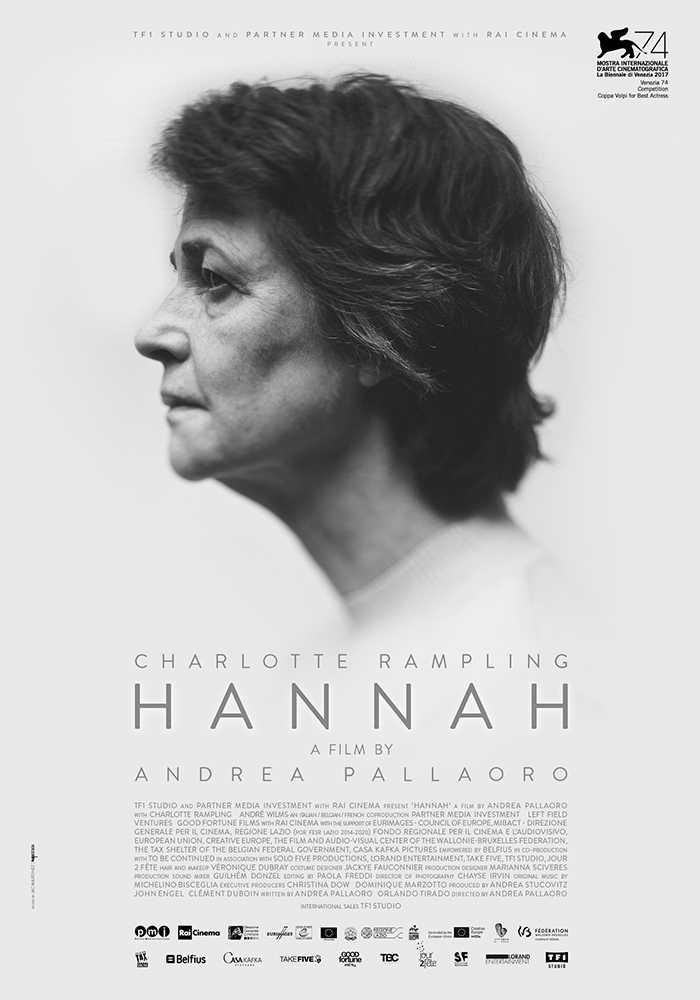
226. Italian/US director Andrea Pallaoro’s film “Hannah” (2017) (Italy/France/Belgium): A film with minimal spoken words and yet providing a subtle, complex and visually informative narrative, aided by an award-winning performance, intelligently captured by the camera


Hannah is the second film of Italian director Andrea Pallaoro—and, according to him, it is the second film of a trilogy of films he is making which appear to be having a common  thread of  a woman  internally reassessing her relationship to her family members over time.  One would often expect a female director to grapple with such subjects but here is a male director getting inside the female mind.  All three films in the trilogy are original scripts, all co-scripted  by him and his friend Orlando Tirado, a team that has worked not only on the trilogy but also on an early short film called Wunderkammer (2008) again on that very theme.

His debut film and the first of the trilogy was Medeas (2013) which won him awards at Venice, Tbilisi, Marrakesh, Nashville, and Palm Spring international film festivals.  His cinematographer Canadian/American Chayse Irvin won the prestigious Cameraimage cinematography prize and a Special Jury prize at the Nashville film festival for his contribution in Medeas. Pallaoro’s direction of Colombian actress Catalina Sandino Moreno won her an acting award at Nashville. The third film has the title Monica and is under production.

Hannah (Rampling) alone and sad riding a public bus,
reflecting on her predicament

With an interesting recognition of his debut feature film Medeas, it is not surprising that Pallaoro’s second feature film Hannah almost replicates some of the remarkable achievements of his debut film.  Hannah’s lead actress Charlotte Rampling won the deserving Best Actress Award at the Venice film festival. Once again, cinematographer Canadian/American Chayse Irvin won an award for his work in another Pallaoro film, this time a Silver Hugo for Hannah from the Chicago film festival.  The citation for that honor is very appropriate and insightful and reads as follows:

"Hannah tells the story of a very guarded woman and is itself a guarded film, refusing to spell out the motives or contexts behind a lonely woman's behavior. The images, then, must convey feelings and ideas that the screenplay and character will not. Through meticulous composition, unexpected framing, and a finely calibrated color palette, they do just that."

The color captured by cinematographer Irvin,
for a shot where Hannah is briefly recalling her good times

Bleak, muted colours for an important sequence as Hannah walks to throw
an important incriminating item in the garbage, when apartments
appear to suggest prison cells 


The team of Andrea Pallaoro, Orlando Tirado and Chayse Irvin obviously constitute a talented trio and they are getting well-deserved international recognition. (That Hannah has got a low IMDB user rating is arguably not a fair indicator of its innate quality as good cinema.)

Hannah views a beached whale,
a metaphor of her own life at this juncture

The worth of Hannah as a mature work of cinema is apparent in its ability to unspool its tale by leaving bits and pieces of visuals (sometimes as understated reflected images) and few spoken words (sometimes of people you never see but only hear) peppered across the film. An aging husband is preparing to be incarcerated in a prison for unstated crimes, leaving behind a devoted and elderly wife, in an apartment where their only other companion is a pet dog.

The obvious questions for many viewers would be what was the crime that led to the prison sentence of an old and seemingly affable man?  Why are the director/ scriptwriters not revealing it up-front for the viewers? Don’t the old couple have any progeny? When they do not speak much or show emotions, what are they thinking?

Pallaoro’s style is very close to Ingmar Bergman’s, with one major difference.  While Bergman would have tended to give considerable emphasis on spoken words in the screenplay, Pallaoro’s and Tirado’s style uses minimal spoken words and emphasizes communication through body language, visual clues, reaction of the title character to strangers and children (such as  Hannah’s sudden decision to stop swimming when children enter the public pool). Both directors use theatre as a secondary element in their film. Theatre rehearsals and mime are important in Pallaoro’s film as well as it is in many Bergman films.

Hannah (Rampling) breaks down in the closet toilet reprising
Bibi Andersson in Bergman's The Touch (1971) 


Hannah is like a mystery film, say an Agatha Christie detective tale, where clues are subtly revealed to the viewer without much dialogue. The viewer is forced to become the detective connecting the dots—mostly visual and a few spoken lines, often by characters that occupy only  fragments of screen time.  An astute viewer will be able to figure out the crime of Hannah’s husband without it being spoken. The viewer learns the aged couple do have a son and grandson.  The grandson wants to meet his grandmother but the son forbids that. The viewer has to figure out the reason by picking up the clues provided in the film. The viewer has to figure out why Hannah does not have any friends or why the film begins with a scream. There have been major films that ended with an anguished scream (Skolimowski’s 1978 film The Shout and Lumet’s 1964 film The Pawnbroker) but Hannah reverses the effect, introducing the viewer to the scream followed a rather quiet film in contrast to it. The scream, of course, is pivotal to understanding the film as is the long purposeful walk towards the end recalling the walk of Eddie Constantine in Godard’s Alphaville. The walk and the end of the walk state more than what Bergman would have achieved with long conversations. That’s the power of Hannah, the film.

On trains and buses, Hannah witnesses cameos of couples who are breaking up:
in one, the female openly accuses the male of only having interest in sex;
a reflection of what Hannah could have been in the past

If there is one film that Hannah could remind you of, it would be the 1971 French film director Pierre Granier-Deferre’s The Chat, another film about an elderly couple (played by Simone Signoret and Jean Gabin) where they hardly speak to each other in their small apartment they share with their cat. (In Hannah, by contrast it’s a dog,)

Hannah's only friend her pet dog--which she gives away to new owners.
Human friendship has been lost, possibly because of her past inactions

When the actors don’t speak much, the acting capabilities are naturally pronounced to the eye. In Hannah, Charlotte Rampling is awesome from the seminal scream captured in close-up to the final silent shot in the metro taken appropriately in a long shot. Her body language speaks a thousand words. Ms Rampling’s works on screen are varied but always stunning. Cavani’s The Night Porter, Visconti’s The Damned, Ozon’s The Swimming Pool, Andrew Haigh’s 45 years are unforgettable films considerably due to her contributions. Age certainly does not wither her, picking up best actress awards from Berlin and Venice within a couple of years, touching the grand age of 70. The scream in Hannah would have won her an award in most festivals.

Hannah is very European in style. While the film is likely to be remembered for Ms Rampling’s performance, the film belongs to the trio of Pallaoro, Tirado and Irvin. Watch out for them; they are indeed talented.

P.S. Pierre Granier-Deferre’s French film The Cat  (1971) discussed in the above review has been reviewed in detail earlier on this blog. That film won the Best Actor and Best Actress awards at the Berlin Film Festival, just as Rampling won for Hannah at the Venice film festival.

Sunday, September 16, 2018

225. British director Peter Brook’s film “Meetings with Remarkable Men” (1979) (UK): George Gurdjieff’s philosophical quest for life's answers presented on screen using snakes, sandstorms, and musical competitions conducted on open hillsides as metaphors.


“When I realized that (ancient wisdom)... had been handed down...from generation to generation for thousands of years, and yet had reached our day almost unchanged...I...regretted having begun too late to give the legends of antiquity the immense significance that I now understand that they really have” --- George Ivanovich Gurdjieff  (www.ggurdjieff.com)  (1876/7-1949)

Director Peter Brook’s film is an adaptation of George Ivanovich Gurdjieff’s multi-volume book of the same name Meetings with Remarkable Men, specifically focussing on the second volume . For those who have not come across the author of the book, Gurdjieff was a spiritual teacher, originally from Armenia, born to a Christian family, exposed to a “multi-ethnic, multi-confessional” population that respected mystics and holy men. In a life seeking philosophical quest for answers, Gurdjieff travelled to several parts of Central Asia, Egypt, India, Tibet and Italy. His significant interactions were with dervishes, fakirs, the Yazidis (of Iraq and Syria who bore the brunt of the ISIS onslaught in recent times) and finally with the Surmoung Brotherhood, which in turn was influenced by the Naqshbandi Sufi tradition of Islam. Gurdjieff propounded “the Fourth Way” blending the fakir, the monk and the yogi. Various intellectuals, such as P D Ouspensky, artist Alexandre de Salzmann, photographer Rene Zuber, writer/philosopher Colin Wilson, editor Alfred Orage (The New Age), mathematician John Bennett and the eminent New Zealander short-story writer Katherine Mansfield  found solace in his distilled knowledge. His funeral took place in the Russian Orthodox Cathedral in Paris and is buried there.

Peter Brook made the film after he was approached by Jeanne de Salzmann (wife of artist Alexandre de Salzmann, and mother of one of the six Gurdjieff offspring) and there is evidence that Brook himself is a follower of Gurdjieff.   Brook and his production manager Jean Claude Lubtchansky chose to film in Afghanistan before Taliban and other fundamentalist force crippled it. The result is an interesting product that promotes Gurdjieff’s writings and his life’s quest for spiritual wisdom.

Now Peter Brook may not be a major filmmaker comparable to the likes of Tarkovsky, Malick or Welles but he is awesome as a director dealing with dramatic situations, possibly because of his extensive experience with British stage theatre and handling major stage actors. This comes through in spurts throughout his film Meetings with Remarkable Men with some fascinating sequences that unfortunately seem disconnected in time but appear as beads of an unusual necklace.

A strange musical competition on the hills of  Central Asia,
where the judge is not a human being but the hills around the venue


Who are the remarkable men? One could be Gurdjieff’s father who wishes his son could become a Christian priest, but young Gurdjieff expresses interest in science. His father counsels him to study medicine as “body and soul depend on one another.”  He even sagaciously advises “Become yourself—then God and Devil don’t matter” A snake is found indoors and Gurdjieff’s father asks his scared son to buckle up courage and to pick it up, which he does. Those familiar with Christian and Jewish religious texts will see the connection of the snake and the Devil; others might not. Anecdotes like this, pepper the film.  For those inclined towards philosophy, this film is indeed an important film—not for others. It all distils into a single quest for Gurdjieff—“I want to know why I am here.

An early episode in the film has young witnessing a competition of musicians with only one winner being able to get the hilly environs to respond unlike others with echoes that defeat logic. But music does become important to Gurdjieff as he grows up and encounters sages and religious personalities of varied hues across Central Asia, Iran, Egypt, India, and the Gobi Desert.  The Sufi dances and chants are indeed uplifting for any viewer (provided by Laurence Rosenthal adapting the compositions of Thomas de Hartmann, a student of Gurdjieff).


Sufi dances and music (composed by de Hartmann,
adapted by Rosenthal)

Not all of the film is heavy spirituality and metaphysics. Consider this interesting truism spoken by Gurdjieff partly in jest to a young friend intending to be a priest “My father used to say, if you want to lose your faith, make friends with a priest.

There are sequences in the film that provoke the viewer to sift belief in religion from sham—such as the Yazidi child who seems imprisoned in a chalk circle with an invisible cage above it. It takes a rationalist Gurdjieff to erase a section of the circle and child walks out free of the imaginary bars. In another sequence, a village population is unnerved when they find a dead man who they thought was dead and buried, lying on a cot in the centre of the village. A village elder emerges, slits the throat of the dead body, and the village population is subsequently shown relieved and happy.  Is the village elder, one of the remarkable men in Gurdjieff’s life?


What the film does definitely indicates as remarkable men include the Prince Lubovedsky (Terrence Stamp), dervishes, a certain Father Giovanni, and a spiritual stranger who tells the Prince in the company of Gurdjieff “I advise you to die, consciously, of the life you led up to now and go where I shall indicate.” Gurdjieff does interact again with the Prince much later in time who by then has apparently found his spiritual answers in a secluded monastery with Sufi life-styles, dances, and strict regimen.

Brook’s film includes a sandstorm from which Gurdjieff and his friends survive by standing on stilts while animals and all life forms below their feet are swept away.  More than a sandstorm it is a metaphor for a contemplative viewer to absorb all the rich symbols in the film. Towards the end of the film, there is a risky high-elevation bridge crossing—another metaphor captured by Brook with some theatrical elan.

Mind games: A risky high-elevation rope-bridge crossing by Gurdjieff
(Dragan Maksimovic), with no barriers of support on the sides


A character called Father Giovanni (played by Tom Fleming, who had played a similar priest in the 1971 film Mary, Queen of Scots) counsels Gurdjieff thus “Faith cannot be given to me. Faith is not the result of thinking. It comes with direct knowledge. Thinking and knowing are quite different.”

For Brook and for Gurdjieff, remarkable men are quite diverse. Some are obvious, some are not. It is quite possible for viewers of Brook’s Meetings with Remarkable Men to wonder in retrospect, who the remarkable men could have been.  For this critic, they were all remarkable: a musician who could make hills respond, a village chieftain who could slit the throat of a dead man and a stranger who knew intimate facts of a Prince’s life.  A strange film with a stranger central figure.  Yet, a rewarding viewing for a reflective viewer.


P.S. The author saw the film at the 1980 Bangalore Filmotsav sitting next to the legendary former Indian Cricket Team Captain, the late Nawab of Pataudi, Jr (Mansour Ali Khan Pataudi), who to the best of the author’s knowledge only watched this particular film at the festival and apparently had prior knowledge of the subject of the film, having travelled from New Delhi to far away Bengaluru (former Bangalore). The author attended a lecture by Mr Brook on his views on theatre given to a select audience in Delhi in 1981, which resulted in a long article by the author, published in The Hindustan Times. The film Meetings with Remarkable Men competed at the 1979 Berlin Film Festival but did not win any award.


Saturday, July 28, 2018

224. Indian director Rahul Jain’s debut, long-documentary film “Machines” (2016): Hard-hitting and real perspective of modern India


India produces some of the world’s most attractive textiles that contribute to making lives in India and elsewhere colourful and comfortable-- whether it be the clothes one wears or the cloth-based furnishings in one’s dwellings. Few realize the oppressive conditions in which textile printing workers in India toil to make the lives of billions of diverse people across the world happy and content. Machines and human beings together contribute to those lovely printed textiles. The contribution of human beings in the process is rarely in the limelight. Toiling within dingy factories, these human beings gradually become dehumanized and mechanical in their actions in their sheer desperation to earn a regular income to keep themselves afloat above the abject line of hunger and poverty. They become machines not out of choice but more from a lack of choice.

Film director Rahul Jain’s honest perspective is not focussed on the machines that manufacture and print the textiles but more on the faceless tens of thousands of workers, exploited and dehumanized to work like machines for extended work hours, deprived of basic rights of hygiene, medical safety, statutory limitations of working hours and legal age and, of course, fair compensation for their time and toil. The film Machines underscores the no-win situation of migrant workers within India caught between poverty and survival, in the clutches of heartless contractors and factory owners, who spin profits for themselves sitting in contrasting distant cosy comfort.


Cinematography ( Rodrigo Villanueva) picked up two
important international awards

Machines has won several accolades worldwide.  Apart from winning the Golden Eye award at the Zurich Film Festival in 2017 for the Best International Documentary Film, it picked up the cinematography award at the Sundance film festival, the Silver Gateway award at the Mumbai film festival, the best cinematography award of the International Documentary Association and three awards/prizes at the Thessaloniki documentary festival.   What is it that makes Machines tick?


Diegetic sound recorded and mixed by the Indo-German crew
is laudable

Machines could have been made in diverse ways.  Mr Jain could have opted to make a film contrasting machines and human beings with music matching the visuals on the lines of the Dutch maestro Bert Haanstra’s 11-minute Oscar-winning wordless sublime film Glass (1958) on the Dutch glass factories. Jain’s film consciously does not use music—his attempt was not to capture the beauty, but the sweat and grime of the workers much in contrast with the workers in Europe. Machines could have been made without words to mirror the French director Louis Malle’s Humain, Trop Humain (Human, all too human) (1974), which is roughly the same length as Machines. That French film looked at the Citroen automobile factories in France and compared the human workers with the machines on the assembly line without words spoken except for brief pitches of the sales staff selling the cars.  There are commonalities between Jain’s and Malle’s film: same length, human workers who appear and work like machines, and no music. The big difference in Machines compared to the two European filmmakers is that the punch of the Indian film comes from the honest spoken lines of the workers captured by the camera replacing the silence of the European works. Malle probably thought that he conveyed a lot by choosing as the title of his film to be same as Nietzche’s last book which appeared to revise all his earlier written works. But little did Malle realize that all filmgoers need not be as well read as he was to make the bigger connection beyond what was obvious within the film’s visuals and sounds of the factory.

Spoken words matter in the film

Words when spoken in Machines sock you on the jaw. The workers have fled their villages because incomes from crops are undependable compared to grimy, sleep-deprived, and low-paid work that in sharp contrast can be depended on as steady income.   It is steady as long as you don’t upset the apple cart by protesting the raw deal meted out by the contractors and the factory owners.
 
The few spoken words are stronger than the visuals. The workers state they have never seen the factory’s owners—but the owners watch them on closed circuit TV in comfortable offices.  The workers can’t afford to buy cigarettes and instead ingest the cheaper semi-dry mix of raw tobacco and slaked lime locally called khaini while the factory owner ironically justifies the low wages as being more than double of what it was 10 years before, especially when workers were comparatively more committed to their work than today, casting a blind eye to the rising costs of living. (Khaini is proven to be injurious to health as much as it is to work with chemicals and dyes without adequate physical protection.) Equally disturbing is the logic of a teenage boy (it is illegal for children to work in factories in India) who claims that working at his age would develop him into a superior and sharper worker when he grows up compared to others who didn’t have his experience.  Or of another boy who reaches the gates of the factory each day and wishes soon after entering it that he could run out of the factory from another gate but chooses not to. More disturbing are the statements of a worker that any potential unionist seeking better compensation and hygienic conditions would be knocked off, while fearfully looking over his shoulder if someone heard him make that statement.

A factory worker reminiscent of a
Thomas Hardy novel

The critical decision that goes in the favour of Machines is that the spoken words are not preceded by questions.  Questions don’t matter.  Those have to be imagined.  When the workers do ask inconvenient questions of the filmmakers, the answers too are not heard.  The film as the finished product is the answer.  The brief silence before the end credits is loud and punchy.

After hard labour, a brief nap in the factory


The crucial bit beyond making of the film was revealed by the young talented director—the film having won all the global awards is yet to be widely seen within India because it is awaiting a Censor Certificate from the Government.  Few can deal with truth, fewer with injustice. Economic growth for those who matter is the mantra of the day. If the film is indeed seen widely, the question asked by the workers at the end of the film would be answered. Nietzsche could be smiling in his grave.


P.S. Director Rahul Jain, who grew up near a family owned small textile mill in India  and studied in the US will soon be teaching at a prominent US University and hopefully continue to make hard hitting films. Terrence Malick used to teach at MIT. Both wear similar hats.

Sunday, July 15, 2018

223. Japanese director Hirokazu Kore-eda’s 12th feature film “Sandome no satsujin” (The Third Murder) (2017): An amazing script and film less about a murder but more about why murders are committed and what is truth, presented by re-working the Rashomon principle.


M
ore than half a century ago the Japanese maestro Akira Kurosawa made a classic film Rashomon (1950) about a samurai’s death and the rape of the samurai’s wife.  Different versions of what transpired are narrated by different characters. Each version made the viewer ponder over which version indeed was the truth and why each personality concocted their own twisted perspective of the truth. Many filmgoers would be convinced the tale belonged to director Kurosawa but Kurosawa had merely adapted a tale written by the “father of the Japanese short story”—Ryunosuke Akutagawa for the screen, with considerable help from Kurosawa’s trusted scriptwriter Shinobu Hashimoto, who contributed significantly to six of Kurosawa’s most famous works, including the original story of Kurosawa’s Ikiru (1952).

Nearly seven decades later, another Japanese director gives us a more complex film on similar lines to unravel the truth about a killing—with a major difference.  Unlike Kurosawa’s famous film that stood on the shoulders of a famous literary work, Hirokazu Kore-eda’s The Third Murder is based on Kore-eda’s own original tale and an evolved concept of filming.  The basic difference between the two outstanding Japanese directors is just that Kore-eda does not require the help of another co-scriptwriter and (with one exception) someone else’s story to make a film. He writes, edits, and even sometimes produces his own films—akin to the credentials of the late Italian director Ermanno Olmi, as in the case of his awesome The Tree of Wooden Clogs.


There are aspects of The Third Murder that can take a cinephile by surprise. First, the film shows a murder upfront. The viewer is shown the murderer and the victim.  Everything seems to be in place. The murderer is arrested and has apparently confessed to the crime, his third “murder.” A death sentence appears to be inevitable  As the film progresses, the motive, the event, and the players involved in the crime become fuzzy and less clear-cut as compared to the early part of the film. Why does the director/writer do that? Kore-eda reverses the conventional accepted narrative--the late Argentine director Fabian Bielinsky did achieve something similar in The Aura (2005).

The defence lawyer Shigemori (Masaharu Fukuyama) (left)
meets his client Misumi (Koji Yakusho) (right) in prison
separated by glass

Some key lines spoken in the film are all laden with food for thought for any astute viewer of The Third Murder:
  1.    Some people in this world should never have been born”—stated by the ‘murderer’ Misumi  (Koji Yakusho)
  2.     Our legal strategy is the truth”—stated by the idealistic defence lawyer Shigemori (Masaharu Fukuyama) and son of the very judge who had spared Misumi from a death sentence taking into account the murderer’s social and economic background and instead sent him to 30 years in prison
  3.    I am the one who should get judged”—stated by the murdered man’s daughter, Sakie (Suzu Hirose), school-girl, sexually molested by her father, who had gotten rich by intentionally mis-labelling the food product he sold
  4.   People’s lives get decided for them” —stated by the ‘murderer’ Misumi       
  5.  “He is an empty vessel”—lawyer Shigemori’s father and former judge view of the ‘murderer’ Misumi “Are you just a vessel?” —asked by lawyer Shigemori to his client the ‘murderer’ Misumi as his appreciation for Misumi grows, “What is a vessel?” –rhetorical question from the ‘murderer’ Misumi

Sakie (the murdered man's daughter) (Suzu Hiroze) notices the fake labelling
on her father's products

Let’s re-examine the above five quotes from the film.

Some people in this world should never have been born.” That statement could easily be applicable for a triple murderer.  In The Third Murder, the line is spoken by the murderer. He is referring to other types of low-life more despicable than murderers—fathers who rape their daughters, loan-sharks who lend money to the needy, women who pay money to have their husbands eliminated and live off the insurance money, businessmen who make money by intentionally mislabelling the product. But in case one thinks a murderer is indeed the more despicable person who should not have been born—do we study why the murder has happened? Was the murderer dispensing justice when there was none else to do so in the present society? Is the legal system perpetrating the third murder of the ‘murderer’ Misumi by sentencing him to death?  Or is Misumi or any economically deprived individual wishing he was never born in an unjust world where he cannot look after his own daughter for 30 years while he was incarcerated?


Our legal strategy is the truth.” The defence lawyer Shigemori believes that he can win cases by uncovering and presenting the truth. The film begins with Shigemori wanting to save his client from a death sentence by uncovering the truth. He first persuades his client to write a letter of apology to his victim’s family, which he does. Soon it is found out that the victim’s wife paid the murderer a large sum of money via a bank transfer in an incriminating email. Did Misumi kill for money? Did Misumi kill to avenge the violation of his victim’s daughter, who was as handicapped as his own? Was it murder for theft or a theft after murder? Was there someone else physically present during the murder? Any of these scenarios could save Misumi from the inevitable death penalty. He tells his lawyer that he is not guilty but refuses to say that in court as he possibly wants to protect his victim’s daughter. Is Misumi accepting a death sentence to protect someone?

Lawyer and client, after the verdict

I am the one who should get judged.” That’s a statement from the victim’s daughter, Sakie, an individual viewed by all as an indirect victim. Kore-eda even provides shots of blood on her face. The role of Sakie and her mother, remain open-ended and never fully revealed. As cinema evolves there is less spoon feeding of the viewer--the viewer has to join the dots.

The site of the opening murder sequence appears to be marked
by a visual cross marking where the charred murdered body lay 


The birds killed by Misumi are metaphorically
buried with a cross

People’s lives get decided for them.”  Kore-eda introduces the birds and the empty birdcage for metaphoric purpose.  Misumi had a lot of birds in his birdcage within his rented flat taken after his release from prison.  He killed all of them except one and buried the dead ones in a grave marked with a cross. He gave freedom to one bird and was hoping that the released bird would return to his cell window. Kore-eda appears to be indirectly questioning the existence of the theological “free will.”

Misumi hopes that the bird he released will return to his 
outstretched palm stuck out of  his prison window to eat the grains he is offering 


The obvious and enigmatic visual cross marks the position of the lawyer on the road
looking upwards--there is not an iota of religious matter spoken in the entire film


“Are you just a vessel?” The good defence lawyer is shaken by the client’s statements and actions. His client is gifted.  By bringing their palms together, with thick glass separating them, Misumi can find out that his lawyer has a daughter with whom he has not met.  The lawyer realizes that his client has much that deserves respect rather face execution.  Is he a vessel to teach us higher values than legal ones? Kore-eda’s film suggests many profound ideas without appearing to be ham-handed.

The lawyer Shigemuri meets up with his daughter,
whom he has neglected, after separating from his wife,
 in a restaurant


The Third Murder is an incredibly well-crafted tale seeking to divulge the truth but the viewer gets to realize how fuzzy and complicated the truth is—in a modern Rashomon twist. Kore-eda’s writing craft may be missed by many casual viewers.  The “murderer” Misumi has a daughter with a bad leg who he could not take care of during the 30 years he spent in jail. The murdered man also has a daughter with a bad leg. Finally, the defence lawyer Shigemori also has a daughter (with no deformities) but also lacking a caring father, as he is more interested in his career than in her after he has separated from her mother.  The visuals of  interaction between the prisoner and lawyer that are edited delectably and the music add to the quality of the strong screenplay, acting, and direction. Fascinating stuff, Mr Kore-eda! One of best Japanese films in recent years. 

P.S. The two films referred to within the above review--Olmi's The Tree of Wooden Clogs (1978) and Bielinsky's The Aura (2005)--have been reviewed earlier on this blog. The film The Third Murder won six awards at the Japanese Academy in 2018, including awards for the best film, the best direction, the best screenplay and the best editing. The Third Murder is now included among the author's top 100 films ever made and the author's 15 most important films of the 21st century.


Tuesday, May 15, 2018

222. Russian director Andrei Konchalovsky’s US film “Shy People” (1987): An original story/screenplay by the film’s director with notable performances and cinematography, all worthy of greater recognition than bestowed


To appreciate the nuanced merits of Shy People, the viewer would be better advised to know a bit about its Russian director and story-writer Andrei Konchalovsky. 

First, Konchalovsky is equally renowned as an original scriptwriter as he is as a director. Few are aware that Konchalovsky and Andrei Tarkovsky (who is now accepted worldwide as a cinematic maestro) were classmates in film school. Fewer are aware that three of Tarkovsky’s films (Tarkovsky’s diploma film made for his film school and two later celebrated feature films Andrei Rublyev and Ivan’s Childhood) were coscripted by Konchalovsky. Both these Russian directors are equally well-versed in Christian theology, a fact that most viewers not sufficiently exposed to that aspect will miss out on, in almost all their works. Konchalovsky, more than Tarkovsky, is more exposed and devoted to great writers (playwrights Chekov, Turgenev, Pushkin, Shakespeare and contemporary ones such as Tom Kempinsky, and novelist Dostoyevsky) and scripts and writings of the Japanese master filmmaker Akira Kurosawa (The Runaway Train) as is evident from his cinematic and dramatic output.  His interests and knowledge are staggering—music, sociology, politics, to mention a few but often Russia-centric.

Drugs and sex: the young girl from Manhattan, Grace (Martha Plimpton) woos
her "jailed" cousin Tommy (John Philbin)

There are three phases in his career—his pre-US output in film and theatre within Russia, his short-lived US career, and his current post-US work on his return to his native land. By any evaluation, his career in USA had its highs and its lows. Shy People is one of the three remarkable films made in this period, the other two being The Runaway Train and Maria’s Lovers. The weaker works of this period included the film version of Kempinsky’s play Duet for One, Homer and Eddie and the very commercial Tango and Cash (which Konchalovsky did not write but merely co-directed under intense interference by studio executives). A major contributing factor for the low popularity of Shy People was the demise of the Cannon film company, which coincided with that film’s completion and release. Shy People, after winning the Best Actress Award at Cannes, suffered a limited release within USA and no Oscar nomination. This is in sharp contrast with the success of The Runaway Train (a film that won a Golden Globe for Jon Voight as Best Actor and three Oscar nominations, and a nomination at Cannes), Duet for One (a Golden Globe nomination for actress Julie Andrews), and Homer and Eddie (winner of the best film award at the San Sebastian International Film festival). Thus even the bad films of the uneven US period actually resulted in critical recognition, with the exception of Tango and Cash.

The post-US phase that began in 1991 has resulted in higher international acclaim for Konchalovsky.  Two of his films in this phase (The Postman’s White Nights and Paradise) have won the Best Director award and a third (House of Fools) a Grand Jury Prize at the Venice film festival.

A prison within a house, created by a mother for a son Tommy (John Philbin),
while his mentally challenged brother Paul (Pruitt Taylor Vince) is free to roam 

Thus, Shy People, which was to be his final film of his US phase, uncannily anticipates his eventual return to Russia, because there are several elements in the film that are very Russian for a keen observer. What is Russian in Shy People, one might ask? If you knew the basic information on the director and a little bit of Stalin’s Russia, the huge portrait in the living room of the Sullivans has an unmistakable resemblance to Joseph Stalin. Joseph and Joe (the film’s character) are other hints.  The fictional character of Joe closely resembles the famed brutality of the Russian dictator. The isolation of the fictional Louisiana family in the bayou devoid of friends and technological progress complete with a prison within the compound of the house would bring back memories of Stalinist Soviet Union with its penal colonies in Serbia. A Konchalovsky devotee who has seen his much later work The Postman’s White Nights (2014) made in the post-Stalinist, post-Glasnost Russia that reprises the lonely and sometimes scary boat rides of the Louisiana bayou after a 30-year gap will wonder at how his mind was focused on life in his homeland while he filmed in USA and how he transposes the filmed imagery in USA to modern Russia.  The basic statement in both films remain the same—some people live in a time warp removed from scientific progress rubbing shoulders with good people and bad people, essentially carbon copies in both countries. Both films give a lot of importance to memories, metaphorically presented as photographs of the past—the 2014 film begins with such a sequence, while Shy People includes it in the middle. In Shy People there are townsfolk in smaller US towns living in awe of color TV programs, while in The Postman’s White Nights there are isolated rural communities, the inhabitants of which are ironically penalized for fishing in their nearby waterbodies while influential military personnel can do that without restraint and Russia continues to send vehicles into space in a facility not far removed from them.

  Barabara Hershey as Ruth (left) and Jill Clayburgh as Diana (right) are cousins
meeting for the first time. The jewelry, hats, clothes and demenor are
contrasting. Looking on is Ruth's mentally challenged son Paul (Vince).


Shy People is a lovely essay on family relationships contrasting the stronger binding forces in rural, isolated communities to the weaker, cosmopolitan urban communities—here Louisiana’s bayou versus the freedom of the upper crust living in Manhattan in New York. Two mothers are contrasted from the two different represented geographies, both dealing with wayward offspring.  One mother is religious and indirectly quotes a passage from the Bible’s book of Revelations on being “lukewarm and not being hot or cold.” There is no mention of religion in the spoken passage, but the director is able put it in context by adding the end-quote at the end of the film, soon after the urban mother decides to be “hot” (taking assertive control) about influencing her wayward but intelligent daughter on the flight back home to New York

The end-quote appearing in the night sky through the
aircraft window on the return flight

  “I know thy work, and thou art neither cold nor hot; I would thou wert cold or hot. So then because thou art lukewarm, and neither cold nor hot, I will spew thee out of my mouth” Revelations 3: 15-16
The choice of names by scriptwriter Konchalovsky seems to be deliberate and alludes to Biblical characters, e.g., Ruth in the film and the Bible, while Diana is very Greek and non-Biblical. The three sons of Ruth have Biblical names. Both Tarkovsky and Konchalovsky reflect their spiritual beliefs in their films, often deliberately.

For those who are familiar with Russian films, the importance of the bonding between mother and her offspring recurs with poetic flourish in Aleksandr Sokurov’s masterpiece Mother and Son (1997) and way back in the silent era with Vsevolod Pudovkin’s Mother (1926). Sokurov explored connected subjects—grandmother and grandson in Aleksandra (2007) and father and son in Father and Son (2003). A recent Cannes award-winning film Closeness (2017) deals with the reverse—the bonding between a daughter and her parents.


A casual viewer of Shy People is likely to dismiss the film for being unrealistic—which it is, in some ways. Can a writer of Cosmopolitan magazine throw her weight around in a small town in Louisiana and influence the local police? Can a woman injure a man in public with a gun wound and get away with it? Is it a ghost story or is it not?

Repeated viewings of the film will reveal the depths of the film and magical combination of inspired acting (Barbara Hershey and Jill Clayburgh, in particular), the cinematography of Chris Menges, the art direction/production design of Leslie McDonald, the music of Tangerine Dream,  and the director’s script. This is a masterpiece of American cinema, crying to be discovered and acknowledged as such and definitely a Konchalovsky gem ranking alongside his The Runaway Train made two years earlier.

.

P.S. Shy People is one of the author’s top 100 films. It won the best actress award for Barbara Hershey at the Cannes Film Festival. Several films mentioned in the above review, the US film The Runaway Train (1985) and the Russian films The Postman’s White Nights (2014) and Paradise (2016) have been reviewed earlier on this blog. (Click on the name of the film in this post-script for a quick access to those reviews on this blog.) Thankfully, the film has been uploaded on Youtube by a kind soul making it available for wider viewing.