Sunday, February 09, 2014

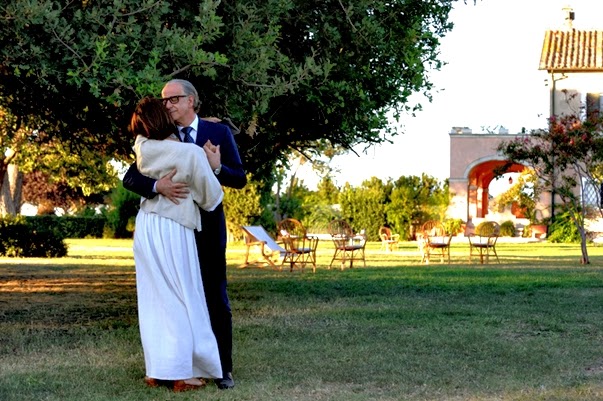
160. Italian director Paolo Sorrentino’s “La Grande Bellezza” (The Great Beauty) (2013) (Italy): “Combining the sacred and the profane” according to Sorrentino (on its music, and perhaps much else)


Paolo Sorrentino’s The Great Beauty has two small yet important facets in common with Terrence Malick’s The Tree of Life. Both films begin with a profound quote that provides a key to the viewer for a full understanding of the film that follows. Both films use the music of “Dies Irae” (Requiem for my Friend, which includes Lacrimosa 2) by Zbigniew Preisner (the talented composer of Kieslowski’s Dekalog and The Three Colors trilogy) and Henryk Gorecki’s 3rd Symphony.

Just as Mallick used an interesting quote from the Book of Job, the opening quote for The Great Beauty is from Sorrentino’s favorite author Louis-Ferdinand Céline's Journey to the End of the Night. 

The quote is To travel is very useful, it makes the imagination work, the rest is just delusion and pain. Our journey is entirely imaginary, which is its strength.” 

The ‘travel’ in The Great Beauty is the figurative journey of Jep Gambardella, a journalist who at the age of 20 wrote a novel that made him a celebrity and propelled him into a cosmic trajectory of Rome’s high-life filled with the glitterati and the cognoscenti for the next 45 years without having to write another novel of substance. And he is celebrating his 65th birthday, early in the film, with a birthday bash that many of us, including the Beatles, who sang When I am 64, would dream of enjoying.

There is “imagination” of the successful journalist Jep that Sorrentino introduces us, the viewers, for the first time, smiling at the camera, a lit cigarette dangling precariously between his teeth, dressed in fine clothes cut to perfection by the best outfitters, in the midst of cavorting men and women with loud music playing somewhere on a terrace of a building in the center of Rome. Jep has it all--the women, the reputation, the money, the circle of friends, and a lovely apartment near the Colosseum.  To anyone who is familiar with Rome—that is the best address one could dream of.

Jep (Toni Servillo), the misanthrope, smiling while surrounded by people

For those who have seen Sorrentino’s earlier works The Consequence of Love and This Must be the Place, the director and his regular cinematographer Luca Bigazzi, the central figures of the two movies are always shying away from people and a figurative distance is intentionally created on screen by the talented cinematographer between individuals. In The Great Beauty, in contrast, Sorrentino and Bigazzi show the central character Jep surrounded by people in close proximity. Is it a reversal of positions? And yet Jep the central character is alone as in the previous films. In Jep’s own words “I'm not a misogynist, I'm a misanthrope.” He loves women but distrusts or has a disdain for people irrespective of their sex. The visuals are playing a trick on the mind of the viewer. As is the music...but more on that later.

The “delusion and the pain” comes ‘the morning after’—to quote and recall the 1986 Sidney Lumet film with that name. Jep, who is dancing in the evenings, heads home to sleep when the children of the city are waking up to go to school and less privileged workers are cleaning up the neighborhood preparing for the day that is dawning.

The “delusion and the pain” also comes when great art is equated with the bizarre, as in the case of a screaming young girl who is considered a genius of an art form, for her quixotic ability of throwing cans of paint on a massive empty canvas as her fans watch the process of “art creation” with awe and reverence. It is possible that Jep, the journalist, writes about her extraordinary abilities. It is also possible that Jep, the journalist, writes about the naked woman who is considered a major theatre personality who rushes forward like a mad bull towards a stone wall only to butt her head against it with a resounding sound that seems so real, bloody and painful. Sorrentino is indeed underscoring the “delusion and the pain” with humor as he always does, trusting that his film’s viewer would keep Céline's quotation in focus.
Not a misogynist

One of the finest punches of left-handed humorous self-compliments comes from Jep himself: “To this question, as kids, my friends always gave the same answer: "Pussy". Whereas I answered "The smell of old people's houses". The question was "What do you really like the most in life?" I was destined for sensibility. I was destined to become a writer. I was destined to become Jep Gambardella.” There is yet another favorite sequence for this critic. The ladies’ man Jep encounters the famous French actress Fanny Ardant with an unusual hairdo and exclaims “Madame Ardant!” The actress looks at him from head to toe and slowly responds “Bonne nuit!” (Good night!) and walks away with a smile.

But in The Great Beauty, Sorrentino has positioned his lead character Jep as an intellectual searching for beauty in a city that can truly boast of true man-made beauty with its sculptures, its fountains, its legendary buildings, its history, its beautiful women propped up by costly botox injections, its river Tiber, and wait, the incredible neighboring city state of Vatican and with its population of the pious priests, Cardinals and nuns who intermingle with the other Roman friends of Jep. And since Sorrentino is not a gnostic like Malick, Jep interviews a toothless “104-year-old” nun “who lives on roots” (note the layer of humor in that factoid) who seems to have an odd visual resemblance to Mother Teresa but has found time to have read Jep’s famous book and utters pedestrian and inane comments. The agnostic Sorrentino goes a step further when Jep the journalist interacts with a Cardinal, tipped to be the next Pope, who prefers to give a discourse on a cooking recipe rather than matters of theology.

The sacred and the profane

Forget the visuals. Concentrate on the music in The Great Beauty. Sorrentino deliberately chooses to play pieces of music that directors such as Malick and Kieslowski used to lift their audiences to a lofty spiritual level. Then Sorrentino contrasts those moments with loud banal party music when he chooses to provide a contrast of life’s reality apparently noted by Jep during his past 45 years. It is not without meaning that Jep’s close friend asks Jep to find a husband for his daughter in her forties who performs in a strip club. There are several constant connections between the sacred and the profane.

Towards the end of the film Jep states “This is how it always ends. With death. But first there was life, hidden beneath the blah, blah, blah... It's all settled beneath the chitter chatter and the noise, silence and sentiment, emotion and fear. The haggard, inconstant flashes of beauty. And then the wretched squalor and miserable humanity. All buried under the cover of the embarrassment of being in the world, blah, blah, blah... Beyond there is what lies beyond. And I don't deal with what lies beyond. Therefore... let this novel begin. After all... it's just a trick. Yes, it's just a trick.” Probably those are the words of Jep’s second novel yet to be written at the age of 65. Earlier Jep had told the viewer “I was looking for the great beauty, but I didn’t find it.”

Perhaps a true Sorrentino admirer would prefer his lesser known Consequences of Love (2004) which towards its enigmatic end had the words “Sadness descends upon him and he starts to think...” describing the best friend of the protagonist, working at correcting a fault perched high up on an electric pylon, alone, battling biting cold winds.

"Sadness descends upon him and he starts to think.." words from
Consequences of Love

To understand Sorrentino’s The Great Beauty one needs to revert to his favorite writer Céline whose words from the same literary work that opens the film explains it all : “In the whole of your absurd past you discover so much that's absurd, so much deceit and credulity, that it might be a good idea to stop being young this minute, to wait for youth to break away from you and pass you by, to watch it going away, receding in the distance, to see all its vanity, run your hand through the empty space it has left behind, take a last look at it, and then start moving, make sure your youth has really gone, and then calmly, all by yourself, cross to the other side of Time to see what people and things really look like.” Céline has countless admirers and detractors. His detractors call him a fascist, anti-Semitist, and a bigot. Like Sorrentino’s characters, Céline’s fictional characters are constantly facing anxiety and failure.

Without any doubt, both The Tree of Life and The Great Beauty are truly majestic works of cinema: one optimistic, the other misanthropic. Sorrentino is one of finest filmmakers alive in Italy. And like very few other directors he writes his own original screenplays, in this particular case, taking the aid of another screenplay professional, Umberto Contarello. The misanthropy and the negativism that prevails in The Great Beauty are the only reason that this critic found less staggeringly well-made films, such as Still Life (2013) and Tangerines (2013), products of less talented directors than Sorrentino to be offering a whiff of oxygen.


P.S. The Great Beauty is on the author’s list of his top 10 movies of 2013. Two earlier Sorrentino films—Consequences of Love and This Must be the Place--were reviewed earlier on this blog. The films mentioned in this review The Tree of Life, Dekalog,  Three ColorsStill Life and Tangerines were also reviewed earlier on this blogMr Sorrentino is also one of the author's 15 favourite active filmmakers


Sunday, January 26, 2014

159. Georgian film director Zaza Urushadze’s “Mandariinid” (Tangerines) (2013): A Gandhian perspective on contemporary waves of hate, national and religious


The year 2013 has introduced new talents to the forefront in cinema. 

The Georgian film director Zaza Urushadze can hardly be considered to be a known entity in international cinema. Yet Mr Urushadze has written a witty and touching film called Tangerines, which is an adorable, small-budget film that is superior both in content and quality to the much touted and comparatively big budget films from USA and France made in 2013. What is more, two small brilliant films, Uberto Pasolini’s Still Life (2013, UK/Italy) and Urushadze’s Tangerines, reinforce two thumb rules in cinema—one, talented directors can write their own scripts—they don’t need to lean on professional scriptwriters or adapt their screenplays from successful novels or plays--and two, a positive humanistic tale, interestingly told, will grab a viewer in any corner of the world.  Tangerines is a wonderful film that needs to be viewed and appreciated for its direction, acting and screenplay apart from the general knowledge it provides the viewer about the small nation called the autonomous Republic of Abkhazia, on the shores of the Black Sea, complete with a national flag of the republic that declared its independence in 1992.

A viewer of Tangerines will soon be educated about the war that raged in Abkhazia in 1992. Russia supported the breakaway Republic of Abkhazia by sending mercenaries, as the new Republic wanted to separate from the independent Georgia. The mercenaries that one encounters in Tangerines, are Chechen Muslims. The Georgian soldiers fighting the Chechens are Christian. Caught in the crossfire are some Estonian nationals, whose ancestors relocated to Abkhazia in the late 19th century and have come to love Abkhazia over the period they have lived there, and because of the war are considering returning to the Republic of Estonia where their roots belong. Estonia is another Republic but on the shores of the Baltic Sea way up north in Europe, another Republic which also broke away from the Soviet Union.

Reflecting in the light and the shadows on love and hatred

The film Tangerines has an all male cast; it has no sex and no violence. It is not even a war film. Yet, it is a film that would entertain you from start to finish thanks to the intelligent and witty script. It is perhaps best described as a film on a war of hatred among common individuals. It is not surprising that audiences love the film at all the film festivals where it gets shown.

The plot hinges around an elderly Estonian called Ivo (Lembit Ulfsak) who lives alone, in an almost derelict village in Abkhazia.  He has a neighbor Markus (Elmo Nueganen), another Estonian, who has been cultivating tangerines and is now trying to sell a bumper crop of the fruit in the midst of a war to soldiers. Ivo makes wooden crates for Markus to sell his produce. Ivo’s daughter has already returned to Estonia, escaping the war. Evidently, Ivo is reluctant to leave the village where his wife lies buried—the bonds created by passage of time are strong.

Ivo is not the kind of man who would care to be part of either side in the war. He is a humanist. When armed men come to his door with menacing guns, he gladly provides them food when they ask for it.  When one soldier Ahmed (Giorgi Nakasidze) is critically wounded, he gets an Estonian doctor set to return to Estonia to put the soldier, a Muslim Chechen, who was bullying Ivo earlier, on the road to recovery under Ivo's roof.  By a twist of fate, another soldier equally wounded, literally found alive as he was being buried by Ivo after being presumed to be dead, from the opposite camp, a Georgian Christian, is also put on the road to recovery in another room of Ivo’s house. And Ahmed knows that the Georgian in the adjoining room probably killed Ahmed’s buddies.

The film is about the sparks of hatred that fly between the two soldiers.  The two sworn enemy soldiers are kept at bay by their respect and gratitude to their common benefactor, Ivo.

A "war" fought with kindness

Without revealing what happens next in the film, the crucial aspect of the script is the wry humor in the spoken words and body language that makes the viewer forget the Abkhazian war and the conflict of religions. Here, is a film that gets to the core of hatred peeling away layers of mistrust in the company of a well-meaning individual who has no interest in either politics or religion. It is a film that gradually replaces guns with acts of kindness.

Ivo (Lembit Ulfsak) loves Abkhazia and its natural produce

At the end of the movie, the viewer will feel positive about life in spite of all the negative forces that we encounter in life throughout the world if we look beyond Abkhazia. It is a small film about a little, big man called Ivo. Tangerines is a film that transcends petty issues and looks at life positively, a rare gift when film directors today seem to be increasingly more at home with aberrant behavior or violence. Here is a Georgian film that introduces an interesting Estonian actor called Lembit Ulfsak. One wistfully recalls it was Estonia that produced one of the finest actors of the 20th century, Yuri Jarvet, who was picked by both directors Grigori Kozintsev and Andrei Tarkovsky to play key roles in their respective major works. And this work of cinema from Georgia is arguably the best work from that country since Tengiz Abuladze made Repentance way back in 1987.

The citation for Zaza Urushadze’s best director award for Tangerines given by the Warsaw film festival  reads “The director of the film succeeded in telling a simple, yet very powerful story in a manner that created a warm, delicate, sweet and sour world. “ Something like the fruit—tangerines?


P.S. Tangerines is on the author’s list of his top 10 movies of 2013. The film won the best director award at the Warsaw film festival and the audience awards at both the Mannheim-Heidelberg and Warsaw film festivals.  The Georgian film Repentance (1987) was reviewed earlier on this blog.


Monday, January 13, 2014

158. Iranian film director Asghar Farhadi’s French language film “Le passé” (The Past) (2013): Offering the flipside of Farhadi’s ‘A Separation’ with some parallels to Ray’s ‘Charulata’


The title of a movie often provides a vital clue for a viewer to approach and analyze a film.

In Asghar Farhadi’s latest work The Past, there are several pasts on review:  the past life of the Iranian Ahmad (Ali Mostaffa) and his French wife Marie (Bérénice Bejo) now about to sign divorce papers; the past life of Marie who had lived with a gentleman we never see on screen but is currently living in Brussels and is definitely the father of Lucie (Pauline Burlet) and possibly of even of Lea; the past life of Samir (Tahar Rahim) whose wife Celine is in a coma after a botched suicide attempt, and is a husband-in -waiting  for a pregnant Marie after she divorces Ahmad. These pasts are never shown in the film; the viewer has to flesh out these pasts from bits of dialog in the film as it progresses.  The pivotal point for all the three “pasts” revolves around one individual Marie. She is the one seeking a divorce.  She is the one who has two husbands living under one roof, one a man who is going to be her husband and another a husband who is going sign her divorce papers. It is interesting to note that in both the Farhadi films, it is the wife wanting a divorce, though in both films the wife seems to care for the husband in indirect ways and the husband's seemingly stubborn actions seems to have led to the current situation.

The pasts in the film The Past are developed by the screenplay writer/director Farhadi  in multiple ways. The relationship of Marie towards Samir is captured by a stunning remark by Marie’s daughter to Ahmad “You know why she went to that jerk? Because, he reminded her of you.” Both Ahmad and Samir do resemble each other physically. Both are Muslims who married French women. Both seem to want to leave their respective wives at a later point in their lives.

And at a crucial point in the film, the third unseen “past “, that of Samir’s life with Celine, is recaptured briefly in the film using the effect of smell of the perfume Samir wore when he was with Celine.

'Something unresolved when two people fight after 4 years of separation'

In an interesting visual metaphor, Marie’s “house” is under renovation which includes painting to fixing of leaky kitchen sinks. The Past offers a flipside of Farhadi’s earlier work Nader and Simin: A Separation, where a resolute wife was separating from a distraught husband—a film in which two sets of husbands seemed to be in lesser control of their lives than their respective wives. In both films, the Iranian men prefer to stay in Iran.  Interestingly A Separation had the Iranian actress Leila Hatami in the strong and practical wife’s role of a wife seeking a divorce; in The Past, Ms Hatami’s real life husband plays the strong and level headed husband Ahmad agreeing to a divorce. Director Farhadi is mastering the technique of flipping/mirroring roles on film and in reality from film to film.

Glass barriers separate sound and total communication in the opening
sequence of The Past 

The collaboration of Farhadi and Iranian cinematographer Mahmoud Kalari  on the two films has been a major factor in the success of the two movies. The final scene of A Separation has a glass panel that impedes the crucial spoken words of the daughter of divorced parents to the magistrate from reaching the parent’s ears, while the opening scene of The Past has glass panels of the international airport impeding proper aural communication. The end of A Separation suggests the social fracture between husband and wife has been formalized while in the end scene of The Past the social fracture of one couple seems to be healing. Farhadi is deliberately flipping the story and the coin at different levels. In The Past’s opening scene words are not spoken or heard and in the final scene, too, the communication is limited to the visual, the olfactory, and the body language. Farhadi has honed his skills as a director and scriptwriter, improving as he goes along from film to film.

The perfect father and house-husband


In both films, the children or the offspring of the adults born and unborn play pivotal roles during the screen time of the two films in determining the outcomes. Samir’s son Fouad asks his dad an inconvenient question while riding the metro “Where is home?” as he has lived in two homes, one with his real mother Celine and another with his foster-mother-in-waiting, Marie.  Thus, both the Farhadi movies explore the effects of divorce/separation on adults and children of the adults.

Both films are equally tales of lies that leave a deep impact on different sets of marital lives. For an Iranian like Farhadi, the tenets of marriage are important and sacred, while in France even Muslims like Samir (an inference one draws from the names Samir and Fouad) seem to disregard those tenets.

Asghar Farhadi’s cinema really came to fore after he made About Elly (2009) as his earlier work Fireworks Wednesday pales in comparison both in content and in style. For Indian viewers, About Elly is similar to a tale filmed by an Indian director Mrinal Sen adapted from a short story by Ramapada Chowdhury. The Indian film in Hindi film was called Ek din Achanak (One day suddenly) (1989) which competed at the Venice Film Festival some 20 years ago and even received an honorable mention from the jury. Like Elly disappears in About Elly, in Ek din Achanak, a professor and head (played by Dr Shreeram Lagoo) of a family, that included his two daughters and a son, suddenly disappears without explanation or trace. That Mrinal Sen film had also developed a parallel story to that of Farhadi’s script.

Now The Past, yet again, has an end scene that recalls the end scene of yet another Indian film of repute—this time the Bengali  maestro Satyajit Ray’s Charulata (The Lonely Wife) (1965), winner of the Silver Bear for director Ray at the Berlin film Festival. Both films end with the crucial handshake/touching of hands between husband and wife that is deliberately left ambiguous by the respective directors. In both the Indian and the Iranian films, the respective husbands realize their “past” mistakes in their relationships to their respective forsaken wives and try to reaching out to them with their hands in the end scenes. Ray’s Charulata was based on the Nobel laureate Rabindranath Tagore’s tale The Broken Nest.

Despite the uncanny similarities to two famous works of Indian cinema, the increasing mastery of Farhadi’s screenplay writing abilities is nothing but awesome, considering that he achieves these feats alone without the assistance of a co-scriptwriter.  In The Past, Ahmad’s missing bag on arrival at the airport might appear an innocuous detail—it is common occurrence to flyers worldwide. But the missing/broken bag for scriptwriter Farhadi is a prop for developing the narrative of how Ahmad and Samir differ in dealing with kids who are inquisitive about the contents of a bag when they might contain gifts for them and others in the family. The bag also serves as a metaphor for the affection of Ahmad towards Lea (whose biological father’s identity is blurred in the script) at a time when social ties are about to be broken by an impending divorce. It is a baggage of the “past” connections to the family. But during the car ride from airport to Marie’s home when Ahmad brings up a past detail, Marie cuts him off “It’s not important..I don’t want to go back in to the past.” By a contrast, while Marie wants to forget the past, all the three kids yearn to retain past memories (Lucie and Lea of the time with Ahmad, and Fouad of the time with Celine in his earlier home). In all his later films, Farhadi ensures that his final scene in his scripts are enigmatic and open ended ensuring the viewer has to reflect on Farhadi’s work even after the movie is over to understand it properly. That’s cinema for mature audiences.

In comparison to A Separation, Farhadi’s next work The Past, offers a viewer a structured comparison of the western attitudes and Iranian attitudes.  Consider the following discussion between Marie and Ahmad on her relationship with her future husband and father of he unborn child:

  Ahmad: When did you meet each other?
  Marie: In the drugstore. He came to get his wife's medicines.
  [Ahmad sneers]
  Marie: What?
  Ahmad: In our culture, it is laughing.
  Marie: But in our culture, it is mocking!

For those who missed the point, Farhadi is ironically looking at the start of an illegitimate extramarital relationship when a husband is trying to help his own wife recover from an unspecified illness. Farhadi in The Past actually improves on what he had achieved in A Separation by incorporating additional perspectives of cultural differences beyond the effects of lies and the processes of a divorce on varied characters. Several bits of conversation in the film point to Ahmad’s inability to adjust to life in France as the reason that cost his marriage.  But has the marriage really been torn apart?  A detail of the spoken words in the film indicates otherwise.  The gynecologist discussing Marie’s pregnancy states philosophically “In this situation, every certainty is a doubtful!”  Equally loaded is Samir’s comment about Marie and Ahmad: “When two people see each other after 4 years and still fight together, it shows that there is something unresolved between them.”

Marie: a crucial figure in the three "pasts" presented 

Finally, a word about the citation of the award the Ecumenical Jury at Cannes Film Festival bestowed The Past quoted John 8:32 from the Bible “The truth shall set you free.” If one examines the film closely when the lies are exposed, broken marriages begin to heal and reconciliation starts. It is, therefore, surprising that the Oscars, which honored Farhadi’s A Separation, did not even nominate The Past, a more complex but superior work on several fronts including its acting performances, camerawork, screenplay, and direction.


P.S. The film won the Best Actress Award for Bérénice Bejo and the Prize of the Ecumenical Jury at Cannes film festival; the Best Screenplay Award at the Durban film festival, the Best Foreign Language Film of National Board of Review (USA), and the Best Audience Award at Oslo film festival. The film is on the author’s list of his top 10 movies of 2013. Farhadi’s A Separation and About Elly have been reviewed earlier on this blog.


Sunday, January 05, 2014

157. Chilean director Sebastián Sepúlveda’s debut film “Las niñas Quispe” (The Quispe Girls/Sisters Quispe) (2013): Distant drums of politics affecting lives of the isolated denizens


Debut films very often offer interesting cinema as every new director distills his/her individual vision of cinema to a global audience. Sebastián Sepúlveda’s debut film The Quispe Girls is one such example of a director presenting a complex tale with very little dialog, relying more on capturing emotions of faces and body movements set against a breathtaking natural backdrop rarely viewed.

The Quispe Girls is a beautiful film that offers a mix of emotions that film-goers will recall in three distinctly different films, each one a classic of world cinema: the Greek director Mihalis Kakogiannis’ (popularly referred to as Michael Cacoyannis’) The Trojan Women (1971); the Bulgarian classic The Goat Horn (1972) directed by Metodi Andonov; and the little known Iranian classic Water, Wind, Dust (1989) directed by the talented Amir Naderi in Iran before he left to work in USA. The Quispe Girls adopts the tragic political flavor of the Greek film, the atmospherics of the hard lives of goat herds worldwide captured in the Bulgarian film, and the effect of desolate inhospitable terrains on human lives captured by the Iranian film. Therefore, viewing The Quispe Girls is as rich an experience as viewing all the three movies cited above.

The Quispe sisters Lucia. Justa (played by Digna Quispe, a close relative
of the real characters) and Luciana

The importance of The Quispe Girls stems from Sebastián Sepúlveda’s ability to capture the harsh and yet beautiful environment of Chilean Andean ‘altiplano’, the world’s second highest mountain plateau after Tibet, and transpose the conditions as a factor that could have a bearing on the tragic end of three middle aged unmarried women goatherds. The politics of the day (General Pinochet’s dictatorship) also need to be savored as the backdrop to their actions and worldly and existential worries through snatches of conversations between three sisters. It appears that the dictator, partially out of fear of political opponents, partially to conserve the national ecology, and partially to modernize goat husbandry decreed that goats grazing on the altiplano had to be killed as the sparse vegetation was being gradually destroyed. The decree made it impossible for the goatherds to survive in the fringe Chiliean territories while it also reduced the chances of harboring Pinochet’s opponents on the run from hiding in these otherwise remote inhospitable places and make explosives in the guise of mining rocks.

The title of the movie The Quispe Girls relates to three indigenous Chilean women in their thirties who existed and died mysteriously and made headlines in Chile’s print media. There were four Quispe sisters originally and one had already died when the movie begins leaving the viewers of film to merely study the lives of three remaining Quispe sisters Justa, Lucia, and Luciana to make up the narrative of the film. Adding to the mystery of their existence is the fact there are no Quispe men or boys in the tale and no mention is made of their deaths/lives. Where are they? How did they die or disappear?  There are no clues provided.

Possibly to counter this unusual scenario, director Sepúlveda is able to bring additional authenticity to the film by getting a close relative (Digna Quispe) of the real Quispe trio and the last human being to see them alive, to play one of the sisters, Justa, in the film. And just as in Euripides’ play The Trojan Women (written in 415 BC) which was the basis of the Cacoyannis’ film, which discusses Cassandra who had had been raped and subsequently becomes insane. In The Quispe Girls, Justa the eldest of the three Quispe sisters too had been raped at age of 17 and consequently the effect of that distant incident leave the three sisters wary of men even though the youngest sister Luciana yearns for men’s company and wears attractive clothes to attract suitors, real or imaginary. The eldest sister, Justa, chides Luciana by asking her after noticing her wearing an off-white dress “Why are you dressing like that when you are going to make charcoal?” Just as the Cacoyannis’ film was based on the Euripides’ play, Sepulveda’s film The Quispe Girls is the director’s own screenplay adaptation of a Chilean play Las Brutas by Juan Radrigan. As in any play, the spoken words are loaded with meaning and insinuations.

Chile's Andean altiplano in light and shade as captured by the
camera of Inti Briones

Unlike the tale of the Trojan women, the Quispe girls live in a desolate area where they come across men only on rare occasions. In the film there are only two men who interact with the three middle-aged women. One man of the two men is a peddler of clothes and bare essential s and  is identified as Don Javier—who is attracted to Luciana, the youngest sister.  Justa, the eldest sister, notices this and warns the man to stay away from her sister—her rape has made her intensely distrustful of men. The only other interaction in the film of the sister is with another man, a stranger (possibly a Pinochet opponent) named Fernando who is seeking food and directions to flee the country to neighboring Argentina by crossing the altiplano. The sisters help him but tie a quixotic rope with bells close to their makeshift beds to provide an alarm if the man tries to rape or seduce any of them while they sleep.

The remoteness of the location is accentuated by a sister’s statement in the film “There is no one anywhere. They have all gone.” Apparently the only connection with humans was other goat herders, who have apparently left as a consequence of the new “progressive” edict by Pinochet. However, in the film, when Luciana, is found near a rocky spring lying on the ground, apparently sick, the camera captures a group of animals/people leaving in a single file disappearing in the distance. If the people “had all gone” what can one make of a group of people/animals moving in a single file. Do animals move in a single file on their own? The consequent sequence of sickness of Luciana leave a lot of questions unanswered of what really transpired that makes one recall yet another classic film—the Australian film Picnic at Hanging Rock (1975) directed by Peter Weir, based on a novel written by novelist Lady Joan Lindsay, who enigmatically never confirmed or denied that her story was based on or inspired by real events. In The Quispe Girls,  too, it is for the viewer to guess what actually happened and what Sepulveda wishes us to believe happened to the three women at various crucial stages in the tale.

Luciana Quispe (Francisca Gavilán) and the unexplained single file of moving
humans/animals(in the center of the picture) in the distance,
if there is "no one here anyway"

The film is thus an instance of a male director giving us the perspective of lives of three women who seem to survive in a world where men are not to be trusted.  The press kit provided a at the Venice film festival mentions the term “feminist austerity” captured by the film—terms that possibly come close to the mood of the film. From the conversation of the three Quispe girls, we learn that the youngest and the most attractive sister Luciana was ridiculed by townsfolk for her lack of sophistication where they had gone to get their identity cards (shown briefly by the director towards the end of the film). Evidently, they cannot integrate with the more sophisticated townsfolk and there is impending gloom of Pinochet’s forces culling their precious goats leaving them with few options to survive. So far the goat herds survived by selling sheep and goat cheese and living in stone “rucas” or huts the goat herders lived in. The filmmakers state that the ruca shown in the film was the very ‘ruca’ the Quispe sisters lived in towards the end of their lives.

The real ruca (stone hut) in which the Quispe sisters lived is used in the film

Sepúlveda’s film goes a step further to make the film viewing richer.  With the help of two professional actresses playing Lucia and Luciana, as the film progresses the three sisters do begin to look and act alike. The cinematographer Inti Briones and the director uses the dust kicked up by the herd help in this unusual amalgamation of the three characters reminiscent of how Cacoyannis managed to merge the performances of Katherine Hepburn, Irene Papas, Genevieve Bujold and Irene Papas (four distinguished actors from four different countries) to seem like one single woman’s anguished universal cry in the The Trojan Women. The visuals of The Quispe Girls, reminiscent of the sound and visuals of Naderi’s Water, Wind, Dust accentuate the role that hostile nature plays in the actions of human beings. The magical world of goat herders captured in color in The Quispe Girls is as lovely as the lovely black and white images captured in the Bulgarian classic film The Goat Horn.

A strange man named Fernando arrives seeking food, shelter and directions
to the Argentine border

While we enjoy the film’s use of sound and enigmatic visuals of Chile’s altiplano, The Quispe Girls throws a lot of inconvenient questions at the viewers, social, political, and environmental. These questions are not peculiar to Chile in 1974. These questions are globally valid today. It is a very well made film that makes the viewer appreciate the direction, the cinematography, the sound editing, and the acting. Young Sepúlveda has arrived on the center stage of world cinema with a remarkable debut film.

The cinema of Chile has made an impact on the map of world cinema in 2013 with two notable works: The Quispe Girls and Gloria.


P.S. The Quispe Girls is the second best film of 2013 for the author on his list of his top 10 movies of 2013. The film won the Fedora award for best cinematography at the 2013 Venice film festival's critics week. Amir Naderi's film Water, Wind, Dust (1989) has been reviewed earlier on this blog.

Thursday, December 19, 2013

156. Italian filmmaker Uberto Pasolini’s English film “Still Life” (2013) (UK/Italy): Quietly amazing and powerful cinema


It is not often that you come across a film that looks innocuous at its beginning and then develops gradually into a truly uplifting and amazing work of cinema.

Still Life is a tale of a lower-rung British civil servant John May (his name could well have been John Doe in the US or Joe Bloggs in the UK ), unmarried and yet married to his job with a diligence that makes our own attitudes to work in offices (and homes) look a tad unprofessional in comparison.  The name John May sounds as colorless as is the individual that the director and original screenplay writer Uberto Pasolini gets actor Eddie Marsan to play. The incredible character is a lonely chap working in a small office in UK all alone with files all neatly stacked just as neat and orderly is his small desk with a phone.  And Marsan and Pasolini get around to develop such a colorless individual that some unsuspecting viewers of the movie assumed that the film would be as drab as the character and were seen walking out of the film halfway misled by its quiet beginning. And what a lovely film they missed out on!

Marsan is able to slip into the role of the loner, who ensures that all lonely individuals who die in his official jurisdiction get a proper burial after taking great pains to locate any possible kith and kin to attend the funeral, by either calling up people on the phone or ever visiting addresses he finds in the deceased’s residence. (Marsan had earlier played minor but important roles in Scorsese’s The Gangs of New York,   Iñárritu's 21 Grams and Malick’s The New World.). Marsan, who never smiles in the film, does smile once in the film and what an occasion that is!

Eddie Marsan as John May: Discovering color in "colorless" lives

When May returns to his apartment from work, the viewer is presented a neat and orderly place with the bare essentials, and one even gets to see him eating a meager meal of toast and canned fish. And we also learn that he has been repeating this for the past 20 odd years, and believe it or not, enjoying both his work and his spartan meals.

However, the director Pasolini leaves a crumb trail for the perceptive viewers.That trail, which looks innocuous, is only building up to something unusual, as intelligent viewers would expect. And that Pasolini does deliver at the end of the film, and it's a finale that would make you revisit the earlier scenes with your mind’s eye afresh and enjoy it all over again.

The existential query of a diligent bureaucrat

Who is Pasolini? He is no relation of the famous filmmaker Pier Paolo Pasolini.  Interestingly, he is a descendant of famous Italian  director Luchino Visconti and is a real life Count, if Wikipedia, is to be believed, and he has worked his way up the movie ladder after being the third Assistant Director for Rolland Joffe’s  The Mission (1986), the producer of The Full Monty (1997) and director of Machan (2008), his debut film that picked up a few minor awards worldwide.

Pasolini in Still Life makes visual statements that border on the comical but is never funny in the conventional sense of fun. These statements are thought provoking and real.  Early in the film, the viewer sees empty churches of various Christian denominations where the priest solemnly conducts a brief funeral service and even reads out a few words of praise about the deceased. We subsequently learn that those words spoken by the priest are actually provided by May after painstakingly going through the deceased’s living quarters like a detective and speaking to people who knew the person when he or she was alive.  Mr May is often the only individual present at each of these funerals.  But May ensures that the dead do get a fitting funeral at the cost of the town's exchequer.

The person sitting behind me in the movie hall was heard commenting: “Look at the empty churches,” mistakenly assuming the visual commentary of the director was on religion. But Still Life is not a film about religion but about old age and the lack of friends and family in the evening of our lives. Even when John May contacts the deceased's  relatives and friends they rarely bother to attend the funeral. It is a film that looks at relationships both in life and upon death. It is a film about the uncertainty of our jobs, of being served the pink slip even when you are the ideal worker. It is a film that reminds you that you cannot take tomorrow for granted.

A glimmer of color in the life of John May

Still Life is also a film about essentially good people who remain unmarried and without friends and yet ought to be be be considered as persons who add value to society . Director Pasolini has proven one fact: you can make great cinema if you have a great script with a positive tale and a wonderful performance by an actor such as Eddie Marsan. And Pasolini has a talented composer of music to make the movie even more delectable, his wife Rachel Portman, who had earlier regaled our ears while watching Swedish film director Lasse Halstrom’s two notable works Chocolat (2000) and The Cider House Rules (1999). The power of Ms Portman’s music in Still Life keeps pace with the development of the film’s story and, if the viewer pays attention to the subtle progression in the music, one can anticipate an extraordinary end. The film’s end and the final chords of Ms Portman’s music are truly memorable.

Now Still Life could appear to be a very simple film to many viewers but is it? Still Life captures visual details that can be considered humorous, sofa chairs propped up by books (shown twice in the film), what the elderly consider a great meal on two occasions in the film is toast and canned fish, and when a young man in the mortuary is searching for a four letter world combining death and animal, John May is quick with the correct answer “dodo.”  Visuals in the film are brilliant and evocative: closed curtains of apartment buildings so that no one knows what is happening in another neighbor’s home,  old people looking out of balconies day after day in a vacant manner, streets that seem to empty without children or young couples. It is indeed a Still Life that Pasolini picks to project as a slice of modern England. It is a life where people don’t care about the others. It is a life where officials are quick to spot jobs that can be logically considered redundant in modern society to save money, oblivious of how well someone is executing that particular job, and of the larger value of the job that makes an otherwise drab life colorful, even if the job deals with death of many unsung individuals who fade out without a song. It is a tale that reinforces the fact that the most unimpressive persons can change lives of others if they care to do so–a subject that British director Stephen Frears tried to grapple with limited success in Hero (1992) with Dustin Hoffman playing the lead. It is a British film to the core as it looks at its staid bureaucracy, but with a difference, and it is an European film because Pasolini injects a typical European way to dissect the British subjects, with love and a twinkle in the eye. It has propped up the dwindling British cinema recalling the finer examples of the late Joseph Losey's cinema.

A touch of  "Pier Paolo" in Uberto Pasolini's cinema 

Pasolini’s Still Life is a remarkable film bolstered by an amazing screenplay, astute direction, credible acting and appropriate music. It is the finest film of 2013 that entertains and uplifts the mind of the viewer and it is great to know that there is yet another Pasolini in the world of cinema that matters! It is also a film that shows a director can grow in expertise from film to film as in the case of the Polish maestro Kieslowski who bloomed towards the end of his career. However, it is essential that the viewer watches the film right up to the end to grasp and relish the film’s quiet strength. It was one of the few films that received a standing ovation after the film ended from the knowledgeable audience at the recently concluded International Film Festival of Kerala. Uberto Pasolini had indeed made an impact with those who stayed to watch the film right up to the end.

P.S. Still Life is the best film of 2013 for this critic. It won several minor awards at the 2013 Venice film festival and the award for the best film at the Reykjavik film festival. Still Life won the Black Pearl award (the highest award) at the Abu Dhabi film festival's New Horizons section for "its humanity, empathy, and grace in treating grief, solitude, and death." The citation went on to add  "The film lured us with its artistic sensibility, subtleness, intelligence, humor, and its unique cinematic language." Mr Marsan won the Best British Actor award at the 2014 Edinburgh International film festival. Still Life won the Grand Prix and the Best Actor award at the rapidly emerging 2014 VOICES film festival at Vologda, Russia.  The film, The Mission, in which Mr Pasolini  served as the Third Assistant Director was reviewed earlier on this blog.

P.P.S. The author was delighted to receive a personal "thank you" email from the director of the film Still Life, just weeks after the above review was posted on the internet. The author had neither met nor contacted Mr Pasolini prior to receiving his email.


Friday, December 06, 2013

155. Danish film director Lars von Trier’s film in English “Breaking the Waves” (1996): An unusual, stunning, cinematic ode to all lovers, especially spouses


Lars von Trier’s Breaking the Waves is just amazing cinema.

It is essentially a film about the relationship of a newly married couple Bess (Emily Watson) and Jan (Stellan Skarsgard). It is an unusual film as it never really bothers to explain to the viewer how this couple met or decided to get married. For the director von Trier and his co-scriptwriter Peter Asmussen, those are not details of importance. For the director and his co-scriptwriter the film is all about the post-marriage events—not what led to the marriage. Even Bess’ sister-in-law Dodo (Katrin Cartlidge) who, we learn as the film unfolds, is the closest person to Bess and lives in the same house, states early in the film following the marriage that she does not know Jan well and that she hopes Jan would take good care of Bess. The viewer soon realizes that Bess is still a virgin right up to her marriage and that Jan too is totally devoted to his bride although they obviously never had sex before marriage, unusual details considering that they are so devoted to each other in a contemporary Occidental scenario. Those are some of the few quaint but important elements of the past about the duo that the scriptwriters reveal.

The marriage

The marriage takes up “Chapter One: Marriage of Bess”, which begins with an intriguing still life shot that soon deceptively comes alive with a helicopter appearing in the sky. On the soundtrack, you hear Mott the Hoople belting out his 1973 rock song All the way from Memphis, which is about losing his guitar (in real life) while travelling to Memphis. Soon the song stops halfway. Much later in the chapter you see Bess impatiently waiting in her wedding gown to greet Jan, who has just arrived from his workplace on the helicopter. The way von Trier uses this chosen piece of music as an intermezzo for his narrative is different and interesting. The director expects the viewer to rewind the film in his mind to pick up the connections. It’s not just rock songs that von Trier employs for his chapter breaks’ soundtracks. For “Chapter Five: Doubt”, the director employs the lovely folk song Suzanne written and sung by Leonard Cohen in 1966 with the words

Suzanne takes you down to her place near the river
You can hear the boats go by
You can spend the night beside her
And you know that she is half crazy
But that’s why you want to be there.

Long after the song fades away halfway, the movie presents the “half crazy” Bess trying to seduce Jan’s doctor in his apartment. Again the director expects the viewer to recall the phrases from the song heard a few minutes earlier in screen time to pick up the connections between the almost still life “chapter break” visual, the intermezzo song, and what follows as the narrative of the story within the chapter.

Post-marriage love

Breaking the Waves presents an unusual way to present a tale on screen.

First, while it is structured like a book complete with a prolog, chapters and an epilog, it extends the literary structure to references in contemporary rock and folk music, with lyrics that match the tale that follows within each chapter. Thus, when the chapter is over on the screen, the chapter title and the song add a second level of enjoyment /entertainment in an overt way. One could argue that all intelligent directors do the same when they deliberately choose a song or piece of music in a movie. However, unlike most other filmmakers, for von Trier the musical introduction is used as a precursor to what is to follow—unlike most other directors who would use the music synchronously with the visual tale. If one studies the structure of the film closely, the prolog of the film before Chapter One begins has Bess responding to the question of the elders of the church posed to her as to what Jan and his friends who are outsiders to the Scottish community have “brought of real value” with a simple answer: “Their music.” Those words do not make much sense to the viewer nor to the church with a bell tower and no bells in it make sense until the epilog of the film when the viewer hears glorious sound of the church bells ringing. The screenplay is well crafted. Somewhere in between the prolog and the epilog you see Jan and his colleagues are avid listeners of music on the oil rig. Somewhere in between Bess expresses her sorrow to see Jan depart for work by hitting an overhead crane with a metallic rod, and Jan responds by doing the same action and the sound communicates his love for his wife as no words could. That’s great cinema. You realize the importance of sound and music for the filmmaker in developing the film’s narrative.

Chapter break--rainbow and the church steeple


Second, the film is built around one word: “good.” An alert viewer will be surprised at how often that word is spoken in the film. And sometimes, the “good” aspects are highlighted by deliberately presenting the “bad” and calling it as such verbally. In the intermezzo of “Chapter Seven: Bess' Sacrifice” Pink Floyd sings

If you have been bad
Lord , I bet you have
and you have not been good..

The mesmerizing performance of Emily Watson includes the unforgettable “conversation” with God in a darkened church, with Watson employing her dramatic skills of creating the conversation by voice modulation and by underscoring the words “Now Bess, be a be a good girl.” The film develops a fascinating and sometimes thought provoking tale of what is good. It is an essay on being a good wife and conversely a good husband who is empathetic towards his spouse without thinking deeply of the consequences of his demands. In the epilog, the doctor who has been treating and guiding her post-marriage states at Bess’ inquest that her death was caused by being “good” rather than being psychotic or neurotic. While there are sufficient instances in the film to prove Bess is mentally unstable, the film goes beyond the medical condition to explore what is morally and spiritually considered good and, conversely, considered bad. Even Bess has an opinion of “good” in social terms when she says “I have always been stupid but I am good at this

Post-accident love 

Third, the film is quintessentially a film about love in all its myriad forms. There is carnal love. There is exceptional devotional love for God. There is sacrificial love for one’s beloved, in this case the spouse. There is platonic love expressed by Bess’ sister-in-law for her. The key words of Bess in the film as spoken to her doctor are “Jan and me have a spiritual contact. I choose for myself. To give Jan his dreams.. I don’t make love with them; I make love with Jan. And I save him from dying.” Jan himself acknowledges “Love is a mighty power.”

Love for God: conversing with God  in a darkened church

Finally, the film is a debate on religion. The pious does seem to act in a way that results in a miracle after medical opinion is initially quite unsure of a positive outcome. It is a film about questioning the Church’s (is it Calvinist?) treatment of the dead who have obviously sinned while alive. Bess enters the packed Church midway into the film dressed as a prostitute and on hearing a part of the sermon shouts “How can you love a word? You cannot love words. You cannot be in love with words. You can love another human being. That’s perfection.” These are words that need to be put in context with the words of the priest at Bess’ wedding commending her love for God expressed by her selfless actions in keeping the same church clean over a long period. The script obviously parallels actions of Jesus, Mary Magdalene, and to some extent, Joan of Arc. The movie thus questions aspects of religion as much as it affirms it. To be more precise it is Lars von Trier’s personal look at what constitutes “good” in religion and in marriage.

The modern Mary Magdalene

And when Lars von Trier deals with “good” subjects he is more than a good filmmaker. The bells toll.

Any analysis of Breaking the Waves will be incomplete without praise for Emily Watson’s performance. Though this was the first regular movie role for her, it is sad that she was nominated for an Oscar and that she did not eventually win it. This is a spectacular film performance from a good stage actress (most of them give great turns in cinema by a rule of thumb). Perhaps von Trier should be congratulated on his casting skills and directorial skills in eliciting flawless performances from the entire cast. Lars von Trier can put some viewers off in some of his films but this one is a winner all the way. It could, despite its nudity and adult theme, even serve as a text for students of theology to mull over while discussing love, marriage and being “good” in the sight of God as much as a medical case of analyzing neurosis/psychosis.

The film won the Cannes film festival’s Grand Prize of the Jury in 1996 and the European film awards for best film and best actress, awards that stand out among some 43 awards won by the film worldwide.

P.S. The movie is one of the author’s top 100 films.

Thursday, November 14, 2013

154. US director Bob Rafelson’s “Five Easy Pieces” (1970): One of the finest examples of screenplay-writing from Hollywood


A lot of thought goes into writing a good screenplay. Unfortunately movie directors often walk away with the credit that ought to be shared with the screenplay writer first unless, of course, the director comes up with a cocktail of visuals and music that takes center-stage pushing the script into the background. Among the best of American screenplay-writers that come to ones’s mind are Horton Foote (Tender Mercies and To Kill a Mockingbird) and Ernest Lehmann (Who is Afraid of Virginia Woolf?).  Another brilliant screenplay-writer in the same league was the late Carole Eastman (credited under her pen name Adrien Joyce), who wrote the screenplay of Bob Rafelson’s Five Easy Pieces. Going by the movie credits, the original story was co-written by Rafelson and Eastman, which was developed into a screenplay by Eastman.

Nicholson as Bobby Dupea, the blue-collar oil worker

Carole Eastman’s screenplay is simply brilliant. For nearly half of the film, she builds the character of Robert ("Bobby")  Eroica Dupea (played by Carole’s real-life friend, Jack Nicholson). The viewer is gradually convinced that Dupea is a blue-collar oil rig worker. The spoken words, the accent Nicholson employs for the first half of the film, and his body movements betray no evidence whatsoever that he was brought up in sophisticated white-collar world of fine tasteful living.

Nicholson as the blue-collar oil industry lout yelling at every one, even dogs

The first indication of the real “Bobby” Dupea is when he gets agitated at being caught in a traffic snarl, gets out of his car, and starts clambering up on another car before the owner yells at him to get off, only to get on the back of a truck carrying household goods that include a piano. The sight of a piano transforms the character of Booby and he sits down in front of the piano and plays Chopin’s Fantasy in F minor. The viewer is likely to be shocked for the first time—how come this blue collar oil-rig worker can play Chopin without notes minutes after he was ranting and raving as an ill-mannered ruffian. And Dupea gets so involved in playing Chopin that he does not realize that the traffic is now moving and that the truck he is in on is pulling away in a different direction to his friend’s car. Hats off to the brilliance of Carole Eastman to build up a character and then gradually peel off the made up personality of the oil-rigger Dupea so effectively and in such a dramatic manner!

If the viewer rewinds to what Eastman and director Rafelson have offered up to that point in the movie, Dupea’s disdain for Rayette‘s (Karen Black) Tammy Wynette songs suddenly makes sense. Dupea’s taste for music is apparently notches higher than that of Rayette—a fact that seemed clouded by Rayette’s not very bright demeanor.  But the strength of the screenplay is not limited to the mere ability of the writer to shroud a character and then reveal it. It is also in the second part of the script/movie that we realize that Bobby’s character is not just refined but smart, when he ia ble to order his omelette and toast when the combination is not available on a restaurant menu apart from revealing what he is used to having for breakfast with his real family.
The transformation of Bobby (Nicholson) is evident when he wants a more
sophisticated breakfast than what's on the menu, as Rayette (Black) looks on 

The deeper strength of the screenplay lies in using music to structure the tale.  The “five easy pieces” refer not to five easy women Bobby Dupea  interacts with (Rayette, the bowling alley girl, the two hitch-hikers and Carl’s girlfriend Catherine)  but instead with five classical pieces of music used in the second half of the film—Chopin’s Fantasy (played by Dupea on the truck),  Bach’s Fantasia and Fugue (played by Bobby Dupea’s sister in the recording studio, while Bobby watches), Mozart’s Piano Concerto no.9 (played by Bobby Dupea’s brother Carl and his friend  Catherine while bobby watches), Chopin’s Prelude in E minor or Op. 28, no.4 (played by Bobby Dupea at the request of Catherine and played on the soundtrack of Polanski’s The Pianist) and finally Mozart’s Fantasy in D minor played briefly after Bobby and Catherine have sex. These are all popular pieces for the piano but they are definitely not easy compositions but apparently given to music students as easy works to practice and master. 

Bobby Dupea proves on two occasions that he had fluent mastery of these pieces, that he was probably the most talented person in the musical family, and yet he had a disdain for all that his well heeled family stood for. He liked the family nonetheless, but he was running away from the comfort it offered to his own world of his choosing.

The brilliant screenplay has the Dupea family names linked to music as the family indeed is. Bobby or Robert Eroica Dupea has a middle name linked to the popular name of Beethoven’s Third Symphony,  Bobby Dupea’s sister name is Tita, short for Partita—a term in music for a suit of musical pieces, and  Bobby’s brother Carl has a middle name Fidelio, the name of Beethoven’s only opera (the very name Kubrick would later use enigmatically in his Eyes Wide Shut).

While viewers would wonder where Bobby Dupea is headed at the end of the film a close look at the Eastman’s screenplay provides all the answers. Bobby tells his sister that he will see his father before heading for Canada; the truck driver says he is heading north of Washington State, which would mean Canada or Alaska; and the hitch-hikers given a lift on Bobby’s car talked of Alaska being “clean.”

The transformed Bobby (Nicholson), suave in actions, speech and dress, as sister "Tita" watches 

Beyond the structure and the references to classical music that encompasses the Dupea family (in stark contrast to the Tammy Wynette world of the simple-minded Rayette), the film presents an alienated but very thoughtful Bobby Dupea. Bobby comes back to comfort a hurt Rayette who is sulking in a car lot alone in the night. Again Bobby could have left behind Rayette before going to see his family but he takes her along. When friends of his family poke fun of Rayette’s mental capacity, he comes to her rescue and rebukes her tormentor. Finally, when he wants to cut off his links with Rayette he gives her his entire wallet. So also Bobby cares for his father and his sister. The script builds up a caring Bobby Dupea, who even rushes to the aid of his male friend who is being chased by two strangers.

The script paints the world of USA upset with the Vietnam War, the Kennedy assassination, the drug culture, and what classical music meant for upper-class elite even if their lives were dysfunctional and lacked communication in contrast to the blue-collar workers who ‘seemed’ to be more responsible about family responsibilities. The long one-sided “conversation” between him and his father who cannot speak is memorable as it defines Bobby Dupea’s character so well “I don't know if you'd be particularly interested in hearing anything about me. My life, I mean... Most of it doesn't add up to much that I could relate as a way of life that you'd approve of... I'd like to be able to tell you why, but I don't really... I mean, I move around a lot because things tend to get bad when I stay. And I'm looking... for auspicious beginnings, I guess... I'm trying to, you know, imagine your half of this conversation... My feeling is, that if you could talk, we probably wouldn't be talking. That's pretty much how it got to be before... I left... Are you all right? I don't know what to say... Tita suggested that we try to... I don't know. I think that she... seems to feel we've got... some understanding to reach... She totally denies the fact that we were never that comfortable with each other to begin with... The best that I can do, is apologize. We both know that I was never really that good at it, anyway..I am sorry it didn’t work out.” And Nicholson breaks down and cries. The end of the film reprises these very thoughts without those memorable words. Equally trenchant are the words sculpted by Eastman for Catherine to describe Bobby “You're a strange person, Robert. I mean, what would it come to? If a person has no love for himself, no respect for himself, no love of his friends, family, work, something... How can he ask for love in return? I mean, why should he ask for it?” The words will be unforgettable for any sensitive viewer even after the movie ends. 

It is easy to misconstrue that the brilliance of Five Easy Pieces solely belongs to director Bob Rafelson, even though it is arguably Rafelson’s finest cinematic work, if not one of the two of his finest works, if one wishes to bracket it with King of the Marvin Gardens. The main architect of this film will remain Carole Eastman, who too, never reprised her feat in writing scripts as she accomplished in this film ever again. Eastman’s screenplays for Rafelson in Man Trouble (1992), for director Jerry Schatzberg in Puzzle of a Downfall Child (1970), and for director Mike Nichol’s The Fortune (1975) never got as sophisticated as in Five Easy Pieces. Just like many truly memorable works from Hollywood, Five Easy Pieces was nominated for 4 Oscars but failed win even a single one. It was nominated for in 1971 for Best Picture/Film, Best Writing, Story and Screenplay, Best Actor (Nicholson) and Best Actress (Karen Black for her convincing role as Rayette, the simpleton).

Transformed Bobby: Not relating to the way of life of his upper class family

To his credit Jack Nicholson is simply amazing in this film as when he breaks down in front of his father towards the end of his film. Nicholson might be remembered for his fascinating Oscar winning turns in Foreman’s One Flew Over the Cuckoo’s Nest and Brook’s As Good as It Gets but his role in Five Easy Pieces needs to be bracketed with those two.

Silent reflection: Rafelson's and Kovac's touches of creative masterstrokes

Director Rafelson went on subconsciously looking for scripts to make a trilogy on the male US adult that would progress from an alienated son (Five Easy Pieces) to brother (King of the Marvin Gardens) to father/stepfather (Blood and Wine) all with Jack Nicholson.  They never equaled the brilliance of Five Easy Pieces, because even though Nicholson was on hand and he had the Hungarian émigré Laszlo Kovacs as the cinematographer, at least for the first two films of the trilogy, because the brilliant Carole Eastman was missing from the matrix.


P.S. Five Easy Pieces won Golden Globes for Best Motion Picture-Drama, Best Director, and Best Actress (Karen Black) among several other awards.