Showing posts with label Locarno winner. Show all posts

Thursday, April 02, 2020

250. Brazilian director Maya Da-Rin’s debut feature film “A Febre” (The Fever) (2019) in Portuguese language: Promising debut, treading the path of filmmaking taken by Portuguese director Pedro Costa


Two films made in 2019 mark the resurgence of Brazilian cinema: Dornelles’ and Filho’s joint effort Bacurau (a Cannes film festival winner) and debutant Maya Da-Rin’s The Fever (a Chicago international film festival winner).  The following citation for the Chicago win is a good encapsulation of the merits of the second film, The Fever:

""The Silver Hugo for Best Director goes to Maya Da-Rin for her debut fiction feature The Fever. The film drifts between dream and reality, portraying with both tenderness and precision the world of an indigenous father and daughter in the north of Brazil. It takes us into the family and their hearts, but never forgets the importance of the political context."  Citation for the award from the Chicago International film Festival


Justino (Regis Myrupu), a denizen of the Amazon rainforest,
chooses to work as a security guard
in Manaus, where instead of trees,
he is surrounded by steel containers shipping goods 

Director Maya Da-Rin was into ethnographic documentary filmmaking in Brazil before she decided to make her first fictional feature film The Fever. Ms Da-Rin has had sufficient interactions with the indigenous native tribes of Brazil while making her ethnographic documentaries that preceded this feature film. Those interactions gave her the idea to write a script for a feature fiction film focussing on the migration of the forest dwelling tribes to nearby cities for the sake of jobs, education and healthcare. One of Da-Rin’s two co-scriptwriters is a full time anthropologist Pedro Cesarino. The Fever is tale of Justino (Regis Myrupu), a Desana tribal who comes to the city of Manaus on the banks of the Amazon River, in the middle of the rain forest, to work as a guard at a river port where containers are berthed before or after being transported across oceans. Manaus has evolved as a major duty free zone port city in Brazil.


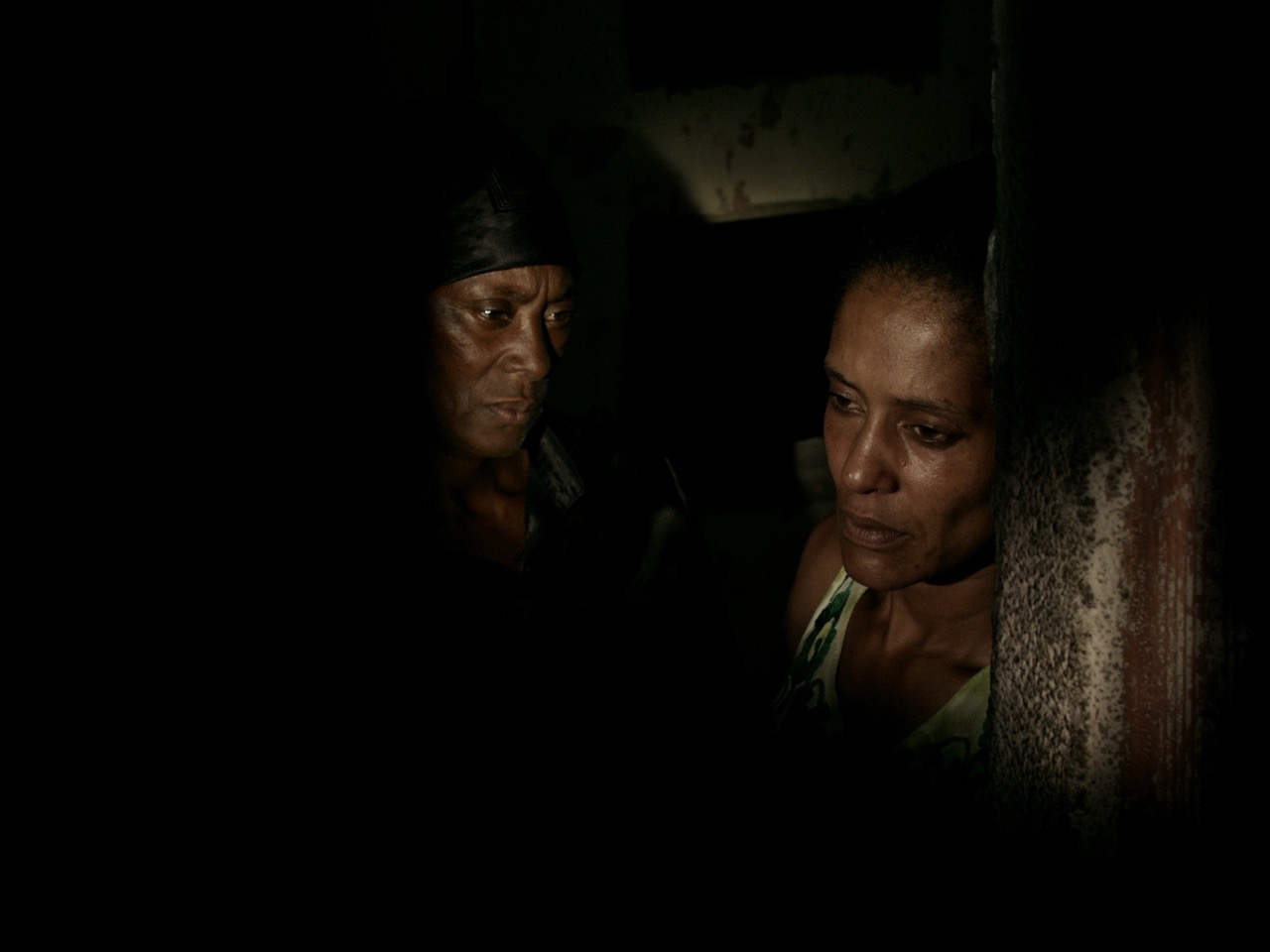
The genesis and the creation of Da-Rin’s film are very similar to Pedro Costa’s Vitalina Varela. another 2019 film, this time from Portugal. Both films are distinguished by their original screenplays developed by their respective directors after discussing with people about their own experiences that ultimately get projected so realistically in the films. Both films are in Portuguese language: one made in Brazil, the other in Portugal. Both films mainly rely on non-professional actors who incidentally have been rewarded internationally for their performances. Both films have most sequences shot at night time with an obvious absence of natural light. Both films were major winners at the 2019 Locarno film festival in Switzerland. The two films underscore the effectiveness of directors to conceive of films by talking to people and developing their films from ideas that emerge from real conversations with people living on the margins of contemporary society,

Justino with his daughter, who aspires
to be a doctor


The fever in the film relates to a realistic medical condition that affects Justino, the guard working in Manaus. Medical tests conducted do not reveal any known disease. Justino is a widower and a Christian (most Desana tribals are apparently Christians)  living with his daughter, who is studying medicine and a recent recipient of a scholarship for further medical studies in Brasilia, Brazil’s capital, to become a  medical doctor. The scholarship means a great deal for the young lady but this development hurts her father as he realizes that he will be deprived of her company in Manaus for the next 5 years.  The fever is perhaps also linked to Justino’s brother’s social visit to Manaus making both brothers recall their early lives as happy hunters in the Amazonian rain forest, content hunting for fresh food in the forest rather than shop for food in the supermarkets. Justino’s brother wants Justino to return to the forests but Justino does not seem to agree, claiming that his employers won’t let go of him and even has a plastic smile when says he “will be fine” after his daughter departs for Brasilia.


Da-Rin’s film explores at a secondary level the true relationship between the employer and the employee, Justino. Even though he has been an ideal worker for a long while, the Human Resource department summons him to state that he could be fired without compensation as he has been found dozing at work. The film explores racism, too.  A greenhorn guard joins Justino’s shift and decides to call him “Indio” rather than Justino. It is this work scenario that Justino describes as one where “his employer won’t let him go.”

Justino (extreme right) with his brother
and family enjoying food from the rainforest

At a third level, there is the psychological beckoning of Justino by the rain forest and its fauna. The food that Justino’s brother brings with him to Manaus attracts Justino’s taste buds by its taste, encouraging him to consider returning to the forest. The strange sounds of fauna heard on the forest edges of Manaus city at night seems to communicate with Justino. But the viewer is never shown the mysterious animal  by the director.  A section of the Manaus population alleges that the animal killed a pig. It is possibly the same animal that made a hole in the fence of the port’s facilities that Justino meticulously guards. The mysterious animal also seems to be trying to connect with Justino.

The fever is a metaphor transcending medical knowledge in this film. It suggests a connection between animals, spirits and humans that the rainforest tribes believe in and the fever seems to attract Justino back to the forest. Whether Justino does return or whether he dreams of his return is for the viewer to figure out.  The film ends with a song sung on the soundtrack that ambiguously states: “This is why I have come to talk to you. Like our ancestors, we must live with strength and courage

At the Locarno film festival, the film’s director Da-Rin indicated her antipathy towards the Bolsonaro regime that is cutting down the rainforests to encourage industry and corporate farming, at the cost of precious natural genetic resources and disrupting the world of the tribes who lived in harmony with rainforest for centuries.

Films like Vitalina Varela and The Fever open up exciting, reflective cinema for serious film viewers while encouraging a new method of developing original scripts and the employment of non-professionals as actors who go on to win awards. These films are indeed  different from the usual.


P.S.  The Fever is one of the author's top 20 films of 2019. Much of the dialogues quoted above are from memory of a single viewing and are approximations. The film won the Best Actor award for actor Regis Myrupu and the FIPRESCI prize for the best film at the Locarno Film Festival; the Silver Hugo Award for the best director at the Chicago International Film Festival; the Best Latin American Film Award at the Mar del Plata Film Festival (Argentina); the Roberto Rossellini  award at the Pingyao International Film Festival (China); and the Silver Alexander Award as the Special Jury Prize at the Thessaloniki International Film Festival (Greece).The Brazilian film Bacurau and the Portuguese film  Vitalina Varela have been reviewed earlier on this blog. (Click on the names of the films in this post-script to access the reviews.)


Saturday, March 07, 2020

249. Portuguese director Pedro Costa’s seventh feature film “Vitalina Varela” (2019): Stunning, austere, melancholic docu-fiction film that highlights the power of cinematography, sound management, lighting, acting, drama and art direction, presenting an aesthetic alternative to Hollywood and Bollywood films


Film director Jean-Luc Godard  had said “In the temple of cinema, there are images, light and reality. Sergei Parajanov was the master of that temple.”  Parajanov, the late master filmmaker from Soviet Union, underscored the importance of bright colors and realistic sound, while Pedro Costa’s  Vitalina Varela goes a step further, accentuating darkness, dark skin, and shadows with muted indirect lighting in a “colour” film, aided with natural sound. When you do see bright images in Vitalina Varela, as at the end of the film, it is not just real bright light and colors, it presents a metaphoric change in the film’s narrative structure.


The award-winning actress plays herself in the film about herself


Vitalina Varela is distinctly different from the Oscar nominees of 2019 or well known commercial films with renowned actors. Vitalina Varela is an unusual film with a title that has the name of its lead actress. The film narrates the real story of its lead actress, a Cape Verdean immigrant arriving without papers in Portugal following her husband’s demise.  (She acquired the formal  papers authorizing her stay in Portugal halfway into the production of this film, several years after her actual arrival.) Its director Pedro  Costa, and his close-knit committed production team of cinematographer  Leonardo Simoes, sound mixers (Joao Gazua and Hugo Leitao), production manager, and stock actors can be proud of their low-cost final product that offers higher aesthetic values than the multi-million dollar products from either Hollywood or Bollywood. It is definitely one of the remarkable films made in 2019, if not the decade, at least for audiences less addicted to conventional action and sex that makes a majority of contemporary films make money at the box office. While the film is made by a white (Caucasian) Portuguese crew,  all the  characters in Vitalina Varela  are dark-skinned Africans from Cape Verde. Half of a film festival audience viewing Vitalina Varela  (in which this critic was a spectator) walked out of the film screening halfway, while the other half stayed rooted in their seats right up to the end of the film and stood up to applaud the film, even though none of the filmmakers were present at the screening.  (This critic recalls that in 1979, when an Andrei Tarkovsky film retrospective was screened in New Delhi, during an international film festival, some spectators who had paid for their tickets tore up their seats at the Archana theatre where the films were screened in frustration as they could not comprehend or appreciate Tarkovsky's cinema. Today, ironically the same films, are likely to be treated with awe and respect.)

Ms Varela, the lead actress of  Vitalina Varela, has little or no acting experience. She emotes and reconstructs with staggering dignity the world of her recent widowhood and love for her late husband, Joachim, who chose to live the demanding  life of an immigrant in the Fontainhas sector of Lisbon, Portugal, for some 25 years, retaining for his memory Ms Varela’s wedding photograph, carefully preserved in a photo frame in his ill-lit, shanty dwelling. This award-winning performance of the actress is comparable to the very best in the world, thanks to Costa’s perseverance and extended committed interaction with her developing the film from scratch for several years prior to the shooting of the film. 

The priest (Ventura) and the widow (Vitalina Varela),
in the church without any other worshippers


The most amazing part of the film Vitalina Varela is that there was no prior written script (just as in most  of Terrence Malick’s films) making it all the more difficult for Costa to  attract producers. The spoken words are essentially recollections of Ms Varela’s life and her second interaction in Lisbon with a real Cape Verdean  priest (played in the film by Ventura, a regular actor in several of Costa’s films), who buried Ms Varela’s husband Joachim, just days before her arrival in Portugal. The concept of the film itself emerged from  Costa’s, his wife’s, and his team’s interactions for 4 years with Ms Varela. Costa has explained that the film evolved with those extensive interactions and the award-winning performance Ms Varela was her honest outpouring of grief and loving memories of her husband who had promised her a palace in Lisbon decades ago, only to find it was a mere shack, which included some clues left behind in the derelict abode of the late husband’s recent lover. The evolution of the film has several parallels with the 2019 Brazilian film The Fever, which also was made after its director Maya Werneck Da-Rin's extensive interactions with indigenous Brazilians.

Contemporary Russian maestro Aleksandr Sokurov made unforgettable, poetic  films: Mother and Son (1997) and Father and Son (2003). Had Sokurov made Vitalina Varela, he would possibly have titled it as “Wife and Husband.”  

Vitalina Varela is a recounting of real events of Varela’s arrival in Portugal from Cape Verde island in the Atlantic, off the African continent (and a former Portuguese colonial territory), a few days after the death and burial of her husband Joachim, originally a bricklayer, more recently a person who survived by doing odd jobs. Like Sokurov’s elegiac Mother and Son, Costa’s Vitalina Varela is essentially a monologue of Vitalina seemingly speaking to her dead husband about her memories with him, comparing the stone house in Cape Verde they built together decades ago, with the tin shanty house in Lisbon.  The Lisbon “palace”  that Joachim promised her decades ago that she occupies following Joachim’s  passing is a shanty house with a leaking roof.


The priest (Ventura) metaphorically "carrying the cross
on his shoulders": director Costa and
cinematographer Simoes at their best

The only real dialogues in the film are those between the priest—a real character, a priest of a derelict church in Lisbon, reeling under his guilt of turning away a busload of Cape Verde Christians, who had approached him while he was a priest in Cape Verde to baptize a child without proper papers. The busload of Christians he turned away were killed in a road accident a short while later and the priest carries that cross of his action of refusing to baptize the child to this day.  Costa’s film brings together two individuals from Cape Verde, both suffering from recent tragedies, both religious individuals, both alone in a new country where even God seems to have forsaken them.  One line spoken during  the interaction between the two is evocative: “I had the cross of Christ on my shoulders. I couldn’t move. When I fell, I was free.” A fascinating religious commentary, indeed, in a film that did not have a prior written script.

In Vitalina Varela, the spoken words are less important than the visuals.  A striking point in the film is the arrival of Vitalina in Lisbon.  A plane arrives on the tarmac of the airport and the sole V.I.P. to emerge from it is Vitalina. The “V.I.P.’s” bare feet are shown as she climbs down the steps from the plane. (A cineaste would recall the Japanese director Mikio Naruse’s  classic 1960 film When a Woman Ascends the Stairs (with proper shoes) and the inverse relationship of the wet, bare feet shown in Vitalina Varela descending from the plane in this sequence.)  You would expect lights in an airport at night—but the scene is dark, the person is dark skinned, and wearing clothes appropriate for mourning. The “V.I.P.'s" reception committee are made up of fellow Cape Verdean immigrants working as cleaners/support staff at the airport, one of whom honestly tells her “Vitalina, my condolences. You are too late. Your husband’s funeral  was 3 days ago. There is nothing for you in Portugal. His house is not yours. Go back to Cape Verde.” Some reception for a widow!

A rare bright shot in the film is at the grave of Joachim

Just as Parajanov emphasized light in his films, Costa and his cinematographer Leonardo Simoes emphasize the importance of light by erasing it and using it sparingly to accentuate its importance. This is a colour film that appears to show more black (or lack of light) in most of the sequences with indirect lighting often behind the actors to give a silhouette. It fits with its the subject matter—it is a film dealing with death, sorrow, loneliness, African immigrants struggling to survive in Europe, lack of money and love. Even in daytime, much of the scenes are shot in shadows. Each of these dreamlike shots is aesthetically crafted in austere surroundings and a pleasure to perceive.  There are unforgettable sequences of tired immigrant workers returning home at night, hardly speaking to each other, in dimly lit streets close to cemeteries. You are reminded of sparse visual stage settings crafted by playwrights Samuel Beckett and Eugene Ionesco for their works. And natural sounds and bleak visuals, "speak" as much as humans do in this film.

Vitalina interacts with another woman,
who has burdens of her own


Ultimately Vitalina Varela is a film about a widow and the spoken words are bound to reflect a feminine viewpoint. In a response to the priest, who has kind words for her dead husband, Vitalina acerbically responds with criticism that is considerably true ”Men favor men. When you see a woman’s face in the coffin, you can’t imagine her suffering.” Suffice it to say that the film captures all this and more.

The citation for the film’s Silver Hugo award at the Chicago film festival sums it all up: “..for a ravishing and masterful vision between horror and melodrama, spirituality and desperation that blew the jury all away."


P.S.  Vitalina Varela is one of the author’s top 20 films of 2019. Much of the dialogues quoted above are from memory of a single viewing and are approximations. The film won the Golden Leopard award for the best film and the Best Actress award at the Locarno Film Festival; the Silver Hugo Award for the best feature film at the Chicago International Film Festival; the Best Director, Best Actor and Best Cinematography Awards at the Mar del Plata Film Festival; the Grand Prize of the Jury at the La Roche-sur-Yon International Film Festival (France); and the Best Cinematography Award at the Gijón International Film Festival (Spain). The Brazilian film, The Fever, mentioned in the review, is also one of the author's top 20 films of 2019.

Sunday, December 20, 2009

92. Polish director and scriptwriter Urszula Antoniak's debut film "Nothing Personal" (2009): Amazing tale on solitude beautifully told


Solitude is often craved for by individuals who are thinkers (and sometimes by misanthropes, due to their personal past experiences). It is a state that monks and people spiritually inclined love to enjoy at some stage in their lives. It is an accepted life stage in Hindu religious practice and certain Buddhist and Jain traditions. Gertrude Stein wrote on solitude "When they are alone they want to be with others, and when they are with others they want to be alone. After all human beings are like that.Nothing Personal is a very interesting film that reflects Ms Stein's thoughts. It begins with a woman who for unknown reasons gives away all her worldly possessions and leaves on a journey to nowhere. In a secluded spot in Ireland, another man--a widower--lives alone valuing his solitary life. Yet, he realizes that he could do with some hired help to tend his garden. The two individuals meet but do their lives change? The Irish-Dutch film directed by a Polish director explores the theme with remarkable results.

Polish director and scriptwriter Urszula Antoniak, currently living in Holland, is someone to watch out for in the future landscape of world cinema if Nothing Personal is an indicator of her capabilities. I have a soft corner for any talented debut filmmaker who relies on his/her own story and script. Ms Antoniak is one such director revealing her potential of greater works to come.


Actress Lotte Verbeek essays the fascinating character


Nothing Personal, a very recent Irish-Dutch co-production, making its Indian premiere at the 14th International Film Festival of Kerala, had its audience clapping away at some delightfully composed shots by cinematographer Daniel Bouquet and director Antoniak, conjured for the viewer. It is without doubt a nugget of a film. Ms Antoniak deservedly won the best first feature of a director award at Locarno Film Festival. The film has won an incredible tally of 10 awards already, 6 of which came at the Locarno film Festival itself in Italy.

Lotte Verbeek, a Dutch actress with a magnetic screen presence, plays a young attractive Dutch woman who discards all her material possessions in Holland one fine day and watches strangers pick up the material from the window of her apartment. She is shown wearing a wedding ring, which she is shown removing. Evidently, she was once married but there is no mention of her past or of her marriage as the film unspools. Ms Verbeek won the Silver Leopard best actress award at Locarno Film Festival portraying the main role of a young woman with no money, backpacking from Holland to an unknown beautiful desolate spot in Ireland with no apparent purpose with all the qualities of a misanthrope. During the film, Ms Verbeeck’s demeanor gradually changes from the unfriendly to the affable and then back to her old self. The changes in her character that are subtle are truly a treat to watch. Like Ms Antoniak, we can be sure that Ms Verbeek, too, will be talked about in the future.


Director and scriptwriter Antoniak presents an enigmatic character with minimal spoken conversations. But when words are spoken the carefully chosen words provide a lot of meaning. The woman is distrustful of men, who possibly mean her no harm, and rude to women who want to get know her or even help her. The woman feeds herself by checking out trash bins for left-over food. On reaching a scenic spot in Ireland by apparent chance, she spots a lonely house of rich owner. When the owner, a well-to-do genial old widower, returns to the house, he offers her food. She is initially rude to him as well. The two come to an arrangement where she would work for food, but refuses to reveal her name or speak a word of who she is. Throughout the film she is addressed as “You’ by the house-owner Martin after she says he can call her ‘You ‘ The deal is food for work, but no discussion on personal matters. Hence, the title of the film--Nothing Personal.

The film is essentially about the relationship that is built over the days between the two. Both are individuals who, for their own reasons, like to be alone. Both, it is gradually revealed, are well-educated and cultured Europeans. The back-packer with no money is capable of making haute cuisine when she chooses and is well versed with good music and books. What follows is a gripping tale of appreciation of solitude, not because one hates people and their friendships, but because they value their own space and time without intrusions from others. Yet, even such people can value companionship when they find people of a similar vein.

This film will provide a great boost for Irish cinema. The film showcases yet another commendable performance from Irish actor of repute Stephen Rea, who had a major role in the award-winning film The Crying Game. It will also serve as a great advertisement for Irish tourism with its fascinating locales liile known to potential tourists.

Without revealing the end of the film, I would advise all viewers of this film to pay attention to the sound and visual details throughout the film. A perceptive viewer will truly enjoy the remarkable epilogue of the film, which tells an aspect of the story that the film does not reveal right up to that point of the tale.


Monday, January 05, 2009

78. Algerian director Amor Hakkar’s French/Algerian film “La maison jaune (The yellow house)” (2008): Underscoring goodness in humankind

Directed, written, acted (playing the lead role of Mouloud) and co-edited by Amor Hakkar, The yellow house will win hearts anywhere. It is humanistic, deceptively simple and uplifting. Having seen the French/Arabic/Berber language film, the viewer will leave with one thought--there is goodness in all of us, whether Algerian or a citizen of any other nation. It is rare to encounter such movies when violence, evil, and bitterness pervade most films being made these days. Some viewers tend to disparage “feel-good” films because they tend to be escapist, but here is an example where realism rarely goes out of focus.

This Algerian film is apparently the second feature film of the director, who studied in France. The story/screenplay written by Hakkar is simple: a poor Algerian agrarian family, who survives by growing and selling potatoes and vegetables, deals with grief following the untimely death of the eldest son in an accident. The filming appears simple too: no flashy editing distracts the viewer, camera angles are unobtrusive, and the viewer's sensibilities are soothed by the delightful strains of evocative oudh (a string instrument) music. The oudh player Faycal Salhi, who provided the music for the film, was present at the International Film Festival of Kerala (IFFK) 2008 to collect on behalf of the Algerian director, the deserving Special Jury Award. The movie had earlier won the top award at the Valencia film festival, the best actor award at the Osian (New Delhi) festival, three awards at the Locarno festival, the special jury prize at the Carthage festival, among other honors elsewhere.

Sociologically, the film criticizes the lack of electricity in some villages of the oil rich country and yet commends the quick remedial, intervention when lapses are brought to the notice of the Algerian government officials. The film is not about economic injustice or government apathy; even though these real issues are present in the backdrop. In the forefront of this wonderful film are issues that are more universal: strong family bonds between husband and wife, between father and children, dead and alive.

The first half of the film deals with the impact of untimely death of the farmer's eldest son in an accident while serving in the police force and the father’s journey to Batna to identify and collect the mortal remains. The second half deals with the husband’s quixotic but dogged plan to bring the shattered life of his wife to normalcy with the help of a video recording made by his son before his death.

The film underlines everything that is positive about the Muslim world in a charming way that is not didactic. Policemen, who have never met the farmer before, help the man by providing him with a hazard light free-of-cost as he travels in the night on a three-wheeled farm tractor without headlights to bring his son's body home. Taxi drivers go out of the way to help him locate addresses in the city. An official at the morgue, instead of taking the farmer to task for “stealing” his son's body circumventing official procedures, takes the trouble to catch up with him on the highway and hands him the signed legal papers approving the release of the dead body. A pharmacist is asked by the farmer for some medicine to cure his wife’s depression from the tragedy, and the well-meaning pharmacist who has heard of a cure (painting the walls of his house yellow) that shares that information with the farmer. Ordinary individuals, who could easily have been indifferent to a poor man, go out of the way to lend a helping hand to man coping with grief. Would such good deeds happen in real life, one could well ask. My answer would be that human bonding when we recognize another person’s grief or loss is quite extraordinary.

What is remarkable about this film is the contribution of one man Omar Hakkar who acts, directs and edits a delightful film that does not criticize at any point what is wrong in society and yet presents a realistic canvas of Berbers in Algeria. The farmer might appear simple and poorly educated, but the film is intelligently crafted killing several birds with one stone. There is criticism of the economic disparity in the film but it is latent. The film also silently underlines the important supportive roles of young girls in a Muslim family, rarely underlined in Arab films.

Hakkar’s film is one of the finest films to emerge from North Africa in recent years almost comparable to Mohamed Asli’s lovely Moroccan film In Casablanca, angels don’t fly, also on the Berber community made in 2004. Hakkar has not just proved his mettle as a director but also as an interesting screenplay writer, who is capable of merging tragedy with low-key visual humor that never goes overboard. Hakkar’s dignified performance in the main role seems contagious—every other character in the film rises above petty minds to lend him a helping hand. The film’s screenplay underlines the need for all of us to tackle grief with courage and adopt a positive outlook at life’s continuity in all weathers. It is a film that reiterates that one can attain the pot of gold at the end of the rainbow through dogged persistence in life, while being gentle and considerate to others.


P.S. In Casablanca, angels don't fly was reviewed earlier on this blog.