Showing posts with label The Netherlands. Show all posts

Friday, December 06, 2013

155. Danish film director Lars von Trier’s film in English “Breaking the Waves” (1996): An unusual, stunning, cinematic ode to all lovers, especially spouses


Lars von Trier’s Breaking the Waves is just amazing cinema.

It is essentially a film about the relationship of a newly married couple Bess (Emily Watson) and Jan (Stellan Skarsgard). It is an unusual film as it never really bothers to explain to the viewer how this couple met or decided to get married. For the director von Trier and his co-scriptwriter Peter Asmussen, those are not details of importance. For the director and his co-scriptwriter the film is all about the post-marriage events—not what led to the marriage. Even Bess’ sister-in-law Dodo (Katrin Cartlidge) who, we learn as the film unfolds, is the closest person to Bess and lives in the same house, states early in the film following the marriage that she does not know Jan well and that she hopes Jan would take good care of Bess. The viewer soon realizes that Bess is still a virgin right up to her marriage and that Jan too is totally devoted to his bride although they obviously never had sex before marriage, unusual details considering that they are so devoted to each other in a contemporary Occidental scenario. Those are some of the few quaint but important elements of the past about the duo that the scriptwriters reveal.

The marriage

The marriage takes up “Chapter One: Marriage of Bess”, which begins with an intriguing still life shot that soon deceptively comes alive with a helicopter appearing in the sky. On the soundtrack, you hear Mott the Hoople belting out his 1973 rock song All the way from Memphis, which is about losing his guitar (in real life) while travelling to Memphis. Soon the song stops halfway. Much later in the chapter you see Bess impatiently waiting in her wedding gown to greet Jan, who has just arrived from his workplace on the helicopter. The way von Trier uses this chosen piece of music as an intermezzo for his narrative is different and interesting. The director expects the viewer to rewind the film in his mind to pick up the connections. It’s not just rock songs that von Trier employs for his chapter breaks’ soundtracks. For “Chapter Five: Doubt”, the director employs the lovely folk song Suzanne written and sung by Leonard Cohen in 1966 with the words

Suzanne takes you down to her place near the river
You can hear the boats go by
You can spend the night beside her
And you know that she is half crazy
But that’s why you want to be there.

Long after the song fades away halfway, the movie presents the “half crazy” Bess trying to seduce Jan’s doctor in his apartment. Again the director expects the viewer to recall the phrases from the song heard a few minutes earlier in screen time to pick up the connections between the almost still life “chapter break” visual, the intermezzo song, and what follows as the narrative of the story within the chapter.

Post-marriage love

Breaking the Waves presents an unusual way to present a tale on screen.

First, while it is structured like a book complete with a prolog, chapters and an epilog, it extends the literary structure to references in contemporary rock and folk music, with lyrics that match the tale that follows within each chapter. Thus, when the chapter is over on the screen, the chapter title and the song add a second level of enjoyment /entertainment in an overt way. One could argue that all intelligent directors do the same when they deliberately choose a song or piece of music in a movie. However, unlike most other filmmakers, for von Trier the musical introduction is used as a precursor to what is to follow—unlike most other directors who would use the music synchronously with the visual tale. If one studies the structure of the film closely, the prolog of the film before Chapter One begins has Bess responding to the question of the elders of the church posed to her as to what Jan and his friends who are outsiders to the Scottish community have “brought of real value” with a simple answer: “Their music.” Those words do not make much sense to the viewer nor to the church with a bell tower and no bells in it make sense until the epilog of the film when the viewer hears glorious sound of the church bells ringing. The screenplay is well crafted. Somewhere in between the prolog and the epilog you see Jan and his colleagues are avid listeners of music on the oil rig. Somewhere in between Bess expresses her sorrow to see Jan depart for work by hitting an overhead crane with a metallic rod, and Jan responds by doing the same action and the sound communicates his love for his wife as no words could. That’s great cinema. You realize the importance of sound and music for the filmmaker in developing the film’s narrative.
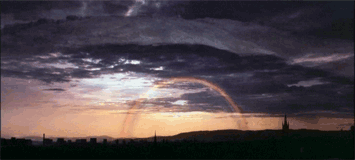
Chapter break--rainbow and the church steeple


Second, the film is built around one word: “good.” An alert viewer will be surprised at how often that word is spoken in the film. And sometimes, the “good” aspects are highlighted by deliberately presenting the “bad” and calling it as such verbally. In the intermezzo of “Chapter Seven: Bess' Sacrifice” Pink Floyd sings

If you have been bad
Lord , I bet you have
and you have not been good..

The mesmerizing performance of Emily Watson includes the unforgettable “conversation” with God in a darkened church, with Watson employing her dramatic skills of creating the conversation by voice modulation and by underscoring the words “Now Bess, be a be a good girl.” The film develops a fascinating and sometimes thought provoking tale of what is good. It is an essay on being a good wife and conversely a good husband who is empathetic towards his spouse without thinking deeply of the consequences of his demands. In the epilog, the doctor who has been treating and guiding her post-marriage states at Bess’ inquest that her death was caused by being “good” rather than being psychotic or neurotic. While there are sufficient instances in the film to prove Bess is mentally unstable, the film goes beyond the medical condition to explore what is morally and spiritually considered good and, conversely, considered bad. Even Bess has an opinion of “good” in social terms when she says “I have always been stupid but I am good at this”

Post-accident love 

Third, the film is quintessentially a film about love in all its myriad forms. There is carnal love. There is exceptional devotional love for God. There is sacrificial love for one’s beloved, in this case the spouse. There is platonic love expressed by Bess’ sister-in-law for her. The key words of Bess in the film as spoken to her doctor are “Jan and me have a spiritual contact. I choose for myself. To give Jan his dreams.. I don’t make love with them; I make love with Jan. And I save him from dying.” Jan himself acknowledges “Love is a mighty power.”

Love for God: conversing with God  in a darkened church

Finally, the film is a debate on religion. The pious does seem to act in a way that results in a miracle after medical opinion is initially quite unsure of a positive outcome. It is a film about questioning the Church’s (is it Calvinist?) treatment of the dead who have obviously sinned while alive. Bess enters the packed Church midway into the film dressed as a prostitute and on hearing a part of the sermon shouts “How can you love a word? You cannot love words. You cannot be in love with words. You can love another human being. That’s perfection.” These are words that need to be put in context with the words of the priest at Bess’ wedding commending her love for God expressed by her selfless actions in keeping the same church clean over a long period. The script obviously parallels actions of Jesus, Mary Magdalene, and to some extent, Joan of Arc. The movie thus questions aspects of religion as much as it affirms it. To be more precise it is Lars von Trier’s personal look at what constitutes “good” in religion and in marriage.

The modern Mary Magdalene

And when Lars von Trier deals with “good” subjects he is more than a good filmmaker. The bells toll.

Any analysis of Breaking the Waves will be incomplete without praise for Emily Watson’s performance. Though this was the first regular movie role for her, it is sad that she was nominated for an Oscar and that she did not eventually win it. This is a spectacular film performance from a good stage actress (most of them give great turns in cinema by a rule of thumb). Perhaps von Trier should be congratulated on his casting skills and directorial skills in eliciting flawless performances from the entire cast. Lars von Trier can put some viewers off in some of his films but this one is a winner all the way. It could, despite its nudity and adult theme, even serve as a text for students of theology to mull over while discussing love, marriage and being “good” in the sight of God as much as a medical case of analyzing neurosis/psychosis.

The film won the Cannes film festival’s Grand Prize of the Jury in 1996 and the European film awards for best film and best actress, awards that stand out among some 43 awards won by the film worldwide.

P.S. The movie is one of the author’s top 100 films.

Saturday, January 05, 2013

137. Mexican director Carlos Reygadas’ film “Post Tenebras Lux “ (After Darkness, Light) (2012): Visually and cerebrally stimulating cinema.


Carlos Reygadas is one of the few exhilarating filmmakers alive and actively making movies.  His films are never easy viewing.  His films’ images and his films’ soundtrack stun your senses with their groundbreaking ability to make you wonder why other filmmakers did not employ those ideas before.  Then he goads the viewer to reflect and figure out how best to solve the puzzle he has presented on screen. Post Tenebras Lux does just that. It can either elicit your boos or it can open the viewer’s mind’s eye wide in awe. The film won the award best director at the Cannes Film Festival 2012  For this critic, the film is the only film made in 2012 to find a slot on his list of all time 100 best films.

If we deconstruct the movie Post Tenebras Lux, the viewer could perhaps begin to appreciate it.

Rut Reygadas as Rut, daughter of Juan

First, the film is not based on any novel or play—it is the original idea of Carlos Reygadas, scriptwriter and director.  Now when a filmmaker makes a film, the choice of the title is crucial as the title reveals the film. The title is a Latin phrase for After Darkness, Light. Where did it come from? It has its origins in the Vulgate version of Book of Job 17:12, a book in the Holy Bible, and the character Job is equally revered by Jews, Muslims (Job is discussed in the Holy Koran) and Christians. Interestingly this phrase was the motto of the Protestant reformation in Europe as it split from the Roman Catholic Church. This phrase was also the state motto of a country, Chile. The theological connection of the title is not accidental if one considers the fact that Reygadas’ previous film was called Silent Light, a subtle and mischievous play on the Christmas carol Silent Night, with the amazing night to dawn sequences that begins and the reverse sequence that ends that film. The choice of the title Post Tenebras Lux gives the viewer adequate clues to understand and appreciate the theological connection to the film, in spite of the absence of conventional religious symbols, such as crosses, churches, prayers, or even a direct mention of God.

Juan

The opening sequence of Post Tenebras Lux, is another evocative play on light and darkness that recalls the opening and the end sequences of Reygadas’ earlier work, Silent Light.  One of the cutest toddlers on screen, Rut Reygadas (real-life daughter of the director), is out in an open field talking to pet dogs, horses and cows in twilight as ominous dark clouds gather, thunder booms and lighting strikes, and light fades to embrace darkness. Darkness and light are metaphors of what is to follow in the movie.  If the visual metaphors were to be limited to goodness and evil, Reygadas prods your mind further with the appearance of a computer graphic generated priapic devil glowing red and carrying a mysterious tool box once at the beginning and later towards the end, to underscore the theological element in the movie. The silent devil is observed by the male child, Eleazar, one of the two innocent kids in the movie and very importantly the devil leaves the kids alone—the devil is interested in someone else in the house, the adults.  The children remain uncorrupted by the devil. Eleazar is again the son of the director.

Second, is the film an imaginary one or is it autobiographical?  Much of the film is indeed autobiographical if we pick up the details. The two lovely kids in the film are Reygadas’s own.  The lovely wooden house is again his own dwelling.  According to reports, the shots with the devil were taken in the house the director grew up in and the toolbox carried by the devil belonged to the director’s father. The movie is dedicated to his wife, Natalia López, who is the film’s editor. Interestingly the wife of the protagonist in the film is called Natalia an obvious nod to the director’s real life wife. Finally, Reygadas picks an actress Nathalia Avacedo, with a similar given name. Carlos Reygadas daughter is called Rut and so is the protagonist’s daughter in the film.  The same goes for his son Eleazar. Reygadas has studied in the UK and has played rugby for Mexico’s national rugby team, facts which explain the rugby players speaking English shown twice in the film. Reygadas is apparently closely connected to the Mexican rugby team as well. 

The rugby game

Third, is the film only about two nuclear families? If you look deeper into the film's structure, the differences between the two families underscore the social divide in Mexico today. The obvious focus is on the family of Juan and Natalia, and their two cute kids.  They live in a beautiful upscale wooden house in an idyllic location far from the hustle and bustle of commerce and city/town life but they are serviced by poorer sections of Mexico’s inhabitants. Juan and Natalia could easily pass off as Caucasians but the workers have features that are typically native Mexican. In the middle section of the film, Reygadas introduces the viewers to a range of males who speak to the camera as though they were being interviewed by the director and admit to struggling with their problems including one who is a drunkard who has joined the Alcoholics Anonymous while Juan admits to be addicted to internet pornography. Another interesting male talking to the camera is a key figure named Seven who has installed most of the costly fixtures in Juan’s dream house and is apparently close to his boss, Juan. Much later in the film Reygadas shows two sequences of Seven’s “interactions” with Seven’s own nuclear family. There are vignettes of Juan trying to get closer to his workers’ world when he visits the rural pub, where the drunks reveal more of their lives. The social divide between the rich and the poorer sections of Mexico is amply evident in the film, as is the silent rage of two male individuals coming to terms with their own “dark” lives to find “light’ in different and distinct ways,  according to their financial and social status.  The women in both nuclear families are the ones often abused and forgotten, and yet the women seem to shake off their bonds. Reygadas’s women are not easy to decipher—there is a grandmother who hands out large sums of money to her grandchildren urging them to be “businessmen.”  There are rural women who want trees to be cut down for trivial reasons. Did Natalia leave behind some luggage in the house knowingly? Natalia reveals this after Juan holds her hand in the car and she lovingly strokes Juan’s hand before revealing this fact forcing them to turn back. The nagging doubts for the viewer lead us to the fourth element in the movie.

The fourth way to approach the film is by trying to reason individually what is real and what is an illusion, a dream, or an epiphany in the movie.  Reygadas throws another clue at the viewer: Juan asks his wife Natalia to play some music, specifically the Neil Young song “It’s a dream.” Any other director would have got the song sung professionally—but Reygadas makes the singing deliberately look amateurish. It is not the singing that he wants you to appreciate; it is the relevance of the song. Natalia cries in the process. What then is the dream in the film? The dream of a happy “casa”? Remember young Rut’s few words in the opening sequence, and one of them is “casa” or the Spanish for house. There is a link between generations and the house is a suggested metaphor. Evidently the devil carrying the grandfather’s toolbox is only perceived in the movie by the male grandchild in the casa, no one else.  The devil sees the child but is only interested in the parent’s bedroom.  The woodcutter in the film watches as tall trees fall down in the woods as thought they were falling by themselves. The entire film and the tale of the two nuclear families is from a male standpoint but the women, silent as they seem change the flow of the narrative at decisive moments, leading to downfall/self-realization and eventual mortification of the male head in each of the two nuclear familial units. Is the film made by a male director with no concern for the women? That query seems to be negated by the fact that the director has dedicated the entire film to his real life wife and the film's editor. In fact, the "Duchamp" sequence aids Natalia to transcend inhibitions and realize that she is attractive to men. (One of Duchamp's famous surrealist paintings is called  'The bride stripped bare by bachelors, even'  that could have some relevance to the sequence.)

The ‘trees’ do fall in the Mexican garden of Eden and they fall at random towards the end. Trees have visual and metaphorical importance in Post Tenebras Lux. The surprising request made of the woodcutter to cut down a harmless tree because it bothers some women makes a subtle connection with the viewer. So do the parallels of two Mexican family heads as they return to their individual “casas” imply a more significant action as the men realize their individual follies quite in contrast to their silent but strong wives who take care of the children and prepare the family meals.

Natalia, Rut and Eleazar in their "Garden of Eden"
A fifth way to deconstruct the film is to divide the movie by two obvious sections, and the dissection is made by the camera using the refractive image at the edges in some sequences and not using the unusual magical effect of cinematographer Alexis Zabe  elsewhere.  A close study of the film reveals that the refracted images are used for outdoor sequences and not for indoor sequences. Is Reygadas suggesting that the refracted image of what is done outside is less real than what is within the “casa”? One clue to this is the brutal killing of a pet dog (off-screen) by Juan and the self-repentant statement “I hurt those that I love most. You must help me stop doing this.” or words to that effect. Refracted images are real, it only provides the perceiver an “unreal” view. That this critic believes is the way to approach this work of Reygadas. When the child Eleazar Reygadas playing Eleazar son of Juan states that his father is dead it is a case of refracted reality. Do children lie? Of course, not. At the same time you do not perceive Eleazar as a child who has lost a parent. And it is Eleazar who alone is able to see the visits of the devil.

The devil enters the house/casa

A sixth and a crucial way to figure out Reygadas’ cinema is to accept that he is religious and is consciously adapting bits of the Bible into cinema in a personal way, just as Terence Malick does in his films. The only marked difference between Reygadas and Malick is that Reygadas constantly falls back on the carnal aspects of the human being in every work, a method that Malick studiously avoids. The religious elements in Post Tenebras Lux are never obvious, except for the shots of the devil. The first question for a viewer would be to ask if Reygadas is religious or a person questioning religion.  Reygadas’ own children act in the film with their own given names, Rut (for Ruth) and Eleazar, both names of characters in the Bible.  You do not choose to give such names to your progeny merely because it sounds good—Reygadas, one suspects, has sufficient knowledge of the Bible. If the viewer accepts this pre-condition, several bits of the film become loaded with Biblical parallels. The suicide of Seven in a lonely open field has parallels with the suicide of Judas and the potter’s field, following Seven’s remorse of having killed his master Juan. So does the image of the lonely tree in an idyllic garden of Eden in the Mexican landscape take on added significance, when tree cutter is asked to cut it down illogically for metaphorical reasons. 

This critic went back to the Book of Job 17, from where the title of the film is taken. It is interesting that the chapter after the verse 12 which states that the dejected and lonely Job’s philosophical words “hope is in the world of the dead, where he will lie down to sleep in the dark, and I will call the grave my father, and the worms that eat me, I will call my mother and my sisters. Where is there any hope for me? Who sees any? Hope will not go with me, when I go down to the world of the dead.” These lines from the Bible could explain several aspects of the film, otherwise intriguing. It is Eleazar who sees the devil and who states that his father Juan is dead later to Seven.

Isn’t it an interesting coincidence that both Malick’s Tree of Life and Reygadas’ Post Tenebras Lux, two structurally and thematically close works both indirectly refer to the Book of Job? The only stark difference in the two works is that Tree of Life allows for family viewing, while Post Tenebras Lux is strictly for mature adult viewing, thanks to its few carnal sequences.

This critic would like to refer to Reygadas’ statement made to Anna Bielak in an interview published Slant magazine:  “The film may seem mysterious at first sight. But I really hope that by not giving you any simple answers, you eventually feel how much I respect you as a viewer, how I respect the movie in terms of art, and how much I respect myself as a director. The film is what it is. Talking about it afterward makes me feel dishonest. I demand a lot from the audience and I don’t have any limits, that's true. However, I am a free man, and I may do what I really want. I am giving you the best of myself, and I strongly believe that all around me there are lots of people more sensitive and intelligent than I am. Every single person is different, is focused on other things, feels different emotions, and tries to find their own way through the movie, and is able to find their very own and unique interpretation of the story. One viewer could love the film; the other one, as sensible as anyone else, may hate it for a very good reason. Moreover, I am a viewer as well. I watch lots of movies, and I truly appreciate the directors that don’t try to lead me by the hand through their stories. I want to be considered one of them.”

The importance of trees in the Mexican "Garden of Eden"

Reygadas has stated elsewhere about the film “The whole idea of “light after darkness” seems appealing to me in terms of intimate experience, of being a human living in a Western world. In a sense we all live in the darkness of our daily frustrations. Yet, I hope the light would come after us to enlighten the world for our children.” Reygadas has also stated in another interview that the film Post Tenebras Lux is about Mexico becoming evil and that “the real title of my film should have been 'My country is bleeding. Mexico is bleeding’” The film does appear disconnected but the film can be connected up with a bit of reflection and some effort to pick up the references. Post Tenebras Lux is not easy viewing but complex and personal cinema, rarely encountered, and one of the finest films of 2012.A rugby team appears to be losing, but there is hope for the losing team, if they play as one. The movie telescopes the individual into the refracted reality of the home/casa/family and subsequently the country. Like Job, there is hope if one is resolute in what you believe. So too, for Mexico. So too, for Juan’s children.


P.S. Reygadas's Silent Light (2007) was reviewed earlier on this blog. Post Tenebras Lux figures on the list of the author's best 10 films of 2012.

Sunday, December 20, 2009

92. Polish director and scriptwriter Urszula Antoniak's debut film "Nothing Personal" (2009): Amazing tale on solitude beautifully told


Solitude is often craved for by individuals who are thinkers (and sometimes by misanthropes, due to their personal past experiences). It is a state that monks and people spiritually inclined love to enjoy at some stage in their lives. It is an accepted life stage in Hindu religious practice and certain Buddhist and Jain traditions. Gertrude Stein wrote on solitude "When they are alone they want to be with others, and when they are with others they want to be alone. After all human beings are like that." Nothing Personal is a very interesting film that reflects Ms Stein's thoughts. It begins with a woman who for unknown reasons gives away all her worldly possessions and leaves on a journey to nowhere. In a secluded spot in Ireland, another man--a widower--lives alone valuing his solitary life. Yet, he realizes that he could do with some hired help to tend his garden. The two individuals meet but do their lives change? The Irish-Dutch film directed by a Polish director explores the theme with remarkable results.

Polish director and scriptwriter Urszula Antoniak, currently living in Holland, is someone to watch out for in the future landscape of world cinema if Nothing Personal is an indicator of her capabilities. I have a soft corner for any talented debut filmmaker who relies on his/her own story and script. Ms Antoniak is one such director revealing her potential of greater works to come.


Actress Lotte Verbeek essays the fascinating character


Nothing Personal, a very recent Irish-Dutch co-production, making its Indian premiere at the 14th International Film Festival of Kerala, had its audience clapping away at some delightfully composed shots by cinematographer Daniel Bouquet and director Antoniak, conjured for the viewer. It is without doubt a nugget of a film. Ms Antoniak deservedly won the best first feature of a director award at Locarno Film Festival. The film has won an incredible tally of 10 awards already, 6 of which came at the Locarno film Festival itself in Italy.

Lotte Verbeek, a Dutch actress with a magnetic screen presence, plays a young attractive Dutch woman who discards all her material possessions in Holland one fine day and watches strangers pick up the material from the window of her apartment. She is shown wearing a wedding ring, which she is shown removing. Evidently, she was once married but there is no mention of her past or of her marriage as the film unspools. Ms Verbeek won the Silver Leopard best actress award at Locarno Film Festival portraying the main role of a young woman with no money, backpacking from Holland to an unknown beautiful desolate spot in Ireland with no apparent purpose with all the qualities of a misanthrope. During the film, Ms Verbeeck’s demeanor gradually changes from the unfriendly to the affable and then back to her old self. The changes in her character that are subtle are truly a treat to watch. Like Ms Antoniak, we can be sure that Ms Verbeek, too, will be talked about in the future.


Director and scriptwriter Antoniak presents an enigmatic character with minimal spoken conversations. But when words are spoken the carefully chosen words provide a lot of meaning. The woman is distrustful of men, who possibly mean her no harm, and rude to women who want to get know her or even help her. The woman feeds herself by checking out trash bins for left-over food. On reaching a scenic spot in Ireland by apparent chance, she spots a lonely house of rich owner. When the owner, a well-to-do genial old widower, returns to the house, he offers her food. She is initially rude to him as well. The two come to an arrangement where she would work for food, but refuses to reveal her name or speak a word of who she is. Throughout the film she is addressed as “You’ by the house-owner Martin after she says he can call her ‘You ‘ The deal is food for work, but no discussion on personal matters. Hence, the title of the film--Nothing Personal.

The film is essentially about the relationship that is built over the days between the two. Both are individuals who, for their own reasons, like to be alone. Both, it is gradually revealed, are well-educated and cultured Europeans. The back-packer with no money is capable of making haute cuisine when she chooses and is well versed with good music and books. What follows is a gripping tale of appreciation of solitude, not because one hates people and their friendships, but because they value their own space and time without intrusions from others. Yet, even such people can value companionship when they find people of a similar vein.

This film will provide a great boost for Irish cinema. The film showcases yet another commendable performance from Irish actor of repute Stephen Rea, who had a major role in the award-winning film The Crying Game. It will also serve as a great advertisement for Irish tourism with its fascinating locales liile known to potential tourists.

Without revealing the end of the film, I would advise all viewers of this film to pay attention to the sound and visual details throughout the film. A perceptive viewer will truly enjoy the remarkable epilogue of the film, which tells an aspect of the story that the film does not reveal right up to that point of the tale.


Wednesday, January 02, 2008

52. Mexican director Carlos Reygadas' "Stellet licht (Silent Light)" (2007): Visually and aurally breathtaking cinema


Can light have sound? So what is silent light? Something surreal, somehow related to the Christian hymn Silent night? The intriguing answers are provided in the film to the patient, thoughtful viewer. This is not a film for the impatient viewer. “Starlight” (accessible cosmic wonders) begins and ends the film—silence dominates the soundtrack, except for crickets, lowing of cattle, and an occasional bird cry.

This opening shot sets the tone for a film made with non-professional actors (real life Mennonites from several countries, according to reports) . The film won the Jury’s Grand Prize at Cannes 2007. It is a spectacular film experience for any viewer who loves cinema. This is my first Reygadas film and I have become an admirer of this young man.

Mexican filmmaker Carlos Reygadas writes his own scripts. He is one of the few filmmakers of importance today who does that—alongside Spain’s Pedro Almodovar and Japan’s Naomi Kawase.

Reygadas’ stunning movie Silent Light dwells on a collapsing marriage within a religious Mennonite community in Mexico, speaking not Spanish (the language of Mexico) but a rare European language (Plautdietsch) that mixes German and Dutch words, leading up to the eventual renewal of this fragile family. Reygadas begins the film with a 6-minute long time-lapse photography of dawn breaking to the sounds of nature and ends the film with twilight merging into the night.

The opening shot was lost on many in the audience as a noisy viewer kept talking three minutes into the film, unaware that the film was running, until I had to reveal this fact to him at the 12th International Film festival of Kerala. The film's opening shot was so stunning that after the 6th minute the audience who grasped what was happening began clapping, having savored the effect. The last time I recall a similar involuntary reaction from an audience was when Godfrey Reggio’s Koyaanisqatsi was screened decades ago in Mumbai at another International Film Festival.

There is something magical, supernatural in nature if we care to reflect on daily occurrences. There is a touch of director Andrei Tarkovsky in Reygadas’ Silent Light as he captures the magical, fleeting moments in life that all of us encounter but do not register. There is a touch of director Terrence Mallick’s cinema as he connects human actions with nature (a heartbroken wife runs into a glen and collapses trying to clutch a tree trunk). And there is a touch of director Ermanno Olmi in the endearing rustic pace of the film. Whether he was influenced by these giants of cinema I do not know—but many sequences recall the works of those directors.

That the film recalls Carl Dreyer’s Ordet (1955) is an indisputable fact. Ordet was based on a play by a Danish playwright Kaj Munk. Reygadas film is based on his own script that almost resembles a silent film because of the sparse dialog. Both films are on religious themes, on falling in love outside marriage, and leading up to an eventual miracle. Reygadas uses these basic religious and abstract ingredients to weave a modern story that is as powerful as Dreyer’s classic work by adding the realistic and accessible components of nature—automated milking of milch cows (without milking, the cows would be in distress) and a family bathing scene—do seem to be included as daily occurrences that have a cyclical similarity to the main plot—the collapse and rebuilding of a marriage. Reygadas’ cinema invites the viewer to look at nature captured by the film and discover parallels to the story-line. This film is one of the richest examples of cinema today that combines intelligently a structured screenplay, creative sound management, and marvelous photography that soothes your eyes, ears and mind.

Early in the film, the “family” is introduced sitting around a table in silent prayer before partaking a meal. The silence is broken by the tick-tock of the clock. The children are obviously unaware of the tension in the room, except that they would like to eat the food in front of them. The adults are under tension. When the head of the family remains alone on the table (symbolic statement) he breaks into uncontrollable sobs. He gets up to stop the loud clock (symbolic) that evidently disturbed the silent prayer. This action becomes important if we realize that the clock never bothered the family silent prayers before. All is not well. Time has to stand still.

Composition of frames (see above) in the film remind you of Terrence Mallick—the balancing visuals of men and children sitting bales of hay on trailer—again recalling a cosmic balancing force in life

Both Silent Light and Ordet revolve around a miracle, where a woman’s love for a male lover and tears for his dead wife leads to calming a turbulent marriage. The film is not religious but the Mennonite world is religious. Religion remains in the background; in the foreground is love between individuals, lovers, husbands, wives, sons, parents, et al. What the film does is nudge the viewer to perceive a mystical, cosmic world, a world beyond the earth we live in, which is enveloped in love. There is a cosmic orbit that the director wants his viewers to note—a similar cyclical orbit to the erring husband driving his truck in circles as if in a trance on the farm. Mennonite children who are not exposed to TVs seem to enjoy the comedy of Belgian actor and singer Jacques Brel in a closed van. While Reygadas seems to be concentrating on the peculiarities of a fringe religious group, the universal truths about children’s behavior and adult behavior captured in the film zoom out beyond the world of Mennonites. They are universal.

The film begins in silence and ends in silence against a backdrop of stars in the night. The indirect reference to the Silent night (Stellet nacht) hymn is unmistakable. For the patient viewer here is film to enjoy long after the film ends. Reygadas' mastery of the medium is obvious. This is one of the most interesting films of the decade, but sadly will be lost totally on an impatient or distracted viewer.