Showing posts with label Italy. Show all posts

Saturday, May 30, 2026

291. Italian film director Paolo Sorrentino's 10th feature film "Grace" (La Grazia) (2025) in Italian, based on his original screenplay: Grace is the beauty of doubt


God suggests questions and carefully avoids giving answers. It is not our task to provide answers. It is not the task of science to provide answers.
-- A fictional black Pope advising his troubled fictional friend and President of Italy

The Silver Hugo for the Best Screenplay goes to Paolo Sorrentino for Grace because the auteur made words become flesh of the film; for the creation of wonderful characters; and a story that feels spontaneous yet precise in its depiction of power, its moral dilemmas, and the absurd contradictions with the human condition.
-- The citation for the Silver Hugo awarded by the 2025 Chicago Film Festival, USA


Director Paolo Sorrentino is arguably the best Italian filmmaker alive and active.  What makes his works stand out from his Italian contemporaries is that his films are based on his own original screenplays. He also loves to team up with his favorite actor Toni Servillo ever since they worked on Sorrentino's early work Consequences of Love (2004); Grace is Sorrentino's seventh feature film where Servillo adds immense value to the director's work. So too, many of Sorrentino's screenplays are connected with his favorite writer the French novelist Louis-Ferdinand Céline, who viewed 'doubt' not as an obstacle to creation, but as the painful, inescapable reality of the human condition. His writings suggest that we must continuously choose between comforting lies and the relentless, often agonizing "truth." In Consequences of Love, two young girls read out a passage from a Céline's book in earshot of the male protagonist in the film played by Servillo. Doubt resurfaces as the main theme of Grace 22 years and a dozen Sorrentino films later.

In Grace, Sorrentino creates a fictional contemporary Italian President De Santis (Servillo), a widower and a former lawyer, who is in the final months of his elected Presidency and awaiting imminent retirement as an ordinary citizen. The President is loved and respected by the Italian citizens as he averted six crises during his tenure and has gained the nick-name "Reinforced Concrete." There is a connection for Sorrentino viewers to recall the unforgettable ending of the lead character's life in Sorrentino's early film Consequences of Love which shows the lead character buried alive in liquid concrete mixture.  Sorrentino's fictional President Mariano De Santis in Grace is apparently modeled on two real life Italian Presidents--Sandro Pertini, who had a nick-name "Hard Concrete" and another recent one, President Sergio Mattarella, who had his daughter accompanying him during key functions. Sorrentino's fictional President De Santis also has a daughter, Dorotea, a lawyer, who helps him on crucial official matters.


The President (Servillo) and daughter Dorotea (Anna Ferzetti)


Sorrentino's President in Grace, apart from his normal ceremonial duties, has three important decisions to make before he demits office. There are two convicts awarded death sentence by the courts in separate cases which have led to mercy requests from the public to the Italian President for clemency. One convict killed his wife suffering from Alzheimer's disease to reduce her suffering akin to a private act of euthanasia. The other convict killed her husband who was making her married life miserable because of his psychologically warped demands. The third decision relates to making euthanasia legal. There is much to ponder on the last one: assent would make the President a murderer to many Italians including his friend the Pope, who amusingly prefers to ride a motorbike without accompanying Swiss guards in sight and not in a Pope-mobile--aspects of comedy that one can expect in all Sorrentino films. Rejection of the euthanasia bill the President realizes would be tantamount to torture. Sorrentino's script adds a quaint parallel situation nearer to him where the President's favorite horse lies down and refuses to get up and its trainer suggests that it is time to put it to sleep--another case of euthanasia, this time of an animal. The President does not allow it, when it comes to his favorite steed.

Making a decision is never easy for the President--
there are doubts galore

Sorrentino adds yet another "doubt" factor into his tale--the President knew his wife was unfaithful to him and that person was someone close to him--with no further clues. Yet the President continues to love his dead wife, irrespective of her infidelity, who seemed walk on air as though she was free of gravity's pull. The troubled President states in the film "I would like to dream about lack of gravity." That statement is connected with the President's friend currently in a spaceship, their conversation and with a tear drop of the space traveler falling on the camera. Grace does indeed reveal the identity of the President's wife's lover, who is a trusted friend of President De Santis with a touch of comedy that has a typical Sorrentino comic touch that his fans will love. As the fictional Pope in the film remarks to his friend the President: "We weren't clever; we were elegant."

All of Sorrentino's work are elegant; Grace is no exception.


P.S. Grace did not win the Golden Lion at the 2025 Venice Film Festival while competing in the main section--it lost out to the US film Father Mother Sister Brother, directed by Jim Jarmusch. Grace did win, at the same festival other awards, in the main competition for Best Actor (Servillo) and for Best Production Manager (Elda Baldi), and several collateral Pasinetti awards for best Film, Actor, and Actress chosen among all Italian film shown at the festival. Four Sorrentino films have been reviewed earlier on this blog: Consequences of Love (2004); This Must Be the Place (2011); The Great Beauty (2013); and Youth (2015). Mr Sorrentino is one of the author's favorite active filmmakers. This Must be the Place and Youth are two Sorrentino films made in English, with Hollywood/British actors. (Please click on the names of the Sorrentino films in the post-script to access their reviews on this blog.)


Wednesday, June 22, 2022

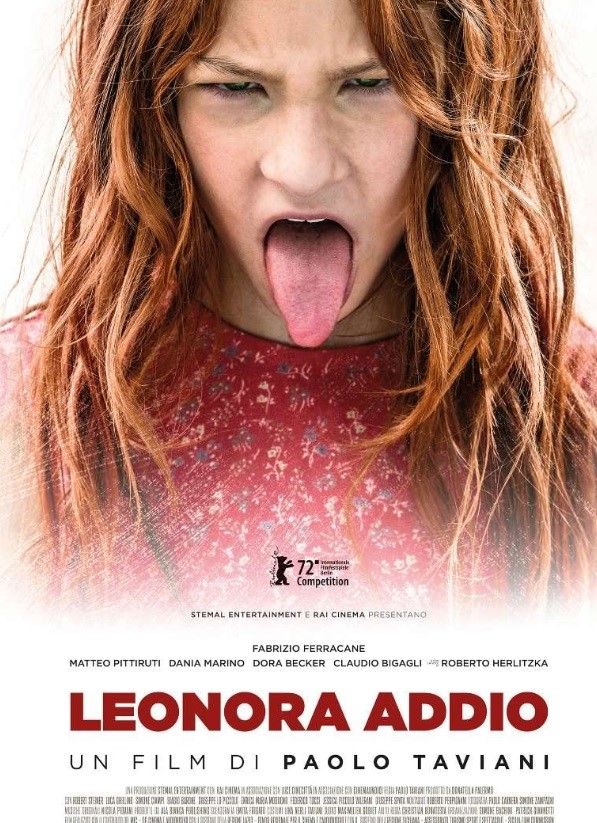
275. Italian director Paolo Taviani’s twenty-second feature film “Leonora addio” (2022), based on his original screenplay: A fitting, unique tribute to the Nobel Prize in Literature winner Luigi Pirandello and to the late film director Vittorio Taviani from the 91-year-old Paolo, younger brother of Vittorio


“Have any of you read Pirandello?” asks a senior priest in a Sicilian seminary to his junior priests 
“I read him in secret, then I confessed” replies a junior priest meekly, with penitence, “I have read one novel--The Old and The Young.” 
“Do you remember the inscription? It reads –To my children: young today, old tomorrow” adds the senior priest, a Pirandello admirer
--conversation between priests in a seminary within the film Leonora addio

Paolo Taviani collaborated with his late elder brother Vittorio on 20 feature films until Vittorio’s demise in 2018 at the age of 88. Their first feature film was released/made in 1962. The two brothers had a unique method of directing their films. Each directed alternate scenes with the other watching but never interfering. That formula worked. The Russian film maestro Aleksander Sukorov, in an interview given to this writer, said it was very rare and commendable for two creative persons to collaborate as directors on feature films for a long stretch of time (he was referring to Grigori Kozintsev and Leonard Trauberg of Russia who worked on a much shorter list of films than what the Tavianis made together.) Two of those Taviani collaborations won the highest award at the Cannes (Padre Padrone) and Berlin (Caesar Must Die) film festivals over the decades. Many of their films are geographically related to Sicily in Italy. All the Taviani films have either original or adapted screenplays written by the brothers. Paolo Taviani has made two feature films after the death of the Vittorio—the first of the two was based on the jointly written screenplay of both the brothers. Leonora Addio, the latest work of Paolo Taviani, made at the ripe age of 91 is the sole work where there is no official contribution of the late elder brother—but in the title credits, soon after the film’s title, are the words “...to my brother Vittorio.” 

Leonora addio is not a mere tip of the hat to Vittorio from Paolo. It is also an acknowledgement of the brothers’ admiration for the Italian playwright, novelist and poet Luigi Pirandello, winner of the Nobel Prize for Literature in 1934. Though controversial as a supporter of Mussolini’s Fascism for a while, he was admired and respected, not merely in Sicily but all of Italy and the world as people became increasingly aware of what he had written and published. The Taviani brothers had made a fascinating 1984 film titled Kaos (released as Chaos in USA) based on four short stories written by Pirandello. In Leonora addio, some scenes from Kaos are included, or rather, recreated. 

Years later in 1998, the brothers made another feature film You Laugh based on two Pirandello stories. Pirandello was indeed close to the hearts and minds of the two Sicilian brothers. 


While Sicilians respect Pirandello, they are superstitious
and refuse to fly on a flight with his ashes on board


Pirandello's ashes arrive in Sicily in a Greek urn
and are transferred to a white coffin meant for a dead child,
while Pirandello's admirers peek at the activity


The comedy of Pirandello rubbed off on films of the Taviani brothers. In Leonora addio, Pirandello’s ashes are carried in a white coffin of small size meant for a sinless child because “the town has run out of adult coffins.” A child who witnesses the stately procession of the coffin asks her father innocently, “Papa, has a child died?,” evoking spontaneous laughter from the grieving adults. 

In this dreamlike sequence, a nod to Kubrick's final sequence in
2001-A Space Odyssey, Paolo Taviani recreates
an old man (Pirandello?/Vittorio?) on his deathbed as the door opens
to reveal three children who emerge and age fast to elderly adulthood


Later in the film, when the final resting place for the ashes is decided after a 15-year search for an appropriate final resting place, there is a leaping leg-clap by the individual who located it, recalling Carol Reed’s musical film  Oliver!, where the leg-clap is beautifully executed by actors Ron Moody and Jack Wild walking into the sunset at end of the film! 

Leonora addio may not be appear to be a perfect film on a casual viewing but it provides perfect entertainment for those familiar with the works of Pirandello and of the Taviani brothers. Much of the film deals with the relocation of the jar containing Pirandello’s ashes to the area in Sicily where the writer was born and grew up. That process of relocation is described with considerable respect which mingles with wry humor, typical of most Taviani films. Most of all, one has to respect the effort of a 91-year-old director showing his love and respect for his elder brother and colleague, as also to a great Italian writer that both brothers admired. Implicit in  Leonora addio are the decisions taken by people in the evening of their lives and how those decisions are dealt with by those who survive the person who has died. The film constantly deals with children and the elderly--"young today, old tomorrow."


Leonora addio's second segment is Pirandello's The Nail,
where an affable Sicilian immigrant boy (in Brooklyn) who
can dance to music while working as a waiter. In Taviani's earlier work 
Kaos, Sicilian boys dreamt to emigrate to USA


The immigrant boy waiter who dances, later kills a girl who was
fighting another seemingly "without purpose." Taviani's earlier film
Good Morning, Babylon was about two Sicilian brothers who
emigrate to USA and find work with D W Griffith in Hollywood 


It is thus not without purpose that the first half of Leonora addio, dealing with the relocation of Pirandello’s ashes as per the writer's wishes, is shot in black and white, which is followed by a Pirandello story titled The Nail set in Brooklyn, USA, filmed in contrasting lush color, This segment also deals with death of a little girl with a large nail and her killer’s frequent trip to place flowers on her grave on a regular basis, after his release from prison. When the killer is asked why he killed the girl, he answers that he killed  the girl because she was was fighting with another “without purpose.” The viewer could reflect if the growth of Fascism under Mussolini was "without purpose" as well.

The most intriguing trivia is that the title Leonora addio is indeed the title of a written work of Pirandello that surprisingly is not discussed within the film. So why did Paolo choose the title of that Pirandello work as the title of the film? There must be a reason and there is one that fits logically. There is a Pirandello play called Tonight We Improvise, which is part of the Pirandello trilogy of plays better known as ‘Theatre within Theatre.’ In this play, a famous opera singer describes the physical theater to her children, who have never seen it, while singing parts of the opera ending with the duet Leonara addio, she apparently dies from exhaustion only to get up later and seek the forgiveness of the audience. 

Time must pass and carry us away with all the scenarios of life” is a Pirandello quote spoken in Leonora addio. The film allows us to do the same recalling both Pirandello and the elder Taviani. All this adds to the details inter-mingling the memories of the works of Pirandello with the past works of the Taviani brothers and other works of Italian cinema shown in clips within the film. Leonora addio’s depth of communication will be lost on those viewers who are not sufficiently exposed to the films of the Taviani brothers or the written works of Pirandello, significantly his most famous play Six Characters in Search of an Author and its related concept of “theatre in the theatre.” It can argued that Pirandello’s “theatre in the theatre” laid the foundation for the more famous concept of “theatre of the absurd” of Samuel Beckett, Eugene Ionesco and Arthur Adamov. However, for those who are familiar with all that, Leonora addio provides quality entertainment. If we look closely at the title credits, the title of the film followed immediately by the dedication, is a personal message from Paolo “Leonora addio.. to my brother Vittorio,” which a lover of good cinema and literature would relish and approve of. 

P.S. Leonora addio won the FIPRESCI prize at the Berlin international film festival in 2022 and was nominated for the Golden Bear. The Taviani brothers' film Caesar Must Die (2012) has been reviewed on this blog. (Click on the film's title in this post-script to access the review). Paolo Taviani is one of the author’s favorite 15 active filmmakers in the world. Two of the Taviani films are included in the author’s list of top 250 films: Padre Padrone and Kaos. Leonora addio is one of the author's best films of the year 2022.


Saturday, August 28, 2021

265. Italian film director Uberto Pasolini’s third feature film “Nowhere Special” (2020) in English, based on his original script: The rare intent and ability to care for the future needs of others when you can do so


“I wanted to make a film with this title for a long time. The title is from a dialogue at the end of Mel Brooks' film  Blazing Saddles; one character asks the other, "Where are you going to go?" and the other replies,"Nowhere special", and the first person replies, "I always wanted to go there." The idea behind this choice is that there is no perfection, that you just have to live, find a place where it is good to live, simply.”

---Director Uberto Pasolini, speaking  on how he chose the title of this film for his own fictional script, written after he read a newspaper story on a similar adoption, with the adoption agency refusing to divulge details of that case to him, due to confidentiality clauses (a rough translation of his interview given to Malik Berkati at the Zurich film festival, quoted in J:Ma. Lifestyle and Citizenship) 


Film director Uberto Pasolini makes small budget films with great care and thought that demand respect of mature filmgoers worldwide. His last two films Still Life (2013) and his latest work Nowhere Special (2020) focus on realistic characters who belong to the middle class but are sensitive to the world around them, lending a helping hand to people who require help in a low-key and admirable manner. Both his works stand out among so many others because he writes original stories/screenplays alone—a very creditable distinction separating him from the bulk of other filmmakers, relying on someone else’s tale to direct.

Nowhere Special is a tale of a single father, John, who has brought up his 3 year-old-son, Michael, with earnings from his work as an independent window cleaner in Northern Ireland. John dotes on his single offspring and takes care of him as a mother would. As the film progresses, we learn that John is in advanced stages of a life-threatening illness and Michael can’t be in his care for long. He approaches an adoption agency and they arrange for John and Michael to meet prospective foster parents for Michael in order for John to decide on Michael’s future family.

The single father John (James Norton)
goes shopping with his son
Michael (Daniel Lamont) 

Pasolini’s amazing ability is in presenting the relationship of father and son in the absence of a mother. John provides all he can, within his financial limitations, which include providing toys and trips to fairs for his intelligent, responsive son. The conversations are minimal and the performances of the first-time child actor Daniel Lamont under the tutelage of Pasolini reminds you of Charles Chaplin directing Jackie Coogan in The Kid (1921) and perhaps even of Vittorio de Sica directing a relatively older Enzo Staiola in Bicycle Thieves (1948). Pasolini’s direction of James Norton as the father John, repressing anger, and alternating frustration with patience in Nowhere Special results in an amazingly controlled outcome. Pasolini had achieved a similar feat with Eddie Marsan in his earlier remarkable film, Still Life.

Are there similar patterns between Nowhere Special and Still Life? Both films study men’s actions in this life and the events after death. Death is the fulcrum of both films, philosophically. In Nowhere Special, John introduces the concept of death to his 3-year-old son by getting him to read about death of dinosaurs. The audience sees some manifestation of his son’s understanding that his father is tired/sick when the boy covers his sleeping father with the blanket that has partially fallen, possibly mimicking what his father would have done for him. Both films of Pasolini are a treat to study for colorful details that the director infuses into the narrative, one example being of John looking at the side mirror of his car to observe an older schoolboy with his bag walking back home, to imagine what Michael would be like when he grows up.  

The single father's treasure notices the tattoo,
which he tries to copy on his own hand

In bits and pieces of conversation in the film, we learn that John was an orphan and therefore is all the more interested that Michael has a good family to take care of him. In Still Life, the colorless bureaucrat, Mr. May, goes the extra mile to contact dead persons' relatives and friends and informs them of the death of their forgotten kith and kin. In Nowhere Special, it is a dying father worried about the future of his son if he hands him over to the wrong foster parents. “This is the most important decision of my life. How will I know if I got it right?” John bursts out his frustration at the quiet adoption agency staffer, who reminds him that the clock is ticking for him to make a decision about Michael. There is no obvious manifestation of his deteriorating health except for a bout of vomiting  (thankfully less repulsive realism than John Cassavetes’ 1970 film Husbands) and a sudden decision to stop working after having climbed a tall ladder to clean a window. I admire Pasolini’s ability to add small details in both his films that say a lot without spoken words. One example is saving John’s wife’s/spouse’s mitten left in the dashboard of his car (which he is now selling to evidently augment his purse as he has decided to stop working) to be included in a box of memorabilia for Michael, when he grows up, along with John’s photographs with Michael.  

Breaking the concept of time to his toddler
with 34 candles on John's birthday cake
It is important to compare and contrast Nowhere Special with Naomi Kawase’s Japanese film True Mothers—both films about adoption made the same year in different parts of the world. True Mothers is a film made by a lady director about real mothers and foster mothers of orphans in the contemporary world. In both films, the single parent is giving up their biological child for foster care out of extreme necessity. Both are remarkably well-made films. While religion is absent in the Japanese film, for Pasolini this is important in Nowhere Special as it was in Still Life. John teaches Michael to pray before he goes to sleep and John has a silent thought of his impending future as he stops his car at a red signal, and he  views a closed church with a cemetery, ending the short car halt with a smile, possibly indicating that he is now well prepared for the inevitable. Compared to Still Life, Nowhere Special has a muted dose of religion. 

John looking at the closed church and cemetery


John drives on with a telling smile


The final incredibly mature goodbye of a 3-year old

Unfortunately, compared to Still Life, Nowhere Special lacks the musical contribution of Pasolini’s wife, composer Rachel Portman, which had enriched the earlier work. Even without Ms Portman’s musical flourishes, Nowhere Special is a very rewarding viewing experience for viewers who are not mesmerized by escapist and unreal tales. Mr Pasolini, the late film maestro Luchino Visconti will be proud of you as his nephew putting so much care and thought into the films you make to entertain discerning viewers!


P.S.  Nowhere Special has won the Best Film award at the Pula (Croatia) film festival, and the Audience awards at the Warsaw (Poland) and the Valladolid (Spain) international film festivals. The director’s earlier film Still Life (2013), winner of the Best Film award in the Venice film festival’s Horizons section, and 18 other awards worldwide, has been reviewed earlier on this blog.  The other  Japanese film by director Naomi Kawase’s True Mothers discussed in the above review also has been reviewed earlier on this blog. (Click on the colored names of the films in the post-script to access the reviews.) Both Nowhere Special (2020) and True Mothers (2020) are included in the author’s list of best films of 2021.  


Monday, October 12, 2020

256. Italian director Mauro Mancini’s debut feature film “Non Odiare” (Thou Shalt Not Hate) (2020), based on an original script by Davide Lisino and Mauro Mancini: Fascinating tale on human contradictions, visually narrated, economizing on spoken words


“I wanted what the characters don’t say to each other to be more important than what they do say to each other”

---Director Mauro Mancini’s statement to interviewer Davide Abbatescianni, in Cineuropa, after the film competed in the International Critics’ Week at the 2020 Venice film festival


Debut feature films are, in most cases, interesting films because the directors invest a lot of fresh thought as in the prime examples of Welles, Melville, Chabrol, Ridley Scott, Mike Nichols, Spielberg and the Coen brothers. So too, Mauro Mancini’s first feature film Thou Shalt Not Hate makes an unusual impact where spoken words take a back seat and silent actions speak louder.


Alessandro Gassmann in the Venice award-winning
role of the reputed Jewish surgeon


The hate in the film refers to the continuing hatred over generations between the Nazis/the neo-Nazis and the survivors of the holocaust (and their progenies), surfacing in contemporary Italy. The strength of the film does not lie in the tale that unfolds but more in the way it is presented. The film stands out as a result of the combined creative abilities of the director/scriptwriter, his co-scriptwriter, and the lead actors that present a simple tale, intelligently told.

The film opens with a scene where a father asks his young son to drown several kittens of a brood but retain one. The film ends with an adult re-visiting the same spot alone. The two key sequences do not seem to have a direct connection with “hatred” depicted in the main tale of the film but it does connect up with ideas/prejudices passed on by one generation to another. While many viewers are likely to spot the obvious tensions and hatred between the neo-Nazis and the Jews in the film, viewers are less likely to note the contrasting relationships between father and son within the two groups, presented in Thou Shalt Not Hate. In one group (the neo-Nazis), the son idolizes the father and his views, in the other (the Jewish Italian) there is almost very little evidence of any close connection between father and son in spite of working in closely connected professions. Interestingly, the mother figures in both groups are almost absent in the film’s script. The tale is either intentionally or unintentionally patriarchal. The viewer is given the choice by the filmmakers to figure out where the hatred lies: whether is it between the Nazis/neo-Nazis and the Jews or between the evolving generational perspectives within each group, or perhaps both.

In terms of religion, the title of the film Thou Shalt Not Hate is not a Jewish/Christian commandment but mirrors the Commandment “Love Thy Neighbor as Thyself.” The film extends this view not just to human beings but to man-animal relationships as well. In contrast to the drowning of the innocent kittens that open the film, a fierce dog guarding the house of the dead dentist viciously snarls at his dentist’s son who had not met his father for a long while. Later sequences with few spoken words, explain the gradual bonding of the dog for his new owner. Another detail that may not be obvious is the burial of the neo-Nazi in a Christian cemetery without a priest, a prayer, or a Bible reading.

When a neo-Nazi dies, his daughter is the only
female mourner

The remarkable abilities of the director Mancini and his co-scriptwriter Lisino are apparent in scenes where no words are spoken and music is not used as a crutch to lift the emotions of the viewer. One such scene is the decision of the doctor to visit the police station to lodge a complaint (not a knee-jerk reaction) on being attacked as he first chose to go home and attend to his wounds and mulled over what to do next. He then turns back after pressing the door bell of the police station and almost opening the door that was remotely unlocked for him to enter. Another is a scene in a supermarket, where he chances to spot his housemaid at work from a distance. He departs discretely without interacting with her. The visuals and the editing speak more eloquently than spoken words. In another scene, the subtle ingrained reaction of the maid while travelling in a crowded bus towards an innocent black immigrant sitting close to her is delicately captured by the filmmakers. So is the subtle visual comparison of the old furniture stacked up in the Jewish father’s house along with clues to identify Nazis responsible for the holocaust meticulously being researched by the dead dentist, while his Jewish son lives in a clean and modern apartment without any clutter. The film studies attitudinal changes in families over a generation with love and forgiveness replacing intense hate. Even consensual sex between two evolved adult individuals from the two groups does not take place because they do not feel it is appropriate, indicating the maturity of the screenplay writers.  

While Thou Shalt Not Hate has an early sequence exhibiting the innate hateful action for neo-Nazis from a reserved, otherwise cool-headed Jewish doctor leading to the death of an “accident” victim, the rest of the film relates to the doctor going out of the way to procure public information on the victim and his family and attempt to discretely provide succor to the family of the deceased to compensate his hate-ridden, knee-jerk action on reaching the accident site.

The doctor seeks redemption for his hate
 in an empty synagogue 

The film recalls the Polish director Krzysztof Kieslowski’s sophisticated ten part Dekalog (Decalogue) on the ten Jewish/Christian commandments and Kieslowski’s incredible continuous collaboration with co-scriptwriter Krzysztof Piesciewicz that followed. It appears director Mancini is following in Kieslowski’s footsteps by continuing his collaboration with his co-scriptwriter Davide Lisino on his next film project.  

Sara Serraiocco, plays the housemaid
to the Jewish doctor

Apparently Mancini and Lisino developed the story after reading a news item about a surgeon who refused to surgically operate a neo-Nazi years ago and developed the film script keeping actor Alessandro Gassman in mind. Gassman appears as an Italian version of Hugh Laurie playing Dr House (minus the limp, of course) and his laconic performance won him the Venice acting award. (Alessandro is the famous Italian actor Vittorio Gassman’s son.) Mancini very aptly paired Alessandro with the equally talented actress Sara Serraiocco, who has been playing major roles in recent award winners at the Cannes and the Berlin film festivals. The casting choices added value to the film. The future collaborative works of Mancini and Lisino will indeed be worth waiting for.


P.S.  Thou Shalt Not Hate won the best actor (Pasinetti) award for Alessandro Gassmann and the award for the best Italian film at the 2020 Venice film festival. The film is participating in the 2020 Denver Film Festival, USA. Thou Shalt Not Hate is one of the author's best films of 2020 Four segments of Kieslowski's Decalogue (Decalogue 1, Decalogue 2, Decalogue 5, and Decalogue 7) mentioned above have been reviewed in detail earlier on this blog. (Click on the names of the films in this post script to access the reviews.) 

Saturday, September 05, 2020

254. US director Abel Ferrara’s semi-autobiographical feature film “Tommaso” (2019), based on his own original script: Trying not to be himself, the director reveals more of himself


T
he year 2019 saw four directors from four different countries make semi-autobiographical feature films: Spanish director Pedro Almodovar made Pain and Glory, Palestinian director Elia Suleiman made It Must Be Heaven, US director Abel Ferrara living and working in Italy made Tommaso and rookie British director Joanna Hogg made The Souvenir. Each of them found different groups of cineastes being enamored by their creative products using distinctly different approaches to filming the problems they as filmmakers face in real life. Some hide their thinly veiled identity by choosing a nom de plume such as Tommaso (played by Willem Dafoe) in Abel Ferrara’s film which will not fool any astute viewer. Tommaso is a fictional name of a filmmaker resembling Mr Ferrara, developing his own original screenplays for future directorial projects, and he too lives in Italy and is learning Italian and teaching acting to potential actors as he has chosen to live and work in that country. Tommaso is married and has a young kid called Deedee. So does Mr Ferrara. The wife of Tommaso is actress Christina Chiriac, who happens to be Mr Ferrara’s wife in real life. Deedee is played by Anna Ferrara, the director’s own biological daughter. Yet, Mr Ferrara opts to use a nom de plume

Tommaso (Willem Dafoe) teaches acting to students in Rome


The approaches of the other three directors in their respective 2019 films are somewhat different. Spanish director Pedro Almodovar made his semi-autobiographical film Pain and Glory with the lead character, a fictional film director named Salvador Mallo (Antonio Banderas, winning the Cannes Best Actor award for the performance) with some obvious parallels to Mr Almodovar’s own life. According to journalist Sabrina Rojas Weiss, writing in Refinery29, Almodovar admitted to Los Angeles TimesThere is a lot of myself there, but somethings belong completely to my life and some do not but could have been.” Joanna Hogg’s film The Souvenir is again autobiographical, recalling her days in a film school through the eyes of a fictional film student called Julie. Only in the case of the Palestinian director  Elia Suleiman, in his admirable work It Must Be Heaven, the director chooses to play himself facing the camera without uttering a word but as a spectator of humorous, semi-fictional events and identifying himself with his initials ES. 

While Suleiman identifies himself and his thoughts in his film almost completely through visuals, Abel Ferrara chooses to identify his honest thoughts using the spoken words of his nom de plume Tommaso. When Tommaso is picked up by the secret police in Italy for making some comments in public and is forcibly made to confront a senior police official, Tommaso states with certain gravitas: “The temple of all laws must fall. A new temple of truth should be built. Don’t take me literally. What is truth? Truth is you are in pain, you have a terrible headache. You are thinking of suicide. You should take a walk in the park. The trouble is you lack empathy. You care for your dog.” The viewer would initially assume the rant is about Tommaso. You realize it isn’t only when the police official removes Tommaso’s handcuffs and responds to Tommaso with respect, “Are you a doctor?” Ferrara is merely emphasizing the importance of a film director to note details and gestures of people around them as an observant doctor would. 

Tommaso with his wife (Christina Chiriac, a.k.a. Mrs Ferrera)


Ferrara does not limit the film to the present. He reveals a bit of his tortured past in a group therapy session for drug addicts where he recalls he asked his 4-year-old adopted girl child “Are you leaving because I make too much noise?” (a likely scenario from his own life). The very same Tommaso ironically rushes out to quieten a drunk Pakistani shouting in the street outside his apartment in Rome at night because Tommaso’s (read Ferrara’s) real girl child born much later in life is likely getting disturbed by the noise of the drunkard’s rants. Mr Ferrara seems to indirectly state that he has matured over the years, being more responsible for his family. In another sequence in Tommaso, the character hallucinates that his daughter is run over by a car while crossing the street while rushing to hug him.  

Tommaso watches his daughter enjoy a cone of gelato 


If one looks at Ferrara’s move to Italy from the US to make films one of his films made in 2009 is a docudrama called Napoli, Napoli, Napoli (Naples, Naples, Naples). In Tommaso, towards the end, there is a scene of Sophia Loren dancing in her 1960 US film It Started in Naples playing on a video screen to which Tomasso’s daughter Deedee is dancing in tune. These visual connections would be lost on a viewer who does not know much about Ferrara’s life and career. In a very revealing interview to Eric Dahan in Numero, Ferrara states “All my films, alas, say something about me, one way or another. I try not to be me but in the end of course I cannot help it.” 

Ferrara reveals his own tortured creative life with simple actions in Tommaso. While Tommaso is trying to work on a screenplay for a film project in the night when all his family is asleep, a light bulb of a crucial lamp in his study fails and new bulb that he replaces it with in the lamp also fails as he switches on the electric current. The next morning, an angry Tommaso, is on screen walking down the pavement with the troublesome lamp in hand, leaving it on the sidewalk but not in the trash bin, as his wife and daughter watch his angry actions with concern from a safe distance. 


For Ferrara watchers, Tommaso is merely one of many films that the director has used Willem Dafoe as a lead actor of preference. Dafoe played the lead in the biopic Pasolini (2014), another Ferrara film set in Italy, 4:44 Last Day on Earth (2011), Go Go Tales (2007), New Rose Hotel (1998, sharing lead with actor Christopher Walken) and again in Siberia (2020). The close ties between the director and the actor increases in Tommaso where Ferrara depicts Dafoe playing Tommaso allegorically “crucified” in public in modern Rome creating a visual connect between Dafoe’s role as Christ in The Last Temptation of Christ. Next to the “crucified” Tommaso is a “crucified” African immigrant as a follow up to a sequence where Tommaso offered a group of African immigrants, sitting around an open fire in a garden the previous night, an allegorical “bloody heart” during a “last supper” while speaking the words “Take this. This is all I have.” 

To appreciate Tommaso, the viewer has to be essentially familiar with Ferrara’s work. If one is familiar with Ferraro’s life and work, Tommaso offers a lot for the viewer. Evidently Dafoe knows this well and gives fine performances in each Ferrara film. Tommaso is no exception. 

P.S. Tommaso is one of the author’s top 20 films of 2019. The film won the grand jury prize at the Lisbon and Estoril Film Festival. Elia Suleiman's film It Must Be Heaven mentioned above has been reviewed on this blog earlier (Click on the name of the film in this post-script to access it.)


Saturday, September 14, 2019

238. Italian maestro Roberto Rossellini’s film “Stromboli, terra di Dio” (Stromboli) (1950) (Italy) (Italian, English): A slightly different perspective of the classic nearly 70 years after the film was made--atheism vs. theism


Many cineastes are aware of Roberto Rossellini’s famous work called Stromboli. But how many are aware of its complete title Stromboli, terra di Dio, which translates as Stromboli, land of God? The full title is essential to grasp what Rossellini as its director and its original story writer wanted to state through the film he conceived and made for us to enjoy and appreciate.

The bulk of the critical analyses of the film considers the story outside of the film’s narrative—the extramarital affair between Swedish actress Ingrid Bergman and Rossellini, which led to the birth of three offspring and a brief self-enforced exile of Ms Bergman from Hollywood. Ms Bergman, while working in Hollywood, had expressed her desire to work with Rossellini after viewing his two films prior to StromboliPaisan and Rome Open City—by writing this brief and famous letter to him without having met him.

Dear Mr Rossellini,
I saw your films Open City and Paisan, and enjoyed them very much. If you need a Swedish actress who speaks English very well,who has not forgotten her German, who is not very understandable in French, and who in Italian knows only "ti amo," I am ready to come and make a film with you.
Ingrid Bergman

Ingrid Bergman as Karin

It is quite conceivable that Rossellini wrote the story of Stromboli, terra di Dio with Ms Bergman in his mind to play the role of a Lithuanian prisoner-of-war who had an affair with a German army officer during World War II. In contrast to Alfred Hitchcock, who made films (three of those with Bergman in the lead roles) with detailed scripts and precise words to be learnt by rote and spoken by the actors, Rossellini merely wrote a story sketch and developed the spoken lines as he went along, just as Terrence Malick made films many decades later.  The volcano on the island of Stromboli was not expected to erupt during the filming and the entire volcanic activity captured in the film is real and not faked or recreated artificially. The denizens of the island knew what to do if and when the volcano erupted and knew the procedure of taking shelter in boats cast out to sea but well within view of the island.


The simple, hard-working fisherman Antonio (Mario Vitale),
husband of Karin

Antonio falls in love with Karin, a Lithuanian prisoner of war,
exchanging few words with barbed wire separating them 


Rossellini wrote the story/script that tossed the lives of the main characters against a very unpredictable and life threatening natural calamity. Being an Italian, Rossellini was influenced by the Catholic Church and evidently he was quite familiar with the Bible and consciously included the character of a Catholic priest with a significant role within the film’s tale.

Rossellini’s familiarity with the Bible is evident when the film opens with a quote chosen from the Bible—The Book of Romans, Chapter 10, verse 20, which reads “I was found by those who did not seek me. I was made manifest to those who did not ask for me. ” The passage is attributed to Apostle Paul writing to the Romans in the New Testament where the “I“ refers to God. Interestingly, the passage itself is a cross reference to the precise words of the prophet Isaiah stated earlier in the Old Testament within the Book of Isaiah Chapter 65, verse 1. 

It is immaterial whether director Rossellini and actress Bergman were staunch believers in God—what matters is that the title of the film Stromboli, terra di Dio includes the word “Dio” (God) and the film begins with an important quotation in the Bible, which incidentally appears twice in the Bible.

Karin is found lacking in modesty by the elder womenfolk of the island

The biblical start of the film gains importance towards the end of the film when Ms Bergman’s character Karin in the film utters the final words of the film “God..my God..help me,  give me the strength.. the understanding .. and the courage.  God, God, God, merciful  God. God, God. God.” Prior to those words are Karin’s words of epiphany “Oh God! Oh God! What mystery, what beauty!”  after the volcano settles down, and the smoke withdraws to show birds flying against a clear sky.

The last words and the ending of the film are in stark contrast to the words spoken earlier by Bergman’s Karin to the priest on the island that God had not been merciful to her and had left her desolate. (“With me, God has never been merciful” ..“These black rocks, this desolation, that...that ‘terror,’ the island drives me mad, Father!”)


Karin finds the population of the island "horrible"


Karin, as Rossellini etched her character, is able to comprehend that she has sinned in the past by having an affair with an officer of the invading Nazi German army (“I was trapped like all the rest .I..I have sinned but I have paid”) Karin is also a woman who threw out an image of Virgin Mary that Antonio’s (Mario Vitale) dead mother had kept in the house  while renovating  the meagre dwelling, much to the chagrin of Antonio, when he realizes what his wife Karin had done. Even if Karin has no respect for images of Virgin Mary in the house, Karin who calls the villagers of Stromboli “horrible,” for  describing her to be lacking in modesty, self realizes with magnanimity during the volcanic eruption that she, Karin, is worse than them.“They don’t know what they are doing. I am even worse.” Some of the theology in the film can be attributed to Father Felix Morlion, who was consulted by Rossellini while writing the script.


Now, if the viewer accepts the theological undercurrent of the film, it is most amusing that in USA the film was released as an 81 minute version (in contrast to the restored 107 minute version) bowing to the call of church groups, women’s organizations and US legislators who wanted the film to be banned solely because of the publicity of the extra-marital affair of Ms Bergman with Rossellini and the birth of their illegitimate child rather than the contents of the film. A Colorado Senator called Ms Bergman “a powerful influence for evil” (Ref. Stromboli film on Wikipedia). The  81-minute US version that did not have Rossellini’s approval had an ending that implied Karin was returning to her husband Antonio, which is never assumed in the restored 107 minute version. (Ironically, Ms Bergman was re-accepted and lauded by Hollywood years later for her role in Anastasia.)  In contrast to the negative reception of the film Stromboli, terra di Dio in USA, the longer Rossellini film version won the Rome Prize for Cinema (the best Italian film award) in 1950.

Now, if the viewer were to be an atheist, the film can be appreciated differently. Karin is obviously a woman who is not respectful of the religious artefacts kept by husband Antonio’s dead mother and throws them away to renovate and redecorate the house. She is an attractive woman who wants and enjoys attention from male personalities that she encounters—including a Catholic priest who tries to help her adjust to her husband but resolutely rebuffs her advances.

Karin is an opportunist wanting a life more interesting than what she had in Lithuania (her hope there was the German army officer), more interesting than Italy (she wanted to emigrate to Argentina), escape the life of a POW in Italy (she succeeds in marrying an Italian) and after being in Stromboli for a while, she yearns for a better life by leaving her devout, simple husband and escaping to the other side of the island. But the protective woman in Karin emerges briefly in the film when she is upset viewing a trapped rabbit being killed by a ferret.  Visually it is clear that Karin, after the volcano has stopped erupting, is as concerned about the child in her womb as she was with the rabbit. She aspires for a better deal for herself and her unborn child, in another geographical location, even though she is penniless and without a change of clothes (reminiscent of the final pages of John Bunyan's book The Pilgrim's Progress written in 1678) .  What she does or rather what she intends to do is never clearly stated.

Karin escaping her life with husband Antonio and the erupting volcano 

Rossellini leaves the ending open ended for the viewer to interpret–a treatment rarely accepted in commercial cinema worldwide.


The greatness of this work is the depiction of conflicts of man and nature without employing special effects or cinematic tricks which flood cinema today. Rossellini’s filming recalls the world of Robert Flaherty and his classics Man of Aran (1934), shot in Ireland, and Nanook of the North (1922), shot in USA. Like Flaherty, Rossellini used the real population of Stromboli, except those employed for the major roles. Thus, the real tuna fishing sequences can be termed docu-fiction taking a leaf out of Flaherty.

The exhausted Karin falls asleep as the violent eruptions
of the volcano subside, the profile of Karin seemingly mimicked
by the now quiet volcano, while the moon shines at both


The effort of Rossellini to craft the final half hour of Stromboli, terra di Dio is commendable while some detractors will fault the film’s details such as the lack of grime on Ms Bergman's body. This film is truly one of the best works of neo-realism ranking alongside Olmi’s The Tree of Wooden Clogs, made without professional actors decades later.


P.S.  Ermanno Olmi’s The Tree of Wooden Clogs (1978), reviewed earlier on this blog, is a neo-realist classic that won the top honour at Cannes film festival and one of the author’s top 10 films. Few are aware that the then Indian Prime Minister Jawaharlal Nehru was so impressed by Rossellini's work that he invited him to come to India and invigorate the state-run Films Division's documentaries. Rossellini accepted the invitation only to fall in love with another married woman, this time a Bengali lady, Sonali Dasgupta, create another controversy, and eventually marry her! The influential journal of film Sight and Sound's Critics Poll lists Stromboli, terra di Dio as one of 250 greatest films of all time.


Friday, June 28, 2019

237. Italian maestro Ermanno Olmi’s feature film “La Leggenda del Santo Bevitore” (The Legend of the Holy Drinker) (1988) (France/Italy): One of the finest examples of magic realism in film history and the importance of making the right choices of appropriate background music


Ermanno Olmi (1931-2018) is not often discussed on the same plane as Orson Welles or Andrei Tarkovsky. Yet they have certain similarities in their body of film output.  Olmi made 20 feature films and bagged over 50 international awards. His best work The Tree of Wooden Clogs (1978) is as awesome as Welles’ masterpiece Citizen Kane (1941). Olmi’s film was based on his own original script, which he directed, cinematographed, edited and for which he personally picked an array of non-professional actors. For Citizen Kane, Welles had co-written an original script with Herman Mankiewicz, directed, produced, acted in the main role, and chosen his own cast of professional actors (most of them making their film debuts) and crew.  Olmi’s film won the Golden Palm at the Cannes film festival for the best feature film; Welles won a solitary Oscar for the co-written original screenplay. Olmi and Tarkovsky have common streaks, too; both are evidently theistic, Olmi a fervent Roman Catholic, Tarkovsky a resolute adherent of the Russian Orthodox Church. Both Olmi and Tarkovsky chose their music for their works with considerable deliberation, a fact missed out by many of their respective fans.

The scruffy vagrant Andreas (Rutger Hauer), living under a bridge

A stranger and benefactor (Anthony Quale) offers Andreas a "loan"


Olmi’s 12th feature film The Legend of the Holy Drinker,made 10 years after The Tree of Wooden Clogs, won the Golden Lion award for the best feature film and another minor award at the Venice film festival.  In this film, Olmi made a couple of departures from his usual trademark style—he chose to mix professional actors (Dutch actor Rutger Hauer of Blade Runner fame, British actor Anthony Quayle of Anne of the Thousand Days fame, Dominique Pinon of Delicatessen fame) with non-professional actors (the enigmatic Sophie Segalen who plays the Polish woman Karoline, and Jean-Maurice Chanet, who plays the Polish boxer) who never returned to the world of film. Olmi made another significant departure in this film: he chose to adapt a novel written by Austrian writer Joseph Roth, instead of writing his own original script as in most of his other films. Olmi co-wrote the adapted script based on Roth’s book with Tullio Kezich (who had earlier played the role of the psychologist in Olmi’s earlier film Il Posto).

Andreas can look somewhat distinguished when he can afford a shave
(and has a roving eye for women)

Sophie Segalen, who plays Karoline, a nonprofessional actress picked by
Olmi, who never returned to the world of film 


The tale is deceptively simple.  Andreas is an alcoholic, unemployed tramp with a Polish passport, living homeless under bridges along the river Seine in a rainy Paris. His passport bears a stamp stating that he has been expelled from France. For a vagrant, he is unusual. He wears a necktie and believes in looking respectable when he can afford a shave. His looks and demeanor indicate that he is a “gentleman” tramp, which is possibly why men and women trust him and are only eager to help him.  He is reluctant to accept money (a sum of 200 French Francs) from a stranger as a gift but agrees to take it when the generous stranger states that he could consider it as a loan. Andreas is resolute in his intent to repay the loan, when possible, not to the stranger but to the vicar of the church of St Therese of Lisieux in Paris, who the stranger had indicated will know what to do with the returned sum.

Andreas is not overtly religious—merely a gentleman tramp, with a roving eye, but always ready to help a friend in need.  As the film progresses, we learn that in school, Andreas would let his classmates, who were not as bright as he was, copy his answers in the examinations.  The film, if you examine it closely, is less about religion and more about being morally upright and being good to those less fortunate. The film propounds magic realism to underscore to the viewer that good deeds will eventually lead to amazing blessings from unexpected sources.  The film suggests in a fabulous magical sequence of epiphany involving a poor elderly couple who magically transform to Andreas’  recollection of his parents—a sublime sequence indicating that Andreas is indebted to his parents for inculcating fine traits in him that have held him in good stead. It is a sequence that has so many similarities with Tarkovsky’s Mirror where magic realism is employed to recall the role of parents and in his later work Stalker where a girl observes a glass on a table moving on its own accord, aided by external reverberations.


Repaying the loan of 200 French francs, finally as agreed


Olmi and Kezich crafted the script of The Legend of the Holy Drinker where the spoken words are minimal. The tale is communicated with visuals (read cinematography of Dante Spinotti), editing, and musical score (the last of which is lost on most viewers because the other two elements dominate).  While other directors and scriptwriters would have wasted spoken lines on the inconsequential sexual encounters of Andreas, Olmi and Kezich reduce them in one sequence to mere furtive glances and the closing of curtains, without a word spoken.  When words are spoken in The Legend of the Holy Drinker  it is to indicate the integrity of the tramp:  when a stranger offers him a drink at a bar and a job, his acceptance is sealed with another round of drinks that the gentleman tramp insists on paying for with the meager possession of coins with him. That the tramp was not religious is indirectly inferred by a cryptic statement he makes to an old friend from Poland “These last few days I have started believing in miracles.” He should. He buys a wallet, and finds money in it.  Then a policeman returns him his wallet, with more money in it. Andreas believes in returning his “loaned” money several times in the film, but is distracted near the church each time by extraneous interventions.  He wishes to return the loan, but the goodness and grace that embody every little action of his seem to prevent his fervent desire to repay the loan. One can assume the connection between gracious actions and unexpected rewards are from Roth’s book.  

The reaction of Andreas on meeting "Therese" at the
restaurant near the Church where he has to repay the loan

Olmi’s distinct contributions are the visual complements of the cinematic craft at key points in the film: the smiling “Therese” in her third appearance in the film approving the repayment of his loan shown through a door slightly ajar edited into the film—a private communication between the two, another epiphany.

Olmi chose three pieces of music written by Stravinsky—not his famous Rites of Spring. The three pieces are Divertimento, Symphony in C, and Sinfonia di Salvi per Coro—Salmo 40 or Psalm 40. The last of the three Stravinsky pieces is very significant. Psalm 40 in the Bible is King David’s song of praise “I waited patiently for the Lord; he turned to me and heard my cry.  He lifted me out of the slimy pit, out of the mud and mire. He set my feet on a rock and gave me a firm place to stand….” 

Tarkovsky’s choice of music in Solaris—Bach’s Prelude and Fugue in F minor and The Little Organ Book: Ich ruf zu Dir, Herr Jesu Christ—are conscious decisions, too, to complement the visuals in specific sequences. That the film The Legend of the Holy Drinker won the Golden Lion at Venice from a jury headed by Sergio Leone whose films used music so eloquently is possibly a nod to Olmi’s musical selection in the film that Leone could perceive.


Olmi’s films always deal with deprived sections of society.  More so Olmi’s protagonists (e.g., Il Posto, The Tree of Wooden Clogs) are far removed from the reflecting, philosophizing intellectuals we encounter in Tarkovsky’s films—here they are honest, hardworking, principled individuals, often losing out to the machinations of the rich or unprincipled folks, akin to scenarios that we encounter in the films of Ken Loach and his scriptwriter Paul Laverty.  


A painting? Cinematography of Dante Spinotti,
capturing light and shadows


Olmi chose to work with Italian cinematographer Dante Spinotti for the first time in The Legend of the Holy Drinker and later in yet another film The Secret of the Old Woods (1993). Spinotti had a similar effect on Hollywood director Michael Mann, who was so impressed with his work on Manhunter that their collaboration extended to other more impressive films: Heat, The Last of the Mohicans, The Insider, and Public Enemies.

Few cineastes might be aware that The Legend of the Holy Drinker won several national awards in Italy for direction, cinematography and editing while competing with Tornatore’s Cinema Paradiso. The Olmi film is a gem that can be appreciated beyond Joseph Roth’s tale.  It is a rare example where tools of filmmaking—direction, appropriate casting, music, cinematography and editing--prove their subtle prowess.


P.S. The Legend of the Holy Drinker is one of the author’s top 100 films. It won the best Golden Lion award for the best film and the OCIC award at the 1988 Venice Film Festival. Actor Rutger Hauer won the Best Actor award for this film at the Seattle International Film Festival. Several films mentioned in the above review, the Olmi film The Tree of Wooden Clogs (1978) and Tarkovsky’s Solaris (1972) and Mirror (1975) have been reviewed earlier on this blog. (Click on the name of the film in this post-script for a quick access to those reviews on this blog.)