Friday, February 22, 2013

140. Uruguayan director Rodrigo Plá’s “La Demora” (The Delay) (2012): Meaningful and mature cinema that has universal relevance

An evocative poster of the film at the Berlin Film Festival
The conventional poster


Uruguay is not a country that one would easily associate with great cinema.  Even for Latin American standards, Uruguay cannot boast of major cinematic works.  And yet, Rodrigo Plá’s La demora (The Delay) offers without any doubt a major Uruguayan contemporary counterpoint to Michael Haneke’s Amour (Love), both films made in the same year, both major winners on the film festival circuit, both offering quality cinema that will grip the viewer right up to the end.

While Amour dealt with uxorial love, The Delay is all about paternal love. Both films deal with the problems of the elder citizens today. While Amour dealt with the problem within the economic comforts of a small Parisian apartment where the principal characters could afford hospitalization, home nurses, a baby grand piano, a good music system, and a concierge to buy groceries, The Delay pushes the viewer to the bitter realities of the Third World. These Third World realities include possible loss of a job that economically sustains the sizable family, the costs related to bringing up three young children by a single parent, old age homes in Montevideo (Uruguay’s capital) that are either too costly or are over populated with severely incapacitated elders to accommodate a less severe case of an old man struggling with the onset of dementia. While the world goes gaga over the subject and storytelling of Amour, the Uruguayan film The Delay is comparatively a lesser known and lesser celebrated cinematic work that underscores several social issues Haneke’s more sophisticated work never dealt with.


A modern "King Lear" played by first time actor Vallarino

One of the key issues The Delay deals with is with the travails of a single parent. At no point in the movie do the viewers get to know anything about the children’s father. Is he dead or alive? Was the mother married? Neither does Maria, the “Mother Courage” who is in her forties in this movie, ever talk about him or even indirectly refer to him. Rodrigo Plá’s film built on Laura Santullo’s script is very clear: the focus of the film is the relationship between a daughter and her aging father, just as Haneke’s film zooms in on the husband and wife relationship. All other characters in both films are mere foils to build the central relationship. The Plá-Santullo script includes a brief plea from Maria to her married sister to help take care of their father and the response is negative. The interaction is not so much to introduce and delve on the sister, but more to reiterate the situation of Maria and her commitment as a daughter to take care of her dad and her household of three growing kids all dependent on her as the sole breadwinner.  The script is equally silent on the absence of Maria’s mother—one can only assume she is dead.  So is the script clever in sidestepping the relationship of Maria with a male admirer, now married, who remains Maria’s only help in emergencies.  The script is equally clever in sidestepping the obvious action Maria ought to have taken in her search for her father, which she does at the end of the film. But then it is this cleverness that makes the film tick.

It is interesting to compare the scripts of the two films Amour and The Delay even further.  The response of Maria’s sister in The Delay contrasts starkly with the daughter of the old couple in Amour—both are averse to taking direct responsibility of the parent in distress and in urgent need for care.  The European and the economically stable frameworks presented in Amour’s screenplay offer a convenient way out for the daughter—place the parent in an affordable old age home. In The Delay, even for the less caring of the two daughters, the option would be to take care of the parent herself—which she refuses point blank for reasons never discussed in detail in the film. 

Maria (actress Blanco) combining "Cordelia" and "Mother Courage" 

The financial stress for the family plays a major emotional chord in The Delay, even though Maria’s family is not extremely poor by Third World standards. Maria works as a tailor/seamstress for a struggling medium-sized company and what she earns has to be hidden away in her stockings so that the money is not stolen or misspent. Even this hard earned sum gets almost destroyed when the stocking is put into the washing machine accidentally.  Director Plá and scriptwriter Santullo are able to weave in the financial stress and wry humor into the larger tale with a felicity that is commendable.  A hair-dressers wife in the movie wryly snaps at her husband (Maria’s long-term admirer) by stating that the value of his modest establishment has just hit the sky on the New York Stock exchange. And yet director Plá is not showing the warts of Uruguay’s less endowed environments but instead the middle class parts of Montevideo, clean and well maintained.

While Michael Haneke’s script of Amour focused on love between husband and wife, the Plá-Santullo script of The Delay deals with a similar love of a daughter for her father slipping further into dementia and/or aggravation of the Alzheimer’s disease. The financial stress leads to a sudden impulsive decision by the daughter Maria in The Delay, which is not very dissimilar to the sudden act  of the husband to end the misery of his wife in Amour. A viewer of The Delay could wonder where the love of the caring daughter seems to vaporize from that impulsive point onward.  And it is this brief switching off of the parental love in The Delay and the final resolution of the tale that makes the film admirable. The film provides sufficient clues that there is no fracture in the love between daughter and father. In fact, Maria is not just a daughter to her father but a “mother” to her father.

But how does director Plá make the script come alive? He gives ample footage to prove that the father has faith in his faithful daughter, like a Lear for his Cordelia.  He can wait and brave the cold and desolation in the faith that his daughter will ultimately rescue him. Even the sequences of strangers trying to help the old man are to no avail—the old man has faith in his daughter.  He is convinced that the true love resides is in his daughter’s heart, a love stronger than that of well meaning strangers. The old man not only refuses food and shelter but also urinates unwittingly while sitting on a park bench in the cold winter night and wants someone to clean him up, possibly the way his daughter would have done if he had done this in his daughter’s apartment. The director Plá’s ability to capture these feelings in a lonely cold urban landscape makes The Delay a major cinematic work of the year.

Unlike Haneke’s Amour, which had top class actors for Haneke to manipulate, director Plá had only actress Roxano Blanco (playing the lead role of Maria) who was a professional actor. Maria’s father, Augustin, is played by a first time actor Carlos Vallarino. Perhaps Mr Vallarino’s lack of confidence in front of the camera helped in portraying the forgetful and genial old man in the evening of his life. It is not surprising that some of the awards at minor festivals for this film have gone to Ms Blanco (at the Biarritz Latin American Film Festival) and to Mr Vallarino (at the Hamptons International Film Festival).  The more significant awards the film has picked up include the Celebrate Age Prize at the Mumbai International Film Festival, the Ecumenical Jury Prize at the Berlin Film Festival 2012, and the Best Director Award at the Pune Film Festival 2013–all deservedly for Rodrigo Plá—and the Best Screenplay Award for Laura Santullo at the Lima Latin American Film Festival. The spectrum of awards won on three different continents by this amazing little movie could not have accentuated its inherent strengths any better. It is a lovely counterpoint to Amour “sung” visually in a different style to highlight the sufferings of the elderly and the travails of those who try to ameliorate their pitiable condition.


P.S. La Demora (The Delay) is one of the top 10 films of 2012 for the author. It was also Uruguay's official submission to the Oscars 2013.

Sunday, February 10, 2013

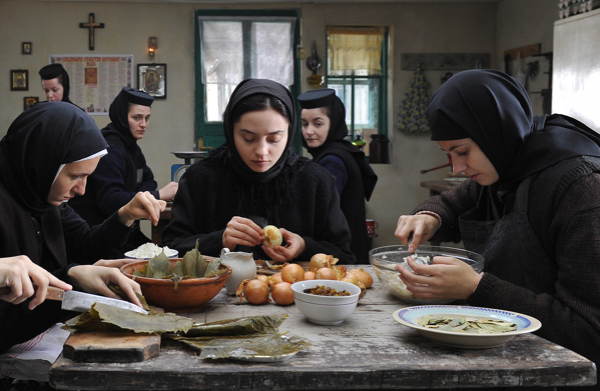
139. Romanian director Cristian Mungiu’s “Dupa dealuri" (Beyond the Hills) (2012): Beyond the obvious


Romanian cinema produces fascinating movies from time to time. Beyond the Hills is one of them.  There are several reasons why this film is remarkable.

First, it is amazing to have a film with two women, who have never acted in a movie before, to face the cameras and do a job that is so convincing on screen that they both walk away with the prestigious Best Actress Award at Cannes Film Festival, 2012. So what, a cynic could exclaim.  The fact remains that the two ladies won the award when they were competing  against a rather outstanding performance of Ms Emanuelle Riva in Amour (Love), a rare performance that even the American Oscars felt worthy of nominating for the Best Actress Oscar, even though Ms Riva was performing in a movie in a foreign language.


The postures tell a tale of award-winning performances


The two Romanian actresses in Beyond the Hills are Cosmina Stratan (playing an angelic nun named Voichita) and Cristina Flutur (playing a not-so-religious and emotionally unstable Alina). These two can glue the viewer to the screen for the entire duration of the movie but the credit for their outstanding performances truly goes to their director Cristian Mungiu.  In an interview for New York Times, Mungui stated “We rehearsed a lot during casting, read a lot, and I acted a lot for them, so I am giving them directly the tone of voice, the energy, the rhythm, the body language that I want. Guidance, but not with words. I’m not telling them what to do, I show them how to do. But it’s fair to say that by the end, I had adapted as much to them as they adapted to me. We did what was there in the script, but each time it wasn’t possible to get the dialogue exactly right, I was adapting what I wanted to do and editing the scene to what they could do. Because you can’t push onto the actors something that does not belong to them.”  This is what this critic believes contrasts the performance of Ms Riva in Amour versus the Romanian actresses in Beyond the Hills, the difference between the effort of an amateur and a professional. And yet the amateur can perform well under the right mentor—in this case, the director Mungiu.

Second, Beyond the Hills is important cinema not just because of the acting of the two budding actresses who grabbed the Cannes center stage for their undeniable achievement in acting but because of the unmistakable strength of Mungiu’s screenplay in the film (which incidentally won the Best Screenplay Award at the Cannes festival for the director).  The story of the film ostensibly is based on a true life incident in Romania picked up by a journalist Tatiana Niculescu Bran and later turned into a “non-fiction” novel by Bran. Now Bran apparently brought to light a bizarre set of real incidents in a small Christian Orthodox monastery where a girl dies following an “exorcism” done by a group of not-so-educated nuns and a priest. Mungiu’s amazing screenplay takes Bran’s journalism and a subsequent novel to a different plane beyond the incidents. The film asks the viewer the most discomforting and an important unspoken question “Who is responsible?” which is underscored by the final shot of the film of the windscreen wiper following a seemingly innocent conversation between two policemen in a closed vehicle.

Questioning the status quo

The simplistic answer to the “who is responsible” question for many viewers would be the nuns and the priest, belonging to the Orthodox Church living in Moldavia in the twentieth century post-Communist Romania who carried out the exorcism in their blind belief that what they were doing was right, just as the Catholic Church committed atrocities during the days of the Spanish Inquisition in the fifteenth century in Iberia. Yet Mungiu’s script is actually neutral towards the Church. It does not condemn the pious but it condemns a host of ills within the Romanian social fabric. It condemns isolation from development in various spheres, including the world of medical care and the rehabilitation of orphans, religious and atheist and the general lack of education of the denizens of the monastery. 

Beyond the Hills encourages the viewer to ask questions on blind acceptance of priests (of all religions by the extension of this particular vivid example) and their interpretation of religion, the dangers of well-meaning people wanting all to fall in with a particular priest’s line of thought, which actually is a reflection of the Communist mindset that the Romanian people endured for decades.  The director Cristian Mungiu in an interview to Indiewire with journalist Christopher Bell said: “I always try to get inspired by life itself and by things I see happening close to me. The film deals with two different ways of understanding love, about abuse, and about what people are asked to do in the name of love. And hopefully it speaks about this desire we all have whenever we make decisions – we hope we make them with our own heads and not in the name of any kind of ideology which can be extreme. It's one thing where you give people the freedom to decide, but to keep them in the state of mind where they think they don't have information, they don't get education. They are free but don't have the means to make the proper decisions. I don't think communism stopped in 1989, it stopped then as a political system but the consequences will be around for a long while."

Third, the script of Beyond the Hills will bring to the mind of an avid film viewer another film made 10 years ago—the Irish director Peter Mullan’s film The Magdalene Sisters (2002), which won the Golden Lion at the Venice film festival that year. Now both Mullan’s film and Mungiu’s film have common threads. Mullan made the Irish film based on his own script just as Mungiu’s work. Mullen’s film ostensibly relates to the Roman Catholic Church, while Mungiu’s movie deals with a monastery run by an Orthodox Christian priest, facing problems with his own Church leaders.  Both films hark back to real life incidents. Mullan’s film was made because Mullen felt victims of Magdalene Asylums had no closure and had had not received any recognition, compensation, or apology, though the victims remained lifelong devout Catholics.

Happiness with the status quo

The moot point both films raise is beyond religion. Even though the events and setting of the stories are definitely religious, both directors point fingers at the society that blindly follow religion. In The Magdalene Sisters, any Catholic girl who is raped and becomes pregnant out of marriage is considered "unacceptable" by society and the girls' parents force them to become nuns (the Magdalene sisters) that offer only a world of strict discipline without any exposure to the outside world. In Beyond the Hills, the acceptance of becoming a nun is assumed to be less forced by society and more of an individual choice—though the choice is an outcome of lack of education that there are options to lead a life other than that of a nunnery. In Beyond the Hills, the two orphan women who take the center stage of the movie, brought up together, seem to have had options. One chose to be a devout nun: another to live with a foster family outside the religious confines.

While the film Beyond the Hills seems to be focused on the events that take place within the monastery, Mungiu’s screenplay explores the mindsets of two sets of doctors/medical fraternity in Romania today, one before the death of the girl and one after the death.  Mungiu's screenplay deals with how an unfortunate orphan is dealt by doctors and by a family who seek to make money out of civil laws that financially help such foster families. The evocative but silent reaction of the dead girl’s brother when informed of his sister’s death is one of the striking scenes of the movie. Mungiu’s interesting screenplay finally settles down to the reaction of the policemen towards the end of the movie. The end of the film might appear to be abrupt, but the windscreen wiper’s inanimate action clearing the dirt splashed on the windshield is a lovely figurative comment on the film’s preceding tale and the shocking conversation between the two policemen about another recent killing in Romania that had nothing to do with religion or religious people.

Finally, the movie is essentially a tale of an individual against a larger group, where the individual loses out. Here, the individual is relatively more educated because she has been exposed to certain options to choose from, whether acceptable or unacceptable to the viewers, and this individual faces a well-intentioned but uneducated group cloistered in old ways, cut off from the world outside. In yet another interesting perspective, the film offers a love triangle involving two orphan girls and God, where predictably the loser is one of the girls. Beyond the Hills, just as the title of the film suggests, lets the viewer look at options beyond the impediments that obstructs one’s vision. Mungiu is not questioning God, he is questioning social controls, just as Mullen seeks an apology from the Church and society for lifelong devout Catholics who had to spend years of suffering just because they were raped and hence not acceptable to Irish society. But Mungiu’s cinema offers a fascinating and seemingly “abrupt” end to a rather long film without external music. And it is the unusual final sequences, which actually contribute to the movie's inherent strength. 

The recent Romanian films Beyond the Hills and Cristi Puiu’s The Death of Mr Lazarescu (2005) are entertaining examples of social criticism that combines well with superb acting performances and intelligent screenplays.

P.S. Cristi Puiu’s The Death of Mr Lazarescu was reviewed on this blog earlier. Beyond the Hills is one of the top 10 films of 2012 for the author.

Friday, January 25, 2013

138. Austrian director Michael Haneke’s French film “Amour” (Love) (2012): Well-crafted, comprehensive cinema that will touch both the heart and the mind of the viewer equally


Amour is the best film that this critic viewed in 2012. There are two ways to appreciate this film. One way is to appreciate its subject and the second is to appreciate the artistic manner the contents of the movie are presented to the viewer.  The following review attempts to appreciate both aspects separately.

The subject of the film would win the hearts of the larger segment of its viewers.  Amour is French for “love.”  However, the subject of the film deals also with inevitable appointment with death for all of us. Both subjects intertwine in this movie.  Love depicted in the film is the rare kind of love not often elaborated on screen; it is the love between couples in the evening of their lives. The only types of viewers who might not like the subject are those who themselves are already beginning to experience situations similar to those depicted in the film. Amour has already won the Golden Palm at the Cannes Film Festival, the top four awards at the European Film Awards (Best Film, Best Director, Best Actor, and Best Actress), the two BAFTA awards (Best Actress and Best Film not in the English Language), and the Best Foreign Film Awards at the Oscars and Golden Globes. Predictably, it has also swept the top French Cesars (the French national film awards)--best film, best director, best actor, best actress, and best screenplay.

Amour, the film, brings many modern day social issues to the fore. The film’s point of view is that of the elderly person, not of a young man or a young woman. The filmmakers have indirectly achieved two remarkable feats.  One, the filmmakers are able to reinforce the importance for young people to understand, and thereby empathize with, the agony of elderly sick persons in hospitals and old age homes cut away from their immediate family and familiar surroundings. Two, the film underscores the importance of younger people to apportion quality time with the elders in the family when they most need their presence. It is also a film on the dignity of the old and the dying. It also presents a subtle plea for euthanasia for such unfortunate elders as an alternative to increasing levels of pain and degradation; when their offspring are not near to alleviate their suffering.


Anne and Georges

Most viewers will find Amour to be a film that is both endearing and thought-provoking. You love and empathize with the main characters in the film, Georges and Anne. Yet it is also a film about the darkest reality all of us have to accept eventually. It is about the evening of our lives when death seems strangely more attractive than life.

The film does not state whether the duo is married or not, what is clear is the communication and understanding between the two, spoken and unspoken, are alive and well. The film is primarily about the duo and when peripheral characters come on screen they are there to substantiate the love between the elderly spouses.  A key character in the film is their only offspring, a daughter, who herself has a family and associated problems, that leave her with little time to attend to her parents’ needs.  She prefers that her parents move to an old age home and be looked after by paid staff as most youngsters in the western world would like. The introduction of this character reveals that the primary couple, Georges and Anne, the parents of this woman, Eva, have been together for at least 30-odd years, if not more. This movies’ tale is not of a fleeting love of spouses who have been together for a short while but of a couple who have loved each other for a long, long while.  The film presents the outcome of a long relationship with music as their common interest and a factor closely related to their individual careers.  Two other individuals shown briefly in the movie are the concierge and his wife who bring the elderly couple their provisions including the heavy bottles of Evian (drinking water). These individuals are also old but less advanced in age compared to the main duo and the film records the honest appreciation of the younger couple for the elder couple.  The film also briefly brings into focus two youngsters interacting with the elderly duo. One is a pianist student of Anne who drops by to thank the couple for attending his concert and promises to bring a CD of his concert. The second is a nurse who is rough with Anne while taking care of her, and is subsequently fired by Georges.  The actions of the youngsters are of secondary importance, the reactions of the elderly couple to each youngster are of primary importance. The two youngsters provide differing responses of the younger generation to the elders. And finally, there is the pigeon, which enters the apartment and is trapped by Georges and eventually set free. Each interloper’s entry into the elder’s life and time provides additional psychological details of the elders’ mind. All this makes Amour a great tale to recall after one has watched the film in a movie hall or on a television screen. The viewer begins to empathize with the elderly duo’s condition, not with the peripheral characters.

Such contrasts are what Michael Haneke is so adept at presenting in his cinema. He loves to make the viewer enjoy viewing uncomfortable truths that he presents in his films. Haneke’s cinema often excels in adding a documentary-like touch that he provides to his fictional characters.

Now that brings us to the second way to appreciate Amour—the way the tale is presented.

The strength of Amour is not merely the subject of love but the cumulative creative strength of the team both in front of the camera and behind the camera that will enrapture audiences of all ages and mindsets and satiate the mind of an attentive and patient viewer.

Michael Haneke, the director, had earlier made a film called Caché (Hidden) in 2005 which had won him the best Director Prize at Cannes that year. Haneke is the sole author and scriptwriter of the tales of both Caché and Amour. Interestingly both movies/tales have a Georges and an Anne as the main protagonists. A coincidence? This critic doesn’t believe it is. Both films are studies of intelligent cinema in getting the viewer to participate in the film’s tale beyond what is presented on screen. Caché opened and closed with the static camera capturing the external part of a middle class Parisian apartment with hardly any changes in the visuals. The viewer was pulled into the role of the camera psychologically. Amour does something quite similar early in the film. After having revealed the dead body of Anne (Emmanuel Riva), a similar static camera takes in an audience waiting for a piano recital to begin in an auditorium. The camera is not interested in capturing the images on stage but that of the audience. The viewer has to spot the face of Anne just by the brief recollection of the dead face of Anne shown a wee bit earlier in the movie with no additional help from the director or the cinematographer. Mind you, this is not cinematographer Darius Khondji at work—this is the trademark of Haneke and Haneke’s regular cinematographer Christian Berger, perfected in previous Haneke films.

For Haneke watchers, the concept of demarcating the ’outside’ and the ‘inside’ living spaces of our lives is important. Much of Amour is built around the modest apartment of Georges and Anne representing the inside, and only the brief shots of the piano recital auditorium and the trip back home from the recital represent the outside.  The scriptwriter and director Haneke is clear about his intentions:  the subject is mainly confined in space and psychologically to the living spaces that limit the elders physically as they age. The few occasions in Amour that transgress the boundaries are when Anne returns after a brief hospitalization, the open windows that allow the pigeon to enter, and the final decision to go for a walk “outside.”  The one brief segment of the film that stood out for this critic was ability of Haneke and Khondji to metamorphose the ‘inside’ with the ‘outside’ by showing and focusing on the ‘outdoor’ paintings in the apartment walls—that imbued both the pathos of the time with the dark waves of the sea and the recall of the youthful years with the image of a girl/young woman captured in the light of the exterior rays of the sun. This brief interlude of images not only took the viewer outside the apartment, but provides the viewer another opportunity to relate with the tale as an independent observer and make judgments of what would transpire next.

Haneke has another trade mark for his kind of cinema:  surprise the viewer with an action when the viewer least expects it. Both Caché and Amour has such sequences that jolt the viewer.

Haneke, the scriptwriter, has written the tale following an identical situation he is privy to in his own family. One begins to wonder if the Georges and Annes will continue to surface in Haneke’s cinema in the future as in Caché and Amour even though common links between the two sets of Georges and Annes are limited to the fact both are supposedly married and both have the same names. In   Caché, the events in the movie lead to a fracture in the marriage; in Amour, the events only affirm the relationship. Haneke is exploring the strengths of such relationships under trying circumstances in the two films. Haneke goes one step further in both films, he explores the possible effects on the offspring and interestingly both films offer distinctly different outcomes, in one the offspring is indifferent, in the other there seems to be a new awakening of real affection and understanding.

Space in the apartment is optimized to meet functional requirements

The strength of Haneke’s subjects and his ability to maximize the potential of his chosen cinematographers is surpassed by Haneke’s incredible ability to work with his lead actors: Jean-Louis Trintignant (81) and Emmanuelle Riva (85).  (Ms Riva is the oldest actress ever to be nominated for the Best Actress Oscar.) Now Trintignant is a master thespian who has enriched cinema with his unforgettable roles as the brave magistrate in Costa Gavras’ Z and a retired judge in Kieslowski’s Three Colors: Red, two cinematic works that standout among a remarkable list of great performances. Riva, too, is an accomplished thespian who considerably contributed to masterpieces such as Resnais’ Hiroshima, mon amour, Kieslowski’s Three Colors: Blue, and Gilo Pontecorvo’s Kapo.  Haneke coaxed Trintignant, who had retired from acting, to return to play another amazing role. In many ways, this critic feels Trintignant was no less than Riva in acting prowess in Amour. Both actors prove that subtlety is more important in conveying feelings than shouting and raving. Even in Caché, the performances that Haneke elicited from Daniel Auteuil and Juliette Binoche stood out over all else. Haneke is to be admired for this ability to bring out the best in his chosen actors.

When eye cannot meet eye
 
The art direction of the film is very well thought out as well. Apparently the apartment used in the film is a set and even trained viewers will miss out on this fact—it is so well done. While the electronic equipment in the house is modern, the furniture is as old as its occupants including a baby grand piano that takes up costly space in an apartment where even the extra bed (shown at the final sequence) is tucked against the wall. The “crowded apartment” looks empty in the final sequence after the elders have left and the daughter takes their pace in the apartment.  The spatial difference is striking.

Amour proves a point or two to mainstream cinema today. One is the importance of sound (not of music) that is a crucial element in good cinema. The water gushing from a tap for washing dishes is used twice in the film eloquently in a manner that words and visuals rarely achieve in cinema. Then a CD playing the music of Anne’s protégé is switched off. Again Haneke underscores the loaded importance of silence. Most of all, Amour continues Haneke’s constant effort to empower the viewer to get involved in interpreting what is shown on the screen. If we compare Caché with Amour, the latter film requires less of the viewer, and is therefore able to please a larger potential viewership.  Haneke is able to throw the euthanasia question at the viewer without making it obvious. He is able to discuss the lack of love and care among modern-day youth for the elders by appearing to discuss “love” of two individuals who exhibit the epitome of love by caring for the other—even the concierge and wife split their labors (bring up the water) according to their physical condition. Haneke loves to shake up the viewer without appearing to do so.

While Amour is the finest work of comprehensive cinema this critic has viewed in 2012, Haneke has not treaded new paths with this work. The late Maurice Pialat’s French film La gueule ouverte/The Mouth Agape (1974) had dealt with a parallel tale and a similar treatment. That important work of cinema from the late Pialat also dealt with death of an elderly wife, reactions of the young offspring towards a dying parent, the sparse use of music, and ‘deafening’ silence with aplomb. While Amour’s strength lies in the performances and the film’s marvelous end-sequence, Pialat’s work, on the other hand, exhibited both the directorial skills of Pialat and the camerawork of the legendary Nestor Almendros at their very best. Pialat’s movie, with its own fascinating ending, will remain as one of this critic’s top 100 films of all time.  Amour, without doubt, offers a complete cinema experience and the finest movie of the past year with an interesting ending but it is not a movie that opens new pathways in the world of cinema.


P.S. Michael Haneke’s Caché was reviewed earlier on this blog. Though Amour is no.1 on the author's list of best films of 2012, Post Tenebras Lux, no.2 on the list is the only movie made in 2012 to be included on the list of the top 100 films of all time. This is a deliberate decision. This critic considers the Mexican film to be path-breaking cinema, which Amour is not. While Amour has virtues of being a movie strong in departments of acting, scriptwriting and art direction as well, and has the awesome capability of universal appeal, Post Tenebras Lux loses out on those specific aspects. However, if this critic were to choose the better director of the two films, Carlos Reygadas scores over Haneke. The Cannes jury got it dead right while sitting in judgement over the two outstanding works of 2012 by bestowing Amour with the Golden Palm for the best film and Post Tenebras Lux with the Best Director award.

P.P.S. Two friends have pointed out that Amour has two critical sequences that are almost identical to the Icelandic film Volcano (2011) directed by Runar Runarsson, made a year earlier. This new information dilutes my fervent appreciation of Amour.


Saturday, January 05, 2013

137. Mexican director Carlos Reygadas’ film “Post Tenebras Lux “ (After Darkness, Light) (2012): Visually and cerebrally stimulating cinema.


Carlos Reygadas is one of the few exhilarating filmmakers alive and actively making movies.  His films are never easy viewing.  His films’ images and his films’ soundtrack stun your senses with their groundbreaking ability to make you wonder why other filmmakers did not employ those ideas before.  Then he goads the viewer to reflect and figure out how best to solve the puzzle he has presented on screen. Post Tenebras Lux does just that. It can either elicit your boos or it can open the viewer’s mind’s eye wide in awe. The film won the award best director at the Cannes Film Festival 2012  For this critic, the film is the only film made in 2012 to find a slot on his list of all time 100 best films.

If we deconstruct the movie Post Tenebras Lux, the viewer could perhaps begin to appreciate it.

Rut Reygadas as Rut, daughter of Juan

First, the film is not based on any novel or play—it is the original idea of Carlos Reygadas, scriptwriter and director.  Now when a filmmaker makes a film, the choice of the title is crucial as the title reveals the film. The title is a Latin phrase for After Darkness, Light. Where did it come from? It has its origins in the Vulgate version of Book of Job 17:12, a book in the Holy Bible, and the character Job is equally revered by Jews, Muslims (Job is discussed in the Holy Koran) and Christians. Interestingly this phrase was the motto of the Protestant reformation in Europe as it split from the Roman Catholic Church. This phrase was also the state motto of a country, Chile. The theological connection of the title is not accidental if one considers the fact that Reygadas’ previous film was called Silent Light, a subtle and mischievous play on the Christmas carol Silent Night, with the amazing night to dawn sequences that begins and the reverse sequence that ends that film. The choice of the title Post Tenebras Lux gives the viewer adequate clues to understand and appreciate the theological connection to the film, in spite of the absence of conventional religious symbols, such as crosses, churches, prayers, or even a direct mention of God.

Juan

The opening sequence of Post Tenebras Lux, is another evocative play on light and darkness that recalls the opening and the end sequences of Reygadas’ earlier work, Silent Light.  One of the cutest toddlers on screen, Rut Reygadas (real-life daughter of the director), is out in an open field talking to pet dogs, horses and cows in twilight as ominous dark clouds gather, thunder booms and lighting strikes, and light fades to embrace darkness. Darkness and light are metaphors of what is to follow in the movie.  If the visual metaphors were to be limited to goodness and evil, Reygadas prods your mind further with the appearance of a computer graphic generated priapic devil glowing red and carrying a mysterious tool box once at the beginning and later towards the end, to underscore the theological element in the movie. The silent devil is observed by the male child, Eleazar, one of the two innocent kids in the movie and very importantly the devil leaves the kids alone—the devil is interested in someone else in the house, the adults.  The children remain uncorrupted by the devil. Eleazar is again the son of the director.

Second, is the film an imaginary one or is it autobiographical?  Much of the film is indeed autobiographical if we pick up the details. The two lovely kids in the film are Reygadas’s own.  The lovely wooden house is again his own dwelling.  According to reports, the shots with the devil were taken in the house the director grew up in and the toolbox carried by the devil belonged to the director’s father. The movie is dedicated to his wife, Natalia López, who is the film’s editor. Interestingly the wife of the protagonist in the film is called Natalia an obvious nod to the director’s real life wife. Finally, Reygadas picks an actress Nathalia Avacedo, with a similar given name. Carlos Reygadas daughter is called Rut and so is the protagonist’s daughter in the film.  The same goes for his son Eleazar. Reygadas has studied in the UK and has played rugby for Mexico’s national rugby team, facts which explain the rugby players speaking English shown twice in the film. Reygadas is apparently closely connected to the Mexican rugby team as well. 

The rugby game

Third, is the film only about two nuclear families? If you look deeper into the film's structure, the differences between the two families underscore the social divide in Mexico today. The obvious focus is on the family of Juan and Natalia, and their two cute kids.  They live in a beautiful upscale wooden house in an idyllic location far from the hustle and bustle of commerce and city/town life but they are serviced by poorer sections of Mexico’s inhabitants. Juan and Natalia could easily pass off as Caucasians but the workers have features that are typically native Mexican. In the middle section of the film, Reygadas introduces the viewers to a range of males who speak to the camera as though they were being interviewed by the director and admit to struggling with their problems including one who is a drunkard who has joined the Alcoholics Anonymous while Juan admits to be addicted to internet pornography. Another interesting male talking to the camera is a key figure named Seven who has installed most of the costly fixtures in Juan’s dream house and is apparently close to his boss, Juan. Much later in the film Reygadas shows two sequences of Seven’s “interactions” with Seven’s own nuclear family. There are vignettes of Juan trying to get closer to his workers’ world when he visits the rural pub, where the drunks reveal more of their lives. The social divide between the rich and the poorer sections of Mexico is amply evident in the film, as is the silent rage of two male individuals coming to terms with their own “dark” lives to find “light’ in different and distinct ways,  according to their financial and social status.  The women in both nuclear families are the ones often abused and forgotten, and yet the women seem to shake off their bonds. Reygadas’s women are not easy to decipher—there is a grandmother who hands out large sums of money to her grandchildren urging them to be “businessmen.”  There are rural women who want trees to be cut down for trivial reasons. Did Natalia leave behind some luggage in the house knowingly? Natalia reveals this after Juan holds her hand in the car and she lovingly strokes Juan’s hand before revealing this fact forcing them to turn back. The nagging doubts for the viewer lead us to the fourth element in the movie.

The fourth way to approach the film is by trying to reason individually what is real and what is an illusion, a dream, or an epiphany in the movie.  Reygadas throws another clue at the viewer: Juan asks his wife Natalia to play some music, specifically the Neil Young song “It’s a dream.” Any other director would have got the song sung professionally—but Reygadas makes the singing deliberately look amateurish. It is not the singing that he wants you to appreciate; it is the relevance of the song. Natalia cries in the process. What then is the dream in the film? The dream of a happy “casa”? Remember young Rut’s few words in the opening sequence, and one of them is “casa” or the Spanish for house. There is a link between generations and the house is a suggested metaphor. Evidently the devil carrying the grandfather’s toolbox is only perceived in the movie by the male grandchild in the casa, no one else.  The devil sees the child but is only interested in the parent’s bedroom.  The woodcutter in the film watches as tall trees fall down in the woods as thought they were falling by themselves. The entire film and the tale of the two nuclear families is from a male standpoint but the women, silent as they seem change the flow of the narrative at decisive moments, leading to downfall/self-realization and eventual mortification of the male head in each of the two nuclear familial units. Is the film made by a male director with no concern for the women? That query seems to be negated by the fact that the director has dedicated the entire film to his real life wife and the film's editor. In fact, the "Duchamp" sequence aids Natalia to transcend inhibitions and realize that she is attractive to men. (One of Duchamp's famous surrealist paintings is called  'The bride stripped bare by bachelors, even'  that could have some relevance to the sequence.)

The ‘trees’ do fall in the Mexican garden of Eden and they fall at random towards the end. Trees have visual and metaphorical importance in Post Tenebras Lux. The surprising request made of the woodcutter to cut down a harmless tree because it bothers some women makes a subtle connection with the viewer. So do the parallels of two Mexican family heads as they return to their individual “casas” imply a more significant action as the men realize their individual follies quite in contrast to their silent but strong wives who take care of the children and prepare the family meals.

Natalia, Rut and Eleazar in their "Garden of Eden"
A fifth way to deconstruct the film is to divide the movie by two obvious sections, and the dissection is made by the camera using the refractive image at the edges in some sequences and not using the unusual magical effect of cinematographer Alexis Zabe  elsewhere.  A close study of the film reveals that the refracted images are used for outdoor sequences and not for indoor sequences. Is Reygadas suggesting that the refracted image of what is done outside is less real than what is within the “casa”? One clue to this is the brutal killing of a pet dog (off-screen) by Juan and the self-repentant statement “I hurt those that I love most. You must help me stop doing this.” or words to that effect. Refracted images are real, it only provides the perceiver an “unreal” view. That this critic believes is the way to approach this work of Reygadas. When the child Eleazar Reygadas playing Eleazar son of Juan states that his father is dead it is a case of refracted reality. Do children lie? Of course, not. At the same time you do not perceive Eleazar as a child who has lost a parent. And it is Eleazar who alone is able to see the visits of the devil.

The devil enters the house/casa

A sixth and a crucial way to figure out Reygadas’ cinema is to accept that he is religious and is consciously adapting bits of the Bible into cinema in a personal way, just as Terence Malick does in his films. The only marked difference between Reygadas and Malick is that Reygadas constantly falls back on the carnal aspects of the human being in every work, a method that Malick studiously avoids. The religious elements in Post Tenebras Lux are never obvious, except for the shots of the devil. The first question for a viewer would be to ask if Reygadas is religious or a person questioning religion.  Reygadas’ own children act in the film with their own given names, Rut (for Ruth) and Eleazar, both names of characters in the Bible.  You do not choose to give such names to your progeny merely because it sounds good—Reygadas, one suspects, has sufficient knowledge of the Bible. If the viewer accepts this pre-condition, several bits of the film become loaded with Biblical parallels. The suicide of Seven in a lonely open field has parallels with the suicide of Judas and the potter’s field, following Seven’s remorse of having killed his master Juan. So does the image of the lonely tree in an idyllic garden of Eden in the Mexican landscape take on added significance, when tree cutter is asked to cut it down illogically for metaphorical reasons. 

This critic went back to the Book of Job 17, from where the title of the film is taken. It is interesting that the chapter after the verse 12 which states that the dejected and lonely Job’s philosophical words “hope is in the world of the dead, where he will lie down to sleep in the dark, and I will call the grave my father, and the worms that eat me, I will call my mother and my sisters. Where is there any hope for me? Who sees any? Hope will not go with me, when I go down to the world of the dead.” These lines from the Bible could explain several aspects of the film, otherwise intriguing. It is Eleazar who sees the devil and who states that his father Juan is dead later to Seven.

Isn’t it an interesting coincidence that both Malick’s Tree of Life and Reygadas’ Post Tenebras Lux, two structurally and thematically close works both indirectly refer to the Book of Job? The only stark difference in the two works is that Tree of Life allows for family viewing, while Post Tenebras Lux is strictly for mature adult viewing, thanks to its few carnal sequences.

This critic would like to refer to Reygadas’ statement made to Anna Bielak in an interview published Slant magazine:  “The film may seem mysterious at first sight. But I really hope that by not giving you any simple answers, you eventually feel how much I respect you as a viewer, how I respect the movie in terms of art, and how much I respect myself as a director. The film is what it is. Talking about it afterward makes me feel dishonest. I demand a lot from the audience and I don’t have any limits, that's true. However, I am a free man, and I may do what I really want. I am giving you the best of myself, and I strongly believe that all around me there are lots of people more sensitive and intelligent than I am. Every single person is different, is focused on other things, feels different emotions, and tries to find their own way through the movie, and is able to find their very own and unique interpretation of the story. One viewer could love the film; the other one, as sensible as anyone else, may hate it for a very good reason. Moreover, I am a viewer as well. I watch lots of movies, and I truly appreciate the directors that don’t try to lead me by the hand through their stories. I want to be considered one of them.”

The importance of trees in the Mexican "Garden of Eden"

Reygadas has stated elsewhere about the film “The whole idea of “light after darkness” seems appealing to me in terms of intimate experience, of being a human living in a Western world. In a sense we all live in the darkness of our daily frustrations. Yet, I hope the light would come after us to enlighten the world for our children.” Reygadas has also stated in another interview that the film Post Tenebras Lux is about Mexico becoming evil and that “the real title of my film should have been 'My country is bleeding. Mexico is bleeding’” The film does appear disconnected but the film can be connected up with a bit of reflection and some effort to pick up the references. Post Tenebras Lux is not easy viewing but complex and personal cinema, rarely encountered, and one of the finest films of 2012.A rugby team appears to be losing, but there is hope for the losing team, if they play as one. The movie telescopes the individual into the refracted reality of the home/casa/family and subsequently the country. Like Job, there is hope if one is resolute in what you believe. So too, for Mexico. So too, for Juan’s children.


P.S. Reygadas's Silent Light (2007) was reviewed earlier on this blog. Post Tenebras Lux figures on the list of the author's best 10 films of 2012.

Sunday, December 02, 2012

136. Taiwanese director Ang Lee’s film in English “Life of Pi” (2012): Visually spellbinding cinema made standing on the shoulders of a marvelous novelist


Ang Lee needs to be congratulated for making an engaging movie Life of Pi.  Few other directors would have dared to even attempt the feat. As a Taiwanese director, the odds were stacked against him—filming an award-winning book populated with Indians talking in authentic Indian English accents about their quilt of culture, religion and even politics. Add to these problems, the technical difficulties of creating credible scenes of various animals and then editing all the visuals to match the tale is truly daunting.

Ang Lee had earlier proven his incredible skill of incorporating computer graphics (CG) and special effects in his Crouching Tiger, Hidden Dragon (2000--a movie  that went on to win a bagful of Oscars and worldwide popular acceptance).  Some will point out that Crouching Tiger, Hidden Dragon never won a major award at any major film festival of repute. So also, a keen cineaste will note, that Life of Pi, which can boast of the finest CG in cinema to date in 3D, was not picked up by the three major international film festivals--Cannes, Venice and Berlin--in their competition line-ups. But at the same time, Life of Pi is a sure shot contender in the 2013 Oscar race just as many Ang Lee films have turned up trumps in the past.  And quite appropriately, Ang Lee and the studio’s publicity mandarins have ensured that Life of Pi will open lesser film festivals: New York, Goa’s Indian International Film Festival and Dubai. Ang Lee knows where his film belongs. Ang Lee has consciously made the film to grab a particular slice of the global audience that would make the box office jingle. And that he will.


Life of Pi is a CG dreamboat. The team behind Life of Pi needs to be congratulated on recreating a Royal Bengal Tiger with muscles rippling under its fur and a face that is more expressive than many living actors today. The film even has shots of an emaciated tiger climbing out of the boat after months without sufficient food and water, floating in the Pacific, and then stepping out on terra firma on the Mexican coast, testing the ground if it was indeed real.  The visuals are so real that it is difficult to persuade an ignorant viewer that the animals are fake and that the actor playing Pi never had a live tiger’s head on his lap or even saw one while in front of the camera. One would be surprised if Life of Pi does not sweep a bagful of Oscars in 2013. But what did Ang Lee truly achieve in this movie beyond the 3D CG magic?

Without any doubt, Ang Lee has been able to convey the spirit of Yann Martel’s novel--faith in God, well-researched animal behavior, fantasy, and an intriguing end that tosses the question of illusion and reality in the viewer’s lap. Ang Lee has been successful in presenting the ecumenical Pi, who is a practising Hindu, Christian and Muslim, even though Pi’s conversion to Islam is barely shown in the film (not so in the novel).

An honest evaluation of Ang Lee’s Life of Pi is not possible without having read Yann Martel’s Life of Pi, winner of the Man Booker Prize. Any viewer who has read the book will see Ang Lee’s touch as he and his scriptwriter David Magee have intentionally chosen not to film certain parts of the book but instead added sequences to the film that never appeared in Martel’s book. These differences provide the viewer with insight into judging the true merits of Ang Lee’s film Life of Pi.

It is very evident to an observant viewer--even without reading the book--that Ang Lee has one aim. That one aim is to make the film bereft of blood and violent scenes.  Ang Lee has very intelligently shown a tiger killing a hyena and a hyena eating a live zebra, just to mention two of many sequences that strangely do not put off the viewer. There is no blood (or almost no blood) and no reason why a caring parent will cover the eyes of their children from seeing a carnivore kill another animal to survive.  Ang Lee and the studios that made Life of Pi have made a film that cleverly suggests various animal actions that never end up repulsing the viewer.  It almost brings to mind the sanitized Walt Disney films of yore.  Imagine the lifeboat in the tale, several days in the sea with all the animal remains.  When Ang Lee does show the boat’s floor briefly, it is only water that you see on an unscratched surface.  That is just one of the departures the filmmakers have intentionally made.  They have made a film that is agreeable to the largest number of viewers possible.

The director and scriptwriter made three or four fascinating additions to the Yann Martel tale. The sequence where the tiger named Richard Parker jumps out of the boat and then finds that it is able to swim but unable to climb back on board and is helped back on the boat by an innovative Pi is truly a lovely addition.  This sequence strengthens the bond between man and animal under trying unnatural situations, affirming that man is possibly more considerate than an animal. I congratulate the filmmakers for their artistic license they took to make this addition. The second addition is the creation of Pi’s sweetheart Anandi, the dance student, who never graced the novel.  This addition reveals Ang Lee’s commercial instincts to add a female character to a film dominated by males. Did it add value?  This critic is not convinced that it did. A third addition to the book is the shot of the young Pi trying to feed a live tiger in the zoo and being stopped at the eleventh hour by his father. (In the book, Pi claims he never did any such thing and is puzzled why his father should show him and his brother, how dangerous the animal could be by sacrificing a live goat in front of his sons' eyes to the horror of his wife as well.) This is an addition that improves on the book and makes the incident more credible. The fourth addition that an inattentive viewer could miss is the brief long shot of the mysterious floating island built on algae that resembles a sleeping human form as Pi’s boat drifts away, after the visit to "the island." That was indeed a clever addition by the filmmakers but it lacked its virtual symbolic punch because of the director’s and scriptwriter’s deliberate decisions not to show the bizarre and the terrifying bits of the book, which made the book what it is.

To some it is unfortunate that Ang Lee and his team decided to verbalize the alternate story of Pi narrated towards the end of the film to the Japanese representatives of the sunken ship instead of visualizing it on screen.  One could easily understand that an Ang Lee who was obviously flinching from showing details of raw animal meat or even raw fish earlier in the film would never include a gruesome beheading that the alternate tale entailed. So, too, is the surrealistic encounter of Pi with another boat carrying a man with a French accent that the tiger kills and subsequently driving Pi to cannibalism, which was a key bit to the story described in the novel that Ang Lee decided to discard again for the sake of popular taste.  Assume for an instant that Ang Lee had decided to have Gerard Depardieu (who plays the French cook on the sunken ship) reappear in that scene from the book. Life of Pi would then have been catapulted into an intellectual plane and made the Cannes/Venice competition class—but then Ang Lee was making a Disney film and not making a realistic film with blood and gore. The simple vegetarian meal prepared by Pi, in the movie, would then have suggested something more profound for the viewer.


Life of Pi, the movie, provides sanitized entertainment. It presents Indian characters that appear more Indian than David Lean, a perfectionist in his time, accomplished in his A Passage to India (1984). The only scene that was compromising in CG quality was perhaps the one which has Pi’s uncle swimming in Piscine Molitor in Paris where Pi's uncle looked unreal. Even with what the filmmakers chose ultimately to show on screen, Ang Lee’s Life of Pi is a treat to watch in 3D with its limited intellectual query made to the viewer to mull over about which of the two tales narrated by Pi is the real one.  However, before one sings praises of Ang Lee and his talented team, one ought to demarcate what needs to be credited to Martel (who in turn, borrowed the basic idea from a 1981 Brazilian novel  Max and the Cats). Martel’s book offers much more than the film for the reader/viewer to figure out but Ang Lee and his team has brought the beauty of the tiger and the ocean’s fauna closer to the average viewer’s minds in a manner words can never accomplish.

P.S. Life of Pi is no.7 on the list of Best 10 films of 2012, ranked by the author of this blog. The movie won the Golden Globe for Best Original Score and the BAFTA awards for Best Cinematography and Best Special Visual Effects.The film has subsequently won the Best Direction Oscar and three other Oscars for Music, Cinematography and Visual Effects.

Monday, November 26, 2012

135. Turkish director Semih Kaplanoglu’s film “Süt” (Milk) (2008): The Turkish "artist as a young man"


Semih Kaplanoglu is one of the finest Turkish filmmakers—and one who has a very distinct and intriguing style of film-making.  His cinema is slow, introspective and personal. He picks his actors for each role and camerapersons with considerable thought and care and the result is always apparent in the finished products. In his films, the emphasis is not on the spoken word but more on what you see and hear. In his Yusuf trilogy, each film is remarkable in the unusual manner it expounds the subtle weaves of a dyad—a sociologically significant relationship---some obvious and some less so. Süt (Milk) belongs to that very same Yusuf trilogy and constitutes the middle film in the trilogy. The three Yusuf films constantly remind this writer of the James Joyce novel A Portrait of the Artist as A Young Man. The Yusuf films offer epiphanies and the coming of age autobiographical tale of a sensitive artist just as James Joyce had developed his own semi-autobiographical “Yusuf” that he called Stephen Dedalus, complete with physical disabilities. Joyce is demanding of the reader: so is Kaplanoglu’s cinema of the viewer. But the patient and intelligent viewer of the Kaplanoglu films will be rewarded just as Joyce is rewarding to an analytic and reflective reader.

 Few films have an opening sequence as unforgettable as the one in Semih Kaplanoglu’s film Süt (Milk). The scene is rural Turkey. The viewer is initially shown some villagers watching some activity from a distance on a misty morning. People are talking in hushed tones. An old man is boiling a pot of milk in the open and writing something. The camera then reveals the unusual bit above the boiling pot of milk—a young girl is strung live upside down from a tree branch so that the fumes of the boiling milk reach her face. The viewer wonders if some weird devilish torture sequence is to follow. If the viewer is already squirming in the seat, wait---out of the mouth of the girl emerges a small live snake. End of sequence. A patient viewer will sit through the film and realize that this bizarre opening sequence has one primary linkage with the main film---not the girl, not the old man, not the snake but just milk. And Milk is the title of this film and milk has so many tenuous connections to the sequences that follow, just as the other titles of the Yusuf films connect with sequences in those.

Months after viewing this unusual scene in the film, this critic decided to ask the director directly about this unusual sequence that reminds one of some kind of exorcism. Kaplanoglu’s response is revealing “There is nothing unreal about it. At first we tried model snakes in that scene, but they didn’t seem realistic no matter how hard we tried to make them seem so. I decided not to make that scene. We had little snakes in jars which were brought by a zoologist, and we used it in the other scenes. Ms. Ozen (the actress hung upside down in the film) said that she would put one of them into her mouth. We were surprised but started to think about it. The snakes have an interesting property. When they are hot, they move very fast; when they are cold they move very slowly. Our zoologist suggested we decrease the body temperature of the snake so that Ms. Ozen could put it into her mouth without any risk. I looked at both the zoologist and Ms. Ozen with surprise. It was a dreadful thing, but both the zoologist and Ms. Ozen persuaded me to allow them to do it. So we made the scene. When the film was shown abroad, some people asked me if that was just an old wives’ tale. It is not. It usually happens to people in that region. When workers sleep near the water, some snakes slither into their mouths and then into their stomachs. And people drink lots of milk so that the snake can go throughout their intestines with the milk and come out of their bodies at the other end. Or they hang upside down from a branch so that the snake falls out through their mouths. “

Süt (Milk) is the second film of Semih Kaplanoglu’s Yusuf trilogy—and it deals with the adolescent Yusuf and his mother living in a village in Turkey. While it is a standalone feature film, Süt (Milk) can be best appreciated if the viewer has seen the other two Kaplanoglu films in the Yusuf trilogy. This is because of the absence of the father in Süt (Milk) and the relationship of Yusuf with his father is never revealed in this film—the viewer gets to know about that relationship in the next film in the trilogy Bal (Honey). The second film in the Yusuf trilogy is not a mere Oedipal tale as it could suggest in isolated deconstruction but more about the original mother-son relationship (possibly with breast milk being a forgotten link that is never shown or alluded to in the film) as the young man has grown up and is selling milk, one of the many rural outputs produced on their farm (run by Yusuf and his mother), in the nearby town. Yusuf’s complex psyche is comprehensively and progressively unraveled only after watching the three Kaplanoglu films in the trilogy. Once the viewer has seen all the three films, the Oedipal angle in Süt (Milk) recedes in significance and the viewer grasps the trilogy is really about the artist flowering from bud to bloom. Explains Kapalonglu on his website “We all have mothers and it is highly possible that much is hidden in the time we spent with our mothers, and the time we are no longer able to spend with them.


Süt (Milk) is indeed a complex film. It captures the tension of a young man who wishes to be a poet, and yet is an introvert, a loner, a reader of books and one who has toiling on a farm with his mother to make ends meet, especially in the absence of a father, the traditional bread winner of all conventional families. When the struggling young poet does get his first poem published in a local journal of repute, both mother and son are happy—but for different reasons. The poem is about a beautiful, adorable woman. The mother, as most mothers would, believes it is about some young girl her son fancies, while in reality the poem is about her. The film is indeed about how the mother figure plays a crucial part in a poet’s life just as the father was so crucial to the development of the poet at an earlier stage in life (as depicted in Bal (Honey).


And there are women in Süt (Milk) who knock at Yusuf’s door, figuratively speaking. A local girl is attracted to him but the constant cell phone conversations by the girl to others while in Yusuf’s company, underscore for Yusuf how meaningless the relationship is or would end up being. At the same time, there is a sequence where Yusuf looks at a female silhouette in a Turkish bathhouse. The director seems to imply that the young poet is interested in the opposite sex but they do seem literally and figuratively shadowy and out of focus at this stage of his life. Kaplanoglu’s cinema is just that—beads of intriguing shots and sequences that could make an interesting necklace only if the viewer chooses to string them together.

Kaplanoglu’s Süt (Milk) provides insights into the manly aspirations of the Turkish male—it is a rite of passage in life to be enrolled in the military—apparently a done thing in that country to be considered a regular male Turk. And Yusuf flunks the entrance requirements as he is found to be epileptic (for Joyce’s Dedalus it was poor eyesight that was a stone round the young artist’s neck). Later in the film Milk, Yusuf the reject from the military is working in a mine of sorts with a friend whose pocket is filled with unpublished poems. Yusuf is physically capable of hard manual labor but he is still attracted towards poetry or friends equally interested in poetry. Milk is a film with sequences that can imply that imply much more than is shown. For instance young Yusuf catches a fish that could make a great meal for him and his mother. When he reaches the kitchen, to his surprise he finds his mother plucking a bird’s feathers. Obviously someone else has provided it. The sequence underscores that Yusuf is not and will not be the breadwinner for the family; his mother has chosen someone else for that role. That is Kaplanoglu’s cinema—quiet statements that add up to paint a larger picture.


Kaplanoglu’s third and arguably the most fascinating film in the trilogy is called Bal (Honey) and that film explores the father-son relationship with Yusuf as a young boy, where the presence of the mother is not paramount. His first film Yumurta (Egg) in the Yusuf trilogy looks at Yusuf as a grown up man, with both his parents now dead, but assessing a relationship with a woman who could possibly be the key to his aspirations to sculpt an artist’s life. Thus while Honey explored Yusuf under the influence of his father, Milk explores Yusuf’s growth in the shadow of his mother, while Egg deals with Yusuf who has emerged from the parental shadows and is able to understand complexities of life on his own, having distilled the influences of both his parents. Kaplanoglu is one of the two mesmerizing Turkish filmmakers alive and making films today--the other being Nuri Bilge Ceylan. While Nuri Bilge Ceylan has written and developed most of his recent works with his spouse Ebru Celyan and an early work with Emin Ceylan, Semih Kaplanoglu has often developing his scripts either on his own or with Orçun Köksal (on Honey and Egg) and Özden Cankaya (on his debut film Away from Home). If there is a major difference between Kaplanoglu and Ceylan, it would be that Kaplanoglu’s films are more personal and inward looking than Ceylan’s cinema. Both filmmakers are distinctive in their respective styles and both are fascinating filmmakers.

This writer was intrigued by the physical oddities of the character Yusuf in Kapalnoglu’s Honey and Milk, especially when we know that the trilogy is close to the life and thoughts of the director and screenplay writer. In Honey, the young Yusuf is very close to the director Kapalanoglu. Kaplangolu had clarified in an earlier interview put up on the European film awards website that Yusuf “has parts from me. I referred to my own youth and childhood while writing the three scripts and I believe I was able to handle the issues about Yusuf’s life, troubles and quests realistically. My own childhood served as a point of reference for the script of Bal (Honey) as well. My troubles at school while trying to learn how to read and write, my questions which grown-ups left unanswered, the intense cruelty and richness of nature...”

In Milk, the young Yusuf is not conscripted into the armed forces because of his epilepsy. Kaplanoglu’s explanation provided to this writer’s query on the epileptic Yusuf is revealing—and it reveals the influences on a sensitive director while developing a script. Explains Kapalanoglu, “Yusuf’s illness is genetic and was passed on to him from his father. This illness is all that remains of the father in Egg. It is also related to the sensitivity of Yusuf. I don’t see any men with epilepsy nowadays, but when I was a child there were lots. It was not uncommon to see people having seizures in the street. They were so common that the proper ways to help someone in that condition became common knowledge. Also Prince Myshkin has epilepsy in Dostoyevsky’s “The Idiot”. It was a character that influenced me years ago. Maybe this is why I decided for Yusuf to have epilepsy in the film.” For those familiar with Prince Myshkin, the actions of Yusuf in Milk and Egg do bear some resemblance.

The most useful response of Kapalnoglu to this critic’s specific questions was the one relating religion--an element that was quite obvious in Honey, but less prominent in Milk and Egg. Explained Kapalanoglu : “According to many religions, this is the journey of the soul which comes from the spiritual world, matures in this physical world and returns to the spiritual world when we die. According to those religions, this world is merely an illusion, a test, a play ground, a dream as Prophet Mohammed said ‘All the human beings are asleep, when they die, they wake up.’ This is a circle which unites Yusuf’s life with the adventures of mankind. Yusuf’s life story is the life story of mankind.” This is probably why the cinematic works of Kaplanoglu (Turkey), Clair Denis (France), Zvyagintsev (Russia), Reygadas (Mexico), Kawase (Japan) and, last but not the least, Terrence Malick (USA) stand out as substantive personal cinema of a philosophical kind rarely encountered today.


P.S. Kaplanoglu's Bal (Honey) was reviewed earlier on this blog. Viewers who have seen Tarkovsky's Mirror will note several points of convergence in the scene where the baby Alexei's mother meets the doctor who has lost his way and falls down while sitting on the fence and the scene in Kaplanoglu's Milk, where the postman falls down from his bicycle while making small talk with Yusuf's mother. In both films, the rear part of the respective mother's head is underscored in close-up while opening the scene. (See the clip below.)