Showing posts with label San Sebastian winner. Show all posts

Monday, January 26, 2026

288. Georgian director Dea Kulumbegashivili's second feature film "April" (2024) (in Georgian language) based on her own original screenplay: Can moral beliefs to help the poor and needy override the laws of the land and put one's career in jeopardy?


Do you understand how laws work? You will have no more patients; you will not have a job. Even if you are not arrested, you will be ruined. If you want to work, you have to obey the laws. Sometimes, the law may go against our moral beliefs.
-- Head doctor of obstetrician/gynecologist at Nina's hospital asks Nina the gynecologist, who conducts free extra-curricular abortions for the poor and needy in rural Georgia

This Georgian (the country, not the US state with the same name) film will grip any cinephile exposed to rapidly evolving contemporary cinematic grammar from start to finish. Dea Kulumbegahivili's film expresses its narrative through visuals (fascinating cinematography of Arseni Kachaturan) and music (young award-winning composer Matthew Herbert) minimally relying on spoken dialog.

Early in the film, we see a mysterious inexplicable somewhat-human ash-colored grotesque figure from the rear without clothes, breathing heavily heading towards water-bodies in semi-darkness. Initially nothing is explained to the viewer except that the heavy breathing on the soundtrack resembles human breathing. Cinephiles will recall the image of the literal goat-headed, horned figure of a devil with an arrow-shaped tail, carrying a toolbox, entering a sleeping household in Mexico in Carlos Reygadas' Post Tenebras Lux (2012) at night. Reygadas' followers inferred that unusual surreal image to be an allegorical representation of the entry of corruption into an innocent family's house bypassing sleeping children in their bedroom enroute to their parents' bedroom. Both the Mexican and the Georgian films begin with visuals of rain and mud. In both films, the images only make sense to a perceptive viewer as the film's narrative progresses, forcing the viewer to connect earlier images with the information provided much later, helping put the earlier mysterious sequences in context. Both the Mexican and the Georgian directors are reinforcing a film grammar rarely used in commercial cinema, but had existed in bits of the early works of Bunuel (e,g., Un Chien Andalou,1929) and of Herzog (e.g., the visually stunning flow of rats in Nosferatu the Vampyre made in 1979).

In the Georgian film, April, the bizarre opening sequence is linked with an early incident in the life of  Nina, a gynecologist in a government hospital, who is the film's main protagonist, revealed much later in the film  when as a young girl she was scared stiff to rescue her female friend who was drowning in a water-body. That inaction on her part scars her moral conscience in diverse ways. First, she rejects a possible marriage with a male gynecologist, who likes and appreciates her as a person and as a very capable and trustworthy colleague at work. 

Subsequently Nina, now a gynecologist sets on a somewhat secret mission to help poor women in rural Georgia, who get pregnant in non-consensual situations to abort their fetus as hospitals do not allow abortions in that country. This is Nina's personal, discreet way to make amends for her inaction to save her friend from drowning while pleading for Nina's help. Nina's chosen double life is akin to the secret lives of the fictional Batman and Superman though in her case not to fight evil forces but to help those who have no succor. Like the comic book superheroes, the film does not indicate that Nina's secret night life is to earn any additional income; it is truly gratuitous--traveling long distances alone in her car, with full medical accessories required to conduct an operation at night, to help the helpless.

Nina prepares to abort the fetus of a physically/mentally
challenged lady, impregnated without consent, on a dining table
of a family with limited resources

The cinematic grammar of April is akin to verbal punctuation in a written work, only using visuals and sounds to provide additional information beyond the minimal spoken narrative for the attentive viewer. The somewhat-human, ash-colored grotesque figure re-appears in the film at crucial junctures in the narrative. Even a bicycle ridden by Nina's colleague is captured by the camera's vision indoors to indicate the importance of the location of the shot with the grotesque figure being held by Nina's colleague just as lovers would. Then there are sequences with spring flowers growing in April in the Georgian rural landscape in happier sequences and with ominous clouds and thundershowers as precursors to difficult scenarios--each chosen to complement the narrative with care.

Nina's dream sequence, where the mysterious grotesque
human figure is held by Nina's senior colleague,
who once hoped to marry Nina. His bicycle appears in the
right-hand corner, accentuating the location, as the hospital

The main tale of April includes the dramatic charges levelled against Nina's official work within the hospital made by a parent that his child died in the hospital due to Nina's negligence during childbirth. The viewer of the film awaits the outcome of that inquiry, while the hospital authorities worry whether Nina's extra-territorial illegal  activities would come out in public or not and the consequences for Nina. 

A lonely Nina outside the office of the Head of her hospital
awaiting the outcome of an internal inquiry into an
allegation against her that her operation caused a child's death

The end of the film proves to be fascinating and thought-provoking, worthy of its Special Jury Prize awarded by the Venice film festival for film's director. While right-wingers would dig up the "Roe vs Wade" arguments in USA, this remarkable Georgian film is a delight essentially for the way it has been constructed, and the importance of respect one bestows on those few who place importance to their moral stance to help those that need one's discreet help above the controversial subject of the legality of abortions. Director Dea Kulumbegashivili has exhibited her talent as a filmmaker to the world in April and that has been recognized widely at diverse festivals around the globe. This talented director could emerge as a major force in East European cinema.

P.S. The Mexican film Post Tenebras Lux (2012) has been reviewed earlier on this blog, Click on the name of the film to access that review. April is one the best films of 2024 for this critic.


Sunday, December 15, 2024

284. Indian director Payal Kapadia’s 2nd feature film “All We Imagine as Light” (2024) in Malayalam, Hindi, and other Indian languages: An honest, sophisticated perspective of real India, intelligently presented


"There is always a feeling that I have to leave." -- an off-screen remark on the cloud of impermanence faced by an Indian immigrant to Mumbai, the Indian metropolis 

"Desire, love, religion, class, gender, and social structures--all come under director Payal Kapadia's close and sensitive gaze. The ensemble's tender and unadorned performance also deserves special mention"--Special Mention by the Jury of the Denver International Film Festival, 2024

Very few Indian films have been able to pack in considerable realistic socio-political details and cinematic styles as Ms Payal Kapadia accomplished in All We Imagine as Light, comparable to similar contemporary cinematic works made elsewhere.  Further, her modest film is bereft of high-cost special effects or an alluring star-cast value associated with commercial cinema. While it appears simple and ordinary documentation of real life, it merely blankets the well-structured conceptualization that made it a remarkable work, providing a fresh, wholesome treat for a perceptive viewer.

The Realistic Details

Few film viewers and critics distinguish the difference in value between films perceived as great works that were essentially the adaptation of existing creative materials (novels, plays, short stories, etc.)  or true historical incidents when compared to films built on an original screenplay conceived and written by the director of the film. All We Imagine as Light belongs to the latter group. When Ms Kapadia chose to make a film on the lower-middle class population in a city, which is also a home to some of the world's richest billionaires, her choice to build her film around two nurses, among all possible professions she could have chosen to build her tale of compassion and camaraderie was most appropriate. Care-givers are often invisible wall-flower cinematic characters, while doctors are more likely to be hogging the spotlight. Kapadia's Florence Nightingales are strengthened mentally to deal squeamish situations. The main character in the film deals with a dementia patient who imagines conversations she had with her husband in the past. That very sequence prepares the viewer to link it to the somewhat similar sequence much later on in the film. 

Kapadia's choice of nurses as principal characters become strategic in the development of her film.  A nurse becomes empathetic towards a worried cook she interacts with at her workplace and discovers her problems--fleshing out her screenplay as it unfolds. Kapadia's choice of Malayalee nurses is again commendable as these professionals from the state of Kerala have spread their wings far and wide to distant lands gaining appreciation and goodwill. Not many will note that Kapadia is not a Malayalee from Kerala making a film that is predominantly in Malayalam language.

Kapadia's film, which is considerably Mumbai-centric, is different from the two Kolkata-centric Indian  trilogies, made in the Seventies, by the acclaimed Indian directors Satyajit Ray (Pratidwandi; Seemabaddha; and Jano Aranya) and Mrinal Sen (Interview; Calcutta '71 and Padatik) because all those six films were adaptations of well-known written works in Bengali language. The closest comparable work to Kapadia's film would be Satyajit Ray's Mahanagar, which won the director a Silver Bear award at the Berlin Film festival in 1963; but that film too was an adaptation of a literary work of  Narendranath Mitra. In comparison, Kapadia's work is truly original.

The world of Mumbai and the ever present camaraderie and goodwill of its immigrant Indian population with all the folks they rub shoulders with over time is infused into the screenplay. Indians are often inquisitive when they encounter someone they know who appears to be under stress or heading for trouble, bypassing their social pecking order, unlike their Occidental counterparts who insist on respecting privacy of others.


Prabha (Kani Kasruti, left) receives a surprise gift from
her husband working in Germany, while her roommate
Anu (right) inspects details of the gift

Prabha (Kani Kasruti), a married senior nurse, craves for her husband's physical and emotional presence after he left for Germany seeking greener pastures soon after her hurried marriage, arranged by her parents. Surprisingly, Prabha's husband, who sparingly communicates with her after his departure, sends her a surprise gift--an electric rice cooker. Prabha's longing for her husband is visually communicated by a brief sequence of Prabha, hugging her unused gift, when she is alone in her room, which she shares with her younger colleague Anu. Anu (Divya Prabha), another Hindu nurse, in contrast is unmarried and is having a surreptitious affair with a Muslim man, which is likely to be frowned upon by their respective families and friends in contemporary India with its increasing Hindutva intolerance and the fear of "love Jihad," realistic trends rarely touched in frothy commercial Indian cinema. Parvati (Chhaya Kadam), the hospital cook, is widowed and possibly childless, and is forced out her 2-decade-old dwelling by uncaring land developers because her dead husband either never had or never chose to share with her any document of ownership or tenancy. Kapadia's social commentary on the rich getting richer at the expense of the poor is underscored when two principal women characters in the film pelt stones in the night at a land-developer's hoarding to attract real estate buyers of a new housing project built on acquired land that once belonged to the poor. The hoarding has the ironic and magnetic words: "Class is a Privilege. Reserved for the Privileged." Even flooding of parts of Mumbai leading to stoppage of local trains are cleverly weaved into the script. Casual viewers are likely to miss out on the critical socio-political commentary that dot the film, if they were merely concentrating on the story.

Anu (Divya Prabha) is lost in happy dreams while having
a respite from dealing with patients
at her hospital counter, where she soon
gives helpful advice to a lady patient on birth control


Similarly, Kapadia developed Prabha and Anu to be different, yet complementary and seemingly inverse of the other. Prabha is married, mature, true to her spouse and rejecting the overtures of a qualified doctor also from Kerala but accepting her destiny of being married and living alone. Anu is young, adventurous, and rebellious enough to test the social and religious prejudices of the day. Parvati's character seems have a limited role of merely presenting the unpredictability of Mumbai for the less educated immigrants. 

Much of Kapadia's script reflects the real India and is obliquely in consonance with the Indian Opposition parties' views on economic conditions of the poor in India. Even the man rescued from drowning states that he was toiling in a job where he could not differentiate between night and day. That comment from the rescued man leads us to the styles employed in the film.

Styles Adopted in Kapadia's Film

Light is a key element not just in the title of the film All We Imagine as Light but equally important in the structure of the screenplay. The man rescued from drowning in the sea speaks of having toiled somewhere where he could not distinguish night from day. 

Very rarely does one see daylight in the Mumbai sequences. When it is day, the characters are indoors with electric lights brightening up their working space. When they are home after work, their small room is lit up by electric lights.  

Sequences outside Mumbai is swathed in sunlight. Here Anu is 
lost in her dreamworld of her future with her lover.

Daylight is reserved for the mid-segment of the film, when Prabha and Anu accompany Parvati to her rural home near the sea-shore after Parvati loses her right to stay on in her dwelling in Mumbai. Even when Prabha enters Parvati's modest house with reduced daylight, Prabha instinctively tries to switch on an electric light switch noticing it but realizes that there is no electricity. Otherwise there is sunlight throughout Prabha's and Anu's stay in Parvati's sea-side village, except when Prabha and Anu await their bus to board for their return to Mumbai, with bright-colored lights decorating the pre-dawn open-air shanty restaurant.

Cineastes familiar with contemporary world cinema will recall Carlos Reygadas' film Silent Light (2007) and its unforgettable opening and closing sequences. In that film, the opening sequence begins with insects chirping in the night until dawn breaks and reverses the gradual changes of light and sound for its end-sequence. That film too, is all about light and darkness, metaphorically used to tell a tale. That film also won awards at the Cannes and Chicago film festivals, the very same festivals that first honored Kapadia's film, 17 years apart. In both films, the respective directors wrote their original screenplays. Darkness and light can indeed be used as parentheses in the ever-evolving cinematic grammar to separate key sections for cine-literate audiences, beyond the limits of the common Dr Jekyll and Mr Hyde scenario.

In this film All We Imagine as Light, light could well refer to the aspirations and dreams of immigrant Indians in Mumbai.

Kapadia treads into the world of magic realism as Prabha interacts with a person she had resuscitated after being rescued from drowning in the sea, in a manner used effectively by Italian director Ermanno Olmi in The Legend of the Holy Drinker (1988) in a magical sequence in a bar where the protagonist assumes an elderly couple sitting across his table are his dead parents communicating with him.

Kapadia might have upset the current Government in power with her films and implicit commentary. With her mother's (the talented painter Nalini Malani) genes in her blood, she is already stealing a march over the best of Indian film directors over several decades. 

All We Imagine as Light is not just a film that has won the Grand Prix at Cannes and the Silver Hugo at Chicago in the annals of Indian cinema or the first Golden Globe nomination for an Indian director. It is a film that transcends Bollywood that makes films in Hindi, and regional cinema that limits language to small geographical areas of the Indian map. The film has gone beyond the late Bengali director Karlovy Vary film festival award-winning Mrinal Sen's film Oka Oorie Katha (1977) in Telugu language, adapting Munshi Premchand's Hindi literary work Kafan, with actors from Karnataka and West Bengal states. Payal Kapadia's effort will go a long way in introducing the concept of an Indian film that unifies India with a mix of Indian languages and cultures. 

P.S. This critic values his brief encounter as a journalist in the early-Eighties with Payal Kapadia's mother Nalini Malani at the Lalit Kala Akademi, New Delhi, and the impromptu discussion on one of her paintings on exhibit. All We Imagine as Light is now on this critic's list of best Indian films and one of the best cinematic works of 2024. Ermanno Olmi's film The Legend of the Holy Drinker  (1988) was reviewed on this blog earlier. Similarly, Carlos Reygadas' film Silent Light was also reviewed earlier on this blog. (Click on the name of the film in this postscript to access the review. ) 


Monday, August 22, 2022

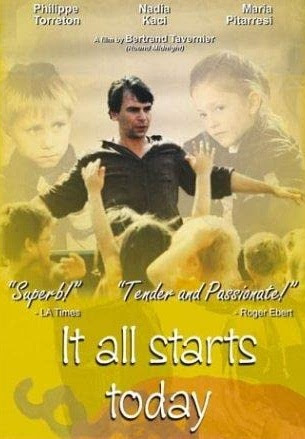
276. The late French director Bertrand Tavernier’s feature film “Ça commence aujourd'hui” (It All Starts Today) (1999), based on a commendable screenplay co-written by the director, his daughter Tiffany, and Dominique Sampiero: A primary school teacher who walks the extra mile to serve and speak for the tiny tots raised by parents with marginal incomes


"For its commitment to everyday heroism, its multi-layered approach to an array of social problems, and for the visual force of the storytelling.”

--Citation of the FIPRESCI award bestowed on the film It All Starts Today at the Berlin International Film Festival

There have been several films made on uplifting student-teacher relationships. These include To Sir, With Love (1967) a film on boisterous white high school students from slums of London eventually admiring and respecting their black rookie teacher;  Dead Poet’s Society (1989) on another rookie teacher kindling creative self-expression through poetry in  a US boarding school for senior US students from wealthy  backgrounds resulting in their unwavering respect and love for him; Goodbye, Mr Chips (1969), a remake of a film made 30 years before, where a stodgy Latin teacher after his marriage transforms  himself into an endearing school headmaster winning the hearts of his students;  Not One Less (1999), a neorealist Chinese film with real life characters playing their real roles directed by Yimou Zhang, focusing on a real life 13-year-old substitute teacher bringing to the fore the urban-rural education divide and the earnest desire of the teacher to teach and care for all her wards equally well;  and The Class (2008), a French film on the true experiences of a French language and literature middle-school teacher dealing with his foreign-born students disciplining them and gradually gaining their confidence--yet, not all students feel they ‘learned’ anything in his class.

It is Bertrand Tavernier’s two feature films on related subjects that discuss matters more substantive in the teacher-pupil interactivity, namely his films A Week’s Vacation (1980) and It All Starts Today (1999). In both films, the teachers are not rookies they have some credible experience in their jobs. The former discusses the importance of a female teacher observing and "listening" to her pupils in their early teens in a school in Lyons, France. The film underscores the fact that a reflective teacher could gain from the interactions with the pupils. However, Tavernier’s  It All Starts Today inverts the teaching role further to a teacher taking proactive steps to get the local government and the student’s parents to get involved in helping the teachers to impart education as they wish they could with limited resources provided by the local government.


Daniel (Philippe Torreton) truly cares for his students
and they love him for it


It All Starts Today has actor Philippe Torreton playing the role of Daniel, a head teacher of a primary school in a small mining town in France where former miners Daniel’s father survive with an oxygen cylinder strapped to his back. Miners not only battle pollution of particulate matter affecting tem while they worked in the mines, they have few other options of re-employment. Some are not clever enough to look for sustainable options for livelihood and slip into despair. Most are not sufficiently educated to move out and nor do they have any plans to start a new life and hence spend their days and nights in front of the TV sets. Their offspring are named after characters like “Starsky” and “Hutch”  from popular US TV serials. Some of the families cannot pay their utility bills and send their kids where they can get some education and mingle with others of their age. Worse still it is these cash-strapped families who are expected to support Daniel’s school through funds provided by the local civil council.

Daniel is the angry young man who is livid when the council cuts the lunch program for the kids and the parents are supposed to provide each kid with their lunches. When Daniel confronts the chief of the civic body, he is told the council has no money and Daniel, the underpaid teacher, offers a small contribution from his purse so that they make efforts to garner more funds to restart the scheme.


Daniel takes food on a personal initiative to the home of a
child whose parents are struggling to survive;
the other kids on the street are only marginally better off

Tavernier and his co-scriptwriters keep the viewer cleverly engaged to the bleak tale of the film using two tools. The first is Daniel’s demanding parallel personal life where his father is sick and his girlfriend wants him to father her next child while he pleases every student  (including his girlfriend's son from an earlier relationship with another man) with care and empathy. The second is Daniel's and his girlfriend’s out-of-the-box ideas to keep the young students happy and educated. One such innovative idea is to ask a parent, who is a truck driver, to bring his heavy duty truck to the school for the students to see what it could do—which proves to be a real treat for the kids who have never seen such a huge vehicle up-close.

Daniel, the angry multi-tasking primary school teacher,
is not just good at his job, he is loved by his students


When a financially struggling parent commits suicide with the children, the community that had preferred to look the other way comes out in full strength providing a flower-decked hearse.  Tavernier’s strength has been his choice of credible actors in minor roles such as the lady—Mrs Henry--who is driven to suicide because she does not see any hope to improve her lot.


Daniel talks to a child to figure out if he is 
being ill-treated at home, a role uncommon in a usual
teacher-student relationship

Daniel is concerned and takes proactive steps to stop a student from being brutalized at home by an abusive step-parent. The film is not merely a tale of an angry teacher forced to multi-task; it is a film about an individual being proactive to make the economically depressed society of a mining town to realize that change in their attitudes will go a long way to help their progenies to prepare for the future. The FIPRESCI award citation for the film (mentioned above) captured the strengths of the film well.


P.S.   It All Starts Today won the FIPRESCI prize at the Berlin international film festival in 1999 and was nominated for the Golden Bear. It won the Prize of the Ecumenical Jury and an Honorable Mention from the main Competition Jury for “the specialty of the topic;” the Best Film awards at the ASECAN, Sant Jordi  and the Fotogramas de Plata film festivals, all  three in Spain; the Audience Award at the San Sebastian International Film Festival, Spain; the Best Actor award at the Lumiere Awards, France; and  the Ecumenical Film Award at the Norwegian Film Festival. The other 1999 film mentioned above Not One Less, made in China, was reviewed earlier on this blog. (Please click on that name in this post-script to access the review)


Sunday, November 25, 2018

230. Vietnamese director Ash Mayfair’s debut feature film “The Third Wife” (2018) (Vietnam) based on her original story: Gorgeous cinematography, interesting visual allegory, female characters and actresses add value to a film that ought to make Vietnam proud!


Debut films of several directors worldwide have often been unforgettable, even when compared to their later works:  Orson Welles’ Citizen Kane, Satyajit Ray’s Pather Panchali (Song of the Little Road), Ridley Scott’s The Duellists, Steven Spielberg’s Duel, Jean-Pierre Melville’s The Silence of the Sea, Mike Nichols’ Who’s Afraid of Virginia Woolf?, Claude Chabrol’s Handsome Serge, Bertrand Tavernier’s The Watchmaker of St Paul...the list goes on.  That stamp of unmistakable awesome standards of filmmaking is apparent in Ash Mayfair’s debut feature film The Third Wife.

Within minutes of the film’s opening credits an observant viewer gets a clue of the quality of the film that follows—intelligent use of visual editing in presenting the title of the film and the aesthetic and delicate balance between silence and music on the soundtrack. The Third Wife is an original tale written by the film’s director. It is set in the 19th century Vietnam involving a rich nobleman living comfortably far away from the towns, with a retinue of servants, three wives of different ages, their progeny, and his father. The nobleman’s writ is the law in this remote household.  The film is set in a time frame in which men made the rules, when child marriages were acceptable, and when the birth of a boy was held at a premium for the parents over that of the birth of a girl.

May (Nguyen Phuong Tra My) as the 14-year old third wife

The title character of the film, May (Nguyen Phuong Tra My), is a 14-year-old child bride who has to travel by boat to reach her future husband’s abode.  She is welcomed by the entire family and household staff with pomp and feasting. The first wife Ha (Tran Nu Yen-Khe, who had earlier graced two significant Vietnamese films Cyclo and Scent of the Green Papaya) and the second wife Xuan (Mai Thu Huay Maya) welcome May with genuine warmth. The film narrates the tale economizing on spoken words but revealing much more visually by the brilliant camerawork of the lady cinematographer Chananun Chotrungroj, twice a winner of the Nestor Almendros (of Days of Heaven fame) award for cinematography. If the Spanish/Cuban maestro was alive today, he would have been delighted with the mastery of the visual elements from start to finish in The Third Wife.

The tale weaved by writer/ director Ash Mayfair, deals with the child bride’s interactions with the family members of various age groups over a period of approximately a year, learning quickly that to gain favour of her husband she has to bear a son and not a girl. Ms Mayfair’s tale is often visually edited to link her tale with the allegorical of life cycle of the silkworm—caterpillar, cocooning, fresh cocoon, cocoon with pupae, and finally a silk moth.  Why the silkworm? Evidently nobles of 19th century Vietnam saw silk as a valuable income source. And lots of silkworm pupae are killed while preparing the cocoons for making the silk threads. The tale of the film has obvious parallels between the mute silkworms and the human characters.

The pregnant third wife spends cordial time with the first and second wives

...and cordial interactions in the evening indoors.

The film has a predominantly a female production crew (writer/director, cinematographer, editor, etc.) and naturally the perspective is from a female viewpoint. Yet the feminism in the film is subtle, only making a silent but powerful statement towards the end.  Bereft of spoken words, the last ten minutes of the film is a fascinating recounting of critical past images from the film as recollected by the third wife May, who has matured over a year witnessing incest, patriarchal preferences to indulge boys over girls, the fate of children born out of wedlock among the servants, and the humiliation of a bride not accepted by her future husband.  The casting of May’s cute female child and the facial expressions of the infant captured by the film crew are highlights of the film. 

May's cute baby girl looking at her mother holding the
the yellow flowers, very significant to the tale


Though the ending of the film is ethically unacceptable, one gets a premonition that the last ten minutes of the film will be slowly accepted as one of the most powerful and sophisticated endings ever devised to end a feature film in recent years.

When director Ash Mayfair dispenses with spoken lines, she has two other tools beyond the camera. The music and wordless vocals (used for the end credits) composed by Ton That An (a Vietnamese male composer), and sound mixing (by Roman Dymny) that are ethereal. In a crucial point within the film, prior to a tragic development, the sound department introduces the sound of crows cawing though you don’t see them on screen (Russian director Andrei Zvyagintsev has employed this effectively in his 2011 film Elena). To Ms Mayfair’s credit, at no point in the film does the soundtrack seem overpowering—when you hear sound/music, it is soothing and calming to the viewer’s senses complementing the incredible camerawork.

Even interior shots are elegantly captured: a pregnant May,
 with the second wife's daughter

If there is a loser in this lovely film it would be the lack of emphases for details of realism. The film is a picture postcard view of Vietnam in the 19th Century.  Everything you see in the film is picture perfect, every detail of exteriors and interiors are dust free, polished and colourful.  The silk linen clothes hung out to dry in the sun are the whitest of white, the absence of mud and dirt on the feet of women walking in the night is unbelievable in a tropical country. So too are the absence of insects and reptiles beyond the silkworms and a single lizard on a mosquito net. Are there no snakes and other insects/ reptiles found in vegetated tropical Asian countries then and now?  Especially near bamboo groves at night?

Arrival of the third wife, May, by boat, to her husband's house


Ms Mayfair has thanked American director Spike Lee (of The BlackKkKlansman fame) among many others in the film's closing credits for the Spike Lee Fellowship she won as a student of New York University which enabled the development of the film.  Ash Mayfair has thanked the Government of Vietnam that lent a helping hand in making this high quality film in that country. The film’s highly talented cinematographer Ms Chananun Chotrungroj is also an alumnus of New York University and a recipient of the Ang Lee Fellowship. This film ought to encourage successful film directors to invest a part of their life’s earnings to develop new talents in filmmaking who otherwise would have never made a mark. Finally, Ms Mayfair choice of the actresses who played the three wives and their performances and her choice of the music composer also contributed to the incredibly well-made debut film. Even the poster of the film says a lot of the care taken to communicate the tale of the film intelligently.


The citation for the Gold Hugo for The Third Wife at the Chicago Film Festival reads:
"The Gold Hugo goes to The Third Wife. Ash Mayfair's lush, assured debut feature which follows a 14-year-old girl as she enters a wealthy household. Mayfair's unshakeable vision grants the women of this world an individuality their society rejects, treating them as creations as wondrous as the natural world that surrounds them, as the film builds to a staggering climax that devastates and thrills in equal measure."
P.S. The film has already won the Gold Hugo award at the Chicago Film Festival and the Royal Bengal Tiger Award for the best international feature film at the Kolkata International Film Festival. It won minor awards at Toronto and San Sebastian Film Festivals. The film was also part of the recent Denver Film Festival. The film is one of the best 10 films of 2018 for the author.

Saturday, January 10, 2015

172. Argentine director Damián Szifrón’s “Wild Tales” (Relatos salvajes) (2014): Black comedy that entertains while making us introspect


The "wild" characters from the six segments


Wild Tales is a gem of an entertainer made up of six stand-alone, dark, comic tales. It is a portmanteau film with a difference; all the six tales are written and directed by one man--Damián Szifrón.  He is also the co-editor of this impressive work. Surprisingly, this Argentine director is only in his late thirties and he has made a film that belies his age. Most audiences will love it because there are elements in the six tales they will easily identify with, irrespective of where they live on this planet.  Interestingly, the film was co-produced by the Spanish director Pedro Almodóvar, who must be delighted that he has invested his money well.

It is “wild” because it depicts extreme reactions of ordinary individuals, who are frustrated by present urban societal pressures and the outcomes are quite plausible if the frustrated individuals are left with little or no choice to correct their predicaments, created often not by themselves but by others. Damián Szifrón may be zooming in on frustrations in urban Argentina but a global viewer would easily identify the situations as universal.

"Pasternak": Wild revenge of a snubbed creative mind

The opening segment “Pasternak” is a prologue to the main film before you see the film’s credits hilarious credit sequence. The prologue is essential for the viewer to appreciate the comic elements in the illustrated animals shown in the credits.  The humans in the film Wild Tales are not far removed from the colorful wild animals in the credit sequence. The humans are ordinary people who can indeed become wild.

Without providing spoilers for those who are yet to enjoy the film, it is important to note ’’Pasternak” is a tale relating to the frustrations of a budding music composer named Pasternak, who finds his creative output is trashed by critics/professors and his life is gradually ripped apart by several people in his life. And the brilliant part of this segment is that you never get to see Mr Pasternak—you only get to see those who have ruined him.

"The Rats:" How to deal with rats in a restaurant 

The next segment “The Rats” is set in a restaurant but the rodents are human.  The human rat is a social climber who has succeeded in life by trampling down on poorer sections of society, often wrecking their lives with impunity and killing the bread winners of marginal lower middle class families who cannot survive the economic pressures.  This segment also presents the flip side view of lower middle class family members driven to prison for offences created by economic strains and eventually preferring to remain behind bars with basic food and amenities rather than succumb to “human” rodents who wreck your life outside prison.


"The Strongest": Class wars on the road

The segment “The Strongest” is all about road rage of two individuals with a difference. Director-writer Damián Szifrón adds the element of social economic disparity—one is driving a high-end car, the other a jalopy, both using the same highway.  The rich look at the slow moving jalopy refusing to give way for fast moving cars with disdain. The poor look to avenge the cocky rich. Who is stronger? The best part is the finale of the segment where the policeman makes an ironical statement. Kudos to the writer Damián Szifrón! The audience anywhere will erupt when they hear that line. (This critic is intentionally not reproducing it as it would be spoiler!)

"Little Bomb": The expert demolisher (Ricardo Darin) demolished

Argentine actor Ricardo Darin is impressive in every role in every film that this critic recalls having seen him in and the segment “Little Bomb” in Wild Tales is no exception. Ricardo Darin plays a well-paid demolition expert, married and a father of a lovely girl. His well heeled life is slowly demolished by a private sector Buenos Aires traffic entity responsible for ensuring cars are parked only in designated places and having the authority to tow away those that do not comply to the rules.

But such entities can get high handed and citizens can get high strung, if they are convinced that they did not break any rules but have option but to pay the large fines. This segment also reveals writer Damián Szifrón’s empathy for the parking woes of car owners in Buenos Aires and how a “terrorist” can become a local hero. Damián Szifrón’s characters here and elsewhere act and react as ordinary individuals driven up against the wall by forces un-intentionally created by a well-meaning society.

The segment “The Proposal” reiterates Damián Szifrón’s interest in the class divide and how the rich try to use the poor to get out of nasty situations such as a rich family member causing a car accident leading to a death of a poor citizen.  As in the earlier segment “The Rats,” Szifrón’s script deals with corruption but in “The Proposal” that aspect is openly shown with amazing humor. The black comedy takes a U-turn when the righteous, scarred public avenges by “wildly” killing the wrong person.


"Till Death Do Us Part": The bride confirms the bridegroom's infidelity

The final segment titled “Till Death Do Us Part”—the famous wedding phrase used in Christian weddings--is about a wedding reception for the newlyweds in a hotel in Buenos Aires.  The bride stumbles on a hidden relationship the bridegroom has with one of the invited guests and what follows is best described by Shakespeare’s words “Hell hath no fury like a woman scorned.” The resulting “wild” roller coaster events during the wedding reception constitute black comedy, sinister and yet hilarious.

While we laugh at all the six segments, there are pointers from the film to take home. Can critics destroy creative minds? Can the upwardly mobile successful citizens realize who they have trampled along the way? Can we project our road rage towards people who are indeed breaking rules without considering the consequences? Can the private and public sector perform with a heart towards society? Can public rage against corruption and the wrongdoings of the rich go sadly wrong?  Can spouses who fall deeply in love forgive each other’s weaknesses?

Wild Tales is a combination of intelligent original screenplay writing and good direction. This wild film is a social critique of Argentina today, entertaining the audiences in its stride. Intelligent comedy is not easy; Wild Tales makes it look easy. The numerous audience awards it has picked up at film festivals globally testify to its universal appeal and for Argentine cinema, rare indeed is a film that has won a staggering tally of 15 national awards. Damián Szifrón has arrived on the world cinema map.


P.S. Wild Tales  has won audience awards at the San Sebastian film festival, the Sao Paulo film festival, the Sarajevo film festival, and the Oslo Films of the South film festival. Its box office returns have already exceeded 7 times its production cost. It is one of the 5 films that made the final  list of nominees for the Best Foreign Film Oscar 2015 but did not win it. Wild Tales is one of the author's top 10 films of 2014.

Tuesday, December 09, 2014

170. The late Chilean maestro Raúl Ruiz' Portuguese film “Mistérios de Lisboa” (Mysteries of Lisbon) (2010): A brilliant cinematic treatise on memories


     “My films are not fiction films but about fiction”---Raúl Ruiz

     “In today’s cinema there is too much light, it is time to return to the shadows”--- Raúl Ruiz in his book ‘Poetics of Cinema’

      “I chose to take refuge in the dramaturgy of dreams” ---Raúl Ruiz


These three quotations of Raúl Ruiz are important starting points for analyzing the penultimate cinematic work of the talented Raúl Ruiz-- Mysteries of Lisbon. Ruiz had already made over a hundred movies and he made Mysteries of Lisbon knowing well that his days were numbered after being diagnosed with a life threatening liver tumour.  He completed the film while recovering from a successful liver transplant, only to die soon after, ironically from a lung infection.  While one can sense the brilliance of this cinematic work, it is difficult to distinguish what credit ought to be attributed  to the Portuguese novelist Camilo Castillo Branco, who wrote the book in 1854, without having read the work (the English translation of the book is not easily available), and what needs to be actually credited to director Ruiz.  Despite that conundrum, there are obvious pointers to what was definitely the contribution of Ruiz. The following analysis pertains to those aspects of the movie that are predominantly attributable to Ruiz alone.


Young Joao looks at his 'mother' in the company of Father Dinis


Father Dinis and Joao's "mother" (Maria Joao Bastos) after she becomes a nun

Mysteries of Lisbon is a 272 minute film unfolding a convoluted and yet interesting tale narrated by a tormented epileptic orphan Joao under the care of a priest named Father Dinis and some nuns. The tale is mostly set in the early 19th century Portugal. Priests and nuns there often have led colourful lives, preceding their final vocation. For author Branco, who was by all accounts a religious person, the Church in Portugal at that time provided sanctuary for orphans, widows, and those in trouble. Either Branco or Ruiz, or both together, use the puppet paper theatre as a prop and as a narrative punctuation device for the epileptic Joao to imagine vivid tales of grown-ups in aristocratic Portugal, who are all somehow connected to Father Dinis (Adriano Luz) and a lady who claims to be his mother, who has gifted him the puppet paper theatre while recovering from an epileptic attack. It is thus not surprising that characters in Joao ‘s world are closely interrelated.  (For example, Joao’s “mother’s“  husband’s mistress turns up later in the tale as the wife of Albert de Magalhaes, another important person in Joao’s life story.) In that process, Branco examines the social importance Portuguese gave to the firstborn in a family, how paternal titles made or unmade individuals, how fathers wreck the love lives of their daughters for personal benefit only to rue their actions much later in life and the lack of fidelity of abusive husbands.

Any approach to appreciate Ruiz’ cinema cannot dissociate it from  Ruiz’ life--a Chilean director who chose self-exile in the early Seventies following the US-supported coup that removed the democratically elected Salvador Allende while installing the Chilean armed forces Commander Augusto Pinochet in power instead.  Today, the world knows the late Pinochet was implicated on over 300 charges of human rights violations. The multi-talented Ruiz fled from Chile under Pinochet hopping from one European country to another, frenetically writing plays and books and making over a 100 films. Each of these works reflected his distaste for the armed forces that took power in Chile and his wistful love of Chile, a country he could not return to work as before.  Even though Mysteries of Lisbon is predominantly set in Portugal and France, there is a sequence where the ‘orphan’ Joao ‘appears’ to end his last days in Brazil, not far from Ruiz’ homeland Chile. Ruiz forever dreamt of returning to Chile. As per his wishes, Ruiz was buried in Chile. Such indirect references abound in each work of Ruiz. While Mysteries of Lisbon is essentially about dreams, the final sequence reiterates the importance of dreams.  At the end, the colours of the screen fade to merge with empty white light. The film of shadows comes to a close. Ruiz transcends Branco’s words using cinematic effects.

Shadows and perspectives: Ruiz upstaging Branco
(the shadow is of  Father Dinis) 
A casual viewer of Mysteries of Lisbon would not associate the work with surrealism and magic realism more obvious in Ruiz’ works, such as, That Day (Ce jour-la) (2003) and Three Crowns of the Sailor (1983). Early into Mysteries of Lisbon, there is a short sequence where another kid of Joao’s age leads Joao to a spot behind the hedges of the orphanage where some men have been hanged in public view. The kid claims that one of the hanged men is a thief and his father. The viewer can see the hanged individuals. Joao is crestfallen as he has been accused of being the son of a thief and confused but does not respond as one would expect.  Father Dinis, who accompanies young Joao and the kid who is showing Joao the hanging, is merely studying Joao’s face  rather than the hanged persons, and he leads Joao back impassively after Joao has taken in the scene of  the hanged individuals. Where is the surrealism or magic realism?  Could this be a real hanging, so close to the orphanage? If it was real, why is Father Dinis not appearing to be concerned with the hanging? Why is he only concerned about Joao? Why do doors open and close by themselves in the film? Why do certain paintings come alive for Joao? Why does an important transaction between two friends take place in a room with two massive religious frescoes on the walls and just two chairs, devoid of any other furniture? Why does Ruiz employ two Joaos during the duel scene, one committing suicide after pensively walking in the background, and another active Joao who partook in the duel going on to live another day with honour? The answers to each of those questions are “mysteries” that contribute to the richness of the film and help the viewer to unravel Ruiz’ complex movie Mysteries of Lisbon with its unusual ending.

Towards the end of Ruiz’ Mysteries of Lisbon, the grown up Joao encounters Elisa de Montfort (Clotilde Hesme). She pauses in her walk and comes to Joao to state, “You lacked courage, my dear.”  This is a sequence which could have been typical of Ruiz’ cinema referring to Ruiz’ political courage or it could also have been Branco’s idea. While the lack of identity is a problem for Joao the orphan, the lack of citizenship of Ruiz is perhaps one reason for the director to choose to make this film, which mirrors his own life.

Riches to rags: The teenaged Joao encountering a once proud Marquis
reduced to beggary searching for the 'mausoleum' of his daughter
Throughout Mysteries of Lisbon, the peripheral non-aristocratic characters listen to conversations of the aristocrats and seniors openly. Servants not just bring in chairs and messages for their masters, but serve as silent and sometimes expressive external commentators within the film.  Even in an abbey, junior priests eavesdrop on the colourful tales of senior priests. Money transforms people of lesser social stature into aristocrats in Mysteries of Lisbon and a proud Marquise is transformed into a blind beggar in the course of the tale.

Torn shreds of an unread letter captured by the camera
placed below the resting pieces

The cinematography (André Szankowski ) of the film is stunning. The camera teases the viewer. The camera goes under a glass table to capture the torn pieces of a letter that is never read. Stories within a story deliberately show individuals with unreal beards and make-up, while the main story in contrast never compromises on quality. Dreams within dreams are treated differently by Ruiz.


Using the paper puppet theater to punctuate Acts

Mysteries of Lisbon is essentially a brilliant treatise on memories. At the end of the movie the viewer is shown a tired and graying Joao who needs a walking stick, but no taller than a teenager, narrating his tale to a scribe. He says “I was 15 years old and I didn’t know who I was. I went on no outings or holidays. I received no presents. I don’t know how long it has been since I lost consciousness. And the moment I opened my eyes. I thought I dreamt it all“, while lying down on a cot broad enough for a kid. Doors close by themselves and the screen brightens gradually to be covered by pure white light.

This film won the San Sebastian Festival Silver Seashell for Best Director and the Sao Paulo Festival Critics award for best film. The film was carved out by Ruiz from several episodes he made for the Portuguese TV.


P.S. Mysteries of Lisbon is the first film of Ruiz to be included in the author’s top 100 films. It was also one of the top 10 films of 2011 for the author and one of the 15 top films of the 21st Century for the author.  Ruiz’ earlier work, That Day (Ce jour-la) (2003) was reviewed earlier on this blog. Ruiz’ last film that he completed before his death, La Noche de Efrente (Night Across the Street) (2012), was one of the top 10 films of 2012 for the author.


Thursday, November 06, 2014

169. French director François Ozon’s French film “Dans la maison” (In the House) (2012): Second Ozon film on creative writing, this time adapting a superb Spanish play


François Ozon seems to be fascinated by what makes writers tick. And he loves to prod the viewer to reconsider his/her mental evaluation of fiction and reality as they watch his later films.

Many viewers are likely to initially consider the superb tale of In the House to be solely Ozon’s creative work; it is not. In the House appears to be almost totally leaning on the product of a contemporary Spanish playwright Juan Mayorga titled The Boy in the Last Row, if one goes by the reviews of the play. It is, thus, not a coincidence that the French film went on to win the well-deserved Golden Shell (the grand prize) and the Jury prize for Best Screenplay at the San Sebastian film Festival in Spain. Then why is the film important, if almost all the credit rests with the play on which the film is built? This is because Ozon forces any intelligent viewer to evaluate himself/herself as they progress with the viewing of his film beyond the film’s tale. Is the viewer being cajoled to infer more than what the movie actually informs us?  Is the viewer a voyeur, wanting to see more than what the film offers? Those are Ozon’s questions thrown at us by cinematically adapting the play.


However, the Spanish play proved to be a perfect extension of the very ideas director Ozon presented in his previous movie The Swimming Pool (2003).  In The Swimming Pool, a film based on a story written by Emmanuèle Bernheim, director Ozon presented a riveting thriller, complete with dashes of murder and sex, which was essentially an essay on how a creative fiction writer (Charlotte Rampling)  gets and develops ideas to write her novels, while jolting the viewer to realize at the end of the film that what they read in books (or see and hear on screen) need not be true and that a clever writer can manipulate your mind to make you believe it is indeed true until the end, when you comprehend the real truth.

It is to the credit of director Ozon that he chose to film Mayorga’s play, which logically extends the cinematic argument presented by director Ozon in The Swimming Pool. Mayorga’s play is also about the creative writing process, laid out in a greater and more entertaining detail than in the previous film; with an important additional question relating to morality asked of the viewer. Does the creative process need to be merely smart or does it have to combine moral/social values?  Ozon never dealt with morality in The Swimming Pool but he does that to a certain extent in In the House.


Creative writing: Teacher Germaine Germaine (Luchini)
and student Claude (Umhauer)
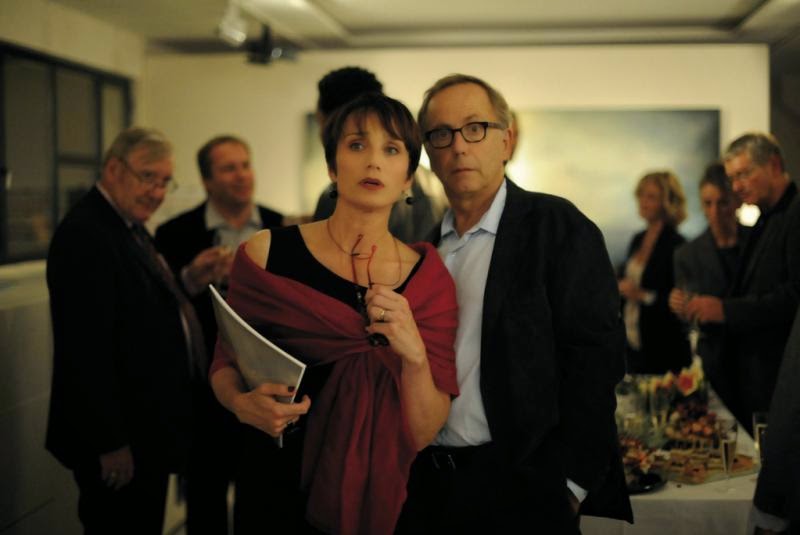
In the House is a tale of a young, intelligent male school student, Claude already good at mathematics, who occupies the last rows in his class (the detail referenced in the title of the play), trying out his skills in creative writing in a literature class. Playwright Mayorga is erudite and one assumes is familiar with Vladimir Nabokov’s book Lolita, which has a literature professor double-named Humbert Humbert, who gets obsessed with his step-daughter nicknamed Lolita.  Playwright Mayorga alludes to Nabokov’s work by creating a literary teacher named Germaine Germaine (the viewer gets to see the teacher’s full double name on the cover of his very unsuccessful published book, in the Ozon movie). It’s not just Ozon and Mayorga who are taken in by Nabokov’s novel, even the maestro Stanley Kubrick decided to film Nabokov’s Lolita. Germaine Germaine  is not the only oblique literary reference in this film. They are scattered all over. The name of the French school in the movie is Lycee Gustave Flaubert and the teacher Germaine Germaine (Fabrice Luchini) refers to Flaubert’s Madame Bovary, a novel that prevails on the reader not to quickly judge characters presented in it, while introducing the work to his students. (Madame Bovary was also the inspiration for Robert Bolt’s script of David Lean’s film Ryan’s Daughter, made in 1970, initially trashed by critics who were ironically too quick to judge what it offered.) The school-teacher’s wife Jeanne (Kristin Scott Thomas) knocks down her husband in the film with a hardbound copy of Celine’s novel Journey to the End of the Night, quoted at the start of Sorrentino’s recent movie The Great Beauty (2013). The choice of the book is not an accident. Knowledge of international literature can provide additional entertainment for the viewer by enjoying the trenchant remarks of various characters in the movie/play.

The teacher (Luchini) and his wife (Kristin Scott Thomas),
who reads and comments on student Claude's creative writing

The film/play, like Nabokov’s character's name Humbert Humbert, presents and discusses on screen two fathers, two wives, two mothers (one on screen, the other off-screen). and a pair of twins, who own an art gallery, The position the young schoolboy Claude (Ernst Umhauer) occupies in his class is the last row—and visually ironically enough his teacher Germaine Germaine also occupies the last row during an internal teachers’ meeting in the school to discuss school uniforms. Both pupil and teacher are astute observers and thinkers at their individual levels, both sitting on benches in classrooms/schools or in open parks. Both are critical of the middle class to which they themselves belong. The last shot of the film is of both teacher and pupil sitting on the same bench, observing lives of people they have never met.  Ozon’s cinematic rhetorical unspoken question at the end of movie is who is the teacher? Ozon dissects the creative process of writing and storytelling for the viewer. The answers do not lie in the film; the resolution of the conflicts rests with us the viewers. Is the sharing of an apple by a woman and a boy symbolically innocent or not so innocent?

The film/play is a tongue in cheek look at the growing power of TV soap operas which keep viewers dangling on the edge at the end of each episode, convinced and reassured the tale is to be continued in the next, and thus ensnaring the viewer to watch the next episode.  People need stories like the ones Scheherazade narrated keeping her Sultan asking for more tales for 1001 Arabian nights. The creative writing process not merely ensnares the reader/viewer but also involves the creation of a good ending. The teacher of creative literary writing explains to his pupil that a good ending is one that is “necessary, unpredictable, inevitable and surprising.”  Director Ozon does just that by providing such endings in both his films: The Swimming Pool and In the House.


Real or unreal 'barbaric invasion:" Claude (Umhauer) appears to sleep
 between his classmate's parents.
Claude appears to look at the camera/viewer. while
his shadow seems to be looking at his classmate's mother
 (Emmanuelle Seigner)

In the House is ironically about the beguiling”barbaric invasion” of smart students in the school classrooms taking on unsuspecting teachers and extending that invasion to unsuspecting middle class-households with the knowledge of a well-meaning teacher who stokes the embers of creativity in his student not able to decide if his student’s entry into another student’s house is “like an angel or a vampire.” The play/film goes on to compare the allure of mathematics (that “never disappoints”) with that of creative writing (or literature).

The closing shot of the teacher and his pupil

Director Ozon presents a very entertaining and complex film that even prompts Germaine Germaine to wonder if his student Claude’s literary work that keeps his readers transfixed and amazed is close to an imaginary Pier Paolo Pasolini film when Claude is kissed by his male classmate Rapha Jr., while Claude is actually attracted instead to Rapha’s mother (Emmanuele Seigner), in whom he sees his own physically absent mother.  On the flip side, Germaine Germaine’s wife Jeanne wonders if her husband is turning homosexual with his increasing interest in his male student, while her husband actually sees in Claude a son he never had with his wife Jeanne.  Perception and reality are compared at every stage in the film. Who is the Svengali, the literature teacher who is a failed author or his bright student with real raw talent?

It is a film that explores the world of academia recalling Joseph Losey’s and Harold Pinter’s acerbic treatment of the middle class in Accident (1967).  Ozon’s In the House is a film like Accident, which makes a viewer evaluate himself/herself, while presenting a delightful and a surprising ending with endearing performances from an ensemble cast.

For keen Ozon watchers, it would be interesting if he does go on to make a third feature film on the subject to complete a triptych that began with The Swimming Pool and followed up with In the House.

(This review was earlier published on 5 Nov 2014 at  http://dearcinema.com/review/film-recco-francois-ozons-house/5245 )


P.S. Losey's Accident and Lean's Ryan's Daughter were reviewed earlier on this blog.

P.P.S. The two lead actresses Kristin Scott Thomas and Emmanuele Seigner had previously worked together in Roman Polanski's Bitter Moon (1992), coincidentally a tale about a failed author narrating a tale that could have made a great book. Polanski's film was an adaptation of a novel by the celebrated French 'New Philosopher' Pascal Bruckner.