Showing posts with label Hamburg winner. Show all posts

Monday, January 26, 2026

288. Georgian director Dea Kulumbegashivili's second feature film "April" (2024) (in Georgian language) based on her own original screenplay: Can moral beliefs to help the poor and needy override the laws of the land and put one's career in jeopardy?


Do you understand how laws work? You will have no more patients; you will not have a job. Even if you are not arrested, you will be ruined. If you want to work, you have to obey the laws. Sometimes, the law may go against our moral beliefs.
-- Head doctor of obstetrician/gynecologist at Nina's hospital asks Nina the gynecologist, who conducts free extra-curricular abortions for the poor and needy in rural Georgia

This Georgian (the country, not the US state with the same name) film will grip any cinephile exposed to rapidly evolving contemporary cinematic grammar from start to finish. Dea Kulumbegahivili's film expresses its narrative through visuals (fascinating cinematography of Arseni Kachaturan) and music (young award-winning composer Matthew Herbert) minimally relying on spoken dialog.

Early in the film, we see a mysterious inexplicable somewhat-human ash-colored grotesque figure from the rear without clothes, breathing heavily heading towards water-bodies in semi-darkness. Initially nothing is explained to the viewer except that the heavy breathing on the soundtrack resembles human breathing. Cinephiles will recall the image of the literal goat-headed, horned figure of a devil with an arrow-shaped tail, carrying a toolbox, entering a sleeping household in Mexico in Carlos Reygadas' Post Tenebras Lux (2012) at night. Reygadas' followers inferred that unusual surreal image to be an allegorical representation of the entry of corruption into an innocent family's house bypassing sleeping children in their bedroom enroute to their parents' bedroom. Both the Mexican and the Georgian films begin with visuals of rain and mud. In both films, the images only make sense to a perceptive viewer as the film's narrative progresses, forcing the viewer to connect earlier images with the information provided much later, helping put the earlier mysterious sequences in context. Both the Mexican and the Georgian directors are reinforcing a film grammar rarely used in commercial cinema, but had existed in bits of the early works of Bunuel (e,g., Un Chien Andalou,1929) and of Herzog (e.g., the visually stunning flow of rats in Nosferatu the Vampyre made in 1979).

In the Georgian film, April, the bizarre opening sequence is linked with an early incident in the life of  Nina, a gynecologist in a government hospital, who is the film's main protagonist, revealed much later in the film  when as a young girl she was scared stiff to rescue her female friend who was drowning in a water-body. That inaction on her part scars her moral conscience in diverse ways. First, she rejects a possible marriage with a male gynecologist, who likes and appreciates her as a person and as a very capable and trustworthy colleague at work. 

Subsequently Nina, now a gynecologist sets on a somewhat secret mission to help poor women in rural Georgia, who get pregnant in non-consensual situations to abort their fetus as hospitals do not allow abortions in that country. This is Nina's personal, discreet way to make amends for her inaction to save her friend from drowning while pleading for Nina's help. Nina's chosen double life is akin to the secret lives of the fictional Batman and Superman though in her case not to fight evil forces but to help those who have no succor. Like the comic book superheroes, the film does not indicate that Nina's secret night life is to earn any additional income; it is truly gratuitous--traveling long distances alone in her car, with full medical accessories required to conduct an operation at night, to help the helpless.

Nina prepares to abort the fetus of a physically/mentally
challenged lady, impregnated without consent, on a dining table
of a family with limited resources

The cinematic grammar of April is akin to verbal punctuation in a written work, only using visuals and sounds to provide additional information beyond the minimal spoken narrative for the attentive viewer. The somewhat-human, ash-colored grotesque figure re-appears in the film at crucial junctures in the narrative. Even a bicycle ridden by Nina's colleague is captured by the camera's vision indoors to indicate the importance of the location of the shot with the grotesque figure being held by Nina's colleague just as lovers would. Then there are sequences with spring flowers growing in April in the Georgian rural landscape in happier sequences and with ominous clouds and thundershowers as precursors to difficult scenarios--each chosen to complement the narrative with care.

Nina's dream sequence, where the mysterious grotesque
human figure is held by Nina's senior colleague,
who once hoped to marry Nina. His bicycle appears in the
right-hand corner, accentuating the location, as the hospital

The main tale of April includes the dramatic charges levelled against Nina's official work within the hospital made by a parent that his child died in the hospital due to Nina's negligence during childbirth. The viewer of the film awaits the outcome of that inquiry, while the hospital authorities worry whether Nina's extra-territorial illegal  activities would come out in public or not and the consequences for Nina. 

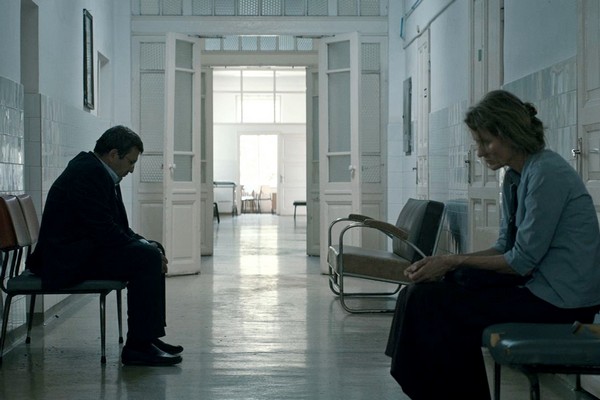
A lonely Nina outside the office of the Head of her hospital
awaiting the outcome of an internal inquiry into an
allegation against her that her operation caused a child's death

The end of the film proves to be fascinating and thought-provoking, worthy of its Special Jury Prize awarded by the Venice film festival for film's director. While right-wingers would dig up the "Roe vs Wade" arguments in USA, this remarkable Georgian film is a delight essentially for the way it has been constructed, and the importance of respect one bestows on those few who place importance to their moral stance to help those that need one's discreet help above the controversial subject of the legality of abortions. Director Dea Kulumbegashivili has exhibited her talent as a filmmaker to the world in April and that has been recognized widely at diverse festivals around the globe. This talented director could emerge as a major force in East European cinema.

P.S. The Mexican film Post Tenebras Lux (2012) has been reviewed earlier on this blog, Click on the name of the film to access that review. April is one the best films of 2024 for this critic.


Saturday, April 22, 2023

279. Iranian film director Mohammad Rasoulof’s second feature film “Jazireh Ahani “ (Iron Island) (2005), based on his original screenplay: Brave cinema focusing on the travails faced by the common citizen, using allegory to bypass hawkish national censors


M
ohammad Rasoulof is different from most filmmakers. He does not adapt written works—he writes his own original screenplays stitched together from what he observes and hears from Iranian compatriots. He has made a modest tally of seven fictional feature films to date and these have picked up a Golden Bear at Berlin, a Golden Peacock in India, a Gold and a Silver Hugo at Chicago and three major awards at Cannes’ important  Un Certain Regard section, among 36 prestigious awards and prizes won globally. The seven feature films do not include his two feature-length docu-dramas/documentaries—Intentional Crime (2022) and Head Wind (2008).

Rasoulof loves to encapsulate the human condition of present day life in Iran and the aspirations of its population in realistic tales that avoids direct criticism of the Iranian government. Unlike the Iranian director Abbas Kiarostami, who never made a film that was obviously critical of the government, Jafar Panahi  (once Kiarostami’s assistant) has evolved into an Iranian filmmaker winning praise, on his own merit, making feature films in which couched criticism of the lack of freedom in contemporary Iran is comparably more forthright. Rasoulof, in turn worked with Panahi on Panahi’s films initially, until Rasoulof, too, became an equally world-renowned filmmaker winning awards worldwide. The Iranian government has not been happy with  Rasoulof ever since he made made his second film Iron Island. Today, both Panahi and Rasoulof are in prison because of the contents of the films they made and their social activism. While Rasoulof’s first film Gagooman (2002) did not ruffle feathers, in spite of the fact that its two principal characters are prisoners serving time in an Iranian jail for minor crimes. That film was widely appreciated within Iran went on to win the Best First Film award at the Fajr Film Festival in Iran. Then came Iron Island (2005) and the spate of problems for the director from the Iranian government sprouted for each subsequent film he made.


The Captain (Ali Nasirian) warns the lad, Ahmad,
not to pursue the unmarried lass on the ship


The unmarried lass, with her face partially covered,
as per certain Muslim traditions, is living on the tanker
and shows interest in Ahmad


The film Iron Island is not about a real island; it is merely a description of a disused oil tanker anchored off-shore, a vessel that is gradually sinking. Rasoulof transforms the disused tanker, awaiting eventual shipbreaking, into a contemporary Noah's ark, providing refuge for homeless poor Iranians, young and old, under the care of a seemingly benevolent "Captain," who is able to provide food and medicines for the refugees her brings on board. He is able to buy provisions and medicines by gradually selling off metal parts and oil on the ship that the young men are made to identify and rip off the ship each day. The Captain is a veiled representation of the Iranian Government, which is dictatorial and brutal to those who step out of line, while appearing to be benevolent to others. The same benevolent Captain, in the film, also mercilessly tortures a lad, who escapes the ship when his beloved, an unmarried girl with a partly masked face, is given away in marriage by the Captain to someone else living on the mainland (a process that makes the 'Captain' richer). The lad is caught and brought back to the “iron island” all tied up in a boat.  The 'Captain' teaches the errant lad a tortorous lesson that leaves him almost dead.  The motley refugee group on the “iron island” represents the innocent folk with little or no income, who accept their fate without being able to question their benefactor’s (the Captain’s) motives or actions out of a combination of fear and gratitude. 

The boy called Fish, ultimately is made to leave the tanker for the shore but resumes his pastime, searching for small fishes, this time trapped on the sandy beach. He picks one and throws them back into the sea as he used to while on the tanker, little realizing that there are fishermen’s  nets set up in the water to catch such fish. 

The lovers on the tanker who were forcibly separated by the Captain are brought together by fate even though the lad is lying in a mosque recovering from his recent torture ordeal and his beloved is married to a rich person who owns a car and employs a chauffeur. The viewer is left to figure out the outcome of that possible meeting which is never shown on screen. Similarly, the viewer has to figure out the allegory of the Captain’s angry action of throwing out the working TV the boys had painstakingly made to work.

The "Captain" intervenes in a skirmish between
two lads as an elder and peace prevails


The "Captain" collects passports of all adults on the tanker
as precursor to collecting their signatures,
the purpose of which is never revealed, even when questioned.
The viewer has to conjecture the purpose. 


Rasoulof’s films provide punches but the endings of each film are deliberately left open-ended. He does it intentionally; his films have to pass the national censors. It is unclear how many of his films have actually been released in Iran and, if released, how much is censored. Iron Island may not be as sophisticated as Rasoulof's later films but it makes you think beyond the obvious tale. Rasoulof is definitely one of the finest and the boldest filmmakers in Iran, if not the world, now languishing in prison. His crime--he made films that were indirectly critical of lack of freedom in Iran in recent decades and his social activism. The bravery and the acclaim of his films cannot be equalled by most other filmmakers, currently alive and making films. 


The "Captain" is attired more like an Arab rather than a typical Iranian
but speaks Farsi the language of Iran


We live in a world where filmmakers cannot tell the truth without offending the governments in power, even though the respective governments criticised are often "elected" democratically. There are brave filmmakers who present the truth using allegory and fables, to bypass hawk-eyed Government censors. In Russia, film directors Andrei  Zvyagintsev, Andrei Konchalovsky  and Alexei German ,Sr., have made allegorical films. Raul Ruiz made films made films in exile with despondent references to his native Chile. When they do make such films they often win major awards at reputed film festivals such as Cannes, Berlin, Venice and Locarno, among others. Contemporary Iranian filmmakers Jafar Panahi, Mohammad Rasoulof, and Mohsen Amiryousefi are three prominent talented filmmakers who have made films that made the Iranian government uncomfortable often banning their release within the country. Panahi and Rasoukof  have been sentenced to long jail terms and are released for short periods for medical or other reasons, after which they have to return to prison and complete their sentences. It is not clear how many citizens in Iran have seen the completed works of these filmmakers in public screenings and, if so, whether the films were shown without cuts by the censors. 

Iron Island is merely a harbinger to Rasoulof’s later films. His later film Goodbye is an extension of the young lad’s decision to leave the tanker and the oppressive environment in Iron Island. His film Man of Integrity, a film on corruption within Iran and on intolerance of minorities is glimpsed by the Iron Island’s Captain’s actions of collecting signatures of the refugees without adequate explanation and sale of the ship’s parts without the knowledge of the real owners, who innocently believe he is doing a good deed for the refugees. What is quite evident is that Rasoulof has improved further technically with each film, ultimately reaching world standards in There is No Evil, which won the Golden Bear at the Berlin film festival. Panahi, Rasoulof and Amiryousefi need the support of cineastes who value filmmakers who use the medium creatively for improving the freedom within Iran and promote the aspirations of its citizens..


P.S.   Iron Island won the Golden Peacock award for the best film in competition at the International Film Festival of India (2005); the Cinema prize and the Script prize at the Avanca Film Festival (Portugal) (2007); the Special Jury prize at the Gijon International  Film Festival  (Spain) (2005); Screenplay award at the Montreal Festival of New Cinema (Canada) (2005; and the Critics prize at the Hamburg Film Festival (2005). Three of Rasoulof’s later films Goodbye (2011), A Man of Integrity (2017) and There is No Evil (2020) have been reviewed on this blog earlier. So are Zvyagintsev's The Return  and Leviathan; Konchalovsky's Shy People, The Postman's White Nights and Paradise; Ruiz'  That Day, all films with subtle bits of allegory on politics and its effects on the common citizens. (Please click on their names in this post-script to access those reviews) 


Wednesday, February 26, 2020

248. French director Céline Sciamma’s fourth feature film “Portrait de la jeune fille en feu” (Portrait of a Lady on Fire) (2019) based on her original screenplay: An awesome film built on impeccable direction, intelligent screenplay, magnetic performances, cinematography and choice of music


Céline Sciamma’s Portrait of a Lady on Fire may be described by some as a feminist film that tells a tale of four women characters in 18th century France devoid of any significant male characters, and made by a female director and a female cinematographer.  At the end of this remarkable film, you tend to discount the female element. You are stunned by the sophisticated quality of cinema the film offers that makes you discount the overwhelming female gender quotient. 

The following two citations of awards bestowed on Sciamma’s Portrait of a Lady on Fire amply describe the worth of the film.
"The Gold Hugo for Best Film goes to Portrait of a Lady on Fire by Céline Sciamma. The film portrays not only the exuberance of falling in love and the all-consuming nature that is love, but also the beauty of women's solidarity and the attempt to fit in a world that rarely seems to be made for them. The strength of the filmmaking combined with amazing acting, photography, and music set the jury on fire."
(Citation for the Best Film Award at Chicago International Film Festival.)

"This is a work, which excels in its audio-visual storytelling. Channelled through a strong female voice, it is at once narratively compelling and aesthetically striking. The film transports us to an age even more firmly in the grip of men than our own, to tell the tale of a handful of women. We follow their fascinating and deeply moving story, as they find intimacy and succour in one another, and a way to live out their dreams of freedom and fulfilment, to satisfy the longing to be a complete human being. In keeping with the best of period drama, our winner speaks to timeless human themes in a rich and stylistically self-assured visual register. With elegance, sophistication and courage, the film explores how love and vitality can - at least momentarily - throw off the shackles of an oppressive social order. Exquisite acting performances and cinematography, combined with a soupcon of mythological symbolism, add up to a work of serious artistic merit."
(Norwegian film critics award citation.)

Héloïse (Adèle Haenel) is an enigma in the early parts of the film,
not suicidal but enjoying her freedom to run to the  edge of the sea
after her long years in the nunnery


Sciamma’s original tale of Portrait of a Lady on Fire is of a female painter Marianne (Noémie Merlant) contracted by a countess (Valeria Golino) to paint a portrait of her second daughter Héloïse (Adèle Haenel) on an island in Brittany, France. The portrait is intended to be a wedding gift for Héloïse’s impending marriage to a wealthy man in Milan, who was earlier meant to marry Héloïse’s sister who suddenly died before the marriage could take place. Héloïse, we learn, was recently brought by her mother to the island from a nunnery where she was educated by the nuns. Héloïse, we further learn as the film progresses, is not looking forward to the prospect of her impending marriage and has deliberately disfigured an earlier portrait of her done by another painter for her impending wedding and has subsequently become a recluse with only Sophie (Luàna Bajrami), the maid, as her regular contact. Therefore, the countess briefs her newly hired painter Marianne that she has to paint her daughter Héloïse’s portrait without letting her know that her portrait is being painted and without revealing that Marianne is actually an artist commissioned to paint her portrait and not a mere hired companion for Héloïse, the official excuse for her  presence on the island.  Sciamma’s screenplay, in the early stages, focuses on Marianne’s intense creativity as a portrait painter in capturing the features of her subject first in her memory only to paint the portrait in secret, which she does in the absence of her subject. Héloïse. in turn. is surprised why Marianne is looking at her so attentively.  The entire process is cleverly captured on film by lady cinematographer Claire Mathon.  In this process, director and screenwriter Sciamma and cinematographer Mathon make the viewer fall in love with the duo on screen, with minimal dialogue spoken between the two characters. Sciamma and Mathon are the true “painters” in the film!

Marianne (Noémie Merlant) paints the portrait of Héloïse
from memory of the details she found while staring at her

The minimal dialogue in the film’s script can be assessed by the fact that Héloïse’s name in the film is revealed only halfway into the film. Early in the film, as Marianne is transported by boat to the island her crate of canvas sheets falls into the sea and Marianne jumps into the sea to retrieve it. Initially the viewer would tend to consider it as Sciamma’s design to introduce and develop Marianne’s character. On deeper reflection, Sciamma’s script and direction add another aspect to that scene: the fact that no male person on the boat bothered to jump into the sea to retrieve the floating crate.

Having introduced the psychological development of interest between Marianne and Héloïse, Sciamma moves on to introduce the physical and, ultimately, to the emotional interest that develops between the two ladies with time. A key element used by Sciamma to aid this development is music, carefully but sparingly used. Héloïse, in the nunnery, had been exposed to choir singing and organ music. Little else. Marianne introduces Héloïse to harpsichord and Vivaldi’s compositions.  Music is used in key sequences with elan. During the bonfire sequence, when Héloïse’s dress catches fire literally and figuratively, the women around the bonfire sing a cappella song. The final sequence in the film and definitely strongest in the entire film is that of the married Héloïse listening to Vivaldi’s second concert “Summer” in his famous four part concerti composition The Four Seasons. One can anticipate that over time that the ending will count as one of the most evocative film endings in the history of film, combining the effects of good scriptwriting, camerawork, direction and performances of the key actors without a word spoken.

The stares for a professional cause that kick off a vibrant relationship
The fire is real, but the fire in the film's title is metaphorical.
Cinematographer Claire Mathon captures the rare moment
as the painter Marianne will recall the magical moment 


Sciamma’s intelligent script suggests parallels with the mythological tale of Orpheus using music to lure his wife Eurydice back from the dead (the nether world of Hades) with a condition made by the gods that the Orpheus does not look at his wife. In the film Portrait of a Lady on Fire, the married Héloïse does not appear to look at Marianne while listening to a Vivaldi concert, music that Marianne had  made Héloïse appreciate prior to her marriage.

Héloïse discovering new aspects of life from Marianne: music.
love, painted images, impending 
marriage,,


There is a sub-plot of the maid Sophie finding out she is pregnant out of wedlock and the subsequent secret abortion conducted by Marianne and Héloïse, when abortion was illegal in the 18th century France.  The role of the countess stresses another typical type of strong-willed woman in those times in France.  Portrait of a Lady on Fire uses the four female characters developed and presented by a predominantly women crew, each of the four characters contrasting and complementing the other. Whether one likes the subject of Portrait of a Lady on Fire is personal choice but most viewers would appreciate the high quality of filmmaking on display.  It is a film that distantly recalls Peter Greenaway’s 1982 film The Draughtsman’s Contract.

Trust and love blossoms between painter and subject
The countess (Valeria Golino) (facing camera) presents
the typical 18th century lady, a lesser developed character of the quartet


Céline Sciamma’s ability as an original script-writer and director brings her in the august company of two other top-notch contemporary female directors: Claire Denis from France (Beau Travail and L’intrus) and Anne Fontaine from Luxembourg (Dry Cleaning). The entire trio have consistently made remarkable films independent of each other.


P.S.  Portrait of a Lady on Fire is one of the author’s top 20 films of 2019. The film won the Best Screenplay award at the Cannes Film Festival; the Gold Hugo Award for the best feature film at the Chicago International Film Festival; the Rare Pearl  award at the Denver International Film Festival; the Best European Screenwriter Award at the European Film Awards; Art Cinema Award at the Hamburg Film Festival: and the Felix Award for the best fiction film at the Rio de Janeiro International Film Festival. Claire Denis’ film L’intrus (The Intruder) (2004) has been reviewed on this blog earlier.

Wednesday, February 15, 2017

202. Romanian director Cristian Mungiu’s film “Bacalaureat” (Graduation) (2016) (Romania), based on his own original screenplay: Fallouts of a father-daughter protective relationship within a contemporary corrupt East European social framework


The year 2016 saw the release of three very interesting award-winning films from three countries on two continents—all films on the same theme.  All three films deal with the father-daughter protective relationship under different patriarchal scenarios.  Daughter is an Iranian film and presents an interesting tale set in a society where the male members of the family protect their wives and their daughters until they are married with a ferocity that might surprise many in Western developed countries. Graduation is a Romanian film with another interesting tale where the father travels the proverbial extra mile to ensure his daughter benefits from a prized graduate education in a prestigious English university that will help her in her future career, a chance he himself never got in Communist and post-Communist worlds. The third film is Toni Erdmann from Germany where the daughter is older and busy trying to climb the corporate ladder without much thought for her father whose only true companion is reduced to his dog. 

In all three films, the role of the mother is marginal. The two European films clearly indicate that the women in Romania and Germany enjoy a greater freedom of action compared to the male-dominated Iran.  In two of the three films, the women have the last word. How interesting it is to find parallel tales emerging from three different communities that grapple with the same concerns almost simultaneously! All three underline love of a father for a daughter.  Interestingly, in all the three films the father does not have a son and only has a single daughter, all old enough to make their own decisions!!!

The father's (back to camera) concern as the daughter drives off
with her boyfriend

The Romanian film Graduation offers the viewer much to mull over beyond the obvious father-daughter relationship. It reflects the statement made by the director Mungiu in an interview to the Los Angeles Times reporter Steven Zeitchik in May 2016, “We live in a world and society that is not very moral but is made up of people who believe they are moral. I come from a country where everyone talks about corruption but they blame someone else.”

It is useful to evaluate the father figure in this film with this comment from its director in perspective. The father figure is a respected doctor and honest in his profession. Yet he is not honest to his wife as he is having an adulterous affair with a single mother. His wife does not know this but suspects his infidelity. The couple seem to be leading a frosty relationship within the small apartment, while the doctor claims to be an idealist. The doctor’s smart daughter is clever enough to be aware of the affair. 

So when the viewer of the film is shown someone throwing a stone at the doctor’s closed windowpane and smashing it, we know there is a message that all is not well.  And this happens before the good doctor stoops to do a corrupt act to help his only daughter in her future life. All through the film we never get to know who threw the stone and why it was thrown.

Later in the film, doctor’s daughter is sexually attacked on a forlorn stretch of land on the way to her place of study and she is able to fend off the attacker but is naturally mentally disturbed by the incident. Despite the father’s clout with police and a police line-up of suspects, the daughter fails to identify the attacker. Once again the viewer is flummoxed. Who attacked the daughter? Who threw the stone? Who is attacking the family? Or is it all a mistaken coincidence of unrelated events?

The very concerned parents are sitting
symbolically apart after the daughter
 is attacked in the hospital

The father who loves his daughter wants to ensure that the daughter gets the required grades to get the scholarship to UK. He is worried that the recent attack on his daughter could affect his daughter’s grades and his dream roadmap for his daughter would go up in smoke. He uses his network of acquaintances who he can tap to ensure his daughter’s examination answer papers fetch the required marks for the UK education.  In the post-Communist “if you scratch my back, I'll scratch yours” scenario, the father ensures that his daughter would get the required marks if her papers are marked by his daughter with a symbol that the answer-paper evaluator will recognize as hers.

The father uses his contacts in the police force to identify
his daughter's (right)  attacker


Now if you have viewed the past works of director Mungiu you can expect an end that will surprise the viewer. That indeed is the case with Graduation. The end of the film surprise most viewers. Mungiu’s strength lies in how he ends his films. Graduation is no exception to that trend. It definitely jolted the Cannes film festival jury to bestow on him the Best Director award.  At the Chicago international film festival the jury again awarded the film the best screenplay award to Mungiu for “a narration that works with suspense as well as slice of life, creating a whodunit story structure while staying emotionally extremely close to the main character.”  And just as the father in the Iranian film Daughter won the best actor award at Moscow for the role of the father, the actor in the role of the father in Graduation won the Best Actor award at Chicago for the “ subtle yet hard-hitting impression he delivered of a father getting himself into corruption for which he pays a heavy price. His portrayal of his love for his daughter as well as his pushiness to control her future is extremely captivating” to quote the citation.

The police line-up does not help; the mysteries in the film remain unresolved

There are three exciting new/young directors making films in Romania: Cristian Mungiu, Calin Peter Netzer, and Cristi Puiu. None of them are likely to disappoint a discerning viewer as the power of each of their tales goes beyond boundaries of the stories. Each work will make you think.


P.S. Daughter and Graduation are both included in the author’s top 10 films of 2016. Mungiu’s previous work Beyond the Hills (2012), which won two major awards at Cannes, was reviewed earlier on this blog. Cristi Puiu’s The Death of Mr Lazarescu (2005) is one of top 15 films of the 21st century for the author. Calin Peter Netzer’s Child’s Pose (2013) is one of top 10 films of 2013 for the author.