Showing posts with label France. Show all posts

Monday, June 08, 2026

292. US film director Jim Jarmusch's 15th feature film "Father Mother Sister Brother" (2025), based on yet another of his original witty, thoughtful screenplays, this time focusing on contemporary grown-up family relationships


Can you toast with tea, though?

 --the film's character Jeff (Adam Driver) playing the role of a son, following a toast by his father raising three glasses of water, some with ice cubes (geographical location: New Jersey, USA)

Can you toast with coffee?

--the film's character Billy (Luka Sabbat) another son of another father in the film asks his sister (geographical location: Paris, France)

In the third and final segment, the act of drinking water is described wistfully by the siblings as native Indian medicine, a symbolic cure to transcend their personal grief and move forward 


There are three top-notch living US film directors who fall in the category of independent filmmakers: Terrence Malick, Jim Jarmusch and John Sayles. They do not compromise with demands of the big studios and influential film producers on creativity, originality and ownership of their final products. None of these three gentlemen won an Oscar. In contrast, the first two have won major awards at the big three film festivals of Europe: Terrence Malick won the Palme d'Or (Golden Palm) for The Tree of Life at Cannes, the Golden Bear for Best Film for The Thin Red Line at Berlin, while Jim Jarmusch won the 2025 Golden Lion for the Best Film for Father Mother Sister Brother at Venice, the 2005 Grand Prize of the Jury at the Cannes festival (second best film in competition) for Broken Flowers and an award for best artistic contribution for Mystery Train at the 1989 Cannes festival; while the best work of John Sayles (in my view), Limbo, was nominated in 1999 for the Golden Palm at Cannes. 

However there are differences between the three independent US filmmakers. Malick deals with contemplative philosophy and theology--so much so that audiences were confused when The Thin Red Line replaced conventional action of war films with philosophical questions presented as voice-overs playing within the minds of soldiers depicted in the film. Further, Malick continued to replace conventional screenplays with sheafs of notes for actors as a guide for them to emote. Malick had graduated from Harvard University, almost completed his doctorate on Kierkegaard, Heidegger, and Wittgenstein at Oxford University in UK before he disagreed with his doctoral advisor, and subsequently taught philosophy at MIT. 

Jarmusch is slightly different. He focusses instead on slow and funny conversations he writes for his fictional characters that is best appreciated when audiences pay attention to details, which when stitched together can provide awesome entertainment rarely encountered in cinema. Jarmusch was a student of English language at Columbia University. His skills are considerably apparent in Father Mother Sister Brother while introducing the idiom "Bob's your uncle" which basically translates as "simple as that." A genuine reaction in the film by another character who is not familiar with the idiom is a surprised query about who is this Bob to which the response is only silence. In another segment of the film, "Bob's your uncle" is changed to "Your uncle's name is Robert" because the speaker is a more accomplished mother (Charlotte Rampling) compared to the unrelated previous parent in the earlier segment and a successful writer and thus one will note the subtle change used in the idiom, is appropriate for her social standing. Jarmusch's care for details is almost invisible but exists, nevertheless, for us to notice, if we care to concentrate. Similarly, all segments of the film have characters using the term/gag "Nowheresville," to emphasize detachment, secretiveness, aimless drifting, and/or emotional distance between family members.


Grown-up son Jeff (Adam Driver) and grown-up daughter 
Emily (
Mayim Bialik) listen to their father, who they respect
but do not know sufficiently.

The reclusive father (Tom Waits), who works on "projects,"
hurriedly transforms a tidy house with a good sofa 
by covering it with a sheet as though it was hiding a bad one and  strews books
of Chomsky and others of that caliber to give an impression of a lonely,
scatterbrained senior, who can only offer water to his visiting offspring


In each of the three almost unconnected segments, the three different sets of grown-up progenies encounter young skateboarders on the road and the reactions of each progeny is in subtle ways different. Rolex watches of three different wearers in each segment are discussed, two claim they are fake (a debatable fact), and one wearer is no longer alive. 

Father Mother Sister Brother is an intelligent, carefully crafted study of contemporary distancing between parents and their grown-up progenies as social and economic issues make sons and daughters live away from their parents leading to infrequent interactions, limited often by costs and distance. All progenies care for their parents, few help them financially, others don't especially when their spouses object. They grow up often unaware of what their parents do or achieved in their lives. As Jarmusch's film suggests, the secretive lives pervade both generations equally, both suspecting the other but careful to be not too invasive of the other. In one segment it is the father, in another it is a daughter, and in yet another it is both parents who have secret lives that enable them to own Rolex watches, facts that are hidden from others in the family. In a broader sense, the film is a witty, original cinematic essay on the need for more communication within families which is increasingly difficult in the developed world. Jarmusch has proved himself to be adept at the anthology film format with his equally well-made films: Night on Earth; Coffee and Cigarettes; and Mystery Train. In Coffee and Cigarettes, just as in Father Mother Sister Brother, the beverages coffee and tea play a silent part, where all episodes have personalities drinking coffee, save one where tea is the beverage of choice. (Refer: the opening quotes of this review. In the opening episode, tea is brewed by the daughter after the father only serves water and she finds does find tea leaves in the house.) Interesting departure for an American film, where alcoholic drinks remain obscured.


Two daughters, Timothea (center; Cate Blanchett) and
Lilith (
right; Vicky Krieps)
visit their successful mother (left; Charlotte Rampling)

It is quite possible that Jarmusch named one of the grown-up daughters "Lilith" with the full knowledge of the name chosen for a character in the film. In the Bible, there is only one mention of Lilith (Isaiah 34:14), implying a demonic character. However, in the medieval text The Alphabet of Ben Sira (written between 8th to 10th century CE),  Lilith was created from the same dust as Adam, had demanded equality with Adam in the Garden of Eden, specifically refusing to lie beneath Adam, and left Eden refusing to return even when God sent angels to bring her back and was eventually considered a demon, as mentioned in Isaiah. For Jarmusch, his Lilith in the second segment Mother has parallels with this aforementioned tale. The mother (Rampling) is worried about her daughter Lilith (Vicky Krieps). Lilith tells her mother candidly, "I don't know, you know, if I want to be tied to a man." It fits in with the images of Lilith's actions before that statement. She is driven to her mother's home by a close female friend, and Lilith asks her to pretend being a Uber driver with Lilith as a passenger, and moves to the rear seat from the front before reaching the destination. It is Lilith making the decisions, her female friend quietly obeys. Lilith gets her mother to order and pay for the return Uber journey, which her mother can see through, silently. More of Lilith's character is exposed when she gallantly offers to take the coat of her sister Timothea (Cate Blanchett) on her arrival at the mother's house, which Timothea accedes to. But instead of carefully hanging Timothea's coat, she casually throws it on an armchair. Then there is a conversation about Lilith's Rolex watch, which she claims is not real. This Jarmusch film is full of details waiting for the audience to note and savor.


Grieving brother Billy (Luka Sabbat) and sister (Indya Moore),
 who loved their parents who recently died in an air crash,
are surprised to find several fake IDs of their parents, including a
Rolex watch, opening up new perspectives of their parents 


Initially, Father Mother Sister Brother was offered to the 2025 Cannes film festival for its main Competition section. Strangely, the selection committee favored other films and instead offered to screen the film out of competition. The angry Jarmusch withdrew his film from Cannes and offered it to the Venice film festival that was opening a few months later. Father Mother Sister Brother not only got included in the main Competition Section at Venice but won the top prize there -- the Golden Lion. It only shows the Cannes' selection committee was looking at a gift horse in the mouth! Congratulations, Mr Jarmusch! 

It is another matter that the US Oscars never nominated Jarmusch as a director, writer or producer. Another case of a prophet never being recognized in his own land!


P.S.  Jarmusch's film Paterson (2016) has been reviewed earlier on this blog. Malick's The Thin Red Line; The Tree of Life; To the Wonder; Days of Heaven; and  Knight of Cups have also been reviewed earlier on this blog. (Click on the names of each film mentioned in the postscript to access the reviews.)  The author's ranking of all Jarmusch films that he has viewed can be accessed here The author's ranking of the best films released in 2025 can be accessed here.


Sunday, February 08, 2026

289. Iranian director Jafar Panahi's 14th feature film "It was Just an Accident" (Yek tasadof-e sadeh) (2025) (Iran), based on his original screenplay: Can sadistically tortured and dehumanized prisoners forgive their former tormentor in a prison when the tables are turned much later?


You killed me a hundred times. Have you forgotten? I am a zombie. One of the living dead.,,,Why did you destroy our lives?

              --Vahid, a former victim of the sadistic Eghbal, a prison official, now confronting him

Film directors Jafar Panahi and Mohammad Rasoulof are without doubt the two most celebrated living Iranian film directors in the world, Both have the dubious distinction of being imprisoned several times in Iran. Their crime--they make films that present the internal problems of their country to the whole wide world, indirectly criticizing political repression of the common man. Panahi has won the very top honors at Cannes (for It was Just an Accident), Berlin (for Taxi) and Venice film festivals (for No Bears and for The Circle) --the most respected film festivals in the world. Rasoulof won the top honor at Berlin for There is No Evil and several major awards at Cannes. One cannot but admire these two gentlemen continuing to make superb films, often surreptitiously and smuggling the film they made out of Iran to be shown at major festivals.

The original screenplay and the film are the very best among all the films made by Jafar Panahi to date. The film begins with a car ride in the night in a poorly lit road, with a father, a mother, and their young daughter in the backseat. The car hits a dog, killing it. The wife comforts the husband with the words "It was just an accident." Hence, the title of the film. Panahi's screenplay telescopes that simple accident to what follows. Cinephiles who have seen the Turkish maestro Nuri Bilge Ceylan's Three Monkeys (2008) will recall a similar car accident in the night early in the film, also telescoping and connecting it to the complex tale that follows.


"Eghbal" insists he is not Eghbal to Vahid

What follows is a complex tale of several male and female prisoners, who were incarcerated in an Iranian prison, now freed but traumatized for life by the sadistic torture, while blindfolded, of a notorious prison official named Eghbal, with a prosthetic leg. One of the prisoners, Vahid, recognizes Eghbal by the audio signature of Eghbal's prosthetic leg, which is etched in one's memory when you are blindfolded. Other blindfolded victims of Eghbal recognize him by smell and touch.

Shiva, the photographer, identifies Eghbal by smell
but is not very sure

Hamid is able to identify Eghbal by touch

What follows is a creative tale scripted by Panahi, with the prisoners who have never interacted before narrating chilling tales of torture of inmates in Iranian prisons. What Panahi presents includes a cameo of the world of corrupt policemen who ask for small bribes in Iran. 

Panahi's well-crafted screenplay brings back the threesome in the car at night who witnessed their car run over a dog, at the beginning of the film, into perspective, as the tale progresses towards the end.

The end of It was Just an Accident is open-ended but the options available to all humane individuals in Iran are universally applicable. This film is definitely one of the very best films of 2025 and an appropriate subject to ruminate on when fear and hate are being increasingly experienced worldwide. It is the very best and most complex work of Jafar Panahi to date, a work that Iranian cinema can truly be proud of for a long while. One has to admire the courage of Panahi and Rasoulof to accomplish their feats under constant fear of imprisonment.

P.S. The films mentioned in the above review--Taxi, The Circle, There is No Eviland Three Monkeys --have been reviewed earlier on this blog. Click on the names of the films in this postscript to access those reviews,


Sunday, December 15, 2024

284. Indian director Payal Kapadia’s 2nd feature film “All We Imagine as Light” (2024) in Malayalam, Hindi, and other Indian languages: An honest, sophisticated perspective of real India, intelligently presented


"There is always a feeling that I have to leave." -- an off-screen remark on the cloud of impermanence faced by an Indian immigrant to Mumbai, the Indian metropolis 

"Desire, love, religion, class, gender, and social structures--all come under director Payal Kapadia's close and sensitive gaze. The ensemble's tender and unadorned performance also deserves special mention"--Special Mention by the Jury of the Denver International Film Festival, 2024

Very few Indian films have been able to pack in considerable realistic socio-political details and cinematic styles as Ms Payal Kapadia accomplished in All We Imagine as Light, comparable to similar contemporary cinematic works made elsewhere.  Further, her modest film is bereft of high-cost special effects or an alluring star-cast value associated with commercial cinema. While it appears simple and ordinary documentation of real life, it merely blankets the well-structured conceptualization that made it a remarkable work, providing a fresh, wholesome treat for a perceptive viewer.

The Realistic Details

Few film viewers and critics distinguish the difference in value between films perceived as great works that were essentially the adaptation of existing creative materials (novels, plays, short stories, etc.)  or true historical incidents when compared to films built on an original screenplay conceived and written by the director of the film. All We Imagine as Light belongs to the latter group. When Ms Kapadia chose to make a film on the lower-middle class population in a city, which is also a home to some of the world's richest billionaires, her choice to build her film around two nurses, among all possible professions she could have chosen to build her tale of compassion and camaraderie was most appropriate. Care-givers are often invisible wall-flower cinematic characters, while doctors are more likely to be hogging the spotlight. Kapadia's Florence Nightingales are strengthened mentally to deal squeamish situations. The main character in the film deals with a dementia patient who imagines conversations she had with her husband in the past. That very sequence prepares the viewer to link it to the somewhat similar sequence much later on in the film. 

Kapadia's choice of nurses as principal characters become strategic in the development of her film.  A nurse becomes empathetic towards a worried cook she interacts with at her workplace and discovers her problems--fleshing out her screenplay as it unfolds. Kapadia's choice of Malayalee nurses is again commendable as these professionals from the state of Kerala have spread their wings far and wide to distant lands gaining appreciation and goodwill. Not many will note that Kapadia is not a Malayalee from Kerala making a film that is predominantly in Malayalam language.

Kapadia's film, which is considerably Mumbai-centric, is different from the two Kolkata-centric Indian  trilogies, made in the Seventies, by the acclaimed Indian directors Satyajit Ray (Pratidwandi; Seemabaddha; and Jano Aranya) and Mrinal Sen (Interview; Calcutta '71 and Padatik) because all those six films were adaptations of well-known written works in Bengali language. The closest comparable work to Kapadia's film would be Satyajit Ray's Mahanagar, which won the director a Silver Bear award at the Berlin Film festival in 1963; but that film too was an adaptation of a literary work of  Narendranath Mitra. In comparison, Kapadia's work is truly original.

The world of Mumbai and the ever present camaraderie and goodwill of its immigrant Indian population with all the folks they rub shoulders with over time is infused into the screenplay. Indians are often inquisitive when they encounter someone they know who appears to be under stress or heading for trouble, bypassing their social pecking order, unlike their Occidental counterparts who insist on respecting privacy of others.


Prabha (Kani Kasruti, left) receives a surprise gift from
her husband working in Germany, while her roommate
Anu (right) inspects details of the gift

Prabha (Kani Kasruti), a married senior nurse, craves for her husband's physical and emotional presence after he left for Germany seeking greener pastures soon after her hurried marriage, arranged by her parents. Surprisingly, Prabha's husband, who sparingly communicates with her after his departure, sends her a surprise gift--an electric rice cooker. Prabha's longing for her husband is visually communicated by a brief sequence of Prabha, hugging her unused gift, when she is alone in her room, which she shares with her younger colleague Anu. Anu (Divya Prabha), another Hindu nurse, in contrast is unmarried and is having a surreptitious affair with a Muslim man, which is likely to be frowned upon by their respective families and friends in contemporary India with its increasing Hindutva intolerance and the fear of "love Jihad," realistic trends rarely touched in frothy commercial Indian cinema. Parvati (Chhaya Kadam), the hospital cook, is widowed and possibly childless, and is forced out her 2-decade-old dwelling by uncaring land developers because her dead husband either never had or never chose to share with her any document of ownership or tenancy. Kapadia's social commentary on the rich getting richer at the expense of the poor is underscored when two principal women characters in the film pelt stones in the night at a land-developer's hoarding to attract real estate buyers of a new housing project built on acquired land that once belonged to the poor. The hoarding has the ironic and magnetic words: "Class is a Privilege. Reserved for the Privileged." Even flooding of parts of Mumbai leading to stoppage of local trains are cleverly weaved into the script. Casual viewers are likely to miss out on the critical socio-political commentary that dot the film, if they were merely concentrating on the story.

Anu (Divya Prabha) is lost in happy dreams while having
a respite from dealing with patients
at her hospital counter, where she soon
gives helpful advice to a lady patient on birth control


Similarly, Kapadia developed Prabha and Anu to be different, yet complementary and seemingly inverse of the other. Prabha is married, mature, true to her spouse and rejecting the overtures of a qualified doctor also from Kerala but accepting her destiny of being married and living alone. Anu is young, adventurous, and rebellious enough to test the social and religious prejudices of the day. Parvati's character seems have a limited role of merely presenting the unpredictability of Mumbai for the less educated immigrants. 

Much of Kapadia's script reflects the real India and is obliquely in consonance with the Indian Opposition parties' views on economic conditions of the poor in India. Even the man rescued from drowning states that he was toiling in a job where he could not differentiate between night and day. That comment from the rescued man leads us to the styles employed in the film.

Styles Adopted in Kapadia's Film

Light is a key element not just in the title of the film All We Imagine as Light but equally important in the structure of the screenplay. The man rescued from drowning in the sea speaks of having toiled somewhere where he could not distinguish night from day. 

Very rarely does one see daylight in the Mumbai sequences. When it is day, the characters are indoors with electric lights brightening up their working space. When they are home after work, their small room is lit up by electric lights.  

Sequences outside Mumbai is swathed in sunlight. Here Anu is 
lost in her dreamworld of her future with her lover.

Daylight is reserved for the mid-segment of the film, when Prabha and Anu accompany Parvati to her rural home near the sea-shore after Parvati loses her right to stay on in her dwelling in Mumbai. Even when Prabha enters Parvati's modest house with reduced daylight, Prabha instinctively tries to switch on an electric light switch noticing it but realizes that there is no electricity. Otherwise there is sunlight throughout Prabha's and Anu's stay in Parvati's sea-side village, except when Prabha and Anu await their bus to board for their return to Mumbai, with bright-colored lights decorating the pre-dawn open-air shanty restaurant.

Cineastes familiar with contemporary world cinema will recall Carlos Reygadas' film Silent Light (2007) and its unforgettable opening and closing sequences. In that film, the opening sequence begins with insects chirping in the night until dawn breaks and reverses the gradual changes of light and sound for its end-sequence. That film too, is all about light and darkness, metaphorically used to tell a tale. That film also won awards at the Cannes and Chicago film festivals, the very same festivals that first honored Kapadia's film, 17 years apart. In both films, the respective directors wrote their original screenplays. Darkness and light can indeed be used as parentheses in the ever-evolving cinematic grammar to separate key sections for cine-literate audiences, beyond the limits of the common Dr Jekyll and Mr Hyde scenario.

In this film All We Imagine as Light, light could well refer to the aspirations and dreams of immigrant Indians in Mumbai.

Kapadia treads into the world of magic realism as Prabha interacts with a person she had resuscitated after being rescued from drowning in the sea, in a manner used effectively by Italian director Ermanno Olmi in The Legend of the Holy Drinker (1988) in a magical sequence in a bar where the protagonist assumes an elderly couple sitting across his table are his dead parents communicating with him.

Kapadia might have upset the current Government in power with her films and implicit commentary. With her mother's (the talented painter Nalini Malani) genes in her blood, she is already stealing a march over the best of Indian film directors over several decades. 

All We Imagine as Light is not just a film that has won the Grand Prix at Cannes and the Silver Hugo at Chicago in the annals of Indian cinema or the first Golden Globe nomination for an Indian director. It is a film that transcends Bollywood that makes films in Hindi, and regional cinema that limits language to small geographical areas of the Indian map. The film has gone beyond the late Bengali director Karlovy Vary film festival award-winning Mrinal Sen's film Oka Oorie Katha (1977) in Telugu language, adapting Munshi Premchand's Hindi literary work Kafan, with actors from Karnataka and West Bengal states. Payal Kapadia's effort will go a long way in introducing the concept of an Indian film that unifies India with a mix of Indian languages and cultures. 

P.S. This critic values his brief encounter as a journalist in the early-Eighties with Payal Kapadia's mother Nalini Malani at the Lalit Kala Akademi, New Delhi, and the impromptu discussion on one of her paintings on exhibit. All We Imagine as Light is now on this critic's list of best Indian films and one of the best cinematic works of 2024. Ermanno Olmi's film The Legend of the Holy Drinker  (1988) was reviewed on this blog earlier. Similarly, Carlos Reygadas' film Silent Light was also reviewed earlier on this blog. (Click on the name of the film in this postscript to access the review. ) 


Monday, August 22, 2022

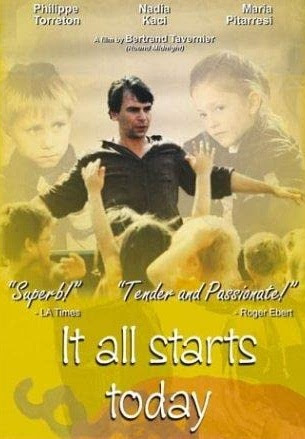
276. The late French director Bertrand Tavernier’s feature film “Ça commence aujourd'hui” (It All Starts Today) (1999), based on a commendable screenplay co-written by the director, his daughter Tiffany, and Dominique Sampiero: A primary school teacher who walks the extra mile to serve and speak for the tiny tots raised by parents with marginal incomes


"For its commitment to everyday heroism, its multi-layered approach to an array of social problems, and for the visual force of the storytelling.”

--Citation of the FIPRESCI award bestowed on the film It All Starts Today at the Berlin International Film Festival

There have been several films made on uplifting student-teacher relationships. These include To Sir, With Love (1967) a film on boisterous white high school students from slums of London eventually admiring and respecting their black rookie teacher;  Dead Poet’s Society (1989) on another rookie teacher kindling creative self-expression through poetry in  a US boarding school for senior US students from wealthy  backgrounds resulting in their unwavering respect and love for him; Goodbye, Mr Chips (1969), a remake of a film made 30 years before, where a stodgy Latin teacher after his marriage transforms  himself into an endearing school headmaster winning the hearts of his students;  Not One Less (1999), a neorealist Chinese film with real life characters playing their real roles directed by Yimou Zhang, focusing on a real life 13-year-old substitute teacher bringing to the fore the urban-rural education divide and the earnest desire of the teacher to teach and care for all her wards equally well;  and The Class (2008), a French film on the true experiences of a French language and literature middle-school teacher dealing with his foreign-born students disciplining them and gradually gaining their confidence--yet, not all students feel they ‘learned’ anything in his class.

It is Bertrand Tavernier’s two feature films on related subjects that discuss matters more substantive in the teacher-pupil interactivity, namely his films A Week’s Vacation (1980) and It All Starts Today (1999). In both films, the teachers are not rookies they have some credible experience in their jobs. The former discusses the importance of a female teacher observing and "listening" to her pupils in their early teens in a school in Lyons, France. The film underscores the fact that a reflective teacher could gain from the interactions with the pupils. However, Tavernier’s  It All Starts Today inverts the teaching role further to a teacher taking proactive steps to get the local government and the student’s parents to get involved in helping the teachers to impart education as they wish they could with limited resources provided by the local government.


Daniel (Philippe Torreton) truly cares for his students
and they love him for it


It All Starts Today has actor Philippe Torreton playing the role of Daniel, a head teacher of a primary school in a small mining town in France where former miners Daniel’s father survive with an oxygen cylinder strapped to his back. Miners not only battle pollution of particulate matter affecting tem while they worked in the mines, they have few other options of re-employment. Some are not clever enough to look for sustainable options for livelihood and slip into despair. Most are not sufficiently educated to move out and nor do they have any plans to start a new life and hence spend their days and nights in front of the TV sets. Their offspring are named after characters like “Starsky” and “Hutch”  from popular US TV serials. Some of the families cannot pay their utility bills and send their kids where they can get some education and mingle with others of their age. Worse still it is these cash-strapped families who are expected to support Daniel’s school through funds provided by the local civil council.

Daniel is the angry young man who is livid when the council cuts the lunch program for the kids and the parents are supposed to provide each kid with their lunches. When Daniel confronts the chief of the civic body, he is told the council has no money and Daniel, the underpaid teacher, offers a small contribution from his purse so that they make efforts to garner more funds to restart the scheme.


Daniel takes food on a personal initiative to the home of a
child whose parents are struggling to survive;
the other kids on the street are only marginally better off

Tavernier and his co-scriptwriters keep the viewer cleverly engaged to the bleak tale of the film using two tools. The first is Daniel’s demanding parallel personal life where his father is sick and his girlfriend wants him to father her next child while he pleases every student  (including his girlfriend's son from an earlier relationship with another man) with care and empathy. The second is Daniel's and his girlfriend’s out-of-the-box ideas to keep the young students happy and educated. One such innovative idea is to ask a parent, who is a truck driver, to bring his heavy duty truck to the school for the students to see what it could do—which proves to be a real treat for the kids who have never seen such a huge vehicle up-close.

Daniel, the angry multi-tasking primary school teacher,
is not just good at his job, he is loved by his students


When a financially struggling parent commits suicide with the children, the community that had preferred to look the other way comes out in full strength providing a flower-decked hearse.  Tavernier’s strength has been his choice of credible actors in minor roles such as the lady—Mrs Henry--who is driven to suicide because she does not see any hope to improve her lot.


Daniel talks to a child to figure out if he is 
being ill-treated at home, a role uncommon in a usual
teacher-student relationship

Daniel is concerned and takes proactive steps to stop a student from being brutalized at home by an abusive step-parent. The film is not merely a tale of an angry teacher forced to multi-task; it is a film about an individual being proactive to make the economically depressed society of a mining town to realize that change in their attitudes will go a long way to help their progenies to prepare for the future. The FIPRESCI award citation for the film (mentioned above) captured the strengths of the film well.


P.S.   It All Starts Today won the FIPRESCI prize at the Berlin international film festival in 1999 and was nominated for the Golden Bear. It won the Prize of the Ecumenical Jury and an Honorable Mention from the main Competition Jury for “the specialty of the topic;” the Best Film awards at the ASECAN, Sant Jordi  and the Fotogramas de Plata film festivals, all  three in Spain; the Audience Award at the San Sebastian International Film Festival, Spain; the Best Actor award at the Lumiere Awards, France; and  the Ecumenical Film Award at the Norwegian Film Festival. The other 1999 film mentioned above Not One Less, made in China, was reviewed earlier on this blog. (Please click on that name in this post-script to access the review)


Monday, February 14, 2022

272. Russian director Andrei Mikhalkov-Konchalovsky’s fifteenth feature film “Dom Durakov” (House of Fools) (2002), based on his original screenplay: An assessment of a film trashed soon after its release by most critics


A majority of film critics and viewers tend to dismiss Andrei Mikhalkov-Konchalovsky’s films in their initial assessments, especially in recent decades. Why is that? To answer that question, one needs to know some key facts about Konchalovsky and the three phases of his career.

Who is Konchalovsky?

Few know or recall that Konchalovsky was partly responsible for the early masterpieces of Andrei Tarkovsky—The Steamroller and The Violin; Ivan’s Childhood; and Andrei Rublyev. As a screenplay-writer, Konchalovsky collaborated with Tarkovsky (his film school classmate) as a co-scriptwriter on these films as well as for other directors’ films: Shaken Ajmanov’s The End of the Ataman (1971) and Tolomush Okeev’s The Fierce One (1974). He also contributed, as a screenplay-writer, to his half-brother Nikita Mikhalkov’s film A Slave of Love (1976). Many of these films dealt with children and childhood. This was the specifically highlighted in his own debut film as a director and co-scriptwriter, The First Teacher (1965), a film that won the best actress award at the Venice film festival. Then he directed Siberiade (1979), which won the Cannes Grand Prize of the Jury (essentially, the second-best film in competition at that event in 1979). These accomplishments mark his first phase evolving from an important screenplay-writer into a notable film director, winning international recognition at major film festivals.

Then his second phase begins when he moves to Hollywood directing a string of  impressive films in USA: Maria’s Lovers (1984), with his screenplay, nominated for the Venice Golden Lion; Runaway Train (1985), based on a re-worked screenplay by Akira Kurosawa, winner of the best actor Golden Globe, and nominated for the Cannes Golden Palm and three Oscars; Duet for One (1986), based on his co-scripted screenplay and nominated for a Golden Globe; Shy People (1987), based on his original story and screenplay, winner of the best actress award at Cannes, and nominated for the Golden Palm at that festival; and Homer and Eddie (1989) winner of the Golden Seashell award for the best film at the San Sebastian film festival in Spain. This was followed by a critical and commercial disaster called Tango and Cash, made the same year. It was a disaster primarily due to the studio’s (and possibly actor Sylvester Stallone’s) interference with the director’s plans at every stage triggering the exasperated director’s return to Russia. This second phase re-emphasized Konchalovsky’s talents as a director (when there was no studio interference), a screenplay-writer (in three films in this phase) and, more importantly, as a director who could extract award-winning performances from his actors.

Then comes his third phase when he returns to Russia and films The Inner Circle (1991), with his screenplay, and wins a nomination for the Golden Bear at Berlin; Ryaba, My Chicken (1994) with his original screenplay, and wins a nomination for the Golden Palm at Cannes that year; and follows those two films by directing  House of Fools  (2002) this time again with his original screenplay, which gets nominated  for the Golden Lion at Venice, winning the Grand Special Jury Prize and the UNICEF award. Konchalovsky followed these three major nominations at the big three festivals with another set of three top-notch films that have actually won him better and more significant laurels: The Postman’s White Nights (2014), Paradise (2016), and Dear Comrades (2020).  The first two were winners of the Silver Lion for the Best Director and the third a winner of Jury’s Special Prize all at the Venice film festival, with all the three screenplays co-scripted by Konchalovsky and his new collaborator, Elena Kiseleva.

The third phase, thus, marks the amazing contributions of Konchalovsky as director and screenplay-writer while collaborating on many films with his actress wife Vysostkaya and his new found co-scriptwriter Kiseleva—a wonderful, winning combination.  

What is most exciting is that Konchalovsky is currently working on rebuilding afresh the Tarkovsky film The First Day, destroyed in 1979 by the Russian Censors, which was based on the script written by Konchalovsky. Both Konchalovsky and Tarkovsky have a close affinity with the Russian Orthodox Church and evidently Tarkovsky’s last film project in the USSR, The First Day, upset the atheist doctrines of USSR in 1979, and contributed in part to the destruction of the completed footage of the film project. That ill-fated Tarkovsky-Konchalovsky film project had followed Konchalovsky’s collaboration on Tarkovsky’s Andrei Rublyev. The destruction of that Tarkovsky film resulted in the self-exile of the director. The timing of the destruction of the film coincides with the year Siberiade was made--the last film of Konchalovsky in the first phase, before he makes films in USA instead of his homeland. 

The numerous nominations and accolades of Konchalovsky over the decades at the big three film festivals of the world—Cannes, Venice and Berlin--are rare feathers in the cap for any film director from any country. Thus, it is rather odd when an awarded work such as House of Fools is hastily dismissed by many..

Assessment of House of Fools

“Why is man happy when he kills another? What is there to be happy about?"—Leo Tolstoy, recalled by a Russian army officer (played by a famous Russian actor, Evginiy Mironov) in the film

Several critics, who assessed this work of Konchalovsky, compared House of Fools with Milos Forman’s famous US film One Flew Over the Cuckoo’s Nest (1975) and found the Konchalovsky film to be a disjointed and unimpressive work. Yet the only common factor between the two films is that both revolve around inmates of a mental asylum.


Yulia Vysotskaya plays an asylum inmate, Zhanna,
who adores Bryan Adams, and dreams that he drives the train
that crosses the bridge each evening, near the asylum


There are major differences between the two films. Forman’s film is an adaptation of novel by Ken Kesey about a criminal who hides in a mental asylum.  Konchalovsky’s film is based on real events and the screenplay is original.

House of Fools is a film on good humans with mental problems. These patients are incarcerated in a mental asylum, run by an efficient doctor, who is dedicated to the well-being of his patients and caring. On the not-so-obvious side--it is based on true incidents in Chechnya (Russia) during the Second Chechen War of 1999-2000. For those unfamiliar with Chechnya, it is a constituent republic of Russia with a predominant Muslim population. Russians predominantly belong to the Russian Orthodox Church. Konchalovsky has proven his Russian orthodox credentials in all his cinematic works.

In this film, the inmates of the asylum include patients of both faiths living in harmony. Outside the asylum, there is war (between the Muslim Chechens and the Christian Russians). Konchalovsky's script underscores the camaraderie between the warring factions when they fought side by side in Afghanistan saving each others lives. During the Chechen war, some soldiers of both sides recall that they were once friends and show respect for each other.

When the asylum is bombed by the Russians, many of the inmates “cross” themselves out of fear of impending death--indicating the majority of the inmates are Christian. Ahmed, a Muslim Chechen and a pacifist, incarcerates himself with this motley group of inmates as he finds safety, anonymity, and friendship among the "crazies" who accept him as one of their own.

Zhanna assumes the actor-turned-Chechen soldier, Ahmed
(Sultan Islamov), intends to marry and dresses in white attire,
contributed by various inmates for the bride-to-be 


During the war, many of the support staff flee to save their lives. The good doctor, who alone has to care for some twenty-odd patients, is worried for the safety of his patients and goes out of the hospital to find a bus to transport the inmates to a safer zone, Significantly, even then, they do not wish to leave the hospital, quite unlike the Milos Forman’s film and Ken Kesey’s novel, where troublemaking patients are not sensitively cared for but lobotomized.  In Konchalovsky’s film, the doctor in charge of the hospital listens to and cares for his wards, in contrast to the Hollywood film. House of Fools is a humanist film where a Chechen ultimately seeks the solace of the asylum compared to the world outside. Most importantly, the film is secular, where the doctor and his patients help and love one another irrespective of their religions. This is where House of Fools is considerably different from the Forman film.

Another facet of the film that will surprise many viewers is that many of the patients in the mental hospital are real mental patients who were working alongside professional actors. Not many directors would attempt such a feat; Konchalovsky did it, with elan.

The caring doctor (Vladas Bagdonas) who returns after his
unsuccessful trip to get a bus to evacuate the asylum patients,
is worried that the Chechen soldiers have harmed the innocent Zhanna


The participation of rock singer Bryan Adams as an actor and singer in the film is Konchalovsky's masterstroke along with the soothing words of the song Have you ever really loved a woman? sung by the singer.  The crash of a helicopter and it bursting into flames within the hospital’s grounds during the war show the intensity of the conflict while the innocent Zhanna plays her accordion oblivious of the gangers with a a few feet of her.

Other important trivia, the lead actress Yulia Vysotskaya is the director's wife of over 20 years. Her acting capability is showcased in a wide variety of roles she has subsequently played in her husband's films--most importantly in Paradise and Dear Comrades.

The film is further strengthened on the aural front beyond Bryan Adams by the music of composer Eduard Artemyev. Artemyev's contribution is often bypassed by the fans of Tarkovsky (in Solaris, Stalker, Mirror), of Konchalovsky (in Siberiade, The Inner Circle, Homer and Eddie),of  Mikhalkov (in The Barber of Siberia, A Few Days in the Life of I. I. Oblomov), etc.

The crux of the film lies in the quotation of Tolstoy "Why is man happy when he kills another? What is there to be happy about?" recalled by a Russian army officer (played by a famous Russian actor, Evginiy Mironov,) in the film towards the end.


The Chechen soldier Ahmed acts as if he has fallen for
the accordion-playing Zhanna and blurts out that he will
 marry her, little realizing the consequences 

Conclusion

When Konchalovsky writes his own original screenplays (as opposed to when he is adapting an existing written work) few aspects emerge: his firm Christian roots, his wide reading, and his love for Russia. While each tale could be set in different locations--a remote marshy forest in USA (as in Shy People), a mental asylum (as in House of Fools), or a remote village in Russia (as in The Postman’s White Nights)--step back from the obvious tale and you will spot a metaphor that is critical of the current state of  the director's homeland.  Those are his unique strengths.


P.S.  House of Fools won the Grand Special Jury Prize and the UNICEF award at the Venice film Festival in 2002. Konchalovsky’s films Runaway Train, Shy People, The Postman’s White Nights, and Paradise, have been reviewed on this blog. (Click on the names of the films in this post-script to access each of the reviews.) Konchalovsky is one of the author's top 15 active filmmakers.


Saturday, November 13, 2021

268. Iranian film directors Maryam Moghadam’s and Behtash Sanaeeha’s feature film “Ghasideh Gave Sefid” (Ballad of a White Cow) (2020) (Iran) in Farsi/Persian language, based on their original script: Fallouts of the miscarriage of justice when an innocent person is executed for a murder he did not commit


And recall when Moses said to his people, “Allah commands you to slaughter a cow”

They answered, “Do you make a mockery of us?”

---“Surah of the Cow” in the Holy Quran (Opening quote in the film)


Iran continues to make interesting feature films, year after year, bereft of sex, nudity, escapist car chases and on-screen violence. Ballad of a White Cow is a tale of the bread-winner of small nuclear family found guilty of the killing of a known friend by a court, condemned to death by a three judge bench according to Iranian law and consequently executed for the crime. Later, the real killer confesses to the crime. A miscarriage of justice has unintentionally taken place.

While the wife of the hastily executed innocent man approaches the Iranian Supreme Court for justice for her and her mute daughter and retribution for the judges, one of the three judges is devastated by the revelations of the real killer and reaches out to help the wife and child of the executed prisoner, without revealing his own identity, and quits his job as a judge much to the amazement of the judiciary and officials, as he had merely applied existing laws of the land. That single judge, among the three judges who jointly  passed the hasty sentence, makes a laudable effort to make amends even before the Supreme Court surprisingly ruled that the wife and child had to be compensated and judges be held responsible in some way. The film is an implicit critique of capital punishment and of miscarriage of justice.

Mina (Maryam Moghadam) with her brother-in-law
reacting to the information that her dead husband
was innocent and the real killer has confessed

The interesting original script treads more on the indirect punishment on the blameless wife Mina (played by the screenplay-writer and co-director Moghadam) and daughter, living in a rented apartment. If a strange man, Reza (Alireza Sani Far), visits her to pay back “a loan” he took from Mina’s husband, the owner of the rented apartment also hastily assumes his tenant is involved in some immoral activity and asks Mina to speedily vacate. In Iran, a single woman with a child and without a job, cannot easily find an alternate accommodation at short notice, even if she has the money. Thus, the film is not just about capital punishment and miscarriage of justice, it is a commentary on single women/mothers in Iran. However, women in Iran do enjoy a lot of freedom and respect compared to their counterparts in some other Muslim countries, such as Saudi Arabia.

Mina explains to her daughter Bita
that her father has gone far away 

Reza is a rare individual with a conscience. His life as a judge crumbles with a hasty judgement he made with two others on the basis of questionable evidence. Reza’s son, whose mother is either dead or divorced, is so alienated from his father after he learns of his father’s involvement in the miscarriage of justice that he rushes to join the army and soon commits suicide. Reza is twice broken. But the good man has no courage to inform Mina that he was one of the three judges who hastily condemned Mina’s husband to death.

The Judge Reza (Alireza Sani Far) arrives at Mina's
door without revealing his true identity, stating that
he has come to return a large sum of money
her husband had lent him

What follows has to be interpreted keeping in mind the opening quote about the cow. A white cow is shown in a mosque (the barbed wire on the walls resemble a prison) readied for slaughter early in the film to help the viewer with a visual connection to the opening quote. The script-writer Moghadam envisages Mina as a worker in a milk-packaging factory, a metaphoric connect to the innocent cow in the quotation. Mina does seem to eventually accept her husband’s execution as a submission to the will of Allah (God) as a good Muslim. When Mina realizes her husband was innocent she finds that she and her mute daughter seems to have been “mocked” by the judicial system. The “mockery” extends to Mina, already under stress from the judiciary, the owner of her initial apartment, and Mina’s father-in-law trying to grab the “blood money” or the financial compensation from the government, added up to Mina losing her job at the milk packaging factory, due to a strike. The finale of the film could confound an average viewer but if the viewer realizes Mina is intelligent, the ending is easy to decipher. The tale can be considered as a modern-day parable. The tale is a very interesting confrontation of the ethics of a remorseful judge and that of the eventual suffering victim’s ability or lack of ability to forgive. The viewer is left much to ruminate on.

Reza realizing Mina's problems of finding
a new apartment provides her an apartment he owns
that is lying unused at discounted rent

Mina and Bita prepare for an uncertain future

Ms Maryam Moghadam (spelled Moqaddam in Wikipedia) and Mr Behtash Sanaeeha are a rare husband-wife team making their first film Ballad of a White Cow as co-directors which won them the awards for the Best New Director at the 2021 Valladolid International Film Festival in Spain. The Uruguayan/Mexican couple of Rodrigo Plá and his wife Laura Santullo are another team who made their first film as co-directors. In both these husband-wife teams, the wife is the main original writer of award-winning screenplays. Unlike Ms Santullo who has never ventured to act, Ms Moghadam is an accomplished actress, having worked as actress in Jafar Panahi’s Closed Curtain (2013) and her husband’s debut film Risk of Acid Rain (2015) and several other feature and TV films. Ms Moghadam’s script refers to a film Bita (1972), made in Iran prior to the Ayatollah revolution, a favorite film of her daughter, Bita, named after the title character of that film. Bita, though mute, can hear and enjoy feature films and is a film addict. The film Ballad of a White Cow is dedicated to “Mina,” which some feel is the name of the screenplay-writer’s mother. If that is indeed true, young Bita’s love for films is an autobiographical trivia of the lady co-director.


P.S.  Ballad of a White Cow has won, apart from the Valladolid award mentioned above, the Best Film award at the Jerusalem Film Festival (Israel), an incredible honor in light of the fact that there is not much love lost between Israel and Iran. The film is currently competing for the Krzysztof Kieslowski award for the best film at the Denver film festival. Rodrigo Plá's and his wife Laura Santullo's first co-directed film The Other Tom was reviewed earlier on this blog. (Click on the film's name in this postscript to access that review) Though initially released in 2020 in some parts of the world, the film is listed among the best films of  2021 of the author.

Tuesday, October 26, 2021

266. The late Chilean maestro Raoul Ruiz’ film in French “Les trois couronnes du matelot” (Three Crowns of the Sailor) (1983) (France/Portugal/Chile): An absorbing non-linear, surreal screenplay with stunning cinematography and loads of remarks that will make you ruminate


“You always need a living sailor on a ship full of the dead. That was me.” (Final spoken lines of the film)

“Never forget that memories, imagination and understanding must be used for an honest and productive life.”

--Two separate statements of the sailor, narrating the stories, reflecting Ruiz’ own life of self-imposed exile, moving from one country to the other, making extraordinary films


If there are two Raoul (Raul) Ruiz films that are extraordinary, these would be Three Crowns of the Sailor (1983) and Mysteries of Lisbon (2010). Both have absorbing, non-linear screenplays with stunning cinematography. Yet, the two films are different in one significant aspect: the former is based on Ruiz’ own original tale while the latter is based on a novel of Camilo Castelo Branco. Both films have lead characters mirroring Ruiz’ departure from and memories of his land of birth and incorporate biographical elements.

The sailor (Guillard, left) who narrates the tales,
asks the student (Deplanche, right) for 3 Danish Crowns
 and his attention to his tales for passage on his ship


The sailor narrates and Ruiz leads the viewer not merely
into the tales but also the narrator's views on death and life


Three Crowns of the Sailor takes a leaf from the Chilean folklore of a ghost ship. The sailors die and reappear, as the film unspools. Ruiz himself was the son of a ship captain. The only likely real individual in the film is a Polish student (Philippe Deplanche) of theology who kills his tutor. We learn from the opening statement of the student that his victim had also taught him the art of “polishing diamonds” and leaves his future killer-student a long letter to leave the country, as though the tutor knew the events in advance. We also get to know that the murder took place in July 1958 from the soliloquy of the killer. When Ruiz incorporates a date, there is a purpose. This writer did some checking. In July 1958, the Polish state police broke into the Institute of the Lady of Czestochowa located in a monastery in Poland and took way all the books, mimeographed texts, correspondence and texts (ref: www.jstor/stable/25777621). Did the killing of the theological tutor and the student picking up the letter, a ring offered by the tutor to the student several times, and some currency notes mirror those historical events? It is quite possible.

The fleeing murderer/student meets a sailor (Jean-Bernard Guillard) who asks him for 3 Danish crowns (currency) and a promise to listen to his tale in exchange for a place on his ship called the “Funchalense” that will take him away from Poland. The ship, the student boards, is rusty but travels to Valparaiso, the main sea-port in Chile (not surprising!). There, as per the narration of the sailor, he looks for his family in his house which is boarded up by planks (suggestion to the actions of military junta regime that ousted President Allende, which in turn led to Ruiz’ self-exile, not stated explicitly in the film). His neighbors do not seem recognize him.

The main tale is a juxtaposition of several tales narrated by the sailor of unusual, bizarre persons he has met at every port of the ship’s journey—Singapore, Buenaventura (Colombia), Tangier (Morocco), Dakar (Senegal), and Tampico (Mexico). For example, there is a shy gum-chewing prostitute, who has a coffin kept in her room full of dolls and marks each customer’s encounter by depositing the chewed gum on the coffin. Then, in Singapore, there is a small boy who the sailor adopts as his son, because the boy is exceptionally intelligent and has already read all the writings of Robert Louis Stevenson.  He is boy who looks like a kid and does not grow old if he does not eat. He does not require light to read books because “he is the light” in the words of the Vice Consul of Singapore. Elsewhere, the sailor meets up with a beautiful singer who has only one orifice—her mouth (a suggestive symbol of scenarios in nations that are autocratic and singers sing only praises). In Dakar, he meets an African doctor who knows the Bible by heart, lives in poverty, philosophically claiming to discuss each minute of his life that would extend to days, and asks the sailor for three Danish Crowns if he is inclined to listen to him. This is the same proposition made by the sailor to the Polish student and the fee required to be paid for recounting the story.

The sailor in an angelic prostitute's room full of
dolls and a white coffin (white is often related
to the sinless dead, especially children).
Note the camera placement.


In Singapore, the sailor is introduced to a well-read
doctor who looks like a child
and can read books without light


Berenice Reynaude’s essay in “Fuse” (February/March 1985) and in “Rouge” (www.rouge.com.au/2/crowns/html) points out the several literary cinematic connections within the narrative—from Coleridge to Borges to Cortezar to Hans Christian Andersen to Selma Lagerloff. Raoul Ruiz could do that with considerable felicity rarely associated with any other director/writer worldwide. Ruiz’ ability to do this in Three Crowns of the Sailor (and in all his other films) would not be easily perceived by viewers unless they themselves are equally well-read and acquainted with works of great writers of different continents and languages to appreciate the full mastery of Ruiz’ craft. For instance, a character is reading the novel The Sea Rose by Paul Vialer, an obscure novel that was made into a French film called La maison sous la mer in 1947. Each Ruiz film is a crossword puzzle (in this film, the Vice Consul of Singapore informs the sailor that his Consulate was attacked by crossword fanatics!)  asking to be solved with clues that include love, money, religion, politics, sailors, perceived insanity, history, art (both paintings and cinematic visual perspectives), music, philosophy and literature thrown in. Three Crowns of the Sailor is no exception in this regard.

While knowledge of literature helped Ruiz carve out a niche among directors, he is also one who opted for surrealism in most of his films. In Three Crowns of the Sailor, Ruiz scripted a ghost tale where all the sailors of the ship, except for the narrator, did not defecate and had worms surfacing from their abscesses on their bodies. He has sailors committing suicide only to resurface alive next day attributing the suicide to someone else. A key spoken line in the film is “Art is barbarous.” Ruiz used surrealism to encourage the viewer to re-evaluate reality.

Surrealism vs reality

Ruiz and cinematographer Sacha Vierny:
The words spoken are neither by the person holding
the food nor the persons immediately behind the beer glass.
They are spoken by the sailor (Guillard)
at the extreme end of the room, also in focus. 


In Three Crowns of the Sailor, Ruiz is helped by the cinematographer Sacha Vierny (a regular for directors Peter Greenaway and Alain Resnais and for Bunuel’s Belle de Jour) to produce the unusual visual perspectives that bear the stamp of Ruiz in most of his films—an aspect that reached perfection in Ruiz’ Mysteries of Lisbon (decades later). The unusual camera angles and the switches from color to black-and-white and back might unnerve the regular filmgoer—but Ruiz does it with a purpose, to nudge the viewer to appreciate the unwritten script suggesting a reality that can be perceived if you distance yourself from the obvious and take in the wider world of the “political exile,” the “stranger,” the “thinker,” the “symbolic sailor striding from one geography to another,” etc.

If there is another filmmaker to match Ruiz in knowledge and surreal filmmaking it is Orson Welles (in particular, Welles’ films The Immortal Story--based on Isaak Denisen’s novel complete with a sailor as a key character as in Three Crowns of the Sailor—and F for Fake on paintings and visual tricks). Ruiz and Welles were an evolved set of directors who have few equivalent peers and have yet to be appreciated sufficiently by a broad swath of the film-going public.

Finally, another quote from the film Three Crowns of the Sailor encapsulates the film for reflection “Our presence here is gratuitous, like most things in life.” The final sequence of the film is appropriately presented in black and white as in the early segment where the sailor asks the student “Do you believe in the hereafter?” and gets the reply “I am an atheist.”

The sailor tells the student: "If all the jerks
 spread their wings, we will never see the sun"
in the final sequence


P.S.  Three Crowns of the Sailor was bestowed the rare “Perspectives du cinema“ award even though it was not a participant in any of the official sections of the 1983 Cannes film festival. The author has reviewed the following films of Ruiz on this blog earlier: Mysteries of Lisbon (2010); Klimt (2006) and That Day (2006). Orson Welles' F for Fake was also reviewed earlier on this blog. Three Crowns of the Sailor has been included among the author’s Best 100 Films which already included Mysteries of Lisbon. (Click on the names of the films in this postscript to access the author's review)