Showing posts with label Singapore winner. Show all posts

Monday, January 26, 2026

288. Georgian director Dea Kulumbegashivili's second feature film "April" (2024) (in Georgian language) based on her own original screenplay: Can moral beliefs to help the poor and needy override the laws of the land and put one's career in jeopardy?


Do you understand how laws work? You will have no more patients; you will not have a job. Even if you are not arrested, you will be ruined. If you want to work, you have to obey the laws. Sometimes, the law may go against our moral beliefs.
-- Head doctor of obstetrician/gynecologist at Nina's hospital asks Nina the gynecologist, who conducts free extra-curricular abortions for the poor and needy in rural Georgia

This Georgian (the country, not the US state with the same name) film will grip any cinephile exposed to rapidly evolving contemporary cinematic grammar from start to finish. Dea Kulumbegahivili's film expresses its narrative through visuals (fascinating cinematography of Arseni Kachaturan) and music (young award-winning composer Matthew Herbert) minimally relying on spoken dialog.

Early in the film, we see a mysterious inexplicable somewhat-human ash-colored grotesque figure from the rear without clothes, breathing heavily heading towards water-bodies in semi-darkness. Initially nothing is explained to the viewer except that the heavy breathing on the soundtrack resembles human breathing. Cinephiles will recall the image of the literal goat-headed, horned figure of a devil with an arrow-shaped tail, carrying a toolbox, entering a sleeping household in Mexico in Carlos Reygadas' Post Tenebras Lux (2012) at night. Reygadas' followers inferred that unusual surreal image to be an allegorical representation of the entry of corruption into an innocent family's house bypassing sleeping children in their bedroom enroute to their parents' bedroom. Both the Mexican and the Georgian films begin with visuals of rain and mud. In both films, the images only make sense to a perceptive viewer as the film's narrative progresses, forcing the viewer to connect earlier images with the information provided much later, helping put the earlier mysterious sequences in context. Both the Mexican and the Georgian directors are reinforcing a film grammar rarely used in commercial cinema, but had existed in bits of the early works of Bunuel (e,g., Un Chien Andalou,1929) and of Herzog (e.g., the visually stunning flow of rats in Nosferatu the Vampyre made in 1979).

In the Georgian film, April, the bizarre opening sequence is linked with an early incident in the life of  Nina, a gynecologist in a government hospital, who is the film's main protagonist, revealed much later in the film  when as a young girl she was scared stiff to rescue her female friend who was drowning in a water-body. That inaction on her part scars her moral conscience in diverse ways. First, she rejects a possible marriage with a male gynecologist, who likes and appreciates her as a person and as a very capable and trustworthy colleague at work. 

Subsequently Nina, now a gynecologist sets on a somewhat secret mission to help poor women in rural Georgia, who get pregnant in non-consensual situations to abort their fetus as hospitals do not allow abortions in that country. This is Nina's personal, discreet way to make amends for her inaction to save her friend from drowning while pleading for Nina's help. Nina's chosen double life is akin to the secret lives of the fictional Batman and Superman though in her case not to fight evil forces but to help those who have no succor. Like the comic book superheroes, the film does not indicate that Nina's secret night life is to earn any additional income; it is truly gratuitous--traveling long distances alone in her car, with full medical accessories required to conduct an operation at night, to help the helpless.

Nina prepares to abort the fetus of a physically/mentally
challenged lady, impregnated without consent, on a dining table
of a family with limited resources

The cinematic grammar of April is akin to verbal punctuation in a written work, only using visuals and sounds to provide additional information beyond the minimal spoken narrative for the attentive viewer. The somewhat-human, ash-colored grotesque figure re-appears in the film at crucial junctures in the narrative. Even a bicycle ridden by Nina's colleague is captured by the camera's vision indoors to indicate the importance of the location of the shot with the grotesque figure being held by Nina's colleague just as lovers would. Then there are sequences with spring flowers growing in April in the Georgian rural landscape in happier sequences and with ominous clouds and thundershowers as precursors to difficult scenarios--each chosen to complement the narrative with care.

Nina's dream sequence, where the mysterious grotesque
human figure is held by Nina's senior colleague,
who once hoped to marry Nina. His bicycle appears in the
right-hand corner, accentuating the location, as the hospital

The main tale of April includes the dramatic charges levelled against Nina's official work within the hospital made by a parent that his child died in the hospital due to Nina's negligence during childbirth. The viewer of the film awaits the outcome of that inquiry, while the hospital authorities worry whether Nina's extra-territorial illegal  activities would come out in public or not and the consequences for Nina. 

A lonely Nina outside the office of the Head of her hospital
awaiting the outcome of an internal inquiry into an
allegation against her that her operation caused a child's death

The end of the film proves to be fascinating and thought-provoking, worthy of its Special Jury Prize awarded by the Venice film festival for film's director. While right-wingers would dig up the "Roe vs Wade" arguments in USA, this remarkable Georgian film is a delight essentially for the way it has been constructed, and the importance of respect one bestows on those few who place importance to their moral stance to help those that need one's discreet help above the controversial subject of the legality of abortions. Director Dea Kulumbegashivili has exhibited her talent as a filmmaker to the world in April and that has been recognized widely at diverse festivals around the globe. This talented director could emerge as a major force in East European cinema.

P.S. The Mexican film Post Tenebras Lux (2012) has been reviewed earlier on this blog, Click on the name of the film to access that review. April is one the best films of 2024 for this critic.


Tuesday, January 09, 2024

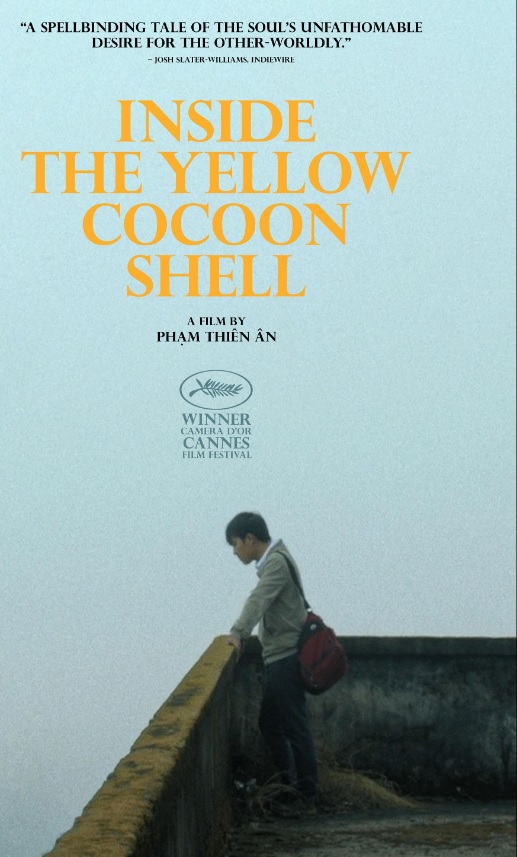
283. The Vietnamese director Thien An Pham’s debut feature film “Ben trong vo ken vang“ (Inside the Yellow Cocoon Shell) (2023), based on his original screenplay: Searching for faith and meaning in life, following a recent personal tragedy


“Faith is what I am searching for --answers the film’s main character, Thien, to his toddler nephew’s question, on what is faith, soon after his dead mother is described publicly as someone who had strong faith  
Would you give your favorite toys to your friend and did you think he would to return them to you?” Thien asks his nephew  
He will return them to me because he is good,” answers the nephew  
Faith is a little bit like that,” Thien explains to his nephew


Inside the Yellow Cocoon Shell is nearly 3-hours long, bereft of sex, violence, or crime. Further, it is slow-moving, philosophical, magical (literally and metaphorically) and charming--aspects missing in most contemporary American and British films. You don’t see fast cars in this Vietnamese film; instead you see mopeds that often breakdown, traversing dirt tracks more often than on proper paved roads. Much of what you see in the film is rural contemporary Vietnam with birds, animals and human beings sharing space and time. Cocks crow before dawn and humans wake early to trap wild, well-fed cocks that fight for fresh territory with others. This is not a film that could conventionally compete and win an Oscar. Yet, this film has won the coveted 2023 Golden Camera award at the Cannes international film festival , from amongst debut films competing in all the competitive sections of the 2023 festival. The Vietnamese film  was chosen in the ‘Director’s Fortnight’ section and won the coveted award that transcends the conventional borders of that particular section of the festival. A dream-start for a young, relatively unknown filmmaker’s career who scripted a mature screenplay with the lead character sharing the director’s name.

Thien and his toddler nephew accompany 
his sister-in-law Hanh's coffin to his village


What is remarkable about this work is the swathe of complex ideas that fill the film’s canvas as the young filmmaker Thien paints it. The film opens with a near-monologue over dinner for three in a small, crowded restaurant in Saigon over the opportunities offered in city life versus those in rural Vietnam. The ensuing film does discuss that in a meandering manner. What is equally remarkable is that the film’s cinematography and the diegetic soundtrack that could amaze perceptive viewers, who notice those aspects while watching a film over the more obvious narrative.   

Thein (back to the camera) listens to former soldier Lu'u
in his humble abode. There is no music, only diegetic sound. 


 As the film unspools, there are ordinary conversations between young and old, strangers and villagers who have known each other’s families over decades; small birds that enter the film’s narrative and then die, adding to the mosaic of lives offered in the film;  magic tricks to entrance kids (and even elder viewers of the film) with props such as a finger-sized bell that proves to have a tale of its own as the film progresses; and dialogs between different elders and Thien that reek of wisdom and philosophy rarely encountered in a film made by a young director. The connection between Thien and his elders are as mystical as varied encounters of Thien has with nature (rain, butterflies, sericulture cocoons, dreams of aggressive buffaloes that sense danger only to turn around, the soothing invitation of the flowing waters of a brook). 

Searching for his brother Tam,
Thien encounters the wise old lady who experienced
a near death event and has wisdom to impart for his search

After the conversation with the old lady, Thien falls asleep
at the same spot, and dreams of an encounter with buffaloes


On waking up, Thien has an urge to walk in the rain,
until encountering the shrub with white butterflies


Each character populating the film offers depth to the screenplay. Thiem’s brother Tam, who has suddenly left his wife and son, had wanted and to be a priest, until his theological teachers advised him to get married instead. Tam’s wife Hanh is described as a woman of “faith,” who wanted to give birth to her unborn child, even after doctors had warned her that the child would be born without arms. A former soldier who had fought in the Vietnam war and had once enjoyed war combats as a young man, explains to Thien that he no longer has interest in lucre even when it is offered to him by Thien and instead  prefers to live a humble life, preparing shrouds for the dead in his village. Then there is an old lady, who claims to have endured a near death experience, providing philosophical solace to Thien in his quest to locate his elder brother to inform him of his wife Hanh’s passing and of his son being admitted into a convent where Thien’s former sweetheart, now a nun, teaches the tiny tots.  

  
Thien gets closer to finding his brother Tam (a sericulturist) 
and holds Tam's child surrounded by yellow silk cocoons

Tam's new wife with Tam's child leads Thien to Tam's
work spot 


At Tam's work spot, Thien falls asleep, Tam's wife and child
disappear, and the farm owner (back to camera) states
that there is no Tam there. (For confused filmgoers. the
maroon bag on the moped is crucial to explain matters)


What is stunning is the long single shot of Thien holding Tam’s baby in his arms and the shot ending without cuts with Thien sleeping on his moped alone and being woken up by the farm owner who states that there is no person named Tam anywhere near his farm.  These are aspects (sleep, dreams, etc.) in Inside the Yellow Cocoon Shell that any knowledgeable filmgoer will recall of the Thai  director Weerasethakul’s superb film  Memoria, another cinematic tale connecting death, history  and the present or the long takes of the Greek director Angelopoulos, drifting in time within a single shot. The sudden rains (common in Vietnam and other parts of Asia) is intentionally used as a stylistic device to blur time and space. Inside the Yellow Cocoon Shell, as in Zvyaginstev’s The Return or Tarkovsky’s earth sequences in Solaris uses rain to invite Thien  on a dreamlike walk that offers images akin to Joycean epiphanies (white butterflies on a particular shrub in the rain). Could it be a mulberry shrub? The viewer is equally reminded of Theo Angelopoulos’ films (e.g., Eternity and a Day) of the historical connections of the Vietnam war and the present and the present through the memories of elders, such as the former soldier Lu’u, content making shrouds for the dead remarking that there will be no one else to do it, if he stopped doing it.


The last shot: Thien lies in the brook as the gently flowing
waters of the brook stroke his body
     
Inside the Yellow Cocoon Shell may not appeal to the millions who love commercial cinema and believe the Oscars, the BAFTAs and the Golden Globes honor the best in world cinema, oblivious of good cinema of a different kind being made elsewhere on the globe. That is where the three big film festivals of the world (Cannes, Berlin, and Venice) step in to alert us to the fact such films do exist.  Knowledgeable folks know that even Hollywood’s best filmmakers compete in those festivals for early valuable recognition before the Oscar circus.  
 
Thien An Pham’s Inside the Yellow Cocoon Shell has heralded the arrival of a new prodigy from Vietnam. This cinematic product amply proves that any young director with talent will get world recognition, if the film’s style and content are original and admirable, while specifically not spoon-feeding a lazy viewer on what the film is all about. A good film has to ultimately make the viewer think.     

P.S. Inside the Yellow Cocoon Shell won the Golden Camera award at Cannes, the Roberto Rossellini award for the Best Film at the Pingyao (China) and the Best Asian feature film award at the Singapore international film festival. Three films, mentioned in passing in the above review—Memoria, The Return and Solaris have been reviewed on this blog earlier and those reviews can be accessed by clicking on their names in this postscript. Inside the Yellow Cocoon Shell is listed by the author as one of  the Best Films of 2023.