Showing posts with label Portugal. Show all posts

Tuesday, October 26, 2021

266. The late Chilean maestro Raoul Ruiz’ film in French “Les trois couronnes du matelot” (Three Crowns of the Sailor) (1983) (France/Portugal/Chile): An absorbing non-linear, surreal screenplay with stunning cinematography and loads of remarks that will make you ruminate


“You always need a living sailor on a ship full of the dead. That was me.” (Final spoken lines of the film)

“Never forget that memories, imagination and understanding must be used for an honest and productive life.”

--Two separate statements of the sailor, narrating the stories, reflecting Ruiz’ own life of self-imposed exile, moving from one country to the other, making extraordinary films


If there are two Raoul (Raul) Ruiz films that are extraordinary, these would be Three Crowns of the Sailor (1983) and Mysteries of Lisbon (2010). Both have absorbing, non-linear screenplays with stunning cinematography. Yet, the two films are different in one significant aspect: the former is based on Ruiz’ own original tale while the latter is based on a novel of Camilo Castelo Branco. Both films have lead characters mirroring Ruiz’ departure from and memories of his land of birth and incorporate biographical elements.

The sailor (Guillard, left) who narrates the tales,
asks the student (Deplanche, right) for 3 Danish Crowns
 and his attention to his tales for passage on his ship


The sailor narrates and Ruiz leads the viewer not merely
into the tales but also the narrator's views on death and life


Three Crowns of the Sailor takes a leaf from the Chilean folklore of a ghost ship. The sailors die and reappear, as the film unspools. Ruiz himself was the son of a ship captain. The only likely real individual in the film is a Polish student (Philippe Deplanche) of theology who kills his tutor. We learn from the opening statement of the student that his victim had also taught him the art of “polishing diamonds” and leaves his future killer-student a long letter to leave the country, as though the tutor knew the events in advance. We also get to know that the murder took place in July 1958 from the soliloquy of the killer. When Ruiz incorporates a date, there is a purpose. This writer did some checking. In July 1958, the Polish state police broke into the Institute of the Lady of Czestochowa located in a monastery in Poland and took way all the books, mimeographed texts, correspondence and texts (ref: www.jstor/stable/25777621). Did the killing of the theological tutor and the student picking up the letter, a ring offered by the tutor to the student several times, and some currency notes mirror those historical events? It is quite possible.

The fleeing murderer/student meets a sailor (Jean-Bernard Guillard) who asks him for 3 Danish crowns (currency) and a promise to listen to his tale in exchange for a place on his ship called the “Funchalense” that will take him away from Poland. The ship, the student boards, is rusty but travels to Valparaiso, the main sea-port in Chile (not surprising!). There, as per the narration of the sailor, he looks for his family in his house which is boarded up by planks (suggestion to the actions of military junta regime that ousted President Allende, which in turn led to Ruiz’ self-exile, not stated explicitly in the film). His neighbors do not seem recognize him.

The main tale is a juxtaposition of several tales narrated by the sailor of unusual, bizarre persons he has met at every port of the ship’s journey—Singapore, Buenaventura (Colombia), Tangier (Morocco), Dakar (Senegal), and Tampico (Mexico). For example, there is a shy gum-chewing prostitute, who has a coffin kept in her room full of dolls and marks each customer’s encounter by depositing the chewed gum on the coffin. Then, in Singapore, there is a small boy who the sailor adopts as his son, because the boy is exceptionally intelligent and has already read all the writings of Robert Louis Stevenson.  He is boy who looks like a kid and does not grow old if he does not eat. He does not require light to read books because “he is the light” in the words of the Vice Consul of Singapore. Elsewhere, the sailor meets up with a beautiful singer who has only one orifice—her mouth (a suggestive symbol of scenarios in nations that are autocratic and singers sing only praises). In Dakar, he meets an African doctor who knows the Bible by heart, lives in poverty, philosophically claiming to discuss each minute of his life that would extend to days, and asks the sailor for three Danish Crowns if he is inclined to listen to him. This is the same proposition made by the sailor to the Polish student and the fee required to be paid for recounting the story.

The sailor in an angelic prostitute's room full of
dolls and a white coffin (white is often related
to the sinless dead, especially children).
Note the camera placement.


In Singapore, the sailor is introduced to a well-read
doctor who looks like a child
and can read books without light


Berenice Reynaude’s essay in “Fuse” (February/March 1985) and in “Rouge” (www.rouge.com.au/2/crowns/html) points out the several literary cinematic connections within the narrative—from Coleridge to Borges to Cortezar to Hans Christian Andersen to Selma Lagerloff. Raoul Ruiz could do that with considerable felicity rarely associated with any other director/writer worldwide. Ruiz’ ability to do this in Three Crowns of the Sailor (and in all his other films) would not be easily perceived by viewers unless they themselves are equally well-read and acquainted with works of great writers of different continents and languages to appreciate the full mastery of Ruiz’ craft. For instance, a character is reading the novel The Sea Rose by Paul Vialer, an obscure novel that was made into a French film called La maison sous la mer in 1947. Each Ruiz film is a crossword puzzle (in this film, the Vice Consul of Singapore informs the sailor that his Consulate was attacked by crossword fanatics!)  asking to be solved with clues that include love, money, religion, politics, sailors, perceived insanity, history, art (both paintings and cinematic visual perspectives), music, philosophy and literature thrown in. Three Crowns of the Sailor is no exception in this regard.

While knowledge of literature helped Ruiz carve out a niche among directors, he is also one who opted for surrealism in most of his films. In Three Crowns of the Sailor, Ruiz scripted a ghost tale where all the sailors of the ship, except for the narrator, did not defecate and had worms surfacing from their abscesses on their bodies. He has sailors committing suicide only to resurface alive next day attributing the suicide to someone else. A key spoken line in the film is “Art is barbarous.” Ruiz used surrealism to encourage the viewer to re-evaluate reality.

Surrealism vs reality

Ruiz and cinematographer Sacha Vierny:
The words spoken are neither by the person holding
the food nor the persons immediately behind the beer glass.
They are spoken by the sailor (Guillard)
at the extreme end of the room, also in focus. 


In Three Crowns of the Sailor, Ruiz is helped by the cinematographer Sacha Vierny (a regular for directors Peter Greenaway and Alain Resnais and for Bunuel’s Belle de Jour) to produce the unusual visual perspectives that bear the stamp of Ruiz in most of his films—an aspect that reached perfection in Ruiz’ Mysteries of Lisbon (decades later). The unusual camera angles and the switches from color to black-and-white and back might unnerve the regular filmgoer—but Ruiz does it with a purpose, to nudge the viewer to appreciate the unwritten script suggesting a reality that can be perceived if you distance yourself from the obvious and take in the wider world of the “political exile,” the “stranger,” the “thinker,” the “symbolic sailor striding from one geography to another,” etc.

If there is another filmmaker to match Ruiz in knowledge and surreal filmmaking it is Orson Welles (in particular, Welles’ films The Immortal Story--based on Isaak Denisen’s novel complete with a sailor as a key character as in Three Crowns of the Sailor—and F for Fake on paintings and visual tricks). Ruiz and Welles were an evolved set of directors who have few equivalent peers and have yet to be appreciated sufficiently by a broad swath of the film-going public.

Finally, another quote from the film Three Crowns of the Sailor encapsulates the film for reflection “Our presence here is gratuitous, like most things in life.” The final sequence of the film is appropriately presented in black and white as in the early segment where the sailor asks the student “Do you believe in the hereafter?” and gets the reply “I am an atheist.”

The sailor tells the student: "If all the jerks
 spread their wings, we will never see the sun"
in the final sequence


P.S.  Three Crowns of the Sailor was bestowed the rare “Perspectives du cinema“ award even though it was not a participant in any of the official sections of the 1983 Cannes film festival. The author has reviewed the following films of Ruiz on this blog earlier: Mysteries of Lisbon (2010); Klimt (2006) and That Day (2006). Orson Welles' F for Fake was also reviewed earlier on this blog. Three Crowns of the Sailor has been included among the author’s Best 100 Films which already included Mysteries of Lisbon. (Click on the names of the films in this postscript to access the author's review)


Saturday, March 07, 2020

249. Portuguese director Pedro Costa’s seventh feature film “Vitalina Varela” (2019): Stunning, austere, melancholic docu-fiction film that highlights the power of cinematography, sound management, lighting, acting, drama and art direction, presenting an aesthetic alternative to Hollywood and Bollywood films


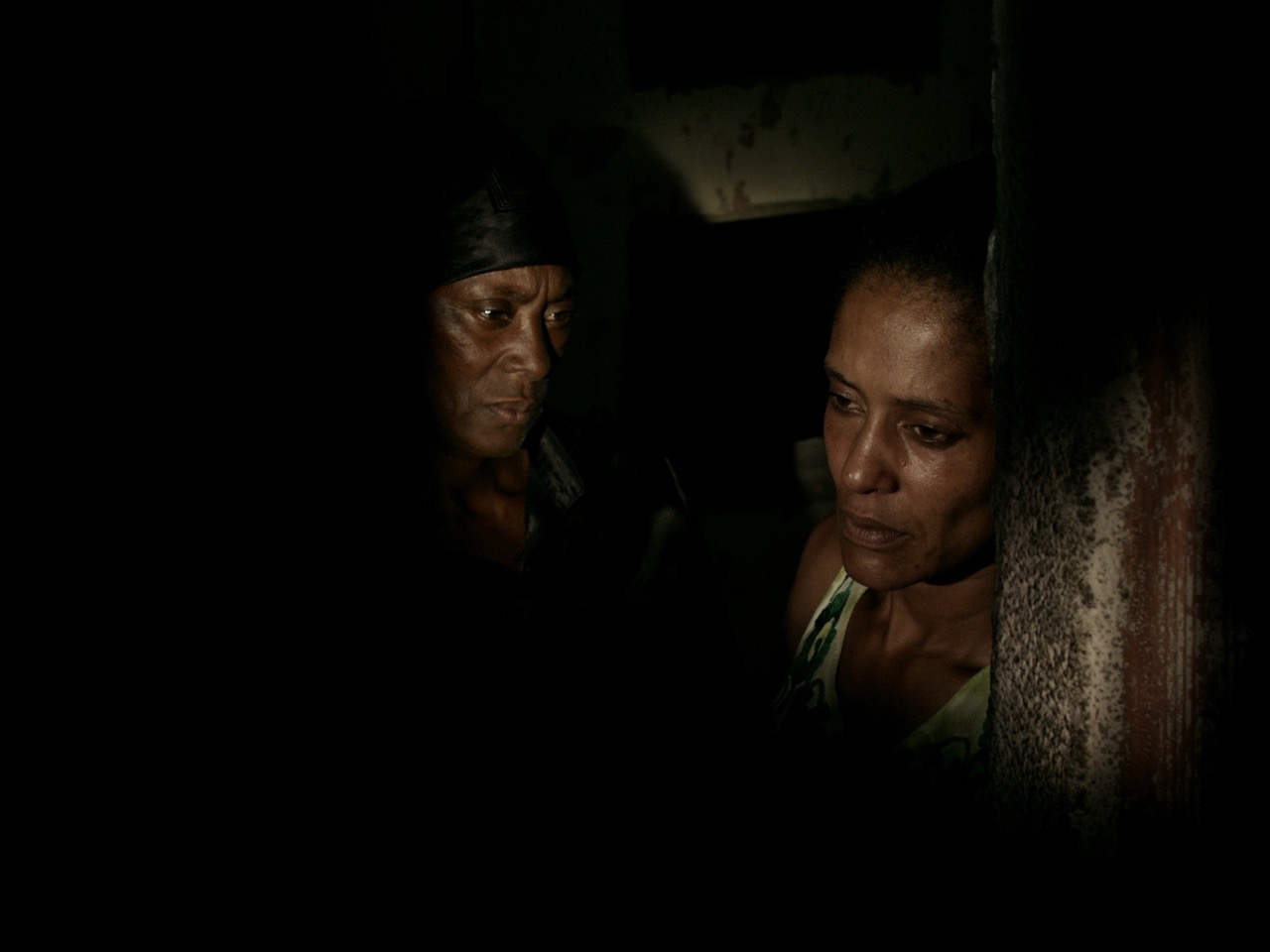
Film director Jean-Luc Godard  had said “In the temple of cinema, there are images, light and reality. Sergei Parajanov was the master of that temple.”  Parajanov, the late master filmmaker from Soviet Union, underscored the importance of bright colors and realistic sound, while Pedro Costa’s  Vitalina Varela goes a step further, accentuating darkness, dark skin, and shadows with muted indirect lighting in a “colour” film, aided with natural sound. When you do see bright images in Vitalina Varela, as at the end of the film, it is not just real bright light and colors, it presents a metaphoric change in the film’s narrative structure.


The award-winning actress plays herself in the film about herself


Vitalina Varela is distinctly different from the Oscar nominees of 2019 or well known commercial films with renowned actors. Vitalina Varela is an unusual film with a title that has the name of its lead actress. The film narrates the real story of its lead actress, a Cape Verdean immigrant arriving without papers in Portugal following her husband’s demise.  (She acquired the formal  papers authorizing her stay in Portugal halfway into the production of this film, several years after her actual arrival.) Its director Pedro  Costa, and his close-knit committed production team of cinematographer  Leonardo Simoes, sound mixers (Joao Gazua and Hugo Leitao), production manager, and stock actors can be proud of their low-cost final product that offers higher aesthetic values than the multi-million dollar products from either Hollywood or Bollywood. It is definitely one of the remarkable films made in 2019, if not the decade, at least for audiences less addicted to conventional action and sex that makes a majority of contemporary films make money at the box office. While the film is made by a white (Caucasian) Portuguese crew,  all the  characters in Vitalina Varela  are dark-skinned Africans from Cape Verde. Half of a film festival audience viewing Vitalina Varela  (in which this critic was a spectator) walked out of the film screening halfway, while the other half stayed rooted in their seats right up to the end of the film and stood up to applaud the film, even though none of the filmmakers were present at the screening.  (This critic recalls that in 1979, when an Andrei Tarkovsky film retrospective was screened in New Delhi, during an international film festival, some spectators who had paid for their tickets tore up their seats at the Archana theatre where the films were screened in frustration as they could not comprehend or appreciate Tarkovsky's cinema. Today, ironically the same films, are likely to be treated with awe and respect.)

Ms Varela, the lead actress of  Vitalina Varela, has little or no acting experience. She emotes and reconstructs with staggering dignity the world of her recent widowhood and love for her late husband, Joachim, who chose to live the demanding  life of an immigrant in the Fontainhas sector of Lisbon, Portugal, for some 25 years, retaining for his memory Ms Varela’s wedding photograph, carefully preserved in a photo frame in his ill-lit, shanty dwelling. This award-winning performance of the actress is comparable to the very best in the world, thanks to Costa’s perseverance and extended committed interaction with her developing the film from scratch for several years prior to the shooting of the film. 

The priest (Ventura) and the widow (Vitalina Varela),
in the church without any other worshippers


The most amazing part of the film Vitalina Varela is that there was no prior written script (just as in most  of Terrence Malick’s films) making it all the more difficult for Costa to  attract producers. The spoken words are essentially recollections of Ms Varela’s life and her second interaction in Lisbon with a real Cape Verdean  priest (played in the film by Ventura, a regular actor in several of Costa’s films), who buried Ms Varela’s husband Joachim, just days before her arrival in Portugal. The concept of the film itself emerged from  Costa’s, his wife’s, and his team’s interactions for 4 years with Ms Varela. Costa has explained that the film evolved with those extensive interactions and the award-winning performance Ms Varela was her honest outpouring of grief and loving memories of her husband who had promised her a palace in Lisbon decades ago, only to find it was a mere shack, which included some clues left behind in the derelict abode of the late husband’s recent lover. The evolution of the film has several parallels with the 2019 Brazilian film The Fever, which also was made after its director Maya Werneck Da-Rin's extensive interactions with indigenous Brazilians.

Contemporary Russian maestro Aleksandr Sokurov made unforgettable, poetic  films: Mother and Son (1997) and Father and Son (2003). Had Sokurov made Vitalina Varela, he would possibly have titled it as “Wife and Husband.”  

Vitalina Varela is a recounting of real events of Varela’s arrival in Portugal from Cape Verde island in the Atlantic, off the African continent (and a former Portuguese colonial territory), a few days after the death and burial of her husband Joachim, originally a bricklayer, more recently a person who survived by doing odd jobs. Like Sokurov’s elegiac Mother and Son, Costa’s Vitalina Varela is essentially a monologue of Vitalina seemingly speaking to her dead husband about her memories with him, comparing the stone house in Cape Verde they built together decades ago, with the tin shanty house in Lisbon.  The Lisbon “palace”  that Joachim promised her decades ago that she occupies following Joachim’s  passing is a shanty house with a leaking roof.


The priest (Ventura) metaphorically "carrying the cross
on his shoulders": director Costa and
cinematographer Simoes at their best

The only real dialogues in the film are those between the priest—a real character, a priest of a derelict church in Lisbon, reeling under his guilt of turning away a busload of Cape Verde Christians, who had approached him while he was a priest in Cape Verde to baptize a child without proper papers. The busload of Christians he turned away were killed in a road accident a short while later and the priest carries that cross of his action of refusing to baptize the child to this day.  Costa’s film brings together two individuals from Cape Verde, both suffering from recent tragedies, both religious individuals, both alone in a new country where even God seems to have forsaken them.  One line spoken during  the interaction between the two is evocative: “I had the cross of Christ on my shoulders. I couldn’t move. When I fell, I was free.” A fascinating religious commentary, indeed, in a film that did not have a prior written script.

In Vitalina Varela, the spoken words are less important than the visuals.  A striking point in the film is the arrival of Vitalina in Lisbon.  A plane arrives on the tarmac of the airport and the sole V.I.P. to emerge from it is Vitalina. The “V.I.P.’s” bare feet are shown as she climbs down the steps from the plane. (A cineaste would recall the Japanese director Mikio Naruse’s  classic 1960 film When a Woman Ascends the Stairs (with proper shoes) and the inverse relationship of the wet, bare feet shown in Vitalina Varela descending from the plane in this sequence.)  You would expect lights in an airport at night—but the scene is dark, the person is dark skinned, and wearing clothes appropriate for mourning. The “V.I.P.'s" reception committee are made up of fellow Cape Verdean immigrants working as cleaners/support staff at the airport, one of whom honestly tells her “Vitalina, my condolences. You are too late. Your husband’s funeral  was 3 days ago. There is nothing for you in Portugal. His house is not yours. Go back to Cape Verde.” Some reception for a widow!

A rare bright shot in the film is at the grave of Joachim

Just as Parajanov emphasized light in his films, Costa and his cinematographer Leonardo Simoes emphasize the importance of light by erasing it and using it sparingly to accentuate its importance. This is a colour film that appears to show more black (or lack of light) in most of the sequences with indirect lighting often behind the actors to give a silhouette. It fits with its the subject matter—it is a film dealing with death, sorrow, loneliness, African immigrants struggling to survive in Europe, lack of money and love. Even in daytime, much of the scenes are shot in shadows. Each of these dreamlike shots is aesthetically crafted in austere surroundings and a pleasure to perceive.  There are unforgettable sequences of tired immigrant workers returning home at night, hardly speaking to each other, in dimly lit streets close to cemeteries. You are reminded of sparse visual stage settings crafted by playwrights Samuel Beckett and Eugene Ionesco for their works. And natural sounds and bleak visuals, "speak" as much as humans do in this film.

Vitalina interacts with another woman,
who has burdens of her own


Ultimately Vitalina Varela is a film about a widow and the spoken words are bound to reflect a feminine viewpoint. In a response to the priest, who has kind words for her dead husband, Vitalina acerbically responds with criticism that is considerably true ”Men favor men. When you see a woman’s face in the coffin, you can’t imagine her suffering.” Suffice it to say that the film captures all this and more.

The citation for the film’s Silver Hugo award at the Chicago film festival sums it all up: “..for a ravishing and masterful vision between horror and melodrama, spirituality and desperation that blew the jury all away."


P.S.  Vitalina Varela is one of the author’s top 20 films of 2019. Much of the dialogues quoted above are from memory of a single viewing and are approximations. The film won the Golden Leopard award for the best film and the Best Actress award at the Locarno Film Festival; the Silver Hugo Award for the best feature film at the Chicago International Film Festival; the Best Director, Best Actor and Best Cinematography Awards at the Mar del Plata Film Festival; the Grand Prize of the Jury at the La Roche-sur-Yon International Film Festival (France); and the Best Cinematography Award at the Gijón International Film Festival (Spain). The Brazilian film, The Fever, mentioned in the review, is also one of the author's top 20 films of 2019.

Tuesday, December 09, 2014

170. The late Chilean maestro Raúl Ruiz' Portuguese film “Mistérios de Lisboa” (Mysteries of Lisbon) (2010): A brilliant cinematic treatise on memories


     “My films are not fiction films but about fiction”---Raúl Ruiz

     “In today’s cinema there is too much light, it is time to return to the shadows”--- Raúl Ruiz in his book ‘Poetics of Cinema’

      “I chose to take refuge in the dramaturgy of dreams” ---Raúl Ruiz


These three quotations of Raúl Ruiz are important starting points for analyzing the penultimate cinematic work of the talented Raúl Ruiz-- Mysteries of Lisbon. Ruiz had already made over a hundred movies and he made Mysteries of Lisbon knowing well that his days were numbered after being diagnosed with a life threatening liver tumour.  He completed the film while recovering from a successful liver transplant, only to die soon after, ironically from a lung infection.  While one can sense the brilliance of this cinematic work, it is difficult to distinguish what credit ought to be attributed  to the Portuguese novelist Camilo Castillo Branco, who wrote the book in 1854, without having read the work (the English translation of the book is not easily available), and what needs to be actually credited to director Ruiz.  Despite that conundrum, there are obvious pointers to what was definitely the contribution of Ruiz. The following analysis pertains to those aspects of the movie that are predominantly attributable to Ruiz alone.


Young Joao looks at his 'mother' in the company of Father Dinis


Father Dinis and Joao's "mother" (Maria Joao Bastos) after she becomes a nun

Mysteries of Lisbon is a 272 minute film unfolding a convoluted and yet interesting tale narrated by a tormented epileptic orphan Joao under the care of a priest named Father Dinis and some nuns. The tale is mostly set in the early 19th century Portugal. Priests and nuns there often have led colourful lives, preceding their final vocation. For author Branco, who was by all accounts a religious person, the Church in Portugal at that time provided sanctuary for orphans, widows, and those in trouble. Either Branco or Ruiz, or both together, use the puppet paper theatre as a prop and as a narrative punctuation device for the epileptic Joao to imagine vivid tales of grown-ups in aristocratic Portugal, who are all somehow connected to Father Dinis (Adriano Luz) and a lady who claims to be his mother, who has gifted him the puppet paper theatre while recovering from an epileptic attack. It is thus not surprising that characters in Joao ‘s world are closely interrelated.  (For example, Joao’s “mother’s“  husband’s mistress turns up later in the tale as the wife of Albert de Magalhaes, another important person in Joao’s life story.) In that process, Branco examines the social importance Portuguese gave to the firstborn in a family, how paternal titles made or unmade individuals, how fathers wreck the love lives of their daughters for personal benefit only to rue their actions much later in life and the lack of fidelity of abusive husbands.

Any approach to appreciate Ruiz’ cinema cannot dissociate it from  Ruiz’ life--a Chilean director who chose self-exile in the early Seventies following the US-supported coup that removed the democratically elected Salvador Allende while installing the Chilean armed forces Commander Augusto Pinochet in power instead.  Today, the world knows the late Pinochet was implicated on over 300 charges of human rights violations. The multi-talented Ruiz fled from Chile under Pinochet hopping from one European country to another, frenetically writing plays and books and making over a 100 films. Each of these works reflected his distaste for the armed forces that took power in Chile and his wistful love of Chile, a country he could not return to work as before.  Even though Mysteries of Lisbon is predominantly set in Portugal and France, there is a sequence where the ‘orphan’ Joao ‘appears’ to end his last days in Brazil, not far from Ruiz’ homeland Chile. Ruiz forever dreamt of returning to Chile. As per his wishes, Ruiz was buried in Chile. Such indirect references abound in each work of Ruiz. While Mysteries of Lisbon is essentially about dreams, the final sequence reiterates the importance of dreams.  At the end, the colours of the screen fade to merge with empty white light. The film of shadows comes to a close. Ruiz transcends Branco’s words using cinematic effects.

Shadows and perspectives: Ruiz upstaging Branco
(the shadow is of  Father Dinis) 
A casual viewer of Mysteries of Lisbon would not associate the work with surrealism and magic realism more obvious in Ruiz’ works, such as, That Day (Ce jour-la) (2003) and Three Crowns of the Sailor (1983). Early into Mysteries of Lisbon, there is a short sequence where another kid of Joao’s age leads Joao to a spot behind the hedges of the orphanage where some men have been hanged in public view. The kid claims that one of the hanged men is a thief and his father. The viewer can see the hanged individuals. Joao is crestfallen as he has been accused of being the son of a thief and confused but does not respond as one would expect.  Father Dinis, who accompanies young Joao and the kid who is showing Joao the hanging, is merely studying Joao’s face  rather than the hanged persons, and he leads Joao back impassively after Joao has taken in the scene of  the hanged individuals. Where is the surrealism or magic realism?  Could this be a real hanging, so close to the orphanage? If it was real, why is Father Dinis not appearing to be concerned with the hanging? Why is he only concerned about Joao? Why do doors open and close by themselves in the film? Why do certain paintings come alive for Joao? Why does an important transaction between two friends take place in a room with two massive religious frescoes on the walls and just two chairs, devoid of any other furniture? Why does Ruiz employ two Joaos during the duel scene, one committing suicide after pensively walking in the background, and another active Joao who partook in the duel going on to live another day with honour? The answers to each of those questions are “mysteries” that contribute to the richness of the film and help the viewer to unravel Ruiz’ complex movie Mysteries of Lisbon with its unusual ending.

Towards the end of Ruiz’ Mysteries of Lisbon, the grown up Joao encounters Elisa de Montfort (Clotilde Hesme). She pauses in her walk and comes to Joao to state, “You lacked courage, my dear.”  This is a sequence which could have been typical of Ruiz’ cinema referring to Ruiz’ political courage or it could also have been Branco’s idea. While the lack of identity is a problem for Joao the orphan, the lack of citizenship of Ruiz is perhaps one reason for the director to choose to make this film, which mirrors his own life.

Riches to rags: The teenaged Joao encountering a once proud Marquis
reduced to beggary searching for the 'mausoleum' of his daughter
Throughout Mysteries of Lisbon, the peripheral non-aristocratic characters listen to conversations of the aristocrats and seniors openly. Servants not just bring in chairs and messages for their masters, but serve as silent and sometimes expressive external commentators within the film.  Even in an abbey, junior priests eavesdrop on the colourful tales of senior priests. Money transforms people of lesser social stature into aristocrats in Mysteries of Lisbon and a proud Marquise is transformed into a blind beggar in the course of the tale.

Torn shreds of an unread letter captured by the camera
placed below the resting pieces

The cinematography (André Szankowski ) of the film is stunning. The camera teases the viewer. The camera goes under a glass table to capture the torn pieces of a letter that is never read. Stories within a story deliberately show individuals with unreal beards and make-up, while the main story in contrast never compromises on quality. Dreams within dreams are treated differently by Ruiz.


Using the paper puppet theater to punctuate Acts

Mysteries of Lisbon is essentially a brilliant treatise on memories. At the end of the movie the viewer is shown a tired and graying Joao who needs a walking stick, but no taller than a teenager, narrating his tale to a scribe. He says “I was 15 years old and I didn’t know who I was. I went on no outings or holidays. I received no presents. I don’t know how long it has been since I lost consciousness. And the moment I opened my eyes. I thought I dreamt it all“, while lying down on a cot broad enough for a kid. Doors close by themselves and the screen brightens gradually to be covered by pure white light.

This film won the San Sebastian Festival Silver Seashell for Best Director and the Sao Paulo Festival Critics award for best film. The film was carved out by Ruiz from several episodes he made for the Portuguese TV.


P.S. Mysteries of Lisbon is the first film of Ruiz to be included in the author’s top 100 films. It was also one of the top 10 films of 2011 for the author and one of the 15 top films of the 21st Century for the author.  Ruiz’ earlier work, That Day (Ce jour-la) (2003) was reviewed earlier on this blog. Ruiz’ last film that he completed before his death, La Noche de Efrente (Night Across the Street) (2012), was one of the top 10 films of 2012 for the author.


Monday, May 02, 2011

113. Centenarian Portuguese filmmaker Manoel de Oliveira’s “O Estranho Caso de Angelica” (The Strange Case of Angelica) (2010): Mixing illusion and reality with the mystery of life and death


One is never sure if any hundred year old can walk or even talk coherently. When you see a feature film made by a '102+ '-year-old that can make the grade to enter the 2010 Cannes official Un certain regard section, your jaws drop. The 102 or 103 year old Manoel de Oliveira’s reported physical handicaps are limited to walking with the aid of a stick and a minor hearing problem and, believe it or not, is busy making another movie after the recent The Strange Case of Angelica.


The Strange Case of Angelica is indeed a ghost story but to classify it merely as one would be missing the wood for the trees. If one is looking for a good ghost story movie, one ought to see The Others or Yella, not this one. If one is looking for special effects associated with ghost stories, this is far from one that can be  recommended. It is definitely not a commercial film: it is merely a film that can make you think. It provides a cinematic repast for an audience that is able to look beyond the decades-old technicalities that would annoy the impatient, modern hi-tech cineaste. Rather than a typical ghost story, this movie is all about capturing the ephemeral beauty of this world of fleeting moments of Joycean epiphanies on film, if you will, for posterity,

Director de Oliviera is probably one of the very few film directors from the silent film era still making movies in the 21st century. He has made some 60 films in the past 80 years. But what is most remarkable is that his films have a certain transcendental quality, often imperceptible to many. The Strange Case of Angelica is a tale written by de Oliveira in 1952, a half century ago for the screen but only executed today. And therefore the purist would find contradictions in the conversations in the film on global warming that are anachronistic for a film that is set in the Fifties. But then this is a sensitive tale from a man who loves cinema, photography, and sound. Had de Oliveira made this film 50 years ago, I am very sure that the mature philosophical turn of the final product would have been missing. It takes a very old man who has lived through life’s many twists and turns to make a film like this one.


The Strange Case of Angelica is about a still photographer—the starting point of any one who loves cinema. The photographer is different, he eats little, he loves the radio, he is an introvert, and is a person trying to catch the elusive beauty of actions being erased by time. The photographer spends hours trying to capture for future generations the feel of a chain of farmers preparing a farm field to grow another crop while of all of them sing a chorus that provide a hypnotic rhythm for the actions of the group. Much later in the film, the photographer revisits the same spot and finds to his dismay the field preparation has been replaced by a clunky tractor—gone are the men and the song. Even though the camera of the photographer has captured the visual beauty, it is cinema that captures the sounds that will be lost in time. Cinema and photography can make time stand still by illusion. That is the precise beauty of the de Oliveira film.

The movie is somewhat autobiographical—de Oliveira was a farmer and obviously realizes that his days on earth are numbered. The photographer in the film is an extension of de Oliveira, the film director (in fact the actor is his real life grandson). Are the hoes in the hands of the farmers a subtle image of the grim reaper for an old man? The film is evidently a poem on the magic that you can find through the view finder capturing the elusive image that you wish can stay with you forever. Here in this film it is a moment of magic realism where a dead woman comes alive through the viewfinder. So is the image of the farmers. So is the bird in a cage.

The Strange Case of Angelica is much more than a tale of a dead woman coming alive in the mind of a young man. It is ostensibly a love story of two individuals who have never met in life, but is destined to meet and be together after death. The beauty of life and death is what this film captures through some amazing sequences. One such sequence in the film is of a cat staring at a bird in a cage, considering the prospect of the bird as its next meal. The cat’s delicious thoughts are hoed down by a dog’s bark—the cat soon realizes that it has to save its own skin. Another amazing bit of conversation in the film relates to a pet bird being fed the remains of an egg and the surprising death of the bird that results from the innocent action.


The film has much to do with philosophy—the opening quote in the film that I do not now fully recollect, had something to link time standing still and God in us. It is not without relevance that a trivial conversation within the film set in 1952 discusses “anti-matter searching for the precise opposite.” For the record the film’s tale revolves around a Jew in post-Second World War Catholic Portugal. A Jew encounters death of a Christian woman and a Jew deals with a photographic death and resurrection following visits to a Church. There is even a passing out in an olive grove. (Much of de Oliveira’s cinema contains suggestive Christian motifs for those familiar with Biblical passages.) The soul departs leaving the body behind. These are interesting images, not statements, in the film. Statements from the film have to be viewed in the context of visuals and sound.


This film has much for a viewer to reflect on. And film is not just a visual crossword puzzle to solve. It has an aural puzzle as well. The Chopin selection and application in the film needs attention. As the credits roll, you hear the very same chorus of the farmers that so fascinated the photographer earlier in the film. That’s de Oliveira’s nudge on the importance of sound that has a magic realism of its own. The bird in the cage flutters when death takes place elsewhere in the room. As the landlady closes the windows and draws the curtains to underscore death, you begin to reflect on this strange film that mixes hallucination, science, music and philosophy. It is a sensitive, delicate film that is unlikely to be appreciated by the conventional filmgoer who prefers a cut-and-dry tale. If you relish the film you will realize that this film could not have been made by a young person. Beyond the lack of modern craftsmanship lies a deep tale of mystery and philosophy rejecting modern machines (loud impersonal efficient farm machinery for one) and modern photography, all the while celebrating a mystical charm of the old world.

P.S. The German ghost film Yella was reviewed earlier on this blog.

Saturday, March 22, 2008

60. Spanish director Carlos Saura’s stunning documentary on the Portuguese folk song tradition "Fados" (2007): Direction upstaging the song and singer

Seventy-six year young Carlos Saura charmed film lovers with several melancholic dance, music and song styles: flamenco in Flamenco (1995), Blood Wedding (1981) and Sevillanas (1992); tango in Tango (1998); and finally, opera and flamenco in Carmen (1983). Then comes his latest film Fados, a heady mix of dance and melancholic Portuguese folk song rendered by mesmerizing singers such as Mariza and Carlos do Carmos…If you thought as I had, that I had seen all that the wizened genius from Spain could do, you will be pleasantly surprised. Fados is undoubtedly one of his finest films—forget the music, forget the song, forget the singers (if you possibly can!) and enjoy the art of fine direction.

I am forced to recall the US film Woodstock (1970). Millions would remember that wonderful film, but few would recall its director Michael Wadleigh. The gifted Wadleigh not only directed the fascinating documentary film, he was one of the cinematographers and one of the editors of the film. His assistant film director for the film was Martin Scorsese! If you enjoyed Woodstock’s groundbreaking editing, it is important to note that Wadleigh's editing collaborator was Thelma Schoonmaker, who has edited each and every Scorsese movie since 1980. Now why am I writing about Woodstock instead of Fados? It is because, like Woodstock, Fados is very likely going to be discussed in years to come for its endearing music, song and dance, bypassing its vibrant cinematic ingredients. (See the shot of the film above and note the varied perspectives of the same scene, captured through multiple projections, recalling the shots of Woodstock--only Saura does the cinematic flourishes a lot better.)

The first few minutes into the film introduce you to breathtaking effect of the cinema of Fados. You have shadows of live individuals walking as they do on a street (you do not see them under direct light). These shadows fall on a screen where another film image is projected. The present and the past merge. As the opening credits roll, you realize you are being seduced by the kinetic images. And even up to the final shot of the film, you realize that you are under the spell of creative use of shadows, images, mirrors, projection screens and shiny reflecting dance floors. The final shot is of the film camera lens, which is the appropriate mainstay of the film—not the music, song and dance, which merely provides the subject for the director. Even the English subtitles were aesthetically placed in the left corner of the frame, so that the beauty of each shot is maximized for the viewer. The director conveys his viewpoint by using light and shadows that say a lot without words.

Saura has a great ear for music. No wonder he made all these movies on music, song and dance. Go back in history, and you will recall his most famous film, Cria cuervos (Cry ravens) (1975) featured a song called Porque te vas (Because you are leaving) sung by an American singer called Janette who was living at that time in Spain. The song had been released by the singer earlier but few took note of it. After Saura’s film won honors at Cannes, Janette’s song soared in popularity and became a worldwide hit. (Somewhat like Antonioni’s boost to Pink Floyd in Zabriskie Point, even though Pink Floyd was arguably quite famous by the time of film’s release) That was unfortunately the career high for the singer. Today, some 30 years after I saw Cria cuervos during a Saura retrospective in New Delhi, the notes of the song resound in my ears. Fados, like Cria cuervos, is a delight for those who can appreciate good music.


In Saura’s Fados, achievements are many. The film is entirely made on a set, eliminating extraneous sounds such as street noise. The Portuguese icons of song come to Spain to film the scenes—a clever canvas of light and shadows, dance and song, mirrors and projection screens that recall the brilliance of another of my favorite documentary films—Hans Jurgen Syberberg’s Hitler--a film from Germany. Like all Saura’s films there is some politics at play—his work is a cry for Iberian unity between two neighboring nations that never historically trusted the other. In an interview Saura stated that he was deliberately removing artists from their natural surroundings so that they could create “something new”. To Saura watchers, he is continuing his favorite exploration merging theatre and film, without being hemmed in by the boundaries of a written play.

After you enjoy the film, you might like to ask yourself the following questions. Why is the aging cinematic genius obsessed with melancholic music/dance styles? Is he urging his viewers to go beyond nationalism and adopt global perspectives in the very manner the Fado evolved? You get a feeling as a viewer that this old man is communicating through the camera more than what is obvious. He is able to present a melancholic song style with pulsating positive resonance, using all the tricks up his sleeve. Now that’s good cinema.

Friday, February 29, 2008

58. Portuguese director Teresa Prata's Mozambican film "Terra Sonâmbula (Sleepwalking Land)" (2007): A lovely film based on a major African novel

Not many filmgoers may be aware of Portuguese director Teresa Prata’s Sleepwalking Land. A film that took Ms Prata some 7 years to complete, it is yet to be extensively screened beyond the international film festival circuit. The movie is evidently Ms Prata’s labor of love after she spotted a goldmine in Mia Couto’s Portuguese novel Sleepwalking Land published in 1992. The novel is now widely recognized as a major literary work from and on Africa in recent years. Extracts (translated into English) that I read indicate a remarkable, powerful literary work, falling within the realm of magical realism. It was indeed a work screaming to be captured on celluloid with the help of special effects and convincing local acting talent. The young lady grabbed the opportunity to shoot the film in Mozambique and do the special effects in Portugal. Today, her interesting movie adaptation is helping publicize Mia Couto’s writing even further and is bringing global attention to both the Mozambican and the Portuguese cinema.

Sleepwalking Land is one of the most interesting and realistic films on Africa. In the past two months, the film has won the international FIPRESCI award for the best film in competition at the recent Kerala film festival, and an award for best director at the lesser known Pune film festival.

African films, in my view fall into three distinct categories. The first category includes films made on African subjects by native Africans, as exemplified by the cinema of the late Ousmane Sembene. The second category includes movies made by African Arabs on subjects relating to north Africa and the Horn of Africa (e.g., films of Youssef Chahine in Egypt, Mohamad Asli and Souhel Ben Barka in Morocco, Mahamet Saleh Haroun in Chad). The third category is African cinema made by expatriates with a short exposure to Africa, blending external sensibilities with those of native Africans (e.g., Gillo Pontecorvo’s Battle of Algiers, Mira Nair’s Mississippi Masala). Teresa Prata’s Sleepwalking Land will fall within that final category.

The book Sleepwalking Land and the film based on the novel are both set during the 15-year civil war that crippled Mozambique. Mia Cuoto has a gifted philosophical turn of phrase to describe the catastrophe of the war: “what’s already burnt can’t burn again.” The film (as in the book) looks back wistfully at the tragedy of the unrest through the eyes of a dreaming orphan boy and provides a glimmer of hope for the survivors of civil anarchy to cope with what is left to build anew. While Mia Cuoto and Teresa Prata focus on the social and economic plight of Mozambique, their respective works can equally mirror the problems of the continent.


The film follows a young orphaned Mozambican boy Muidinga (an endearing performance by an acting novice, Nick Lauro Teresa), who can fortunately read as he had once attended school and is even familiar with Melville’s Moby Dick, and his unrelated, illiterate guardian, a wise old man called Tuahir (played by non-professional actor Aladino Jasse), tossed accidentally together by the civil war. The film and the book trace their common will to survive the difficult days. The young boy might have read, or rather heard, the story of Moby Dick, but the name is indelible in his memory. Director Teresa Prata, who adapted the story for cinema, therefore takes creative license, and allows the young boy to call his pet goat “Mody (sic) Dick.” (When I queried the director on this detail, she stated that she was responsible for this change and that it was not part of Couto’s book.)

The film and book have two parallel plots. The young boy and the old man, on the run in the bushes from marauding, gun-toting factions of the civil war, come across a charred bus with burnt corpses and their possessions that escaped the fire. Among the possessions of the dead passengers are notebooks that describe a story of a woman named Farida, a squatter on an abandoned ship, waiting for her young son to find her, and a hardworking young man Kindzu, who has fled his burning village that has faced the wrath of the civil war-mongers. In this discovered manuscript, Kindzu meets Farida. Subsequently, Kindzu goes searching for Farida’s lost son.

The young boy narrates the tale to the illiterate old man, after reading the manuscript, and begins to associate Farida as his lost mother. He even imagines the name of the ship she is squatting on is called “Mody (sic) Dick” (again, Ms Prata’s contribution to the story).

A strength common to the book and the film is that the parallel love story of Farida and Kindzu never takes center stage—the backbone remains the dreams of the young boy under the guiding spirit of the wise old man. Between the two, the viewer of the film is introduced to the problems of Mozambique, of Africa, of any developing country. As in a Greek tragedy, you trudge along a path that gives you a notion of travel and progress, only to return to the same spot, literally and metaphorically.

Here is a sample dialog from the film/book:
"But isn't it more dangerous on the road, Tuahir? Isn't it better to hide in the bush?"
"Not at all. Here we can watch the passersby. Don't you see?"
"You always know everything, Tuahir."
"It's no use complaining. You're to blame: isn't it you who wants to find your parents?"
"That's right. But the bandits are the only ones to pass by along the road."
"If the bandits come, we'll act like we're dead. Pretend we died along with the bus."

Pretense and dreams make the film move forward. To aid the young boy on his “journey” to his “loving mother Farida” squatting on “Mody (sic) Dick,” the old man devises the means to reach the sea (Indian Ocean) from the bushes of Mozambique. The old man digs a hole in the ground. Water sprouts and a stream forms. The stream becomes a river and at the end of the river there is the ocean. In the Ocean, the lead characters find the derelict “Mody (sic) Dick” with Farida on it. Obviously, if you demand conventional realism—there is very little that the film can offer. If you accept magical realism as a tool to narrate a realistic socio-political scenario in Africa, both Mia Couto and Teresa Prata have much to offer and delight your senses.

The viewer gets a glimpse Couto’s Mozambique. An elderly Portuguese lady chooses to remain in her house even when her servants have fled. A Gujarati shopkeeper family that opts to return to India, when their shop is ransacked during the war. There are railroads that have no trains to run on them. But among the ruins, Couto and Prata, show a glimmer of hope in the form of an orphan, learning hard lessons of life in the bush. Ms Prata has made a fine effort to extract remarkable performances from non-professional actors and has proven her capability to adapt and direct an interesting work that would be interesting for any person interested in good African cinema. This film may not be a cinematic masterpiece, but it is certainly a fine example of good African cinema made by a gifted and persevering lady from another continent.

For the intelligent viewer, the writer and the director throw a silent challenge. Spot the real Captain Ahab and spot the real Moby Dick that confronts Africa today and you could enjoy the film even more. The description of a civil-war torn country as a sleepwalking land offers fodder for thought, beyond the usual images of violence, poverty and carnage that adorn the typical African cinema.


P.S. The above review was included in "The Directory of World Cinema: Africa (Intellect Books, UK: eds. Blandine Stefanson and Sheila Petty; 2015; 302 pages; ISBN 9781783203918)."