
 |
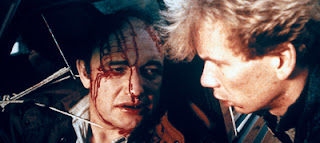
| The killer talks to bleeding victim |
The brilliant Polish director--whom I had the good fortune to meet in Bengaluru at an International Film Festival in 1980--made a series of ten 1-hour long short films, each dedicated to one of the Ten Commandments, handed down to Moses from God. These are commandments given to a man venerated by Christians, Muslims and Jews. Dekalog 5 naturally deals with the Fifth Commandment--"Thou shall not kill." Kieslowski and his co-scriptwriter Krzysztof Piesiewicz weave a modern day story that entertains, while asking disturbing and provoking questions--theological, social and psychological--of the viewer.
Three distinct and distant individuals' lives intersect with the brutal killing of one by another. The one-hour film reveals the event that brings the three individuals together only after half the film is over. I have seen other segments of the Dekalog but this one struck me as the most sparse one in dialog and yet the most fascinating in structure.
The film opens with a law student practicing a mock plea of defense for a man charged with murder. Obviously the same arguments must have been repeated by the man as a full-fledged lawyer but this is never shown on screen (at least in the short 1-hr version of Dekalog 5). We are made to imagine that this must have been the case.
Three distinct and distant individuals' lives intersect with the brutal killing of one by another. The one-hour film reveals the event that brings the three individuals together only after half the film is over. I have seen other segments of the Dekalog but this one struck me as the most sparse one in dialog and yet the most fascinating in structure.
The film opens with a law student practicing a mock plea of defense for a man charged with murder. Obviously the same arguments must have been repeated by the man as a full-fledged lawyer but this is never shown on screen (at least in the short 1-hr version of Dekalog 5). We are made to imagine that this must have been the case.
A cab driver who is a misanthrope, has two facets to his character: the good side feeds a mangy dog, cleans his cab meticulously, picks up dirty rags thrown by people who lack civic sense, and remembers his wife while dying; and the bad side frightens small poodles, refuses to give a ride to a drunk--probably worried that he will puke in the cab--and ogles at pretty girls. The repulsive protagonist who murders without mercy, drops stones from bridges on fast moving traffic, and pushes strangers into urinals without any provocation, is also a person who can make innocent young girls laugh. Kieslowski's film and the script thus present the good and the bad side of two of the three main characters.
Yet the film is not about capital punishment but more a treatise on killing. The Fifth Commandment "Thou shalt not kill" is explored theologically--("Even God spared Cain...'), sociologically the tenderness of brutes to children and poor forlorn dogs, and psychologically (after effects of drunken night with a male friend that led to the accidental death of his sister, whose photograph he carries with him). What makes ordinary persons turn into killers--this is never fully explained but suggestions made are legion.
In Kieslowski's world there is a pattern where events and people are interlinked in a cosmic sense (note the resemblance of the clown as it hangs from the mirror in the cab, to the killer). Kieslowski and the young idealist lawyer seem to ask us to look at the Commandment literally and figuratively--why do we kill? Are the people legally put to death, truly bad? Is there a force beyond society (the drunken night that led to the end of a girl's life) that makes us transform into abhorrent murderers?
It would be missing the forest for the trees to discuss the two detailed killings in the film--both without mercy. The film invites the viewer to contemplate on why we are asked by God not to kill.
I understand a longer full-length version of the film was made by Kieslowski. But even this short 1-hour version is superb with its bleak and sparse script, intelligent editing, interesting cinematography and top-notch direction that provides much more to ponder than the sum of its parts.
This segment anticipates the more wholesome Dekalogs 6,7 and 8. The ten films that constitute the full Dekalog, which for me, remains one of the finest cinematic achievements in the history of cinema.
P.S. Detailed reviews of Dekalog's segments 2 and 5 are posted on this blog by the author. The longer version of Dekalog 5 called A Short Film about Killing won the Jury Prize at the 1988 Cannes Film Festival
Yet the film is not about capital punishment but more a treatise on killing. The Fifth Commandment "Thou shalt not kill" is explored theologically--("Even God spared Cain...'), sociologically the tenderness of brutes to children and poor forlorn dogs, and psychologically (after effects of drunken night with a male friend that led to the accidental death of his sister, whose photograph he carries with him). What makes ordinary persons turn into killers--this is never fully explained but suggestions made are legion.
In Kieslowski's world there is a pattern where events and people are interlinked in a cosmic sense (note the resemblance of the clown as it hangs from the mirror in the cab, to the killer). Kieslowski and the young idealist lawyer seem to ask us to look at the Commandment literally and figuratively--why do we kill? Are the people legally put to death, truly bad? Is there a force beyond society (the drunken night that led to the end of a girl's life) that makes us transform into abhorrent murderers?
It would be missing the forest for the trees to discuss the two detailed killings in the film--both without mercy. The film invites the viewer to contemplate on why we are asked by God not to kill.
I understand a longer full-length version of the film was made by Kieslowski. But even this short 1-hour version is superb with its bleak and sparse script, intelligent editing, interesting cinematography and top-notch direction that provides much more to ponder than the sum of its parts.
This segment anticipates the more wholesome Dekalogs 6,7 and 8. The ten films that constitute the full Dekalog, which for me, remains one of the finest cinematic achievements in the history of cinema.
P.S. Detailed reviews of Dekalog's segments 2 and 5 are posted on this blog by the author. The longer version of Dekalog 5 called A Short Film about Killing won the Jury Prize at the 1988 Cannes Film Festival


2 comments :
excellent review :)
excellent review :)
Post a Comment