Tuesday, July 21, 2020

253. Brazilian director Kleber Mendonca Filho’s debut feature film “O Soma o Redor” (Neighboring Sounds) (2012) in Portuguese, based on his original script: A lovely, innovative example of effective, judicious and discreet use of sound in film-making that complements the mood of the screenplay


Film directors often make amazing debut feature films. These debut films can be awesome if they are based on the director’s original scripts rather than an adapted one. Kleber Mendonca Filho’s debut feature film Neighboring Sounds as a director stands out as he has observed and reflected on the history of Brazil and created a tale that mirrors the race conflicts and the closely related economic and social disparity that has existed in recent decades of that wonderful, naturally well-endowed nation’s history.

Beyond the interesting tale that director Filho wrote for his debut as a feature filmmaker, he evidently decided to build his tale aided by the importance of sounds in a film that most viewers neglect to notice. It is no coincidence that he chose to title the film as Neighboring Sounds. If a viewer approaches the film casually, the story of the film will be more overpowering than the diegetic sounds captured on the film’s soundtrack. Filho divides his film into three chapters (i) Guard Dogs, (ii) Night Guard, and (iii) Body Guards. The common phrase for all three is “guard.” At the end of the film, a perceptive viewer will mull over the emerging necessity of guards for certain sections of Brazilian society.

A view from an empty apartment in the condominium,
 where a past resident committed suicide


A swimming pool would make way for another upscale
apartment as the demand increases.


The film opens with the camera capturing historical sepia images of dark skinned workers of a plantation in Brazil with a huge imposing mansion in the background. The film then brings us back in full color to the modern-day crowded urban Brazil where fair-skinned Brazilians live in varied levels of upper middle-class comfort, with household help, dogs to guard some households and limited common areas with high walls for children to play and recreate with protection. Some of the inhabitants in the condominium and the locality are very rich, some are comparatively less affluent. In an early sequence of the feature film the viewer is introduced to calm locality in the city of Recife, where the calm exterior is shattered visually and aurally by a car suddenly speeding into view, hitting another car. That is the first taste that Filho gives the viewer that all is not well as it appears. A questioning viewer would wonder what that initial sequence was all about—but it would make sense as you absorb various such later incidents that dot the film.  Most of the inhabitants are rich enough to employ maids and an old security guard that some inhabitants are not satisfied with and want replaced. Perhaps that is why one family in the condominium has a dog and the dog’s barking is a nuisance for another inhabitant who tries to kill the dog for the sake of a quiet night. One gets the impression that there is no crime in the area, only to realize that vehicles parked overnight are targets for thieves who find a market for stolen car music systems. 


Some residents of the apartments are not as rich as others;
the lady above is a single mother of two kids, irritated by a
neighbor's dog barking at night and gets her kids to massage her 

In the very first chapter, Filho’s script introduces the fact there is a very rich family with many close relatives residing in the neighborhood and even the old guard is a trusted man of this rich family’s current patriarch and therefore retained as a guard. Whether he is effective in his work or not, can be indirectly associated with the theft of a car music system. Filho’s film never spoon feeds the viewer. The viewer has to appreciate the mosaic of seemingly unrelated details to appreciate what the tale leads up to. The method employed by Filho brings to mind Lars von Trier’s amazing revenge tragedy Dogville (which also had a dog on the fringes of its tale), another remarkable film where the characters could be extrapolated beyond the limited geographical area presented that film to an entire country. Filho’s urban pocket of Recife (Brazil’s sixth largest city) is an encapsulated world of Brazil today that appears calm but is full of seething anger towards exploiters, past and present.  

In the second chapter, when “professional” guards seem to have replaced the old guard and the barking dog, the viewer is introduced to images and sounds of less privileged kids seeming to attack the well-to-do neighborhood residents using the cover of trees and terraces at night. Was that the reason for the guard dog to bark in the night? Filho’s film first suggests the sounds and visuals of these kids scurrying on tree-tops  and roofs in the night as a dream of some residents, until the so-called new guards on duty catch hold of one of the kids hiding on a tree, only to let him go with a warning. The attitude of the guards towards the waif provides an interesting and unusual way to project the later events in the film that the viewer does not anticipate. 


At day time, Filho introduces a sexual escapade between a guard and a maid in an apartment when the owner has stepped out and alerted the guard of his brief absence merely to guard the apartment. Filho surprises the viewer with a shot of a kid hurriedly departing from the supposedly empty apartment through the open doorway. The kid was evidently disturbed by the sounds of the activity of the guard and the maid who has never been inside that particular apartment. 

Sounds matter in varied and surprising ways, in Neighboring Sounds, often contrasting the silence that reveal an important detail. Who was the kid? How come the guard was not aware that the empty house had a silent occupant? As the film progresses, those details make sense in the larger canvas offered by the film. In another sequence, the viewer glimpses the elderly don of the complex walking alone in the quiet night, evidently for a swim in the ocean, going past signs warning people of the sharks in the water. The guards watch their new employer with interest going for the swim alone and returning safely. All is calm but the uneasy calm grows on the viewer.

A new guard offers professional protection to residents,
who have experienced small crimes in the neighborhood


The night guards are recruited and on the job


Filho briefly takes the viewer and some of his characters away from Recife to the more interior areas of Brazil where the elderly don, his son, and the son’s girlfriend go for a swim near a waterfall and Filho gives the fresh water drenching them to surrealistically turn to the symbolic color of blood. Filho keeps the viewer guessing. the location of the waterfall is close to the large house shown in sepia color at the start of the film  and a sugar plantation that the elderly patriarch's family owns.  And right up to the very end of the film, the film discusses and insinuates bloody events that had happened and are likely to take place, without ever showing them on screen. The bloody waterfall, which is not real, is the closest Filho comes to “violence” shown in the film. there is also a passing mention of a recent suicide by a past inhabitant of the Recife condominium. And yet the film suggests violence in a very discreet way! That is what makes Neighboring Sounds stand out among contemporary films. It presents the simmering anger that results from social inequality over decades, with the “guards” displaying similar intolerant behavior they have  experienced in the past from others. A single mother’s irritation towards barking dogs that is only alerting the denizens to dangers in the night is another subtext of the film offered by the screenplay.


The family patriarch (center) shares a meal with his son
and the likely future daughter-in-law

The three visit locations near the patriarch's sugar plantation,
and shower at a nearby waterfall

The water surrealistically turns to the color of blood 

Filho’s film Neighboring Sounds anticipates his co-directed Bacurau (2019). Neighboring Sounds offers more style and sophistication than the later work. The use of sound in Neighboring Sounds does not predict events as most films tend to do—the lack of sound and the abrupt use of sound to aid the script are unusual and remarkable. In some ways, the film  reminds you of the end sequence of Steven Spielberg’s debut film Duel (1971), in which a menacing truck falls off a cliff with a loud metallic groan, as though the inanimate truck had a life of its own. Filho is talented and this Brazilian film is a lot more sophisticated than Bacurau—the latter film having more mass appeal of a modern Western, while the former is more subtle in its message and linkages of disparate events. 

Neighboring Sounds is an important film of the past decade, especially on the technical front, and is a treat for those who seek well made films. The film indirectly seems to ask if Brazilians today have learnt from the lessons of their history. The viewer can decide that.


P.S.  Neighboring Sounds (2012) and The Fever (2019) are two remarkable debut films from Brazil in the last decade. The two films might not boast of the wider appeal of Bacurau (2019) with its violence and some nudity. Quite evidently, Brazilian cinema is on the march long after the days of Cinema Nuovo, mostly in the 1950s up to the 1970s (Glauber Rocha’s Black God, White Devil; Ruy Guerra’s The Guns; Leon Hirschzman’s The Girl from Ipanema; and Nelson Pereira dos Santos’ How Tasty was My Little Frenchman). The two films The Fever and Bacurau have been reviewed on this blog and both are among the author's Twenty Best Films of 2019. Neighboring Sounds has won 38 awards worldwide.


Thursday, May 07, 2020

252. Russian director Ilya Khrzhanovskiy’s debut feature film “Chetyre” (4) (2004), based on a script by post-modern author/dramatist Vladimir Sorokin: A perplexing, absurdist, and depressing study of contemporary, post-glasnost Russia


“Exhausted by hunger, he ate in secret. He thought he was stealing food; but that was better than stealing from strangers”  
-- Narrator of a TV program on dogs, viewed by Oleg in the film 4
The film 4 was made in 2004 and won 11 major film awards across Europe, the Americas and Asia.

Khrzhanovskiy’s  debut film 4 is no ordinary feature film. Four stray dogs on a Moscow street at night open the film. Four persons (3 customers and a bartender) accidentally meet at a bar late night. The three drinkers (Marina, a female prostitute; Vladimir, a male piano tuner/musician; and Oleg, a male wholesale-meat supplier) construct their alternate fictional professions as they consume alcohol and attempt connecting with each other. 


Bar scene: (left to right) Vladimir, Marina and Oleg

As the film progresses, we realize Marina is one of 4 sisters. Marina (played by actress Marina Vovchenko) meets up with two of her other sisters (possibly played by her real life sisters, if we go by their surnames and physical similarity) in her village. The fourth sister has just passed away. Marina travels with three strangers in a train compartment (they too add up to four). Asked by one of her co-passengers about where she is heading, she responds “To shoot a grenade launcher—my psychiatrist’s advice to clear the head. It helps against suicide.” More allegories, more symbols, more absurd connections. The person who asked her the question returns much later in the film as a thief stealing a watch from a car-accident site.

At the early bar sequence, the conversation among the three drinkers are about dogs and humans, after Marina curses a man who has run over a dog at night. “A dog’s life is shit,” says one. “Man’s life is shit” is the terse response. “A dog’s life is comfortable, actually” is a follow-up comment from Oleg, the wholesale-meat seller. “Hit a dog on the road and bad luck follows you; hit a man and good luck follows,’’ adds Oleg. “Dogs are closer to God,” says Vladimir, implying thereby that humans are comparatively less close to God.


"Dogs are closer to God"
Four stray dogs on a Moscow street open the film

Dogs are everywhere, following all the characters--at the meat factory, at the village to eat up the dolls (made up of chewed bread!), following the thief who robs a watch off the hand of Oleg, who has just minutes ago crashed his car in an effort to save a stray dog crossing the road (Oleg, at the bar scene earlierin the film, had professed his love for dogs, constituting an Aristotelian structural balance to end the meandering script of 4).

There is a Muslim, who sells meat of bizarre round piglets (genetically modified?) and kicks a dog (both animals that devout Muslims avoid dealing with) and is promptly reprimanded for his action by the non-Muslim Oleg, who loves dogs and watches dog programs on TV at home, surrounded by spic and span dog statues and stuffed dogs,.

Four planes take off with prisoners (including Valdimir) forcibly trained to be soldiers to fight at some unknown frontier. What’s this strange fascination with the number 4? In one of the comments made at the bar, Vladimir ironically states that 4 legs lend stability to a table.

Old women of the village mourn at the fresh grave
of Marina's sister


Marina’s village reminds one of the derelict world of Tarkovsky's film Stalker. The population of the village is strange. It is surrounded by barbed wires and caution notices warning trespassers of high-tension electrical cables. But Marina knows how to navigate those barriers. The village seems to have survived in a time warp, complete with imposing but closed Russian orthodox churches and where the poor aged inhabitants sing hymns at burials and sell weird dolls to survive. There is just one male in the village, otherwise populated by females. Most of the women are toothless and old. Even in their advanced age, they talk of sex and continue to be proud of their breasts, when inebriate with vodka. The only two young female inhabitants of the village are Marina’s siblings and one of them has just died and had been adept at making the dolls.  En route to her village, Marina passes a truck/shop storing the genetically modified round piglets. (Everything in the film script is connected, if you are observant!) The odd male in the all-female village commits suicide after perfecting the faces of the last four dolls, using up all his savings. 

There is a strange connect between the muddy exteriors of Marina’s village and the mysterious mud that gathers on Moscow streets as though there has been a recent flood that require truck-based bulldozers to clear the detritus.


The sole male inhabitant of the village
carry four unfinished dolls (note the mud)

Thus the film 4 presents you with animals who behave like humans and human beings who behave like animals. Some of the animals are alive, others are now dead carcasses. And some of the carcasses are possibly the result of banned/mad/state-supported scientific experiments to be sold as prized meat to high-end restaurants that exist but do not seem to have much patronage/clientele.

Just a few minutes into the film and any intelligent viewer will know that the tale is a political allegory of Russia today. 

As this writer reviews the film 4 during the worldwide Covid-19 pandemic, the shrill video messages of Wuhan residents pleading for global help are recalled. In 4, stray dogs are suddenly disturbed by sudden arrival of earth-moving equipment to redo a Moscow street at night that did not seem to require major repairs or reconstruction. The dogs and humans in Russia (and now in Wuhan, China) are at the mercy of forces that are incomprehensible to the respective denizens. And yet life trudges on, in an absurdist reality that reminds you of Ionesco's plays.

Vladimir, who was observing fishes, turtles and strange water eels in glass water-tanks, in the film 4 is picked up by the police off the street and later interned in a prison camp and forcibly re-trained to be a soldier to be packed off like hundreds of others to fight an unknown national enemy in 4 huge aircrafts.

The well-to-do Oleg has a father Misha who was/is a scientist constantly worried about dangerous microbes and is a fanatic for health safety to the extent of washing his garbage cans each day. Misha loves his dead wife and wants to visit his wife’s grave with his son Oleg. Misha is a scientist who firmly believes in the power of hell. This is where Vladimir Sorokin’s contribution surfaces as the novelist/playwright/scriptwriter is apparently a devout Christian, getting baptized at 25 and refusing to join the Komsomol, the youth communist cadre. Sorokin subsequently won the People’s Booker prize and other international prizes with his works translated from Russian into more than 20 languages. Sorokin’s tongue-in-cheek aside in 4 that perhaps only die-hard chess enthusiasts will spot includes the names of famous Russian chess players Bronstein and Lukin, dropped nonchalantly by Vladmir at the bar scene as the names of famous genetic engineering scientists in the tale he fabricates.

There are visuals of streets getting cleaned in 4 by water-spraying trucks and bulldozers clearing mud. At the end of the film, you do see a cleaned-up road. But ironically who is using this clean facility? A dirty thief and a stray dog. No detail in this film is non-allegorical. When the village women eat and relish the meat of a dead pig, there is food for thought. When the pig’s head is thrown into a pig sty for other pigs to hog, there is food for thought. When dolls made of chewed bread are eaten by stray dogs, there is food for thought.

These are just some fascinating elements of the film (script by Vladimir Sorokin). Does the film belong to the director Ilya Khrzhanovskiy (his debut feature film) or to Sorokin or to both? The film is audacious and critical of modern Russia, reminding one at times of Joseph Heller's book Catch 22, subsequently made into a feature film by director Mike Nichols. Somewhere, the mad script of 4 comes together. It reminds one of another nihilistic recent debut film--this time from China—Bo Hu's An Elephant Sitting Still (2018). Only Bo Hu committed suicide soon after making his film, while Khrzhanovskiy has finally made his second film. The film 4 could well have had an alternate fitting title “4 dogs not sitting still," on the lines of Bo Hu’s film.

P.S.  Bo Hu’s debut film An Elephant Sitting Still (2018), a film critical of modern China was reviewed earlier on this blog. (Click on the name of the Chinese film in this post-script to access the review.). The film 4 won awards at the Antalya Golden Orange film festival in Turkey (Best Director), the Athens international film festival in Greece (City of Athens award), the Buenos Aires international film festival of independent cinema in Argentina (Best Director), the Golden Apricot Yerevan international film festival in Armenia (Jury Special Prize), Rotterdam international film festival in the Netherlands (Golden Cactus and Tiger awards), Seattle international film festival in USA (New Directors Showcase award), Sochi Open Russian film festival in Russia (Jury Special Prize), Titanic international film festival in Budapest, Hungary (Breaking Waves award), Transilvania international film festival in Romania (Transilvania trophy and Best Cinematography) and Valdiva international film festival in Chile (Best Soundtrack). Some 15 years later, the film’s director Khrzhanovskiy has made his second ambitious and controversial feature film DAU in 2019. The DAU film project also has writer Sorokin of 4 to prop up Khrzhanovskiy.

Saturday, April 25, 2020

251. Turkish director Semih Kaplanoglu’s seventh feature film “Baglilik Asli” (Commitment) (2019): An interesting study of the modern educated woman, motherhood, and family ties in a fast developing Turkish economy


The poster captures the essence of the film--
the child is the fulcrum of the tale,
with the mother almost absent in the frame


Film directors and screenplay writers Semih Kaplanoglu and Nuri Bilge Ceylan are the leading lights of Turkish cinema today. Their contributions have understandably resulted in Turkish films being considered among the very best in the world in recent decades. Unfortunately, Kaplanoglu’s previous film Grain made in 2017 has been totally neglected by most cineastes, even though the film won the top honor at the 2017 Tokyo film festival and was made in English on a subject that ought to interest a larger educated film-going global public. It possibly antagonized the powerful lobby of private sector involved with agricultural genetic engineering that effectively curtailed the film’s distribution and publicity worldwide, similar to the case of the Cannes-award winning European film Little Joe (2019). Grain was a departure for Kaplanoglu, not just for venturing into the world of science fiction but for leaving the recognizable Turkish geographical territory for an indistinguishable one, set in a near-future time frame.


Asli (Kubra Kip) has a happy marriage, financial security
and a child--but wants more


Semih Kaplanoglu’s film Commitment marks a u-turn for the director from Grain. In Commitment, he returns to a very identifiable Turkey, its contemporary status, and the Turkish language. Five of his earlier feature films (he had made six)  focused on male figures, markedly in his Yusuf trilogy comprising the films Honey, Milk, and Egg, though women had secondary but important roles in those films.  Only his second film, Angel’s Fall, primarily focused on a woman. In Commitment, too, he returns, after four films, to focus once again on women.

Turkey, like Russia, is largely located in Asia and less in Europe. Both countries, however, prefer to be identified as European than Asian (e.g., the denizens of the city of Vladivostok situated in Asia). Turkey, in recent years, has been making a bid to be a part of the European Union, disregarding its Asian connection and heritage.  The richer sections of Turkey’s population are rapidly moving closer to European life styles, while the poorer sections still retain the Asian traditions in their social lifestyles. 


Asli (right) hires Gulnihal (Ece Yuksel).to take care of her baby
while she returns to her job as a banker

In Commitment, Asli (actress Kubra Kip) is a well-to-do banker in her late twenties or early thirties, who has given birth to her first child and wants to return to job at the earliest, and attempts to regain her pre-childbirth physical allure. She is not always able to take care of her child, dislikes breast feeding her child, neglects the indoor flowers in her house, and cannot cook well enough to please her husband (she serves cold potato salad of the previous day to her husband when he returns from work). For Asli, her career and her looks are more important than her family responsibilities.  Even her gynecologist doctor does not approve her returning to work soon after childbirth and dislikes her requests for medication to reduce her lactation for the sake of maintaining her appearance.  Asli represents the richer middle class of Turkey yearning to mimic European lifestyles and objectives. Kaplanoglu’s Commitment underscores the fact that despite the wealth of the nouveau-riche, the upper middle-class nuclear families in Turkey are clearly missing self-fulfillment.

In contrast to Asli, the contrasting socio-economic elements of Turkey are embodied in Gulnihal (actress Ece Yuksel), essentially from a village background. Gulnihal is hired by Asli as a babysitter-cum-domestic help to look after her child as she returns to her life as a city banker. On her return to work, Asli finds that she has been given a less important position in the bank following her return from maternity leave than the one she held before. Yet Asli hangs on to the less-attractive job, despite being downgraded. On the other hand, Gulnihal also works for Asli’s family as she needs the money though she would rather be with her own child, almost the same age as Asli’s. Gulnihal knows her child is in good hands—her mother-in-law.  Gulnihal, a young mother herself, dotes on Asli’s child as her own and even breastfeeds Asli’s child without seeking permission.  Gulnihal brings to the Asli household food prepared by her mother-in-law (a typical Asian family gesture of goodwill transcending economic barriers) that Asli’s husband appreciates assuming it was prepared by his wife. Evidently, Gulnihal is relatively a happy individual unlike Asli who is a lot wealthier than her.

Asli's life lacks the true joy of being a mother,
enjoying a good marriage, a child, and a job as a banker

The film is also a study in family relationships.  The film presents multiple subplots relating to the family members of Asli (her parents and siblings and their feelings towards her), the family of Asli’s husband (his parents and their relationship towards him) and finally Gulnihal’s relationship to her husband, mother-in-law and her own child.


Asli gifts Gulnihal a jacket--the economic ploy
of gaining affection of her employee


Add to all this there are political commentaries relating to Turkey’s recent past history (a newspaper or journal that continues to publish despite its dwindling readership, is one example) that Turkish viewers might comprehend better.

Commitment is a film based on an original script written by Kaplanoglu himself. The strengths of the film lie in the script (a male scriptwriter dealing with so many female viewpoints) that is complex and yet a delight for astute viewers, the direction of a very talented filmmaker, the crisp cinematography of Andreas Sinanos and finally a very good ensemble cast. The initial visual of the film (which would perplex the viewer) is replicated at the end where the significance falls into place. 

This critic viewed the film in a packed auditorium at the International Film Festival of Kerala which possibly did not have a single Turk in the audience. That audience loved the film and was clapping away after the film ended. (The director and crew were not present and, therefore, the reaction of the audience was spontaneous and genuine.)


Asli and her husband have a meal at home--the food
becomes an important tool of non-verbal communication


Commitment was Turkey’s submission for the 2019 Oscars in the foreign language category. But it did not earn the nomination even though the film’s screenplay and direction are commendable. Nuri Bilge Ceylan pips Kaplanoglu in international stature because the former has succeeded in infusing internationally accepted literary connections, while Kaplanoglu (with the exceptions of Grain and perhaps Honey) has made films that Turkish audiences would relate to more than international ones. Despite this, Kaplanoglu and Ceylan are filmmakers, whose every new film is well worth the wait.


P.S.  Commitment is one of the author's top 20 films of 2019. It won the Best Director award at the Bosporus (Bosphorus)  Film Festival. Kaplanoglu’s three films Grain (2017), Honey (2010), and Milk (2008) have been reviewed earlier on this blog. Significantly, two other major women-centered films made in 2019, Vitalina Varela and Beanpole were made by male directors/screenplay writers and have been reviewed on this blog. (Click on the names of the films in this post script to access the reviews.)


Sunday, April 05, 2020

The late Hungarian film director Zoltan Fabri speaks to the Indian film critic Jugu Abraham in Budapest, Hungary, in 1982

Zoltan Fabri, 1917-94 (Courtesy: MUBI)


Transcript of the interview published in the daily newspaper The Telegraph, (Kolkata, India) on 15 August 1982 

Zoltan Fabri is not an unknown name in India. His films have been widely shown in screenings in India, courtesy NFDC, and he holds the distinction of winning two awards at the Delhi International Film Festival of India (IFFI). In 1979, Hungarians won the Golden Peacock for the Best Film and in 1981 his film Balint Fabian meets God was awarded the Silver Peacock for the Best Actor. Fabri is one of three great Hungarian filmmakers—Miklos Jancso and Istvan Szabo completing the trio. Jugu Abraham, who interviewed him in Hungary, found him to be ‘a lovely old man’ with impeccable manners and forthright views. The interview: 


Q. In India, we see a lot of your films but we hardly know anything of the person behind the camera. I would like to ask you something of your personal life. Your films have shown the protagonists playing very tragic and sombre roles, full of strife and sadness, in Hungary of the Second World War and before. Was your personal life as tragic, as difficult and as sombre as the heroes of your films?

A. My parents were relatively poor. My father worked in a bank as a clerk. In the summer, I lived with the peasants. And the reason peasants recur in my films is that I learned very much about their lifestyles. I went to school in town. I went to the College of Fine Arts. I wanted to be a painter. At that time film was not taught in college. I was born a weak child. I had problems with my tonsils which were removed, and I was beset by recurring illness of a weak heart.

Q. How much of your life was affected by the World Wars?

A.I was born during the First World War I have very few memories of that World War. We lived in misery. I was living in a big house with lots of people living in it. During the Second World War, I was in college, on a scholarship. In college, I would win at poetry recitals and wonder what I would do later in life. I had to choose between painting and directing plays. In my sixth form, I put up Julius Caesar and played Antony. But am I boring you?

Q. No, please continue.

A. So I joined the School of Fine Arts. At the end of the third year my father tried to find a job for me. He found me a job as a drawing teacher in one of the plush schools. But I decided to leave college.

One afternoon, I went to my father, who was shaving, and told him I am going to quit the School of Fine Arts and I intended to join the Theatre College. My father chased me like a mad man with a razor in his hand for 10 minutes. But after a lot of pleading, he agreed to let me try out theatre studies for a year at college. At the end of the year, my father went to the school to find out how I was doing. I was allowed to stay on. I need not elaborate why.

I finished the school in 3 years, making it clear that I did not want to be an actor but a director. I wrote scripts for an Ibsen play and even made sets for it. And the play was a great success. The production went through all the Budapest theatres in one year.

Two days after getting my degree, I got a letter from the National Theatre that I should go and discuss my contract. In my first play at the National Theatre, there were actors who had been my teachers at the college.

Q. Was your private life greatly affected during the Second World War?

A. In 1943, I was taken prisoner till 1945. I had no contact with my family at that time. I was single then. I wasn’t married. I returned to find Budapest totally bombed. As I approached my house, I found all our neighbouring houses were bombed but my parents’ flat had survived.  I found them safe. It was a horrible memory to reconstruct things.  I went back to theatre and worked in all Budapest theatres as a director, as a set director and sometimes as an actor.

Q. Today if you were to choose between film and theatre which would you choose?

A. I would choose film.

Q. Which films have been close to your personal life?

A. Twenty hours perhaps was one. Unfinished Sentence was almost as if it was written for me. I didn’t come from an aristocratic family but what happens in the family almost happened to me.

Q. Do you feel the characters in your films are reflections of your trials?

A. in my films, I am speaking about people who somehow have to get to the battlefield of history and they have to pass a trial of human conduct, a probe, a search.

Q. What do you feel about your black and white films like Merry Go Round visually?

A. In spite of the fact that I never became a painter, one cannot totally bring oneself to reconcile to making films in colour after making films in black and white.

Q. Why is it that you delve in the past? Doesn’t speculation of the recent past of your country or its future interest you? Science fiction, for instance.

A. I do not think I am suitable for science fiction or the like but I do think of the future. In Unfinished Sentence, I spoke about the future, in a way.  The future became the past in the film. The past and the present are in a very close relationship. You cannot for instance understand the present day Hungary without understanding the past. Consequently, when I make a film on the past, I want to communicate to the present viewer.

A still from the Golden Peacock (IFFI) winner "Hungarians"


Q. Would you like to comment on the fact that you made Balint Fabian meets God after you made Hungarians?  Hungarians chronologically should have come after Balint Fabian meets God.

A. It wasn’t my decision. Studios who wanted me to make Hungarians knew very well I wanted to make a film of Balint Fabian. I told them that chronologically it should be Balint Fabian meets God that should come first. But they considered Hungarians to have a more universal message. So they said “How do you know if you will ever get to finish Balint Fabian? So why not make Hungarians first? “ They were right in saying Hungarians contained the fate of a nation in a delicate and miserable situation, with a limited spectrum of thought and communication. At the same time, the characters in the film thought and expressed in a very universal way without being conscious of it.


A defining moment in The Fifth Seal; filming
"the most important question of our life" for Fabri

Q. Why did you pick up the book The Fifth Seal for a film?

A. I picked it up in 1965. But there were cultural-political reasons, which were against my plans to film it. First, they said it was an existentialist work.  I said that was not true at all. But they won. I could only make it in 1975-76. It was a great message for me to put on screen. First, I was challenged by the stage-like story—it is almost anti-film. The second part was more appropriate for cinema.

What basically attracted me were the four or five petty bourgeoisie characters talking of survival and the extent one can go to survive. As a counterpoint, there is a Fascist who is educating the younger person to emulate the other persons to achieve his own aims. The third part is how neither of the theories will work—neither of the petty bourgeoisie nor of the Fascist.

Q. What made you pick up the book? Did you like what was said in the story?

A. This thesis anti-thesis leading to synthesis formula I found most intriguing. And the most important question of our life is there.

Q. Are you religious?

A. I cannot make dogmatic religion acceptable for myself in spite of the fact that I went to a religious school when I was young. I believe in the moral content of religion; for me it is very significant to assess a person’s moral values. At the same time I am not bothered about a person’s religion or whether he practices it.  Morality is most important.


Crucial scene from Balint Fabian Meets God


Q. In India, after viewing your films, we get an idea that you are ambiguous in your treatment of religion. What is your personal attitude towards religion?

A. In Balint Fabian meets God, it is true that Balint Fabian’s relationship with religion is ambiguous. You can see it as self-sacrifice of a person deeply in love with his wife to meet God. Isn’t that true?

Q. Why are Russians kept out of your films?

A. I have no idea.

Q. Has any filmmaker influenced you other than Marcel Carne and Orson Welles?

A. The French directors, of course but Orson Welles influenced me most. Welles could not surpass what he did at 25—Citizen Kane—which can be appreciated and enjoyed even today.

Q. Children hardly occupy any place in your films. If they come in, they are only fringe characters. Is there any reason for it?

A. Basically, I don’t know why.

Q. Why have you specialized in tragedy? Is it something to do with your theatre experience?

A. Most probably because my view of life attracts me more to tragedy than to comedy. My mentality of daily life style is serious, not comic. However, in Two Half Times in Hell and in The Tot Family, I approach the tragicomic border.

Q. You have worked with Georgy Vukan as the music composer for the last five or six films. Would you like to tell us something about this man who has intrigued me with his music?

A. It is a personal relationship I have with him. He is an artist whom I like. He was a discovery of mine, you can say. I used his music when he was 21 years old. Now he is 30 or about that age.

Q. What do you feel about Boys on Paul Street made for Hollywood?

A. I liked the message of the book. It was not my best film. It was a “noble” film.

Q. What then was your best film?

A. You can pick between Prof Hannibal, Twenty Hours, The Fifth Seal and Hungarians.


P.S. The author's detailed review of Zoltan Fabri's film The Fifth Seal was published earlier on this blog. The Fifth Seal is one of the author's top 100  films ever made. (To access the review, click on the name of the film in this post-script.) The author, who was a staff film critic of the Hindustan Times group of publications in New Delhi, was invited to Budapest to interview Zoltan Fabri and Miklos Jancso in 1982. During the interactions, Fabri expressed his disappointment that US director John Huston's film Victory, in its credits, did not mention Fabri's earlier film Two Half Times In Hell, which was evidently a major source for the US director, a film personality who Fabri always admired.


The opening title sequence of Fabri's "The Fifth Seal" with the music of Georgy Vukan:

Thursday, April 02, 2020

250. Brazilian director Maya Da-Rin’s debut feature film “A Febre” (The Fever) (2019) in Portuguese language: Promising debut, treading the path of filmmaking taken by Portuguese director Pedro Costa


Two films made in 2019 mark the resurgence of Brazilian cinema: Dornelles’ and Filho’s joint effort Bacurau (a Cannes film festival winner) and debutant Maya Da-Rin’s The Fever (a Chicago international film festival winner).  The following citation for the Chicago win is a good encapsulation of the merits of the second film, The Fever:

""The Silver Hugo for Best Director goes to Maya Da-Rin for her debut fiction feature The Fever. The film drifts between dream and reality, portraying with both tenderness and precision the world of an indigenous father and daughter in the north of Brazil. It takes us into the family and their hearts, but never forgets the importance of the political context."  Citation for the award from the Chicago International film Festival


Justino (Regis Myrupu), a denizen of the Amazon rainforest,
chooses to work as a security guard
in Manaus, where instead of trees,
he is surrounded by steel containers shipping goods 

Director Maya Da-Rin was into ethnographic documentary filmmaking in Brazil before she decided to make her first fictional feature film The Fever. Ms Da-Rin has had sufficient interactions with the indigenous native tribes of Brazil while making her ethnographic documentaries that preceded this feature film. Those interactions gave her the idea to write a script for a feature fiction film focussing on the migration of the forest dwelling tribes to nearby cities for the sake of jobs, education and healthcare. One of Da-Rin’s two co-scriptwriters is a full time anthropologist Pedro Cesarino. The Fever is tale of Justino (Regis Myrupu), a Desana tribal who comes to the city of Manaus on the banks of the Amazon River, in the middle of the rain forest, to work as a guard at a river port where containers are berthed before or after being transported across oceans. Manaus has evolved as a major duty free zone port city in Brazil.


The genesis and the creation of Da-Rin’s film are very similar to Pedro Costa’s Vitalina Varela. another 2019 film, this time from Portugal. Both films are distinguished by their original screenplays developed by their respective directors after discussing with people about their own experiences that ultimately get projected so realistically in the films. Both films are in Portuguese language: one made in Brazil, the other in Portugal. Both films mainly rely on non-professional actors who incidentally have been rewarded internationally for their performances. Both films have most sequences shot at night time with an obvious absence of natural light. Both films were major winners at the 2019 Locarno film festival in Switzerland. The two films underscore the effectiveness of directors to conceive of films by talking to people and developing their films from ideas that emerge from real conversations with people living on the margins of contemporary society,

Justino with his daughter, who aspires
to be a doctor


The fever in the film relates to a realistic medical condition that affects Justino, the guard working in Manaus. Medical tests conducted do not reveal any known disease. Justino is a widower and a Christian (most Desana tribals are apparently Christians)  living with his daughter, who is studying medicine and a recent recipient of a scholarship for further medical studies in Brasilia, Brazil’s capital, to become a  medical doctor. The scholarship means a great deal for the young lady but this development hurts her father as he realizes that he will be deprived of her company in Manaus for the next 5 years.  The fever is perhaps also linked to Justino’s brother’s social visit to Manaus making both brothers recall their early lives as happy hunters in the Amazonian rain forest, content hunting for fresh food in the forest rather than shop for food in the supermarkets. Justino’s brother wants Justino to return to the forests but Justino does not seem to agree, claiming that his employers won’t let go of him and even has a plastic smile when says he “will be fine” after his daughter departs for Brasilia.


Da-Rin’s film explores at a secondary level the true relationship between the employer and the employee, Justino. Even though he has been an ideal worker for a long while, the Human Resource department summons him to state that he could be fired without compensation as he has been found dozing at work. The film explores racism, too.  A greenhorn guard joins Justino’s shift and decides to call him “Indio” rather than Justino. It is this work scenario that Justino describes as one where “his employer won’t let him go.”

Justino (extreme right) with his brother
and family enjoying food from the rainforest

At a third level, there is the psychological beckoning of Justino by the rain forest and its fauna. The food that Justino’s brother brings with him to Manaus attracts Justino’s taste buds by its taste, encouraging him to consider returning to the forest. The strange sounds of fauna heard on the forest edges of Manaus city at night seems to communicate with Justino. But the viewer is never shown the mysterious animal  by the director.  A section of the Manaus population alleges that the animal killed a pig. It is possibly the same animal that made a hole in the fence of the port’s facilities that Justino meticulously guards. The mysterious animal also seems to be trying to connect with Justino.

The fever is a metaphor transcending medical knowledge in this film. It suggests a connection between animals, spirits and humans that the rainforest tribes believe in and the fever seems to attract Justino back to the forest. Whether Justino does return or whether he dreams of his return is for the viewer to figure out.  The film ends with a song sung on the soundtrack that ambiguously states: “This is why I have come to talk to you. Like our ancestors, we must live with strength and courage”

At the Locarno film festival, the film’s director Da-Rin indicated her antipathy towards the Bolsonaro regime that is cutting down the rainforests to encourage industry and corporate farming, at the cost of precious natural genetic resources and disrupting the world of the tribes who lived in harmony with rainforest for centuries.

Films like Vitalina Varela and The Fever open up exciting, reflective cinema for serious film viewers while encouraging a new method of developing original scripts and the employment of non-professionals as actors who go on to win awards. These films are indeed  different from the usual.


P.S.  The Fever is one of the author's top 20 films of 2019. Much of the dialogues quoted above are from memory of a single viewing and are approximations. The film won the Best Actor award for actor Regis Myrupu and the FIPRESCI prize for the best film at the Locarno Film Festival; the Silver Hugo Award for the best director at the Chicago International Film Festival; the Best Latin American Film Award at the Mar del Plata Film Festival (Argentina); the Roberto Rossellini  award at the Pingyao International Film Festival (China); and the Silver Alexander Award as the Special Jury Prize at the Thessaloniki International Film Festival (Greece).The Brazilian film Bacurau and the Portuguese film  Vitalina Varela have been reviewed earlier on this blog. (Click on the names of the films in this post-script to access the reviews.)


Saturday, March 07, 2020

249. Portuguese director Pedro Costa’s seventh feature film “Vitalina Varela” (2019): Stunning, austere, melancholic docu-fiction film that highlights the power of cinematography, sound management, lighting, acting, drama and art direction, presenting an aesthetic alternative to Hollywood and Bollywood films


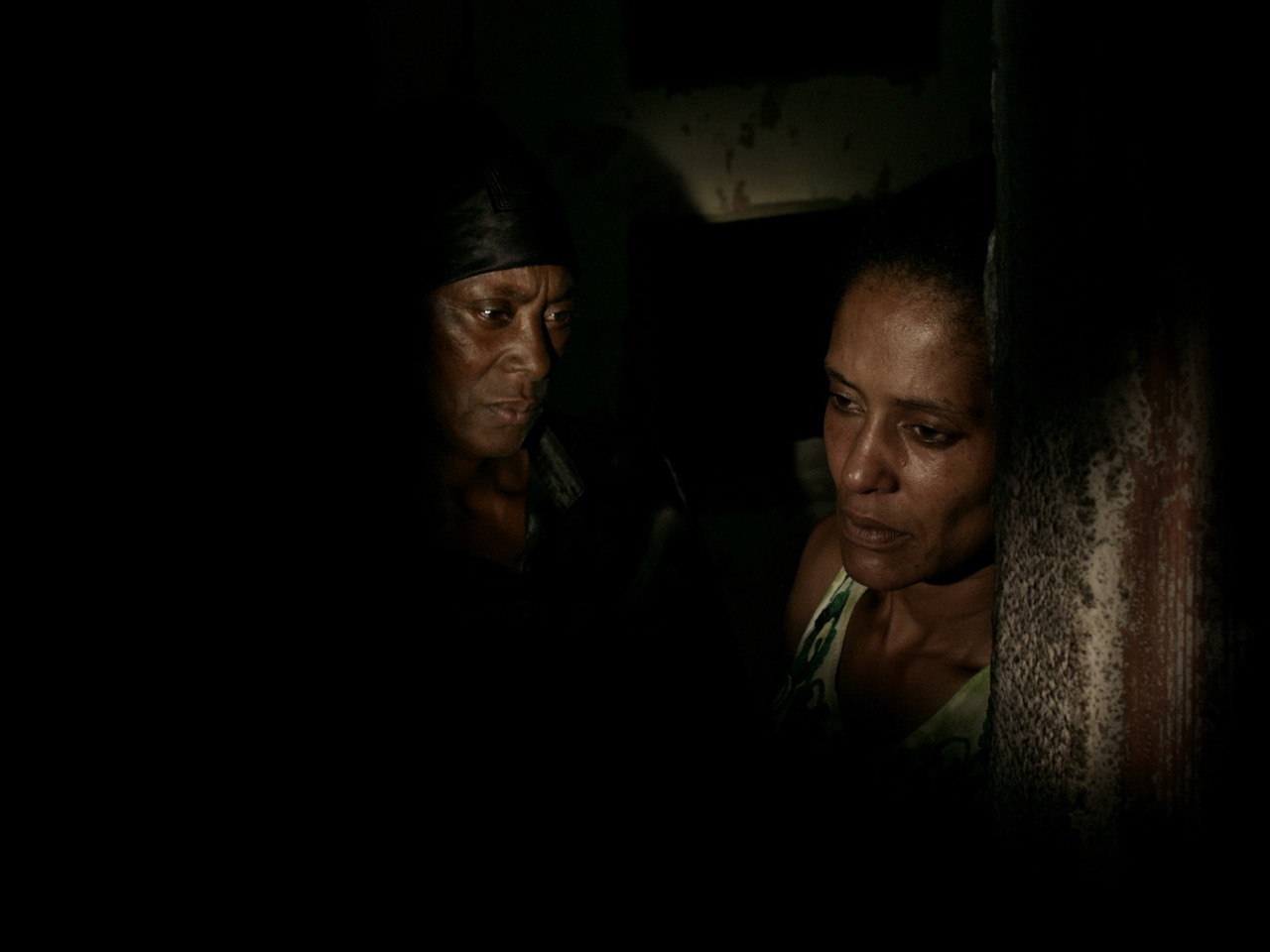
Film director Jean-Luc Godard  had said “In the temple of cinema, there are images, light and reality. Sergei Parajanov was the master of that temple.”  Parajanov, the late master filmmaker from Soviet Union, underscored the importance of bright colors and realistic sound, while Pedro Costa’s  Vitalina Varela goes a step further, accentuating darkness, dark skin, and shadows with muted indirect lighting in a “colour” film, aided with natural sound. When you do see bright images in Vitalina Varela, as at the end of the film, it is not just real bright light and colors, it presents a metaphoric change in the film’s narrative structure.


The award-winning actress plays herself in the film about herself


Vitalina Varela is distinctly different from the Oscar nominees of 2019 or well known commercial films with renowned actors. Vitalina Varela is an unusual film with a title that has the name of its lead actress. The film narrates the real story of its lead actress, a Cape Verdean immigrant arriving without papers in Portugal following her husband’s demise.  (She acquired the formal  papers authorizing her stay in Portugal halfway into the production of this film, several years after her actual arrival.) Its director Pedro  Costa, and his close-knit committed production team of cinematographer  Leonardo Simoes, sound mixers (Joao Gazua and Hugo Leitao), production manager, and stock actors can be proud of their low-cost final product that offers higher aesthetic values than the multi-million dollar products from either Hollywood or Bollywood. It is definitely one of the remarkable films made in 2019, if not the decade, at least for audiences less addicted to conventional action and sex that makes a majority of contemporary films make money at the box office. While the film is made by a white (Caucasian) Portuguese crew,  all the  characters in Vitalina Varela  are dark-skinned Africans from Cape Verde. Half of a film festival audience viewing Vitalina Varela  (in which this critic was a spectator) walked out of the film screening halfway, while the other half stayed rooted in their seats right up to the end of the film and stood up to applaud the film, even though none of the filmmakers were present at the screening.  (This critic recalls that in 1979, when an Andrei Tarkovsky film retrospective was screened in New Delhi, during an international film festival, some spectators who had paid for their tickets tore up their seats at the Archana theatre where the films were screened in frustration as they could not comprehend or appreciate Tarkovsky's cinema. Today, ironically the same films, are likely to be treated with awe and respect.)

Ms Varela, the lead actress of  Vitalina Varela, has little or no acting experience. She emotes and reconstructs with staggering dignity the world of her recent widowhood and love for her late husband, Joachim, who chose to live the demanding  life of an immigrant in the Fontainhas sector of Lisbon, Portugal, for some 25 years, retaining for his memory Ms Varela’s wedding photograph, carefully preserved in a photo frame in his ill-lit, shanty dwelling. This award-winning performance of the actress is comparable to the very best in the world, thanks to Costa’s perseverance and extended committed interaction with her developing the film from scratch for several years prior to the shooting of the film. 

The priest (Ventura) and the widow (Vitalina Varela),
in the church without any other worshippers


The most amazing part of the film Vitalina Varela is that there was no prior written script (just as in most  of Terrence Malick’s films) making it all the more difficult for Costa to  attract producers. The spoken words are essentially recollections of Ms Varela’s life and her second interaction in Lisbon with a real Cape Verdean  priest (played in the film by Ventura, a regular actor in several of Costa’s films), who buried Ms Varela’s husband Joachim, just days before her arrival in Portugal. The concept of the film itself emerged from  Costa’s, his wife’s, and his team’s interactions for 4 years with Ms Varela. Costa has explained that the film evolved with those extensive interactions and the award-winning performance Ms Varela was her honest outpouring of grief and loving memories of her husband who had promised her a palace in Lisbon decades ago, only to find it was a mere shack, which included some clues left behind in the derelict abode of the late husband’s recent lover. The evolution of the film has several parallels with the 2019 Brazilian film The Fever, which also was made after its director Maya Werneck Da-Rin's extensive interactions with indigenous Brazilians.

Contemporary Russian maestro Aleksandr Sokurov made unforgettable, poetic  films: Mother and Son (1997) and Father and Son (2003). Had Sokurov made Vitalina Varela, he would possibly have titled it as “Wife and Husband.”  

Vitalina Varela is a recounting of real events of Varela’s arrival in Portugal from Cape Verde island in the Atlantic, off the African continent (and a former Portuguese colonial territory), a few days after the death and burial of her husband Joachim, originally a bricklayer, more recently a person who survived by doing odd jobs. Like Sokurov’s elegiac Mother and Son, Costa’s Vitalina Varela is essentially a monologue of Vitalina seemingly speaking to her dead husband about her memories with him, comparing the stone house in Cape Verde they built together decades ago, with the tin shanty house in Lisbon.  The Lisbon “palace”  that Joachim promised her decades ago that she occupies following Joachim’s  passing is a shanty house with a leaking roof.


The priest (Ventura) metaphorically "carrying the cross
on his shoulders": director Costa and
cinematographer Simoes at their best

The only real dialogues in the film are those between the priest—a real character, a priest of a derelict church in Lisbon, reeling under his guilt of turning away a busload of Cape Verde Christians, who had approached him while he was a priest in Cape Verde to baptize a child without proper papers. The busload of Christians he turned away were killed in a road accident a short while later and the priest carries that cross of his action of refusing to baptize the child to this day.  Costa’s film brings together two individuals from Cape Verde, both suffering from recent tragedies, both religious individuals, both alone in a new country where even God seems to have forsaken them.  One line spoken during  the interaction between the two is evocative: “I had the cross of Christ on my shoulders. I couldn’t move. When I fell, I was free.” A fascinating religious commentary, indeed, in a film that did not have a prior written script.

In Vitalina Varela, the spoken words are less important than the visuals.  A striking point in the film is the arrival of Vitalina in Lisbon.  A plane arrives on the tarmac of the airport and the sole V.I.P. to emerge from it is Vitalina. The “V.I.P.’s” bare feet are shown as she climbs down the steps from the plane. (A cineaste would recall the Japanese director Mikio Naruse’s  classic 1960 film When a Woman Ascends the Stairs (with proper shoes) and the inverse relationship of the wet, bare feet shown in Vitalina Varela descending from the plane in this sequence.)  You would expect lights in an airport at night—but the scene is dark, the person is dark skinned, and wearing clothes appropriate for mourning. The “V.I.P.'s" reception committee are made up of fellow Cape Verdean immigrants working as cleaners/support staff at the airport, one of whom honestly tells her “Vitalina, my condolences. You are too late. Your husband’s funeral  was 3 days ago. There is nothing for you in Portugal. His house is not yours. Go back to Cape Verde.” Some reception for a widow!

A rare bright shot in the film is at the grave of Joachim

Just as Parajanov emphasized light in his films, Costa and his cinematographer Leonardo Simoes emphasize the importance of light by erasing it and using it sparingly to accentuate its importance. This is a colour film that appears to show more black (or lack of light) in most of the sequences with indirect lighting often behind the actors to give a silhouette. It fits with its the subject matter—it is a film dealing with death, sorrow, loneliness, African immigrants struggling to survive in Europe, lack of money and love. Even in daytime, much of the scenes are shot in shadows. Each of these dreamlike shots is aesthetically crafted in austere surroundings and a pleasure to perceive.  There are unforgettable sequences of tired immigrant workers returning home at night, hardly speaking to each other, in dimly lit streets close to cemeteries. You are reminded of sparse visual stage settings crafted by playwrights Samuel Beckett and Eugene Ionesco for their works. And natural sounds and bleak visuals, "speak" as much as humans do in this film.

Vitalina interacts with another woman,
who has burdens of her own


Ultimately Vitalina Varela is a film about a widow and the spoken words are bound to reflect a feminine viewpoint. In a response to the priest, who has kind words for her dead husband, Vitalina acerbically responds with criticism that is considerably true ”Men favor men. When you see a woman’s face in the coffin, you can’t imagine her suffering.” Suffice it to say that the film captures all this and more.

The citation for the film’s Silver Hugo award at the Chicago film festival sums it all up: “..for a ravishing and masterful vision between horror and melodrama, spirituality and desperation that blew the jury all away."


P.S.  Vitalina Varela is one of the author’s top 20 films of 2019. Much of the dialogues quoted above are from memory of a single viewing and are approximations. The film won the Golden Leopard award for the best film and the Best Actress award at the Locarno Film Festival; the Silver Hugo Award for the best feature film at the Chicago International Film Festival; the Best Director, Best Actor and Best Cinematography Awards at the Mar del Plata Film Festival; the Grand Prize of the Jury at the La Roche-sur-Yon International Film Festival (France); and the Best Cinematography Award at the Gijón International Film Festival (Spain). The Brazilian film, The Fever, mentioned in the review, is also one of the author's top 20 films of 2019.