Thursday, June 19, 2014

164. Portmanteau film “Tickets” (2005) (Italy/UK) in Italian and English, directed by Ermanno Olmi, Abbas Kiarostami, and Ken Loach: Perceptive studies on human behavior of Europeans brought together in a unified, structured film


Tickets is a film rarely discussed by cineastes. If it is discussed, it is often to compare and contrast its three celebrated directors. It is therefore more satisfying to evaluate it as a single movie more than a portmanteau film. This is a movie that progresses in intensity of purpose from one segment to another as though it was one director’s idea rather than of three directors and their own teams.

Tickets is a film that examines how different individuals react with strangers. And interestingly the film focuses on the varied reactions of Europeans on a single train journey to Rome as carefully developed by three top-notch filmmakers Ermanno Olmi from Italy, Abbas Kiarostami from Iran, and Ken Loach from UK. Each director makes the viewer think about the unusual reactions of the characters under differing conditions—all three sections carve out delectable perspectives about human nature. There is a common thread—all three segments underscore the good side of human beings and are therefore uplifting. Of course, the film can also be perceived as a political allegory of the new Europe grappling with immigration, anti-military views, and social inequality. Undeniably, all three directors have a socialist leaning.

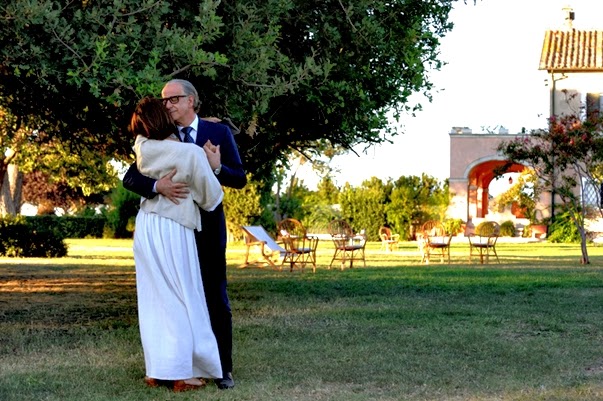
The rich scientist about to board a train

What is most interesting to note is the gradual progression in the film from the subtle to the obvious, from the world of silence, spare lines of conversation, predominance of non-verbal communication though glances and/or stares, and discrete notes classical music (Chopin’s preludes) contrasted to the other extreme decibel level with sounds of raucous yelling and singing of the Celtic song as in a football stadium, verbal abuse, without losing the interest of the viewer in the narrative. The reverse progression would not have worked. Olmi is the master of subtlety, and naturally begins the film. Loach is the master of the “kitchen-sink” cinema with Glaswegian humor spat out like machine-gun fire and naturally deals with the end segment of the film. Kiarostami balances the two opposites—a delightful mix of some polite conversation between four sets of actors set off against an obnoxious harridan, once rich and powerful when her husband was alive, some pop music, providing the progressive transition from Olmi’s quiet cinema to Loach’s loud cinema.

The film is equally interesting as the film progresses gradually from the rich to the poor. The Olmi segment introduces us to a scientist in the pharmaceutical industry, who is rich enough to pay for two seats instead of one for his additional comfort and privacy. The second section dealt by Kiarostami deals with a woman holding second class tickets without reservations but travelling in a first class compartment. The third section deals with sections of the public who either don’t have money for their tickets or do not have money to pay the fines for a stolen ticket.

The three sections in the film are consciously or unconsciously divided into the past, the present and the future as well.

The recent past: The public relations official  (Valeria Bruni Tadeschi)
ensures the scientist has a comfortable journey with a lot of care

The opening Olmi section allows for the respectable 60-year-old scientist to recall his childhood when he had heard the same Chopin piece being played by a girl whose face the scientist cannot recall or perhaps eludes his memory.  He is constantly recalling the attractive public relations lady (Valeria Bruni Tadesschi, sister of Carla Bruni)) who had taken great pains to ensure he has a comfortable trip back to Rome. She has noticed him for years, but the scientist has not but is pleased to note her kindness towards him.  Gentle reveries of the distant past and the recent past are shaken by the present—a sullen military official who occupies a seat opposite him and an Albanian family of limited means he can view travelling evidently without reservations between his coach and the next.  Olmi nudges the viewer to evaluate the present in the context of the past. The final action of the scientist is unusual but assertive; all his co travellers in the first class coach (including a rich Indian regal family, a music enthusiast and a man cutting up news snippets from a daily newspaper) are staring at him, while the military man hides his face behind his jacket. The importance lies in the silence and stares that end the segment.

The present: The harridan who lacks sympathy

The present: A young man is forced to make a choice

The middle section from Kiarostami allows for gentle verbal communication among strangers—some characters are polite even under trying circumstances, others aggressive and repugnant.  As in the first segment, glances and visual appraisal of strangers are important –but with a difference, they are longer than in the Olmi segment.  But each visual and now increasingly verbal appraisal is more detailed than in the previous segment. The movie has discretely begun to change its narrative pace.  The segment encapsulates several vignettes:  a man insisting that a stranger is calling on his cell-phone without his permission, two men who insist on being seated in their reserved seats occupied by strangers, a young man conversing with a young girl from his own Italian town who recalls having played with him years ago, and the harridan who making the life of young male companion increasingly miserable.  The future and the past alluded to in the segment matter less than the present.

The future: Decisions that can make a difference

The final Loach section is about the future as grappled by three lower middle class football crazy Glasgow young men. One of the three well-meaning youngsters seems to have lost his ticket (it is possibly stolen) and has to pay a heavy fine or face jail in Rome if doesn’t pay up. The jail term in turn would affect their jobs they hold in Scotland. Another Albanian immigrant family has possibly stolen the ticket but need it more desperately to reach their destination as it affects their lives. This segment puts the future of the two groups in perspective, with and without the tickets.

Tickets is therefore interesting to appreciate as a well-structured movie made by three directors with similar attitudes to immigration, wealth, and military/police. Olmi’s brilliant Golden Palm winner The Tree of Wooden Clogs (1978), which he wrote, directed, edited and even personally photographed was also an endearing tale on immigrant farm labourers looking at the differences between the rich and the poor in rural Italy a century ago. In Tickets, Olmi looks at the same subject of immigrants from the point of view of the rich, prodding the rich to step out of dreamy comforting images of the past into the present tribulations of the poor. In Tickets, as Olmi advances in age, it is Olmi’s son behind the camera.

The military and their lack of empathy towards poor Albanian immigrants

Kiarostami’s segment in Tickets recalls his first film The Bread and Alley (1970) in which a child encounters a hungry dog while carrying fresh bread in an alley. If one chooses to replace the obnoxious woman in Tickets with the dog in The Bread and Alley, there are several parallels. The man behind the camera is another talented Iranian, Mahmoud Kalari, who was the cinematographer for Kiarostami’s Shirin and Gabbeh and the recent acclaimed Asghar Farhadi films The Past and A Separation.

The Loach segment in Tickets is considerably helped by the cinematography of Chris Menges and scriptwriter Paul Laverty. Laverty’s collaboration with Loach has always raised Loach’s cinema, just as scriptwriter Piesiewicz collaboration with Kieslowski raised the quality of the latter’s later works. Viewers who have seen Loach’s movie The Angels’ Share (2012) will note several similarities in Tickets , including two actors common to the two movies.

A philosopher would have given the film a title such as “The Train Journey” but the film is instead called Tickets. Money and wealth-related power can be associated with the purchase of Tickets.
Tickets is a ticket to evolved entertainment for an attentive and perceptive viewer.


P.S.  Olmi’s The Tree of Wooden Clogs and Loach’s The Angels’ Share have been reviewed on this blog earlier. The Tree of Wooden Clogs is one of the author's favorite top 10 movies of all time.

Monday, June 02, 2014

163. Russian maestro Andrei Tarkovsky’s Russian movie “Solyaris” (Solaris) (1972): An appraisal of a cerebral movie that is truly one of the best 10 movies of all time


Many have seen this cinematic masterpiece. Many have considered it as a major achievement in science fiction cinema. The director himself did not consider this work to be perfect because of the interference of the Russian state machinery at various stages of the film’s production, limiting his artistic freedom, to which Tarkovsky had to finally succumb, to ensure that the film could be released in Russia and elsewhere in Eastern Europe. Though eventually released in limited public theatres, the film slowly gained in reputation as a cult film and did very well in the box office. It won the Cannes film festival’s Grand Prize of the Jury and the FIPRESCI prize in 1972. Elsewhere, the film befuddled audiences who felt cheated of their ticket cost, just as the few disgruntled filmgoers who tore up the seats of the Archana theatre in New Delhi during the screening the Tarkovsky retrospective as part of the Indian International Film Festival in 1979, possibly after reading this critic’s naive but honest 1979 recommendation of the film as the best film of the 2-week mega event. Even today, this cinematic work remains among the top 10 movies of all time for this critic. An extensive analysis follows.


Kris carries Hari version 2: "Whenever we show pity, we empty our souls"

The book vs. the movie: For readers of global science fiction, Polish novelist Stainslaw Lem is a giant among a host of pygmies.  Lem (1921-2006) had predicted concepts such as virtual reality and nanotechnology, in his works written more than 60 years ago, terms that are gaining in currency today. He is indeed a later day Jules Verne. His works have been made into several remarkable movies by varied directors across the world over the decades—each work philosophical and stimulating to the mind. One is a Dutch film by Piet Honderdos called Victim of the Brain (1988). The Israeli director Ari Folman made the animated film The Congress (2013), which won some awards.  The Hungarian director Pater Sparrow chose to film 1 (2009) based on another Lem tale.  An East German filmmaker Kurt Maetzig made an interesting film First Spaceship on Venus (1960).  Then comes a Russian TV film of Solaris made in 1968, then Tarkovsky’s Solaris in 1979, followed finally by Steven Soderberg’s comparatively simplistic adaptation of the novel in 2002.

Now Tarkovsky was able to consult with Lem as he worked on his film--a major advantage for any director attempting to adapt a work of Lem on screen. Typical of the director, Tarkovsky decided to infuse his own ideas into the basic structure of the novel infuriating Lem for whom two aspects of Tarkovsky’s work were unacceptable—the first being the three overbearing  love elements---the uxorial love of Hari (Khari), and the love of Kris for his dead mother, and ultimately the love of Kris for his living father and the second being the obvious theological references in Tarkovsky’s film (the mention and comparison of Protestant theologian Martin Luther’s famous act of throwing the inkwell at the devil’s appearance, at the Biblical Russian artworks complete with halos in Kris’ room on the space station shown at critical points in the film, two separate references to the literary character Faust’s theological tryst with immortality, Kris’ observation to Dr Snaut that “whenever we show pity we empty our souls” and  the use of Bach’s Chorale Prelude in F minor on the soundtrack) since Lem was an atheist, though of Jewish origin. Tarkovsky was doing what Terrence Malick did to the James Jones’ award-winning novel of The Thin Red Line, when he adapted that literary work making the cinematic work considerably personal and different from the Jones’ novel.

Donatas Banionis as Dr Kris Kelvin: "Sleep is the equalizer
between the shepherd and the king, the simple and the wise
./
Cervantes' Don Quixote"   

For Tarkovsky, his family mattered most. All his films accentuate this fact. Women in his life (most importantly his mother and, to a lesser extent, his first wife) are eternally elements that he recalls with love, reverence and gratitude.  (Interestingly it is a parallel case with Malick, as well, especially in The Tree of Life.) It is, therefore, not surprising that the image of his mother smoking her cigarette (often captured with her back towards the camera) is a signature shot of Tarkovsky, which he perfected in Mirror, eventually made 3 years after he made Solaris.  In Solaris, the mother and the cigarette are first introduced in the film within the film, which Kris states was shot by himself and his father. Kris’ foster mother Anna, who evidently loves Kris, is moved to tears when Kris states that he will be taking that home film on his space journey from which he might not return. Soon after the viewer of Solaris is shown the film within the film, the viewer is shown the virtual Hari version 2 (wife of Kris) smoking a cigarette, in the same posture as Tarkovsky’s mother smoked her cigarette in the opening sequence of the autobiographical Mirror. Now Lem and any logical viewer of Solaris could wonder how and where cigarettes got introduced into the scenario when only Dr Snaut was the only human on the space station, orbiting the planet Solaris, who was a smoker.  And that too, a virtual Hari smoking!! Did the real Hari smoke? There is no evidence of that either. (Of course, we know from Mirror that Tarkovsky’s mother also smoked.) Evidently Tarkovsky’s mind was playing with the images of his mother and importing those to merge with those of the virtual Hari version 2. This is clarified by the director in the dream sequence towards the end of the film where images of his dead mother and the virtual/dead Hari switch more than once. Finally, there is Kris’ father in front of whom Kris kneels at the end of the film reprising the kneeling posture in front of the near human virtual Hari at the birthday party of Dr Snaut.

The dog appears on Solaris, as Kris kneels before his father


Lem’s book dealt with the futuristic problem of inter-species communication and the philosophical implications it introduced for us by recalling our past life on Earth and our conscience chiding us for our past guilty actions. This is apparently why some eighty odd original crew members on the space station died leaving only two of the smartest still alive on board, when Dr Kris Kelvin is sent to join them by the scientists on earth to investigate the situation and decide either to call off the Solaris mission after accepting it as a failure or attack the Solaris ocean with high intensity rays from the station. Instead Tarkovsky lunges backwards to explore intensely personal memories and guilt of one individual, Kris, beyond the Lem novel and the Soderberg version, both dealing more with the condition of Dr Snaut (renamed Dr Snow in the Soderberg film-version) than with the evolving condition of Kris. Thus while Lem urges his readers to look outwards to communicate with an unknown species and the problems associated with it, Tarkovsky urges his viewers to look inwards—that too with a covert purpose of being critical of the political climate of USSR in 1972, while espousing Tarkovsky’s personal undeniable love for his country, its arts, its cultural history, and its literary masters. Viewers will note that the script weaves in comments about Dostoyevsky and Tolstoy—while the book and the film versions allows Cervantes’ Spanish classic Don Quixote to take the center stage at Dr Snaut’s birthday party, a connection to discuss dreams and memories that Lem considered to be important for the tale.

Finally, for Lem, the tale was basically set in outer space, while the Tarkovsky film twists the tale to discuss more about events on Earth, in both real time and in memories.

Pet symbols of Tarkovsky and their meaning. Sudden inexplicable rains are often standard visual symbols of epiphany, moments of beautiful recollections of love and passion, seemingly baptized by external, sublime forces.  The rains appear without warning early in Solaris when Kris is spending his last day on Earth before his space trip. Astute viewers will note that it occurs after the statement “I don’t care for new things ” Water pours within the space station in a bath space after Kris tells Hari version 2 why he left Hari behind, evidently after a quarrel, when he was transferred in his job on Earth. Rains appear again as Kris dreams of connecting with his father on an island on planet Solaris: this time the rain falls within the house wetting his father’s clothes. The rains are not real but serve as a metaphor to underscore the sublime and emotional connection with the characters and the scene. 

So are horses and dogs that seem to have no direct purpose but serve as links to memories and forces beyond the normal logic. Horses are part of the Kris’s father’s home and are on the walls of the space station room occupied by Kris’ dead scientist friend.  Crows/ravens sitting on bare tree branches are shown in Solaris as space traveler Burton is questioned on planet Solaris and what he saw and experienced. A similar image appears in a segment of the Breughel painting shown in the personal film within the film. (The contemporary Russian director Andrei Zvyagintsev, often considered to be the new Tarkovsky,   utilizes the same symbols in his films at critical junctures.  Zvyagintsev’s Elena begins with the raven-like birds cawing and this is repeated towards the end of that film.)

Drawings/paintings of hot-air balloons decorated the walls of Kris’ room on earth, which would be a natural interest for a potential space traveler. But Tarkovsky fans will recall the hot-air balloon’s connection to Tarkovsky’s previous cinematic work Andrei Rublyev.

"Hunters in the Snow" by Pieter Breughel the Elder.
(Note the bird on the leafless branch, an image brought into focus in the film,
 and the image recreated during Burton's testimony on tape early in the film) 

Similarly, dogs in Solaris have a purpose and are introduced to serve as links to personal memories. There is a dog at Kris’s father’s house on earth; there is a dog with Kris’ mother in the film within the film and in Kris’ dreams of his mother; there are dogs of a different species in the painting (“Hunters in the snow” by Pieter Breughel the Elder) shown  in the film within the film; the dog’s image is found strewn on the floor of the space station once Kris decides to stay on in the Solaris orbit; and there is a dog in the final image of Kris visiting his father on the Solaris island.

The political elements in Tarkovsky’s movie.  Tarkovsky was always critical of the political system in the old USSR but loved his country intensely. Tarkovsky treaded this path gingerly. He couched his feelings in careful metaphors “We want to extend Earth to Cosmos’ borders. We don’t want any more worlds, only a mirror to see ourselves in.” These are asides that would not be lost on politically aware viewers, just as Tarkovsky sneaked a photograph of the banned Trotsky into his film Mirror, bypassing the Russian censors.

Homage to the Russian literary masters. Literature plays a major role in Solaris and al the works of Tarkovsky. Books are strewn all over Kris’s room on Earth, Kris’ father’s room in the planet Solaris sequence, and the venue of Dr Snaut’s birthday party on the space station. Lem introduced the reference of Cervantes’s Don Quixote and the passage relating to sleep as the equalizer between the shepherd and the king, the simple and the wise. Tarkovsky, intensely Russian, cleverly weaves in references to Dostoevsky and Tolstoy. Dr Snaut refers to Kris’ defense of his friend Dr Gribarian’s suicide as being equal to “second-rate Dostoevsky.” Much later in the film, Kris recalls Tolstoy’s “intellectual suffering about the impossibility of loving human-kind in general.” Tarkovsky was the son of an acclaimed Russian poet and therefore he and the co-scriptwriter Fridrikh Gorenshteyn doff their hats at Russian literary geniuses beyond what the Polish writer Lem offered.

Hari version 2  (Natalya Bondarchuk) with injection scar on her arm visually
 recalling the suicide of the original Hari 

The last words of the film with its rhetorical question. Kris says “Well, anyway, my mission is finished. And what next? To return to Earth? Little by little everything will return to normal. I'll find new interests, new acquaintances, but I won't be able to devote all of myself to them.” Tarkovsky allows the camera to linger on the face of Dr Snaut as Kris says this. Dr Snaut’s face indicates that he has understood Kris’ final decision couched in rhetoric. What follows are images of Kris encountering his father sifting through a pile of books on planet Solaris. Kris opts for the “old interests” (not new ones, recall the words preceding the first rain sequence in the film) of the Earth with all its rich literary and theological memories while on Solaris. For Tarkovsky watchers, it predicts Tarkovsky’s personal actions of the future when he opts for self-imposed exile.

Juri Jarvet as Dr Snaut

The filmmaker and his team. Tarkovsky worked with a select team of actors whom he trusted. This select team included composer Eduard Artemyev, actors Nikolai Grinko (Kris’ father) and Anatoli Solonistyn (Dr Sartorius). Yet, the key performances in Solaris are not from Tarkovsky’s trusted faithful but from the outsiders: Juri Jarvet (Dr Snaut) and Natalaya Bondarchuk (Hari, playing all the versions of the character). Jarvet was peaking in his career having played King Lear for Grigori Kozintsev, and Ms Bondarchuk delighted the director with her flawless performance.

What was the film all about?  While Lem’s book dealt with inter-species communication, Tarkovsky’s film gives more importance to introspective intra-species communication. His film is all about Kris and his family, dead and alive. (Lem would possibly have instead preferred discussion on Fechner’s child introduced by Burton, the large child Burton saw on Solaris and the child with Burton in his car.) At another level, Solaris is a film about Tarkovsky and Russia. And finally, it is a film about science, morality, conscience, and theology, transcending the obvious science fiction tale. A key quote from the film is: “The salvation of humanity is in its shame.”


P.S. Tarkovsky’s Solaris is one of the top 10 films for this critic. Tarkovsky’s Mirror has been reviewed in detail earlier on this blog.


Tuesday, April 08, 2014

162. Romanian director Călin Peter Netzer film “Pozitia copilului” (Child’s Pose) (2013): Selfish nature of relationships

A poster that reveals the structure of the film


Romanian cinema is on the march. In 2005, Romania gave the world the lovely, realistic film The Death of Mr Lazarescu. In 2012, that country followed up with the powerful movie Beyond the Hills, (which scooped up the Best Actress award for the two leading lady thespians in the movie and the best screenplay award at the 2012 Cannes Film Festival and the Best Film award at the Chicago Film Festival soon after). A year later, yet another fascinating work, Child’s Pose, won the coveted the Golden Bear award at the Berlin Film Festival.


The three films are by three different directors but all three have common factors—each of these are critical social essays on life in post-Communist Romania that will resound well with scenarios that are universal. All the three films provide a mighty cinematic punch delivered at the end to make a viewer think and reflect on what preceded the unusual, abrupt end-sequence.  These seemingly abrupt ends are well-crafted to provide an unconventional entertainment for an intelligent viewer.  That is what makes the new Romanian cinema distinct from others—the filmmakers provide you with endings of the narratives that are real enough for the viewer to identify with real situations that they themselves might have experienced in real life, not necessarily in a post-Communist country. And all three films are prisms that exude different colors on the selfish nature of relationships—the relationships of hospital workers towards seemingly anonymous patients in one, the relationships of a dumb but devout Christian priest wanting acceptance of his church and the innocent nuns under his well-meaning care by higher religious authorities after being ignored time and time again, and relationships of a mother clinging to her only progeny and the only individual she has truly controlled and wants to control forever.

"He is a good boy" appeals Cornelia 

In Child’s Pose, the intelligent director Calin Peter Netzer and his talented co-scriptwriter Razvan Radulescu, deal with a 60-year-old mother’s (Cornelia’s) relationship with a grown-up son (Barbu) in his early thirties. In this mother’s case, he happens to be her sole offspring.  Mothers in such situations do tend to be protective to a fault. But Netzer’s film takes the viewer on an unusual study of the relationship, when a perceptive viewer is forced to evaluate the selfishness in all relationships provided in the movie, to levels beyond the mother-son relationship that is so pivotal for this film.

Barbu has accidentally killed a kid on the road while driving his car at a rash speed and Cornelia tries to rescue Barbu from a likely jail term for manslaughter, with all the resources she can muster. Now any mother would do just that. But this film takes the viewer beyond the knee-jerk reaction of a doting, well-placed. architect mother. It’s a mother who loves to control everyone around her--her husband, her son Barbu (even when he is 30-something and ought to be left alone), her son Barbu’s girl friend Carmen, Barbu’s servant maid (when Barbu is not present), her well-connected and influential social and political network, the list goes on and on.  Cornelia’s husband hates her penchant to control him and everyone else and spitefully calls Cornelia, “Controlia.” Cornelia is able to partly achieve this because she is rich, she is well-read to score points in social conversation (she has apparently read the works of recent Nobel Prize winners for literature—Orhan Pamuk and Herta Muller—which she wants her son Barbu to read to improve his own social and intellectual standing) and she is dogged about her unethical purposes in life. Evidently, Pamuk’s and Muller’s writings have not impacted Cornelia in her personal life. Even Carmen’s relationship with Cornelia appears selfish—she hates her but supports her in her effort to help Barbu because she needs Barbu. Barbu, too, does not seem to reciprocate the love of his doting mother; he goes to the extent of rebuking her. A hypochondriac, Barbu, selfishly uses his mother without ever acknowledging her motherly love. He wants to be independent of her but is too much of a coward.

Luminita Gheorghiu as the rich and possessive mother Cornelia


In the second half of the film, the scriptwriters provide two interesting perspectives—one of Cornelia trying to resolve the issues on hand even with a clever show of grief to the mourning family and another of the cowardly Barbu sitting in the car leaving his mother to resolve the issues. The intriguing title of the film in English provides much food for thought. Without disclosing the interesting end of the film, it is without doubt a thoroughly intelligent film with a great screenplay, acting and direction. 

The scriptwriters of this film, as is the case of the other two new wave Romanian films mentioned earlier as well, explore relationships beyond the nuclear family. In Child’s Pose, while the main tale revolves around mother-son-father-and the son’s girlfriend—the scriptwriters compare and contrast this family with that of the killed kid. Of course, there is a contrast in the social status of the two families. The killed boy belongs to the less affluent Romania. It is a family so poor that would find it difficult to pay the costs of the funeral of their son—even Cornelia’s friends in the police suggest that she offer to bear the costs and buy the goodwill of the aggrieved party. In The Death of Mr Lazarescu, the fragile nature of nuclear families is dealt with early in the film as Lazarescu explains that his only progeny, a daughter, has migrated to Canada, his wife is probably dead, while his sister (his only relative left in Romania) is only selfishly  anxious  for the money he sends her from time to time. In Beyond the Hills, the nuclear family is dealt with as an aside to the principal tale of the two orphans. In that film, one of the two orphans is adopted by a nuclear family not out of love for the girl but more for the state’s financial support that comes along with that action.

Cowardly 30-year old Barbu, wanting to break free of a domineering mother

There is an incredible common factor for all the three films—the amazing actress Luminita Gheorghiu who plays personalities diametrically different in Child’s Pose and in The Death of Mr Lazarescu—one personality that is an epitome of money-power and selfishness, and the other that is extremely commendable one of utter unselfishness, caring for a sick, elderly stranger. In Beyond the Hills, she plays the minor role of the foster mother not interested in her ward as much as the pecuniary benefits the adoption offers. Ms Gheorghiu, incidentally,  was picked by Austrian filmmaker Michael Haneke to star in his 2000 film Code Unknown: Incomplete Tales of Several Journeys.

There is a resurgence in Romanian cinema after decades of unimpressive works save for occasional gems like Iakob (Jacob) (1988) directed by Mircea Daneliu. The resurgence is essentially because of the outstanding talents of a handful of individuals who have been common factors contributing significantly to it. Leading the pack is Razvan Radulescu, a scriptwriter who contributed to the prominent works The Death of Mr Lazarescu (2005), 4 Months, 3 Weeks and 2 Days (2007) and now Child’s Pose (2013). Then there is the talented directors Cristi Puiu [who directed The Death of Mr Lazarescu and Aurora (2010)] and Cristian Mungiu (who gave us 4 Months, 3 Weeks and 2 Days and Beyond the Hills). Finally, there is actress Luminita Gheorghiu who plays the pivotal roles in The Death of Mr Lazarescu, Beyond the Hills, Aurora, and Child’s Pose.  These four individuals appear to be the main drivers of change in the quality of Romanian cinema along with a group of supporting actors and crew who have also lent their hands to this surge of creativity. One wishes that Romanian cinema continues to make such interesting works of art in the future as well. 


P.S.  Child’s Pose is on the author’s list of his the top 10 films of 2013. The two other Romanian films The Death of Mr Lazarescu and Beyond the Hills, mentioned extensively in this review, have been reviewed earlier on this blog

Saturday, March 22, 2014

161. Danish director Thomas Vinterberg’s Danish film “Jagten” (The Hunt) (2012): The hunted is always the loser


Denmark has two interesting filmmakers alive and actively making films: Thomas Vinterberg and Lars von Trier. They co-founded the Dogme 95 movement in film-making. This movement vowed to give importance to story, acting and theme and give least importance to special effects and technology. By and large, both gentlemen have tried their best to keep to that manifesto for a decade, while some of their works, especially those of von Trier in the recent past (such as Europa and Melancholia ), have relied heavily on technology. Vinterberg’s The Hunt made nearly two decades after founding the Dogme 95 movement, is an example of film-making that attempts to persevere with the original intent of Dogme 95, namely, relying considerably on story, acting and theme.

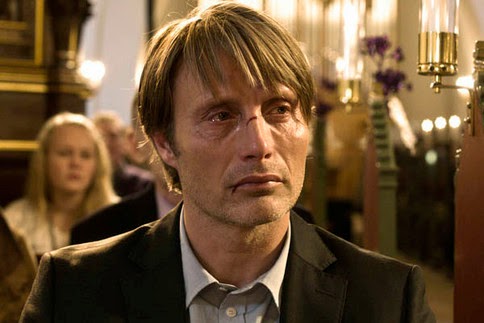
Lucas (Mikkelson): "More sinn'd against than sinning"

The story: What is the story of The Hunt? To very naive viewers of the film, it would be pedophilia. Yes, the film is indeed about a male kindergarten teacher Lucas (Mads Mikkelson) accused of inappropriate behavior with one his favorite female students.  Vinterberg’s movie goes beyond the alleged crime and really addresses an issue that over-arches the obvious. That question is: Will the average person who knows Lucas but hates persons who are sexual perverts, especially those who harm innocent children, be considered honorable by us (the viewers) in making knee-jerk judgments and like the characters in the Danish town depicted in the film, brand a good friend to be evil when there is insufficient legal proof of guilt. Vinterberg’s film goes further by asking the viewer that if a person is indeed convinced about a point of view aided by hysteria whipped up by tabloid journalism, how many of us are prepared to change our views even when all evidence reverses our initial opinion? Would or can our initial distrust ever be fully obliterated with time and by cold reason?

Vinterberg and his co-scriptwriter Tobias Lindholm have raised yet another issue to the viewer: can children be truly innocent as most of us assume them to be. And finally, Vinterberg and his co-scriptwriter present the modern male, stripped of the usual stereo-typed bravura masculinity, the gentle male who can be happy doing a traditional woman’s job of being a kindergarten teacher but yet not to be mistaken for a wimp as he is (as the filmmakers tell the viewers early in the film) also the first among his machismo male friends to jump into an icy pond to save a drowning friend. Vinterberg’s The Hunt is thus a thought-provoking movie with a powerful story that saves the real wallop for the epilogue.

The strength of the story would have been considerable for this critic had he not seen a black-and-white British film directed by Peter Glenville called Term of Trial (1962). That film had Lord Laurence Olivier playing a British schoolteacher who refused to participate in the World War and is thus frowned upon by society even though he is good at his work and is happily married to his attractive but difficult-to-please wife (played by Simone Signoret). Like Lucas in The Hunt, undone by unfounded accusations of inappropriate behavior by his female 5-year-old kindergarten student, in Term of Trial a precocious 16 year old female student (played by Sarah Miles)  accuses the British school teacher (played by Olivier) of rape when he had actually honorably declined her sexual offers. In both cases, the films study the mentality of society that has formed an opinion with their own prejudiced reasoning.  The British teacher must have done it, the public surmises, because he refused to enlist in the war and is therefore guilty even before the court pronounces him to be either guilty or innocent. Similarly, the Danish teacher in The Hunt, is likely to be guilty in the eyes of the majority in the Danish town because Lucas’ wife has left him, because Lucas has such a low self esteem that he opts to teach kindergarten children and because Lucas hugs his child accuser in public out of genuine appreciation of Klara's love for his dog. In both films, the separate female under-aged students are believed to have been wronged even though there is no proof such events occurred. In both films, the female students had a crush (of differing natures, because of their ages) on their respective well-meaning honorable teachers.

In The Hunt, the scriptwriters Vinterberg and Lindholm provide sufficient psychological reasons for the child having to make the statement she makes (her heart-shaped gift made by her being rebuffed by her teacher Lucas and the fleeting indecent images she glimpses on her brother’s smart phone). But a protective modern society believes a child cannot lie, when in reality a child can build imaginary and vivid stories that have no truth.

Vinterberg raises a pertinent question about society, which includes church-going Christians celebrating Christmas who have closed minds when it comes to prejudices that extend to refusing to sell groceries to a man who has not yet legally been proven guilty of the offence. Vinterberg is not very different from von Trier. who had raised similar comments of church-going Christians who are easily prejudiced often for frivolous reasons, in his film Breaking the Waves.

Vinterberg’s and Lindholm’s co-written script is impeccable. The society goes beyond those of the elders in The Hunt. The script has a lovely line ”It is always assumed that the children tell the truth.” The script proves that even children, like the adults in the film, believe in what others say. Klara’s schoolmates pick up imaginary details from her story about Lucas and spread lies that we, the viewers, are told are figments of a fertile imagination. The “hunted” cannot escape.

The acting: Director Vinterberg’s next biggest achievement is the lead performance he elicited from Mads Mikkelson playing the role of Lucas, which was credible and low key, with spurts of violent behavior. It was a performance that richly deserved the best actor award at the Cannes Film Festival in 2012.

Klara (Anna Wedderkopp) -- an amazing performance from a child actor

While Mikkelson’s performance forms the bulwark of The Hunt, Vinterberg gets an equally stunning performance from the 5-year-old Klara, played by Annika Wedderkopp. Klara’s role is no easy one—she convincingly plays a kid with an obsessive-compulsive disorder (OCD) with a fear of stepping on cracks on the road or lines marked for pedestrians without holding on to someone’s hand. Vinterberg’s handling of Annika is as remarkable as Oliver Reed’s direction of the Oscar nominated performance of the 16 year old Jack Wild as the Artful Dodger in Oliver!

Lucas (Mikkelson) confronts his friend Theo (Bo Larsen)
during Christmas service in the church


Then there is Vinterberg’s regular thespian Thomas Bo Larsen playing Klara’s father Theo who has never let Vinterberg down in each of his performances for the director.

The theme: Though Vinterberg does bring in the sequence of hunting wild animals in the film, the real thematic metaphor of the hunt is of the Danish kindergarten teacher being targeted by the townsfolk after a child’s statement, part innocent, part willful. Where Vinterberg and Lindholm succeed is inferring that in any hunt, the hunter is always the winner and the hunted the loser. (The final sequence of The Hunt is comparable to the powerful final sequence of Term of Trial, cinematographically and metaphorically, where in both films the tragic honorable teachers even when they clear their name lose out to forces in society.) 

The hunter or the hunted?

What is remarkable is how Vinterberg and Lindholm were able to state this cinematic “killing of the hunted” in The Hunt even when Lucas, the hunted individual, had forgiven his tormentors without any trace of remorse like a true Christian after being poorly treated by his own buddies—one of whom he had saved from drowning instinctively while others looked on in relative comfort. The theme of the hunt is used to probe into the moral fabric of the Danish society which asserts its strong Protestant Christian values—a common thread for both Vinterberg and von Trier.

The Hunt is indeed a remarkable film of 2013 with a superb performance and a thought–provoking script that questions the viewer’s stand on reason and reasonable doubt.


P.S. The Hunt is on the author’s list of his top 10 films of 2013 though the film was originally released in 2012 and won three Cannes awards in 2012. It was nominated unsuccessfully for the best foreign film Oscar in 2013, losing eventually to the The Great Beauty.

Sunday, February 09, 2014

160. Italian director Paolo Sorrentino’s “La Grande Bellezza” (The Great Beauty) (2013) (Italy): “Combining the sacred and the profane” according to Sorrentino (on its music, and perhaps much else)


Paolo Sorrentino’s The Great Beauty has two small yet important facets in common with Terrence Malick’s The Tree of Life. Both films begin with a profound quote that provides a key to the viewer for a full understanding of the film that follows. Both films use the music of “Dies Irae” (Requiem for my Friend, which includes Lacrimosa 2) by Zbigniew Preisner (the talented composer of Kieslowski’s Dekalog and The Three Colors trilogy) and Henryk Gorecki’s 3rd Symphony.

Just as Mallick used an interesting quote from the Book of Job, the opening quote for The Great Beauty is from Sorrentino’s favorite author Louis-Ferdinand Céline's Journey to the End of the Night. 

The quote is To travel is very useful, it makes the imagination work, the rest is just delusion and pain. Our journey is entirely imaginary, which is its strength.” 

The ‘travel’ in The Great Beauty is the figurative journey of Jep Gambardella, a journalist who at the age of 20 wrote a novel that made him a celebrity and propelled him into a cosmic trajectory of Rome’s high-life filled with the glitterati and the cognoscenti for the next 45 years without having to write another novel of substance. And he is celebrating his 65th birthday, early in the film, with a birthday bash that many of us, including the Beatles, who sang When I am 64, would dream of enjoying.

There is “imagination” of the successful journalist Jep that Sorrentino introduces us, the viewers, for the first time, smiling at the camera, a lit cigarette dangling precariously between his teeth, dressed in fine clothes cut to perfection by the best outfitters, in the midst of cavorting men and women with loud music playing somewhere on a terrace of a building in the center of Rome. Jep has it all--the women, the reputation, the money, the circle of friends, and a lovely apartment near the Colosseum.  To anyone who is familiar with Rome—that is the best address one could dream of.

Jep (Toni Servillo), the misanthrope, smiling while surrounded by people

For those who have seen Sorrentino’s earlier works The Consequence of Love and This Must be the Place, the director and his regular cinematographer Luca Bigazzi, the central figures of the two movies are always shying away from people and a figurative distance is intentionally created on screen by the talented cinematographer between individuals. In The Great Beauty, in contrast, Sorrentino and Bigazzi show the central character Jep surrounded by people in close proximity. Is it a reversal of positions? And yet Jep the central character is alone as in the previous films. In Jep’s own words “I'm not a misogynist, I'm a misanthrope.” He loves women but distrusts or has a disdain for people irrespective of their sex. The visuals are playing a trick on the mind of the viewer. As is the music...but more on that later.

The “delusion and the pain” comes ‘the morning after’—to quote and recall the 1986 Sidney Lumet film with that name. Jep, who is dancing in the evenings, heads home to sleep when the children of the city are waking up to go to school and less privileged workers are cleaning up the neighborhood preparing for the day that is dawning.

The “delusion and the pain” also comes when great art is equated with the bizarre, as in the case of a screaming young girl who is considered a genius of an art form, for her quixotic ability of throwing cans of paint on a massive empty canvas as her fans watch the process of “art creation” with awe and reverence. It is possible that Jep, the journalist, writes about her extraordinary abilities. It is also possible that Jep, the journalist, writes about the naked woman who is considered a major theatre personality who rushes forward like a mad bull towards a stone wall only to butt her head against it with a resounding sound that seems so real, bloody and painful. Sorrentino is indeed underscoring the “delusion and the pain” with humor as he always does, trusting that his film’s viewer would keep Céline's quotation in focus.

Not a misogynist

One of the finest punches of left-handed humorous self-compliments comes from Jep himself: “To this question, as kids, my friends always gave the same answer: "Pussy". Whereas I answered "The smell of old people's houses". The question was "What do you really like the most in life?" I was destined for sensibility. I was destined to become a writer. I was destined to become Jep Gambardella.” There is yet another favorite sequence for this critic. The ladies’ man Jep encounters the famous French actress Fanny Ardant with an unusual hairdo and exclaims “Madame Ardant!” The actress looks at him from head to toe and slowly responds “Bonne nuit!” (Good night!) and walks away with a smile.

But in The Great Beauty, Sorrentino has positioned his lead character Jep as an intellectual searching for beauty in a city that can truly boast of true man-made beauty with its sculptures, its fountains, its legendary buildings, its history, its beautiful women propped up by costly botox injections, its river Tiber, and wait, the incredible neighboring city state of Vatican and with its population of the pious priests, Cardinals and nuns who intermingle with the other Roman friends of Jep. And since Sorrentino is not a gnostic like Malick, Jep interviews a toothless “104-year-old” nun “who lives on roots” (note the layer of humor in that factoid) who seems to have an odd visual resemblance to Mother Teresa but has found time to have read Jep’s famous book and utters pedestrian and inane comments. The agnostic Sorrentino goes a step further when Jep the journalist interacts with a Cardinal, tipped to be the next Pope, who prefers to give a discourse on a cooking recipe rather than matters of theology.

The sacred and the profane

Forget the visuals. Concentrate on the music in The Great Beauty. Sorrentino deliberately chooses to play pieces of music that directors such as Malick and Kieslowski used to lift their audiences to a lofty spiritual level. Then Sorrentino contrasts those moments with loud banal party music when he chooses to provide a contrast of life’s reality apparently noted by Jep during his past 45 years. It is not without meaning that Jep’s close friend asks Jep to find a husband for his daughter in her forties who performs in a strip club. There are several constant connections between the sacred and the profane.

Towards the end of the film Jep states “This is how it always ends. With death. But first there was life, hidden beneath the blah, blah, blah... It's all settled beneath the chitter chatter and the noise, silence and sentiment, emotion and fear. The haggard, inconstant flashes of beauty. And then the wretched squalor and miserable humanity. All buried under the cover of the embarrassment of being in the world, blah, blah, blah... Beyond there is what lies beyond. And I don't deal with what lies beyond. Therefore... let this novel begin. After all... it's just a trick. Yes, it's just a trick.” Probably those are the words of Jep’s second novel yet to be written at the age of 65. Earlier Jep had told the viewer “I was looking for the great beauty, but I didn’t find it.”

Perhaps a true Sorrentino admirer would prefer his lesser known Consequences of Love (2004) which towards its enigmatic end had the words “Sadness descends upon him and he starts to think...” describing the best friend of the protagonist, working at correcting a fault perched high up on an electric pylon, alone, battling biting cold winds.

"Sadness descends upon him and he starts to think.." words from
Consequences of Love

To understand Sorrentino’s The Great Beauty one needs to revert to his favorite writer Céline whose words from the same literary work that opens the film explains it all : “In the whole of your absurd past you discover so much that's absurd, so much deceit and credulity, that it might be a good idea to stop being young this minute, to wait for youth to break away from you and pass you by, to watch it going away, receding in the distance, to see all its vanity, run your hand through the empty space it has left behind, take a last look at it, and then start moving, make sure your youth has really gone, and then calmly, all by yourself, cross to the other side of Time to see what people and things really look like.” Céline has countless admirers and detractors. His detractors call him a fascist, anti-Semitist, and a bigot. Like Sorrentino’s characters, Céline’s fictional characters are constantly facing anxiety and failure.

Without any doubt, both The Tree of Life and The Great Beauty are truly majestic works of cinema: one optimistic, the other misanthropic. Sorrentino is one of finest filmmakers alive in Italy. And like very few other directors he writes his own original screenplays, in this particular case, taking the aid of another screenplay professional, Umberto Contarello. The misanthropy and the negativism that prevails in The Great Beauty are the only reason that this critic found less staggeringly well-made films, such as Still Life (2013) and Tangerines (2013), products of less talented directors than Sorrentino to be offering a whiff of oxygen.


P.S. The Great Beauty is on the author’s list of his top 10 movies of 2013. Two earlier Sorrentino films—Consequences of Love and This Must be the Place--were reviewed earlier on this blog. The films mentioned in this review The Tree of Life, Dekalog,  Three ColorsStill Life and Tangerines were also reviewed earlier on this blogMr Sorrentino is also one of the author's 15 favourite active filmmakers


Sunday, January 26, 2014

159. Georgian film director Zaza Urushadze’s “Mandariinid” (Tangerines) (2013): A Gandhian perspective on contemporary waves of hate, national and religious


The year 2013 has introduced new talents to the forefront in cinema. 

The Georgian film director Zaza Urushadze can hardly be considered to be a known entity in international cinema. Yet Mr Urushadze has written a witty and touching film called Tangerines, which is an adorable, small-budget film that is superior both in content and quality to the much touted and comparatively big budget films from USA and France made in 2013. What is more, two small brilliant films, Uberto Pasolini’s Still Life (2013, UK/Italy) and Urushadze’s Tangerines, reinforce two thumb rules in cinema—one, talented directors can write their own scripts—they don’t need to lean on professional scriptwriters or adapt their screenplays from successful novels or plays--and two, a positive humanistic tale, interestingly told, will grab a viewer in any corner of the world.  Tangerines is a wonderful film that needs to be viewed and appreciated for its direction, acting and screenplay apart from the general knowledge it provides the viewer about the small nation called the autonomous Republic of Abkhazia, on the shores of the Black Sea, complete with a national flag of the republic that declared its independence in 1992.

A viewer of Tangerines will soon be educated about the war that raged in Abkhazia in 1992. Russia supported the breakaway Republic of Abkhazia by sending mercenaries, as the new Republic wanted to separate from the independent Georgia. The mercenaries that one encounters in Tangerines, are Chechen Muslims. The Georgian soldiers fighting the Chechens are Christian. Caught in the crossfire are some Estonian nationals, whose ancestors relocated to Abkhazia in the late 19th century and have come to love Abkhazia over the period they have lived there, and because of the war are considering returning to the Republic of Estonia where their roots belong. Estonia is another Republic but on the shores of the Baltic Sea way up north in Europe, another Republic which also broke away from the Soviet Union.

Reflecting in the light and the shadows on love and hatred

The film Tangerines has an all male cast; it has no sex and no violence. It is not even a war film. Yet, it is a film that would entertain you from start to finish thanks to the intelligent and witty script. It is perhaps best described as a film on a war of hatred among common individuals. It is not surprising that audiences love the film at all the film festivals where it gets shown.

The plot hinges around an elderly Estonian called Ivo (Lembit Ulfsak) who lives alone, in an almost derelict village in Abkhazia.  He has a neighbor Markus (Elmo Nueganen), another Estonian, who has been cultivating tangerines and is now trying to sell a bumper crop of the fruit in the midst of a war to soldiers. Ivo makes wooden crates for Markus to sell his produce. Ivo’s daughter has already returned to Estonia, escaping the war. Evidently, Ivo is reluctant to leave the village where his wife lies buried—the bonds created by passage of time are strong.

Ivo is not the kind of man who would care to be part of either side in the war. He is a humanist. When armed men come to his door with menacing guns, he gladly provides them food when they ask for it.  When one soldier Ahmed (Giorgi Nakasidze) is critically wounded, he gets an Estonian doctor set to return to Estonia to put the soldier, a Muslim Chechen, who was bullying Ivo earlier, on the road to recovery under Ivo's roof.  By a twist of fate, another soldier equally wounded, literally found alive as he was being buried by Ivo after being presumed to be dead, from the opposite camp, a Georgian Christian, is also put on the road to recovery in another room of Ivo’s house. And Ahmed knows that the Georgian in the adjoining room probably killed Ahmed’s buddies.

The film is about the sparks of hatred that fly between the two soldiers.  The two sworn enemy soldiers are kept at bay by their respect and gratitude to their common benefactor, Ivo.

A "war" fought with kindness

Without revealing what happens next in the film, the crucial aspect of the script is the wry humor in the spoken words and body language that makes the viewer forget the Abkhazian war and the conflict of religions. Here, is a film that gets to the core of hatred peeling away layers of mistrust in the company of a well-meaning individual who has no interest in either politics or religion. It is a film that gradually replaces guns with acts of kindness.

Ivo (Lembit Ulfsak) loves Abkhazia and its natural produce

At the end of the movie, the viewer will feel positive about life in spite of all the negative forces that we encounter in life throughout the world if we look beyond Abkhazia. It is a small film about a little, big man called Ivo. Tangerines is a film that transcends petty issues and looks at life positively, a rare gift when film directors today seem to be increasingly more at home with aberrant behavior or violence. Here is a Georgian film that introduces an interesting Estonian actor called Lembit Ulfsak. One wistfully recalls it was Estonia that produced one of the finest actors of the 20th century, Yuri Jarvet, who was picked by both directors Grigori Kozintsev and Andrei Tarkovsky to play key roles in their respective major works. And this work of cinema from Georgia is arguably the best work from that country since Tengiz Abuladze made Repentance way back in 1987.

The citation for Zaza Urushadze’s best director award for Tangerines given by the Warsaw film festival  reads “The director of the film succeeded in telling a simple, yet very powerful story in a manner that created a warm, delicate, sweet and sour world. “ Something like the fruit—tangerines?


P.S. Tangerines is on the author’s list of his top 10 movies of 2013. The film won the best director award at the Warsaw film festival and the audience awards at both the Mannheim-Heidelberg and Warsaw film festivals.  The Georgian film Repentance (1987) was reviewed earlier on this blog.


Monday, January 13, 2014

158. Iranian film director Asghar Farhadi’s French language film “Le passé” (The Past) (2013): Offering the flipside of Farhadi’s ‘A Separation’ with some parallels to Ray’s ‘Charulata’


The title of a movie often provides a vital clue for a viewer to approach and analyze a film.

In Asghar Farhadi’s latest work The Past, there are several pasts on review:  the past life of the Iranian Ahmad (Ali Mostaffa) and his French wife Marie (Bérénice Bejo) now about to sign divorce papers; the past life of Marie who had lived with a gentleman we never see on screen but is currently living in Brussels and is definitely the father of Lucie (Pauline Burlet) and possibly of even of Lea; the past life of Samir (Tahar Rahim) whose wife Celine is in a coma after a botched suicide attempt, and is a husband-in -waiting  for a pregnant Marie after she divorces Ahmad. These pasts are never shown in the film; the viewer has to flesh out these pasts from bits of dialog in the film as it progresses.  The pivotal point for all the three “pasts” revolves around one individual Marie. She is the one seeking a divorce.  She is the one who has two husbands living under one roof, one a man who is going to be her husband and another a husband who is going sign her divorce papers. It is interesting to note that in both the Farhadi films, it is the wife wanting a divorce, though in both films the wife seems to care for the husband in indirect ways and the husband's seemingly stubborn actions seems to have led to the current situation.

The pasts in the film The Past are developed by the screenplay writer/director Farhadi  in multiple ways. The relationship of Marie towards Samir is captured by a stunning remark by Marie’s daughter to Ahmad “You know why she went to that jerk? Because, he reminded her of you.” Both Ahmad and Samir do resemble each other physically. Both are Muslims who married French women. Both seem to want to leave their respective wives at a later point in their lives.

And at a crucial point in the film, the third unseen “past “, that of Samir’s life with Celine, is recaptured briefly in the film using the effect of smell of the perfume Samir wore when he was with Celine.

'Something unresolved when two people fight after 4 years of separation'

In an interesting visual metaphor, Marie’s “house” is under renovation which includes painting to fixing of leaky kitchen sinks. The Past offers a flipside of Farhadi’s earlier work Nader and Simin: A Separation, where a resolute wife was separating from a distraught husband—a film in which two sets of husbands seemed to be in lesser control of their lives than their respective wives. In both films, the Iranian men prefer to stay in Iran.  Interestingly A Separation had the Iranian actress Leila Hatami in the strong and practical wife’s role of a wife seeking a divorce; in The Past, Ms Hatami’s real life husband plays the strong and level headed husband Ahmad agreeing to a divorce. Director Farhadi is mastering the technique of flipping/mirroring roles on film and in reality from film to film.

Glass barriers separate sound and total communication in the opening
sequence of The Past 

The collaboration of Farhadi and Iranian cinematographer Mahmoud Kalari  on the two films has been a major factor in the success of the two movies. The final scene of A Separation has a glass panel that impedes the crucial spoken words of the daughter of divorced parents to the magistrate from reaching the parent’s ears, while the opening scene of The Past has glass panels of the international airport impeding proper aural communication. The end of A Separation suggests the social fracture between husband and wife has been formalized while in the end scene of The Past the social fracture of one couple seems to be healing. Farhadi is deliberately flipping the story and the coin at different levels. In The Past’s opening scene words are not spoken or heard and in the final scene, too, the communication is limited to the visual, the olfactory, and the body language. Farhadi has honed his skills as a director and scriptwriter, improving as he goes along from film to film.

The perfect father and house-husband


In both films, the children or the offspring of the adults born and unborn play pivotal roles during the screen time of the two films in determining the outcomes. Samir’s son Fouad asks his dad an inconvenient question while riding the metro “Where is home?” as he has lived in two homes, one with his real mother Celine and another with his foster-mother-in-waiting, Marie.  Thus, both the Farhadi movies explore the effects of divorce/separation on adults and children of the adults.

Both films are equally tales of lies that leave a deep impact on different sets of marital lives. For an Iranian like Farhadi, the tenets of marriage are important and sacred, while in France even Muslims like Samir (an inference one draws from the names Samir and Fouad) seem to disregard those tenets.

Asghar Farhadi’s cinema really came to fore after he made About Elly (2009) as his earlier work Fireworks Wednesday pales in comparison both in content and in style. For Indian viewers, About Elly is similar to a tale filmed by an Indian director Mrinal Sen adapted from a short story by Ramapada Chowdhury. The Indian film in Hindi film was called Ek din Achanak (One day suddenly) (1989) which competed at the Venice Film Festival some 20 years ago and even received an honorable mention from the jury. Like Elly disappears in About Elly, in Ek din Achanak, a professor and head (played by Dr Shreeram Lagoo) of a family, that included his two daughters and a son, suddenly disappears without explanation or trace. That Mrinal Sen film had also developed a parallel story to that of Farhadi’s script.

Now The Past, yet again, has an end scene that recalls the end scene of yet another Indian film of repute—this time the Bengali  maestro Satyajit Ray’s Charulata (The Lonely Wife) (1965), winner of the Silver Bear for director Ray at the Berlin film Festival. Both films end with the crucial handshake/touching of hands between husband and wife that is deliberately left ambiguous by the respective directors. In both the Indian and the Iranian films, the respective husbands realize their “past” mistakes in their relationships to their respective forsaken wives and try to reaching out to them with their hands in the end scenes. Ray’s Charulata was based on the Nobel laureate Rabindranath Tagore’s tale The Broken Nest.

Despite the uncanny similarities to two famous works of Indian cinema, the increasing mastery of Farhadi’s screenplay writing abilities is nothing but awesome, considering that he achieves these feats alone without the assistance of a co-scriptwriter.  In The Past, Ahmad’s missing bag on arrival at the airport might appear an innocuous detail—it is common occurrence to flyers worldwide. But the missing/broken bag for scriptwriter Farhadi is a prop for developing the narrative of how Ahmad and Samir differ in dealing with kids who are inquisitive about the contents of a bag when they might contain gifts for them and others in the family. The bag also serves as a metaphor for the affection of Ahmad towards Lea (whose biological father’s identity is blurred in the script) at a time when social ties are about to be broken by an impending divorce. It is a baggage of the “past” connections to the family. But during the car ride from airport to Marie’s home when Ahmad brings up a past detail, Marie cuts him off “It’s not important..I don’t want to go back in to the past.” By a contrast, while Marie wants to forget the past, all the three kids yearn to retain past memories (Lucie and Lea of the time with Ahmad, and Fouad of the time with Celine in his earlier home). In all his later films, Farhadi ensures that his final scene in his scripts are enigmatic and open ended ensuring the viewer has to reflect on Farhadi’s work even after the movie is over to understand it properly. That’s cinema for mature audiences.

In comparison to A Separation, Farhadi’s next work The Past, offers a viewer a structured comparison of the western attitudes and Iranian attitudes.  Consider the following discussion between Marie and Ahmad on her relationship with her future husband and father of he unborn child:

  Ahmad: When did you meet each other?
  Marie: In the drugstore. He came to get his wife's medicines.
  [Ahmad sneers]
  Marie: What?
  Ahmad: In our culture, it is laughing.
  Marie: But in our culture, it is mocking!

For those who missed the point, Farhadi is ironically looking at the start of an illegitimate extramarital relationship when a husband is trying to help his own wife recover from an unspecified illness. Farhadi in The Past actually improves on what he had achieved in A Separation by incorporating additional perspectives of cultural differences beyond the effects of lies and the processes of a divorce on varied characters. Several bits of conversation in the film point to Ahmad’s inability to adjust to life in France as the reason that cost his marriage.  But has the marriage really been torn apart?  A detail of the spoken words in the film indicates otherwise.  The gynecologist discussing Marie’s pregnancy states philosophically “In this situation, every certainty is a doubtful!”  Equally loaded is Samir’s comment about Marie and Ahmad: “When two people see each other after 4 years and still fight together, it shows that there is something unresolved between them.”

Marie: a crucial figure in the three "pasts" presented 

Finally, a word about the citation of the award the Ecumenical Jury at Cannes Film Festival bestowed The Past quoted John 8:32 from the Bible “The truth shall set you free.” If one examines the film closely when the lies are exposed, broken marriages begin to heal and reconciliation starts. It is, therefore, surprising that the Oscars, which honored Farhadi’s A Separation, did not even nominate The Past, a more complex but superior work on several fronts including its acting performances, camerawork, screenplay, and direction.


P.S. The film won the Best Actress Award for Bérénice Bejo and the Prize of the Ecumenical Jury at Cannes film festival; the Best Screenplay Award at the Durban film festival, the Best Foreign Language Film of National Board of Review (USA), and the Best Audience Award at Oslo film festival. The film is on the author’s list of his top 10 movies of 2013. Farhadi’s A Separation and About Elly have been reviewed earlier on this blog.